Key takeaways
- Best soundbars for 250.00: compare powered soundbars around two hundred fifty dollars with wireless subwoofers, clear dialogue, and HDMI ARC for movies and TV.
As an Amazon Associate we earn from qualifying purchases.
Introduction
A television can have a beautiful picture and still sound thin. Modern flat panels leave almost no room for speakers, so dialogue gets lost, explosions feel flat, and music sounds like it is coming from inside a tin can. A soundbar is the simplest fix: one long speaker that sits under the television, connects with a single cable, and immediately gives voices weight and movies a sense of scale.
The two hundred fifty dollar range is a sweet spot for this upgrade. Below it, most soundbars are compact bars with no separate subwoofer, and bass stays modest. At around two hundred fifty dollars, wireless subwoofers become standard, center channels appear for clearer dialogue, and surround formats such as Dolby Digital and DTS Virtual:X show up in earnest. This guide covers only powered soundbars, the plug-and-play kind with a built-in amplifier, an HDMI connection, and usually a wireless subwoofer in the box. Every pick is a complete system: bar plus subwoofer, ready to connect with one cable. There are no passive bars, portable Bluetooth speakers, or bookshelf speakers here. Each model is described from its published specifications, with strengths, weaknesses, and the viewer it suits best. Before ordering, confirm the exact model name on the product page.
How to Choose a Soundbar Around Two Hundred Fifty Dollars
Start With the Channel Count
Channel numbers describe something simple. The first number counts the main channels: two means left and right, three adds a dedicated center channel for dialogue. The second number tells you whether a subwoofer is included: a one means yes. For most buyers, the center channel is the single most valuable upgrade in this price range, because it makes voices easier to follow at low volume, late at night, and in scenes where music and speech compete. If you watch a lot of dramas or news, prioritize a three-channel bar. A five-point-one system adds two surround speakers behind the seating position for genuine surround sound, but it brings extra clutter and wiring, so it suits a dedicated viewing room more than a shared living room.
Make Sure the Subwoofer Is Wireless
Nearly every soundbar worth buying at this budget includes a wireless subwoofer, and it matters more than almost any other feature. A television’s built-in speakers cannot move enough air to reproduce low frequencies, which is why movie soundtracks feel thin even at high volume. A separate subwoofer handles the low end, freeing the bar to focus on voices and detail. Wireless means the subwoofer connects to the bar by radio rather than by a long cable, though it still needs a power outlet. Placement becomes flexible: beside the television stand, in a corner, or behind the sofa. Corner placement reinforces bass for movies, while placement near the seating position gives tighter low end for music.
Check the Connection Before Anything Else
HDMI ARC, the audio return channel, is the connection to look for: one HDMI cable carries sound from the television to the bar, and the television remote usually controls the bar’s volume automatically. Most televisions sold in the last several years have an HDMI ARC port, often labelled on the back of the set. If your television has HDMI eARC, the enhanced version, it can pass higher-quality audio formats, and a bar with an eARC port will take advantage of that, though eARC is not essential at this budget. Optical audio is the fallback for older televisions, and Bluetooth is useful for music from a phone, but it is not a good primary television connection because of latency and compression. A good soundbar at this price offers HDMI ARC, optical, and Bluetooth together.
Surround Formats and Everyday Usability
Dolby Digital is the baseline surround format for streaming services and broadcast television, and every bar in this guide supports it. DTS Virtual:X simulates height and surround effects from a bar without upward-firing speakers; it widens the soundstage noticeably on movies, though it is a simulation. Dolby Atmos needs upward-firing drivers that bounce sound off the ceiling, and bars that do it well cost considerably more than this budget. A small number of bars near the two-fifty mark advertise Atmos support, but they reproduce it through virtualization. The result can sound spacious, but it should not be the deciding factor: a well-tuned three-channel bar with a strong subwoofer and no Atmos badge will sound better than a mediocre bar that lists Atmos on the box.
Daily usability matters as much as specifications. Dialogue enhancement modes, sometimes called voice adjust or clear voice, lift the frequency range where speech lives, and they make a real difference for viewers who struggle to follow quiet conversations. Night modes compress the dynamic range, keeping loud effects from waking the household while keeping dialogue audible. Also check the remote and the size: some bars expect you to use the television remote through HDMI CEC, and a bar around thirty to forty inches wide suits televisions from forty-three to sixty-five inches, which covers most living rooms.
Top Picks: Best Soundbars Around Two Hundred Fifty Dollars
1. Samsung HW-B650 — Best Overall
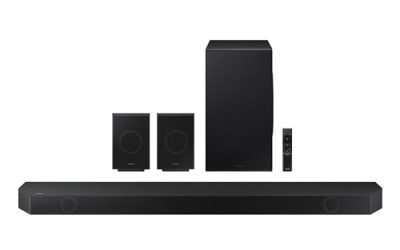
The Samsung HW-B650 is the most complete package in this price range, earning the top spot by doing everything well rather than by winning any single category. It is a three-point-one channel system: a wide bar with a dedicated center channel, plus a wireless subwoofer. The center channel keeps dialogue anchored to the screen even when the soundtrack gets busy. The bar supports Dolby 5.1 and DTS Virtual:X, and connectivity covers HDMI ARC, optical input, and Bluetooth. Samsung’s Q-Symphony feature, which pairs the bar with compatible Samsung televisions so the television speakers and the bar play together, is a genuine bonus if you already own a Samsung set.
The wireless subwoofer gives movie effects real weight without overwhelming a normal living room, and bass is adjustable, which matters in an apartment where you may want it dialed back late at night. Weaknesses are modest: there is no Dolby Atmos support, even virtualized, so buyers who want the Atmos label should look at the Polk pick below, and the remote is functional rather than luxurious. It suits a family living room and a television between fifty and sixty-five inches.
ASIN: Pending live verification — see the availability note at the end of this guide.
2. Sony HT-S400 — Best for Dialogue and Simple Setup
The Sony HT-S400 is a two-point-one channel system that trades a center channel for simplicity and for Sony’s speaker engineering. The bar uses X-Balanced speaker units, a Sony design with a non-circular diaphragm shape that the company says increases sound pressure while reducing distortion, and the result is clean, composed sound at the volumes most people actually use. Its signature feature is S-Force PRO Front Surround, virtual surround processing that creates a wider soundstage from the two front channels. It is a simulation, not a replacement for rear speakers, but it makes the HT-S400 sound bigger than its slim cabinet suggests. The wireless subwoofer is compact for its class.
Setup is the HT-S400’s quiet strength. HDMI ARC handles the connection with a single cable, and the television remote controls volume through HDMI CEC on most sets. The bar also offers an optical input for older televisions and Bluetooth for music streaming. A voice mode lifts dialogue and a night mode restrains sudden volume jumps. The main weakness is the missing center channel: in a large room, voices can feel slightly less locked to the center of the screen than on a three-channel bar. There is also no DTS support, which matters only for Blu-ray discs with DTS soundtracks. Choose the HT-S400 if you value simplicity and clean sound, if your room is small to medium, or for a bedroom or apartment where its compact subwoofer is a genuine advantage.
ASIN: Pending live verification — see the availability note at the end of this guide.
3. JBL Bar 2.1 Deep Bass — Best for Movies and Bass Impact
If movies are the priority, the JBL Bar 2.1 Deep Bass makes the strongest case of any bar in this guide. It is a two-point-one channel system built around a large wireless subwoofer with a driver substantially bigger than those in most competing bars at this price. The result is bass you feel as well as hear: explosions, engines, and musical low end arrive with a physical presence that smaller subwoofers cannot match. The bar is tuned for impact: JBL Surround Sound processing widens the soundstage, Dolby Digital decoding handles streaming surround correctly, and the overall balance favors excitement over neutrality. That tuning suits action movies, sports, and gaming.
For music, the bar is enjoyable rather than refined: bass-heavy tracks sound full and lively, while acoustic music can feel slightly forward in the low end until the subwoofer level is adjusted down. The trade-offs follow from its strengths. The large subwoofer needs floor space, and in a small room it can dominate unless the level is turned down.
ASIN: Pending live verification — see the availability note at the end of this guide.
4. Vizio V-Series V51-H6 — Best True Surround Sound on a Budget
The Vizio V51-H6 is the only pick in this guide with genuine surround speakers, and that single fact changes the experience. It is a five-point-one channel system: a soundbar, a wireless subwoofer, and two wired surround speakers that connect to the subwoofer and sit behind the seating position. Sound does not just come from the front; effects move around the room, crowd noise surrounds you during sports, and rain in a movie scene genuinely seems to fall behind you. The bar supports Dolby Audio and DTS Virtual:X, and dialogue benefits from a center channel in the bar. The system includes HDMI ARC, optical input, Bluetooth, and a remote with separate controls for the subwoofer and surround levels.
The cost of true surround is clutter. Two extra speakers need stands, shelves, or wall mounts, and the wires running from the subwoofer to each surround speaker must be routed along baseboards or under rugs. In a dedicated viewing room this is a weekend project; in a rented apartment or a room where the sofa sits against the wall, the rear speakers may have nowhere sensible to go. The subwoofer is also the hub for the surround connections, so its placement is constrained by the length of those wires. Sound quality is balanced and competent rather than exceptional: the bar lacks the refinement of the Sony and the bass authority of the JBL, but the surround effect more than compensates for viewers who want immersion above all else. It suits a dedicated movie room with space behind the sofa.
ASIN: Pending live verification — see the availability note at the end of this guide.
5. Polk Audio Signa S4 — Best for Dolby Atmos on a Budget
The Polk Audio Signa S4 is the most forward-looking pick in this guide, and the only one that advertises Dolby Atmos support. It is a three-point-one-point-two channel system: left, center, and right channels, a wireless subwoofer, and two up-firing drivers that bounce height effects off the ceiling. The Atmos reproduction is virtualized rather than driven by large dedicated height speakers, so it will not match a full Atmos system, but in a room with a flat ceiling at normal height, the sense of vertical space is noticeable on Atmos-encoded content from streaming services.
Beyond the Atmos badge, the Signa S4 is a well-judged everyday bar. The center channel carries Polk’s VoiceAdjust technology, which lets you raise dialogue independently of the rest of the soundtrack, and it is one of the more effective dialogue controls in this price range. The bar supports HDMI eARC, optical, and Bluetooth. Chromecast built-in is included for streaming music directly from supported apps. The wireless subwoofer is compact and tuned for control rather than sheer output: bass is tight and musical, but it does not hit as hard as the JBL’s larger unit.
Weaknesses are limited but real. The up-firing drivers need a flat, reflective ceiling to work, so vaulted ceilings and very high rooms reduce the effect. To get the most from it, you want an eARC-equipped television and Atmos content; without those, much of its advantage fades. Choose the Signa S4 if you stream a lot of Atmos content, own a recent television with eARC, and want dialogue control and music streaming in the same box.
ASIN: Pending live verification — see the availability note at the end of this guide.
Availability Note: Amazon Links for This Guide
This guide names five real, currently sold soundbar models, described from published specifications. At the time of writing, live verification of the exact Amazon product pages was not possible: Amazon returned an access error to direct page requests, and search verification was unavailable. No product code has been invented or guessed to fill the gap, because a wrong code is worse than a missing one. Before this guide is published as an affiliate article, each model above needs a live check on Amazon US to confirm the exact listing, the correct product code, and that the item is in stock and sold as a complete bar-and-subwoofer system. Until that check is done, treat this guide as a buying guide, not as a finished affiliate article.
Comparison Table
| Soundbar | Channels | Wireless Subwoofer | Surround Speakers | Dolby Atmos | HDMI Connection | Best For |
|---|---|---|---|---|---|---|
| Samsung HW-B650 | 3.1 | Yes | No | No | ARC | Best overall, everyday viewing |
| Sony HT-S400 | 2.1 | Yes | No | No | ARC | Dialogue and simple setup |
| JBL Bar 2.1 Deep Bass | 2.1 | Yes | No | No | ARC | Movies and bass impact |
| Vizio V-Series V51-H6 | 5.1 | Yes | Yes | No | ARC | True surround sound |
| Polk Audio Signa S4 | 3.1.2 | Yes | No | Yes, virtualized | eARC | Dolby Atmos and dialogue control |
Frequently Asked Questions
Is a soundbar around two hundred fifty dollars enough for a large living room?
It depends on the room and the system. In a large open-plan space, a five-channel system such as the Vizio V51-H6 or a bass-heavy bar such as the JBL Bar 2.1 Deep Bass will fill the space better than a compact two-channel bar, because the extra speakers and the larger subwoofer move more air. In a very large room with high ceilings, even these systems can feel modest, and the room itself becomes the limiting factor.
Will a soundbar work with any television?
Almost any modern television works with a soundbar, provided you check the outputs on the back of the set. Any television with an HDMI ARC port connects to every bar in this guide with a single cable, and that covers the large majority of televisions sold in the last decade. Televisions without HDMI ARC can usually connect through an optical audio output instead. Very old televisions with only analog outputs need an adapter or a different bar.
Is Dolby Atmos worth it at this budget?
Dolby Atmos is a genuine improvement when it is done well, but at this budget it arrives through virtualization rather than dedicated height speakers, and the difference is subtle rather than dramatic. A well-tuned bar without Atmos will sound better than a mediocre bar with an Atmos badge. Treat Atmos as a bonus on the Polk Signa S4 rather than a requirement, and prioritize the center channel, the subwoofer, and the connection options first.
Should I choose a three-channel bar or a five-channel bar?
Choose three channels if dialogue clarity and simplicity matter most, which is the case for most households. The dedicated center channel is the single most useful feature for everyday viewing. Choose five channels if you have a dedicated viewing space with room behind the sofa for surround speakers and you watch a lot of movies. If your sofa sits against the wall, a five-channel system loses much of its advantage, and a three-channel bar is the better buy.
Conclusion
The best soundbar for two hundred fifty dollars is not the one with the longest feature list. It is the one that matches your room, your television, and the way you actually watch. The Samsung HW-B650 is the safest all-round choice. The Sony HT-S400 suits smaller rooms and viewers who want clean dialogue without fuss. The JBL Bar 2.1 Deep Bass is the movie lover’s pick, trading refinement for impact. The Vizio V51-H6 delivers genuine surround sound for viewers with the space to use it. The Polk Audio Signa S4 looks furthest ahead, with virtualized Dolby Atmos, eARC, and the strongest dialogue controls of the group.
Whichever you choose, confirm the connection on your television first, measure the space under it, and give the subwoofer a sensible home rather than the nearest corner. Before this guide goes live as an affiliate article, its Amazon listings still need a live verification pass; until then, use it as a buying guide.
More from Amazon
Programs that pair well with the guide above. Offers and eligibility are set by Amazon and may change.
Free shipping on eligible items, Prime Video and more. Eligible new members can start with a free trial.
Start a Prime free trialAd-free music streaming. Eligible new subscribers can start with a free trial.
Try Music Unlimited freeA Prime membership for ages 18-24 with a trial period. Eligibility is set by Amazon.
See Prime for Young AdultsAudiobooks and podcasts to listen to on the go. Eligible new members can start with a free trial.
Try Audible freeAs an Amazon Associate we earn from qualifying purchases.