
Our Short List of 3

- Best for: immersion-first players who want screen-reactive lighting and strong bass from one system.
- Configuration: 2.1 — two satellites plus a down-firing subwoofer
- Peak power: 240W
- Surround processing: DTS:X Ultra virtual surround
- Lighting: LIGHTSYNC game-driven RGB that reacts to on-screen content

- Best for: small desks and laptop setups that need one-cable audio with real bass included.
- Configuration: 2.1 USB-C system with compact subwoofer; model MF0495
- Drivers: custom-tuned 2.75-inch
- Output: up to 15W RMS / 30W peak on USB-C power; higher output with a 30W PD adapter, per the listing
- Connections: Bluetooth 5.3, USB audio, 3.5mm AUX

- Best for: players who want THX processing and a control pod but have no room for a subwoofer.
- Configuration: 2.0 system, two 3-inch full-range drivers
- Surround processing: THX Spatial Audio
- Design: rear-facing bass ports; max sound pressure level 96dB
- Controls: wireless control pod
All 4 Picks at a Glance
| Product | Specs | Action |
|---|---|---|
| Logitech G560 LIGHTSYNC |
| Check price on Amazon |
| Creative Pebble X Plus |
| Check price on Amazon |
| Razer Nommo V2 X |
| Check price on Amazon |
 Edifier G2000 |
| Check price on Amazon |
Key takeaways
- Five gaming speaker systems compared on surround processing, subwoofers, connections and desk fit, from RGB 2.1 flagships to compact 2.0 pairs.
Choosing gaming speakers is a decision about your desk and your roommates as much as your games. A 2.1 system with a separate subwoofer delivers the explosions and engine notes that flat 2.0 pairs cannot, but the sub needs floor space and the bass travels through walls. Compact stereo pairs suit small desks and late-night sessions at modest volume. Over that choice sit the gaming extras: virtual surround processing, RGB that reacts to the game, and a USB connection that bypasses noisy motherboard audio.
This roundup is built for three kinds of buyer: the immersion-first player who wants positional audio and light shows, the desk-space saver who needs a small footprint, and the multi-device user who swaps between PC, console and phone. The five systems below were chosen from their Amazon listings by configuration and stated features: two full 2.1 sets with subwoofers, two THX stereo options at different sizes, and one compact all-rounder with a subwoofer output.
Quick Picks
As an Amazon Associate we earn from qualifying purchases.
| Product | Best for | Key spec |
|---|---|---|
| Logitech G560 LIGHTSYNC | Immersion and screen-reactive lighting | 240W peak 2.1 system with DTS:X Ultra |
| Creative Pebble X Plus | Small desks and one-cable setups | USB-C 2.1 with compact subwoofer |
| Razer Nommo V2 | Cinematic single-player sound | THX Spatial Audio with 5.5-inch subwoofer driver |
| Razer Nommo V2 X | THX stereo with no subwoofer to place | 2.0 pair rated at 96dB max SPL |
| Edifier G2000 | Starting stereo and adding bass later | Subwoofer output and three sound modes |
How to Choose
Start With the Subwoofer Question
Configuration decides more than any other specification. A 2.1 system with a separate subwoofer reproduces explosions, engines and orchestral hits with physical weight that small stereo drivers cannot match, and it frees the satellites to handle dialogue and detail cleanly. The cost is space: the sub needs a home on the floor or a wide desk, and its bass will be heard in the next room. A 2.0 pair fits almost anywhere and keeps late-night volume neighbour-friendly, but low-end effects shrink. Decide where the subwoofer would actually live before you fall for a specification sheet.
Virtual Surround and Positional Cues
Two speakers cannot place sound behind you the way a headset or a multi-speaker rig can, but processing narrows the gap. Systems here use DTS:X Ultra or THX Spatial Audio to widen the soundstage and sharpen directional cues, so footsteps and gunfire sit in a broader, more readable field. Treat these features as enhancements to stereo rather than true surround replacements. They matter most in competitive and atmospheric games; for strategy titles, podcasts between matches and general desktop audio, plain stereo quality counts for more than any processing badge on the box.
Connections Decide Daily Convenience
USB audio is the cleanest route from a PC: it takes a digital signal straight from the computer and sidesteps the hiss and interference that analogue motherboard outputs can add. Bluetooth earns its place when a phone, tablet or console joins the rotation, and a 3.5mm AUX input remains the universal fallback for everything else. Check how switching between sources works — a wireless control pod or front-panel buttons beat reaching behind a satellite every day. Front headphone and microphone ports, where fitted, also save you unplugging anything when a voice-chat session starts.
Fit the System to the Desk You Have
Measure before you buy. Full-size satellites and a floor subwoofer transform a spacious battlestation and overwhelm a narrow desk, where compact angled speakers that aim up at your ears make better use of limited width. Consider what sits between the speakers too: ultrawide monitors leave little room at the edges, and monitor arms change where sound can fire from. RGB lighting is a genuine part of the gaming appeal for many buyers, but decide whether you want it projected behind the desk or glowing on the speakers themselves — the effect on a room differs a lot.
The 5 Best Options
Logitech G560 LIGHTSYNC
- Best for: immersion-first players who want screen-reactive lighting and strong bass from one system.
- Configuration: 2.1 — two satellites plus a down-firing subwoofer
- Peak power: 240W
- Surround processing: DTS:X Ultra virtual surround
- Lighting: LIGHTSYNC game-driven RGB that reacts to on-screen content
immersion-first players who want screen-reactive lighting and strong bass from one system.
the subwoofer needs open floor space rather than a closed cabinet; also confirm the listing is the standalone system under the ASIN below, because a bundle version with a mouse and a Renewed version circulate under different codes.
The G560 is the maximalist option here: a 240W peak 2.1 system whose LIGHTSYNC lighting samples the colours on your screen and extends the game’s palette onto your desk. DTS:X Ultra processing builds a virtual surround field from the two satellites, while the down-firing subwoofer handles the low-end weight that explosions and soundtracks demand. It connects three ways — USB for PC audio, Bluetooth for a phone, and 3.5mm for everything else — so it can anchor a whole setup rather than just a gaming rig. Pick it if immersion, not tidiness, is the priority.
Creative Pebble X Plus
- Best for: small desks and laptop setups that need one-cable audio with real bass included.
- Configuration: 2.1 USB-C system with compact subwoofer; model MF0495
- Drivers: custom-tuned 2.75-inch
- Output: up to 15W RMS / 30W peak on USB-C power; higher output with a 30W PD adapter, per the listing
- Connections: Bluetooth 5.3, USB audio, 3.5mm AUX
small desks and laptop setups that need one-cable audio with real bass included.
on plain USB-C power it runs at 15W RMS — the higher output figure needs a 30W PD adapter, so check what your port or hub can supply before expecting full volume.
Creative’s Pebble X Plus squeezes a 2.1 system into a footprint that suits cramped desks and monitor arms. Custom-tuned 2.75-inch drivers sit in the angled satellites, a compact subwoofer adds the bass that earlier Pebble models lacked, and everything runs from a single USB-C cable that carries both power and audio. Front headphone and microphone ports keep a wired headset within reach for voice chat, and the RGB lighting can be customised rather than merely switched on. It is the tidy-desk pick that still behaves like a proper gaming system.
Razer Nommo V2
The Nommo V2 is Razer’s full-size statement piece: two large satellites backed by a wired subwoofer with a 5.5-inch down-firing driver, tuned for the cinematic end of gaming. THX Spatial Audio widens the soundstage for single-player titles where atmosphere matters, and the rear-projection Chroma lighting throws colour onto the wall behind your desk instead of at your eyes. A wireless control pod handles volume and source switching from wherever you sit. It asks for genuine desk space in return, and rewards it with the biggest sound in this group.
Specs
- Configuration: 2.1 system with wired subwoofer, 5.5-inch down-firing driver
- Surround processing: THX Spatial Audio
- Lighting: rear-projection Chroma RGB
- Controls: wireless control pod
- Connections: USB, Bluetooth 5.3
Best for: single-player and cinematic gaming on a desk with room to spare.
Watch out for: the ASIN sighted for this model sits on regional-variant listings (model suffix R3G1) while US materials use R3U1 — open the product page, confirm it is the exact US listing, and check that a live featured offer exists for this ASIN before ordering.
ASIN: B0BXYBZZKT
Razer Nommo V2 X
- Best for: players who want THX processing and a control pod but have no room for a subwoofer.
- Configuration: 2.0 system, two 3-inch full-range drivers
- Surround processing: THX Spatial Audio
- Design: rear-facing bass ports; max sound pressure level 96dB
- Controls: wireless control pod
players who want THX processing and a control pod but have no room for a subwoofer.
the deal coverage behind this ASIN is older and no current US price point was verified, so confirm a live featured offer for the exact ASIN on the product page before ordering.
The V2 X strips the Nommo formula back to a 2.0 pair for players who cannot house a subwoofer. Two 3-inch full-range drivers with rear-facing bass ports do the whole job, and THX Spatial Audio still supplies the positional processing that competitive and story games benefit from. Razer rates the pair at a maximum sound pressure level of 96dB, which is plenty for near-field listening at a desk. The wireless control pod carries over from the bigger system, keeping volume and inputs at your fingertips rather than on the speaker cabinet.
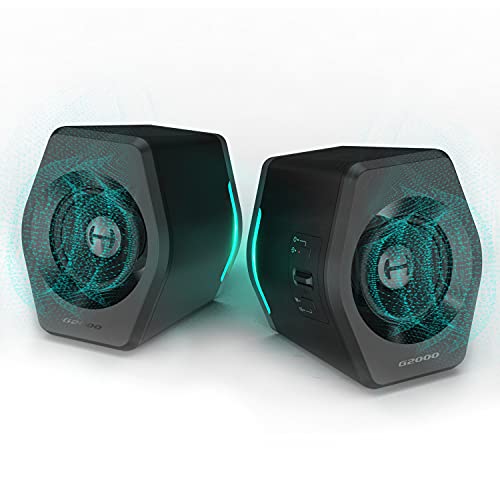
Edifier G2000
- Best for: small desks that may grow — start with stereo today, add a subwoofer later.
- Configuration: 2.0 desktop pair, 2.75-inch full-range units
- Output: 16W RMS / 32W peak
- Inputs: Bluetooth, USB, 3.5mm AUX
- Sound modes: Game, Music, Movie
small desks that may grow — start with stereo today, add a subwoofer later.
tracker data for this exact code is months old even though current roundups still link it, so confirm a live featured offer for the Black version under this ASIN before ordering — and note the White version is sold under a different code.
Edifier’s G2000 is the flexible budget-format pick: a compact 2.0 pair with 2.75-inch full-range units, three switchable sound modes for game, music and movie use, and an input for almost anything — Bluetooth, USB or 3.5mm AUX. Its party trick is the subwoofer output on the back, which lets you add a separate woofer later and grow into a 2.1 system without replacing the speakers. RGB lighting rounds out the gaming brief. For a small desk that might expand later, nothing else here offers the same upgrade path.
Which One Fits Your Situation
Your Battlestation Is the Whole Point
If the setup itself is part of the hobby — reactive lighting, big sound, a screen wall — the Logitech G560 is the natural centre. Its LIGHTSYNC lighting mirrors on-screen colours, the subwoofer supplies real weight, and three connection types let one system serve the PC, a phone and a spare console or handheld without cable swapping.
You Game at a Small or Shared Desk
Compact footprints and restrained bass matter when the desk doubles as a workspace or the room is shared. The Creative Pebble X Plus runs from one USB-C cable, keeps a tiny subwoofer in the system, and puts headset ports on the front for quick switches to voice chat — full gaming features without taking over the room.
Single-Player Games Are Your Main Event
Story-driven and atmospheric titles reward the widest soundstage and the deepest bass in this group. The Razer Nommo V2 pairs THX Spatial Audio with a full-size subwoofer and throws its Chroma glow onto the wall behind the desk, building the cinema feeling that open-world and horror games thrive on — provided your desk can fit it.
You Want Stereo Now and Bass Later
When the budget or the desk says stereo today but you suspect a subwoofer will follow, the Edifier G2000 is the only pick here built for that path: its subwoofer output accepts a separate woofer later, and its game, music and movie modes cover the mixed use most desks actually see in the meantime.
Common Mistakes
- Buying a soundbar for a gaming desk: bars are a different product type, tuned to sit under a TV and fill a room, not to image sound at near-field distance where you sit close.
- Judging systems by peak watts alone: peak figures are momentary maximums, so compare configuration, driver sizes and RMS figures where listed instead of chasing the biggest number.
- Hiding a down-firing subwoofer inside a closed cabinet or on a shelf: the driver fires into the surface below it, so trapping it muffles the bass and rattles the furniture.
- Ordering the wrong listing variant: bundles with a mouse, Renewed units and other colour versions of these speakers all carry different ASINs, so check the code on the page matches the one in this article.
- Assuming speakers replace a headset entirely: none of these systems includes a microphone for voice chat, so keep a headset or separate mic in the setup for team games.
Frequently Asked Questions
Do gaming speakers really need a subwoofer?
Not always. A subwoofer adds physical weight to explosions, engines and soundtracks that small stereo drivers cannot reproduce, which is why 2.1 systems dominate immersive setups. But a good 2.0 pair still covers dialogue, effects and music well at desk distance, and it suits shared rooms and late-night play where deep bass would disturb other people.
Can two speakers actually produce surround sound?
They produce virtual surround, not the real thing. Processing such as DTS:X Ultra and THX Spatial Audio reshapes stereo output to widen the soundstage and make directional cues easier to place. The effect helps in competitive and atmospheric games, but it cannot put sound behind you the way a headset or a genuine multi-speaker system can.
Is USB or 3.5mm the better connection for gaming speakers?
USB is usually the cleaner choice on a PC because it takes a digital signal directly from the computer, avoiding the hiss that analogue motherboard outputs sometimes add. A 3.5mm connection still works with almost any device, and Bluetooth is the convenient option for phones and tablets. Many systems here offer several inputs, so you rarely have to choose permanently.
Will these speakers also work for music and films?
Yes — a gaming desk system is still a speaker system. The Edifier G2000 even includes dedicated music and movie modes alongside its game mode, and the 2.1 systems with subwoofers handle film soundtracks comfortably. Just expect tuning that favours effects and dialogue clarity over the flat, neutral response that studio monitors aim for.
More from Amazon
Programs that pair well with the guide above. Offers and eligibility are set by Amazon and may change.
Free shipping on eligible items, Prime Video and more. Eligible new members can start with a free trial.
Start a Prime free trialAd-free music streaming. Eligible new subscribers can start with a free trial.
Try Music Unlimited freeA Prime membership for ages 18-24 with a trial period. Eligibility is set by Amazon.
See Prime for Young AdultsAudiobooks and podcasts to listen to on the go. Eligible new members can start with a free trial.
Try Audible freeAs an Amazon Associate we earn from qualifying purchases.









