
Our Short List of 3

- Best for: Beginners who want the most frames from every roll.
- Film format: 35mm half-frame
- Focus: Focus-free
- Flash: Built-in flash
- Power: One AAA battery, not included
- Best for: First black-and-white rolls and anyone who values a deliberately simple, reloadable design.
- Film format: 35mm
- Lens: 31mm, single element, f/9, fixed-focus wide-angle
- Shutter speed: Fixed at 1/120s
- Focusing: Focus free, from 1m to infinity

- Best for: Half-frame shooters who want long exposures and a little extra creative range.
- Film format: 35mm half-frame
- Focus: Focus-free
- Lens: Coated improved lens
- Shutter: Bulb function for long exposures
All 4 Picks at a Glance
| Product | Specs | Action |
|---|---|---|
| Kodak EKTAR H35 Half Frame Film Camera |
| Check price on Amazon |
| Ilford Sprite 35-II Reusable 35mm Analog Film Camera |
| Check price on Amazon |
| Kodak EKTAR H35N Half Frame Film Camera |
| Check price on Amazon |
 KODAK Snapic A1 35mm Film Camera |
| Check price on Amazon |
Key takeaways
- Four reusable 35mm film cameras compared for first rolls, travel, and everyday snapshots: half-frame Kodak bodies, a simple Ilford, and a full-frame Snapic.
A 35mm film camera turns every frame into a small decision. There is no screen to check, no burst of twenty near-identical shots to sort later, and no menu standing between you and the picture. You load a roll, wind on, and trust the light. That slower pace is the whole appeal, and it is why a handful of new, reusable 35mm cameras still sell alongside the used classics that change hands in auction listings and camera shops.
The four cameras below are all current, reusable models that take standard 35mm cassettes, and each one suits a different kind of shooter. Two are half-frame bodies that double the frames on a roll, one is a deliberately simple black-and-white companion, and one is a full-frame body with a glass lens and a choice of focus zones. Pick by the scenes you shoot most, the film you plan to load, and how much control you want over each frame.
Quick Picks
As an Amazon Associate we earn from qualifying purchases
| Product | Best for | Key spec from title |
|---|---|---|
| Kodak EKTAR H35 Half Frame Film Camera | Doubling the frames on every roll | Half Frame Film Camera, 35mm, Reusable, Focus-Free |
| Ilford Sprite 35-II Reusable 35mm Analog Film Camera | First black-and-white rolls | Reusable, Reloadable 35mm Analog Film Camera |
| Kodak EKTAR H35N Half Frame Film Camera | Half-frame shooting with a bulb mode | Half Frame Film Camera, 35mm, Reusable, Focus-Free, Bulb Function |
| KODAK Snapic A1 35mm Film Camera | A full-frame step up with a glass lens | 35mm Film Camera, Reusable, 2-Zone Focus, Lightweight, Compact |
How to Choose
Full frame or half frame
A half-frame camera splits each standard 35mm frame in two, so a 36-exposure roll yields around 72 smaller pictures instead of 36 full-size ones. That halves the film cost of every frame and stretches a roll across a whole trip, which is why half-frame bodies suit casual shooters and anyone learning on a tight film budget. The trade-off is resolution: each picture uses half the negative area, so enlargements and heavy crops show grain sooner. A full-frame body keeps the classic 36 by 24 millimetre negative, which holds detail better and scans more cleanly, at the cost of fewer frames per roll. Choose half frame for volume and thrift, full frame for image quality.
Lens and focus
Most new reusable 35mm cameras use a fixed-focus lens, which means everything from about a metre away to infinity stays acceptably sharp without any adjustment. That design is forgiving for beginners, because there is nothing to focus and nothing to get wrong, but it also means close subjects and portraits lose the soft backgrounds that a focusing lens can produce. A camera with a choice of focus zones, such as near and far, gives a little more control without adding complexity. Check the lens width too: a wide lens around 22 to 25 millimetres suits streets and landscapes, while a 31 millimetre lens frames everyday scenes more tightly. Match the lens to the pictures you take most.
Flash and low light
A built-in flash decides whether a simple film camera works indoors and after dark, because fixed shutter speeds and small apertures leave little room for dim scenes. Every camera below carries a built-in flash, but the details matter: a flash with a long recycle time makes you wait between shots, and a flash you cannot switch off will fire in places where you would rather use available light. Remember that film speed matters as much as the flash. A 400-speed film handles indoor rooms and evening streets far better than a 200-speed roll, and a fast film also widens the range of scenes a fixed-exposure camera can handle. Buy the film to match the light you shoot in.
Film, batteries, and running costs
A reusable 35mm camera is only the first purchase. Film, developing, and scanning are the ongoing costs, and they add up faster than most first-time buyers expect. A single roll plus lab developing and scans can cost more than a cheap camera body, so a half-frame camera that doubles the frames on a roll genuinely cuts the cost of learning. Batteries are the other hidden extra: most of these cameras need one or two AAA or AA cells, and film and batteries are not included in the box. Check the battery type before you buy, keep a spare set in your bag, and budget for a few rolls of film and a local lab before your first outing.
The 4 Best Options
Kodak EKTAR H35 Half Frame Film Camera
- Best for: Beginners who want the most frames from every roll.
- Film format: 35mm half-frame
- Focus: Focus-free
- Flash: Built-in flash
- Power: One AAA battery, not included
Beginners who want the most frames from every roll.
Half-frame negatives are smaller, so heavy crops and large enlargements show grain sooner.
The EKTAR H35 is the simplest route into 35mm film, and its half-frame design is the reason it works so well for beginners. Each roll gives you roughly twice the pictures of a full-frame camera, so a 36-exposure roll becomes about 72 smaller frames, and the focus-free lens means you only have to compose and press the shutter. The built-in flash fires through a ring around the lens, the body weighs almost nothing in a jacket pocket, and the whole camera asks for one AAA battery and a roll of film. It is the pick for anyone who wants the film look without learning camera settings first.
Watch out for: Half-frame negatives are smaller, so heavy crops and large enlargements show grain sooner.
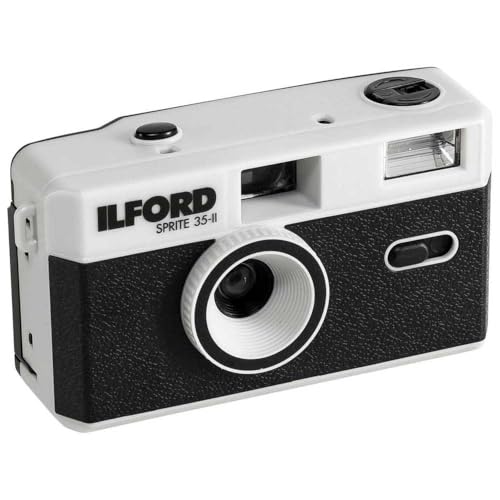
Ilford Sprite 35-II Reusable 35mm Analog Film Camera
- Best for: First black-and-white rolls and anyone who values a deliberately simple, reloadable design.
- Film format: 35mm
- Lens: 31mm, single element, f/9, fixed-focus wide-angle
- Shutter speed: Fixed at 1/120s
- Focusing: Focus free, from 1m to infinity
First black-and-white rolls and anyone who values a deliberately simple, reloadable design.
The fixed exposure suits bright light best, so dim indoor scenes will come out dark without flash.
The Sprite 35-II is the plainest camera in this group, and that plainness is its charm. It pairs a fixed-focus 31mm lens with a fixed shutter speed, a manual wind-on lever, and a built-in flash, and it asks nothing else of its holder. The Ilford name ties it to black-and-white film, and the camera suits that pairing well: load a roll of HP5 or a similar black-and-white stock, and the simple exposure suits bright daylight and open shade. It is light, reloadable, and easy to carry everywhere, which is exactly what a first film camera should be when the goal is to shoot often rather than to fiddle with settings.
Watch out for: The fixed exposure suits bright light best, so dim indoor scenes will come out dark without flash.
Kodak EKTAR H35N Half Frame Film Camera
- Best for: Half-frame shooters who want long exposures and a little extra creative range.
- Film format: 35mm half-frame
- Focus: Focus-free
- Lens: Coated improved lens
- Shutter: Bulb function for long exposures
Half-frame shooters who want long exposures and a little extra creative range.
Long exposures need a steady surface or a tripod, since the camera has no image stabilisation.
The H35N takes the same half-frame idea as the H35 and adds a bulb mode for long exposures and a coated, improved lens. The bulb function keeps the shutter open as long as you hold it, which opens up night scenes, light trails, and other slow-shutter pictures that a fixed-speed camera cannot attempt. A built-in special-effects filter adds a sparkle to bright points of light, and the camera keeps the same focus-free operation, built-in flash, and pocketable body as its sibling. It is the half-frame pick for shooters who have already finished a few rolls and want one more creative tool.
Watch out for: Long exposures need a steady surface or a tripod, since the camera has no image stabilisation.
KODAK Snapic A1 35mm Film Camera
- Best for: Shooters who want full-frame negatives and a sharper glass lens in a simple body.
- Film format: Full-frame, 36mm x 24mm
- Lens: 25mm, three-element glass lens
- Focus: 2-zone focus
- Aperture: Fixed f/9.5
Shooters who want full-frame negatives and a sharper glass lens in a simple body.
Full-frame shooting uses twice the film per picture of a half-frame camera, so rolls run out faster.
The Snapic A1 is the most capable camera in this group, and the one to choose when you want full-frame negatives and a real glass lens. Its 25mm three-element glass lens is sharper than the single-element plastic lenses on the simpler bodies, and the two-zone focus lets you choose between near and far subjects. The frame format is the classic 36 by 24 millimetres, so each roll gives 24 or 36 full-size pictures, and the camera comes with a pouch and a neck strap in the box. It is still a simple camera, but it is the one that grows with you past the first few rolls.
Watch out for: Full-frame shooting uses twice the film per picture of a half-frame camera, so rolls run out faster.
Which One Fits Your Situation
Your very first roll of film
Take the Kodak EKTAR H35. Its half-frame design doubles the pictures on a roll, so mistakes cost half as much film, and the focus-free lens removes the one setting that trips up most first-time film shooters. Load a 400-speed colour film, keep the flash ring on for indoor shots, and you will have a full set of pictures to learn from after a single roll. The light body also means you will carry it, which matters more than any specification.
Travel and street snapshots
Take the Kodak EKTAR H35N or the Snapic A1, depending on how you shoot. The H35N stretches a roll across a whole trip and adds a bulb mode for evening scenes, while the Snapic A1 gives you full-frame negatives and a sharper glass lens for street scenes you may want to print. Either way, pack a spare roll and a spare set of batteries, because film cameras give no warning when the roll ends or the battery fades.
Black-and-white rolls
Take the Ilford Sprite 35-II. Its fixed exposure and 31mm lens suit the bright, contrasty light that black-and-white film loves, and the Ilford heritage pairs naturally with a roll of HP5 or a similar stock. The camera is light enough to carry daily, the manual wind-on keeps you involved in every frame, and the simple design means there is nothing between you and the picture except the shutter button.
A step up from a disposable camera
Take the KODAK Snapic A1. If you have already finished a few disposables and want a camera you can reload, the Snapic A1 keeps the same point-and-shoot ease while adding a glass lens, a choice of focus zones, and full-frame negatives. The included pouch and neck strap make it a proper everyday camera, and the reusable body pays for itself after only a few rolls compared with buying another disposable each time.
Common Mistakes
- Forgetting to buy film and batteries, since neither is included with most of these cameras.
- Loading a slow 200-speed film for indoor shooting, then wondering why the pictures come out dark.
- Winding on before the flash has recycled, which leaves the next frame unlit.
- Opening the camera back mid-roll, which fogs every exposed frame on the roll.
- Expecting half-frame negatives to enlarge as cleanly as full-frame ones, when each picture uses half the negative area.
Frequently Asked Questions
Do 35mm film cameras need batteries?
Most new reusable 35mm cameras need batteries for the flash and the light meter. The cameras in this guide use one or two AAA cells, and those cells are not included in the box. Keep a spare set in your bag, because a dead battery means no flash, and the flash is what makes indoor and evening pictures possible on a fixed-exposure camera.
How many photos do you get from one roll of film?
A standard 24-exposure roll gives 24 full-frame pictures, and a 36-exposure roll gives 36. A half-frame camera splits each frame in two, so the same rolls give roughly 48 and 72 pictures instead. The exact count varies slightly with loading, since the first frame or two of a roll is often lost while the film leader winds on. Always buy one more roll than you think you need.
Is a half-frame camera a real 35mm camera?
Yes. A half-frame camera uses the same standard 35mm film cassettes and the same developing chemistry as any other 35mm camera. The difference is only the frame size: each picture covers half the width of a full frame, so you get twice as many pictures per roll. Labs develop and scan half-frame rolls normally, though some labs charge per frame, which can narrow the savings.
Where do you get 35mm film developed?
Most towns still have at least one lab that develops 35mm film, and many accept rolls by post if there is no local option. A lab develops the negatives and scans them to digital files, which is how most people view and share film pictures today. Ask the lab about turnaround time before you send a roll, and keep the negatives, since they are the only original of every picture.
More from Amazon
Programs that pair well with the guide above. Offers and eligibility are set by Amazon and may change.
Free shipping on eligible items, Prime Video and more. Eligible new members can start with a free trial.
Start a Prime free trialAd-free music streaming. Eligible new subscribers can start with a free trial.
Try Music Unlimited freeA Prime membership for ages 18-24 with a trial period. Eligibility is set by Amazon.
See Prime for Young AdultsAudiobooks and podcasts to listen to on the go. Eligible new members can start with a free trial.
Try Audible freeAs an Amazon Associate we earn from qualifying purchases.









