
Our Short List of 3

- Best for: a first tower pair in a small to medium room, run from a mainstream receiver.
- Design: 3-way, 4-driver floor-standing speaker, bass reflex
- Woofers: two 5.12-inch mica reinforced cellular cone woofers
- Tweeter: 0.98-inch soft dome
- Super tweeter: 0.75-inch soft dome

- Best for: front left and right channels in a growing Monitor XT home theater.
- Tweeter: 1-inch Terylene dome, Hi-Res Audio certified
- Woofers: two 6.5-inch Dynamically Balanced woofers
- Bass drivers: two 8-inch passive radiators
- Impedance: 8 ohms

- Best for: a dedicated home theater or large living room that needs a high-output front pair.
- Sold as: matched pair, Ebony finish
- Woofers: dual 8-inch copper-spun Cerametallic woofers
- Horn: larger 90° x 90° Hybrid Tractrix horn
- Tweeter: vented titanium tweeter design
All 4 Picks at a Glance
| Product | Specs | Action |
|---|---|---|
| Sony SSCS3 |
| Check price on Amazon |
| Polk Monitor XT70 |
| Check price on Amazon |
| Klipsch Reference Premiere RP-8000F II |
| Check price on Amazon |
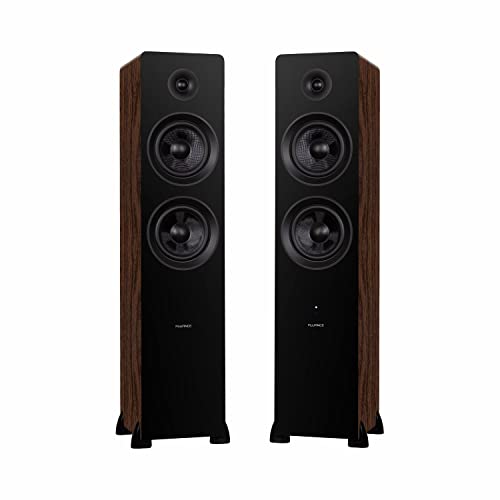 Fluance Ai81 |
| Check price on Amazon |
Key takeaways
- Four floor standing speakers compared on drivers, sensitivity and amplifier needs, from a compact Sony tower to a powered Fluance pair for home audio.
Buying a tower speaker is really two decisions disguised as one. The first is whether your room and listening habits justify a cabinet that stands over three feet tall and cannot hide on a shelf. The second is whether you want passive speakers that depend on a receiver you may still need to buy, or a powered pair with the amplifier already inside. Getting the second decision wrong costs more than getting the model wrong, because a passive tower with no amplifier at home is furniture, not a speaker.
This guide serves three kinds of buyers: first-time tower owners upgrading from a soundbar or bookshelf pair, home theater builders choosing front left and right channels, and listeners who want full-range stereo without a rack of separate electronics. Every pick below was chosen from the specifications on its Amazon product page, including driver layout, sensitivity, impedance and whether the listing sells one speaker or a matched pair.
Quick Picks
As an Amazon Associate we earn from qualifying purchases
| Product | Best for | Key spec from title |
|---|---|---|
| Sony SSCS3 | A first tower pair driven by a mainstream receiver | 3-way floor-standing speaker |
| Polk Monitor XT70 | Movie-first front channels in a Monitor XT system | (2) 6.5″ woofers, (2) 8″ passive radiators |
| Klipsch Reference Premiere RP-8000F II | A large-room home theater front pair | Dual 8″ Cerametallic woofers |
| Fluance Ai81 | Full-size stereo with no receiver to buy | 150W powered floorstanding speakers |
How to Choose
Passive or powered: what else has to live in the room
Most floor standing speakers are passive, which means the cabinet holds drivers and a crossover but no amplifier. A passive tower only makes sound when a stereo amplifier or AV receiver feeds it, so your real purchase is a system, not a speaker. Powered towers such as the Fluance Ai81 move the amplifier inside one cabinet and connect straight to a TV, turntable or phone. Choose passive if you already own a receiver or plan to grow into surround sound. Choose powered if the towers are the whole system and you want two boxes, one power cable and a remote.
Sensitivity and impedance decide how hard your amp works
Sensitivity, printed in decibels, tells you how loud a speaker plays with a small measured input. A tower rated around 98 dB needs far less amplifier power to fill a big room than one rated at 87 or 88 dB, which asks the amplifier to work much harder for the same volume. Impedance matters alongside it: most towers are rated at 8 ohms, while some drop to 6 ohms and draw more current. Check the amplifier or receiver you own against both numbers on the listing before ordering, because a mismatch shows up as an amp that runs hot or shuts down at movie volume.
Driver layout and bass design shape the sound more than size
A two-way tower splits the work between a tweeter and one or more woofers, while a three-way design adds a dedicated midrange driver, which often keeps voices clearer when music and dialogue get busy. Bass arrives three ways in this group: a rear port that uses the wall behind the speaker, passive radiators that move air without a port opening, and larger woofers that simply displace more air on their own. None of these is automatically better. The practical point is placement: rear-ported towers need breathing room behind them, while radiator and down-firing designs are usually more forgiving near a wall.
Sold each or sold as a pair changes the real order
Tower speakers are frequently priced and shipped as a single speaker, and the listing’s unit count is the only reliable way to know. The Sony and Polk picks below are sold individually, so a stereo setup means ordering two, while the Klipsch and Fluance listings are matched pairs in one box. Read the unit count before comparing listings side by side, and also confirm the footprint: a cabinet that is 17 inches deep behaves very differently in a narrow room than one that is 10 inches deep, even when both stand the same height.
The 4 Best Options
Sony SSCS3
- Best for: a first tower pair in a small to medium room, run from a mainstream receiver.
- Design: 3-way, 4-driver floor-standing speaker, bass reflex
- Woofers: two 5.12-inch mica reinforced cellular cone woofers
- Tweeter: 0.98-inch soft dome
- Super tweeter: 0.75-inch soft dome
a first tower pair in a small to medium room, run from a mainstream receiver.
it is sold individually, so stereo needs two; the 6-ohm rating asks more of budget amplifiers than an 8-ohm speaker does.
The SSCS3 is the gentlest way into tower speakers. Its three-way, four-driver layout separates the work into two woofers, a main tweeter and a super tweeter, so a single compact cabinet covers a wider stated frequency range than most small towers attempt. At roughly 36 inches tall and just over 25 pounds, it fits rooms where a full-size tower would dominate the wall. It suits a first stereo pair or front channels in a small home theater, driven by an ordinary AV receiver, and it leaves the door open to Sony’s matching Core Series center and bookshelf speakers later.
Polk Monitor XT70
- Best for: front left and right channels in a growing Monitor XT home theater.
- Tweeter: 1-inch Terylene dome, Hi-Res Audio certified
- Woofers: two 6.5-inch Dynamically Balanced woofers
- Bass drivers: two 8-inch passive radiators
- Impedance: 8 ohms
front left and right channels in a growing Monitor XT home theater.
it is sold individually; the passive radiator design still benefits from a few inches of space behind and beside the cabinet.
The XT70 is built for buyers assembling a home theater one piece at a time. Instead of a port, it loads its two 6.5-inch woofers with two 8-inch passive radiators, a design that produces deep bass without port noise and tolerates placement closer to a wall. Polk rates the speaker for high-resolution audio and designs it to timbre-match the rest of the Monitor XT line, so the same tonal character carries across the matching center channel and surrounds when you add them. As a front pair it gives a small receiver an easy 8-ohm load and enough low end that a subwoofer can wait.
Klipsch Reference Premiere RP-8000F II
- Best for: a dedicated home theater or large living room that needs a high-output front pair.
- Sold as: matched pair, Ebony finish
- Woofers: dual 8-inch copper-spun Cerametallic woofers
- Horn: larger 90° x 90° Hybrid Tractrix horn
- Tweeter: vented titanium tweeter design
a dedicated home theater or large living room that needs a high-output front pair.
these are large, heavy cabinets that need real floor space and clearance; confirm the pair listing and finish before ordering, since the same model is also sold as a single speaker elsewhere.
This is the statement piece of the group, sold as a matched pair of Klipsch’s second-generation Reference Premiere flagship towers. Each cabinet pairs two 8-inch Cerametallic woofers with a titanium tweeter firing through a larger 90 degree by 90 degree hybrid Tractrix horn, the design Klipsch uses to keep output controlled and dynamics high in big spaces. The listing sells the pair in Ebony as one package, which removes the sold-each arithmetic entirely. These are passive speakers that expect a capable receiver, and they reward one: this is the pick for a dedicated theater room where the front stage has to carry action movies at full scale.
Fluance Ai81
- Best for: TV and music in one system, with no receiver or amplifier to buy.
- Configuration: 2-way, 3-driver powered floorstanding system, pair (one active, one passive)
- Amplifier: built-in Class D, 150 W total (2 x 75 W RMS)
- Tweeter: 1-inch silk soft dome neodymium
- Woofers: dual 6.5-inch woven glass fiber composite drivers
TV and music in one system, with no receiver or amplifier to buy.
there is no HDMI ARC and no phono preamp on the listing, so a TV connects by optical cable and a turntable needs its own phono stage; the active tower must sit near a power outlet.
The Ai81 removes the receiver from the equation. One tower in the pair houses a Class D amplifier rated at 150 watts total, and the second tower connects to it with the included speaker wire. Inputs cover the sources most people actually use: two RCA inputs, an optical input for a TV, and Bluetooth 5.0 for a phone, plus a subwoofer output if you want to add low end later. Each cabinet runs two 6.5-inch woven glass fiber woofers and a silk dome tweeter. For a living room that needs music and TV sound from one tidy setup, this is the shortest path from box to listening.
Which One Fits Your Situation
You are replacing a soundbar and own nothing else
Start with the Fluance Ai81. A soundbar owner usually has no amplifier, and every passive tower in this guide would sit silent until one arrives. The Ai81 pair connects to a TV over its optical input, streams from a phone over Bluetooth, and includes the remote and speaker wire in the box. It is the only pick here that turns an empty equipment shelf into a working stereo system on the day it arrives.
You already have an AV receiver and watch mostly movies
Build around the Polk Monitor XT70 as your front pair. Its 8-ohm load is easy on midrange receivers, the passive radiators keep bass full without a port firing at the wall, and the Monitor XT line gives you a matching center channel and surrounds when the system grows. In a genuinely large room where the seats sit far from the screen, step up to the Klipsch RP-8000F II pair instead.
You listen to music first and films second
The Sony SSCS3 fits a music-first room that still watches films on weekends. Its three-way layout with a dedicated super tweeter is the design in this group most clearly aimed at extended, detailed high frequencies, and its modest footprint suits a listening chair setup in a bedroom or study. Pair two of them with a stereo amplifier rather than a home theater receiver if the system will never grow past two channels.
You are furnishing a dedicated theater room
Give the front stage to the Klipsch RP-8000F II. A dedicated room usually means a fixed screen, seats at a real distance, and volume levels that expose efficient speakers’ advantage. The horn-loaded tweeter and dual 8-inch woofers are built for exactly that workload, and buying the matched pair in one listing keeps finishes and production runs identical across the front stage.
Common Mistakes
- Ordering one speaker when the listing sells towers individually, then discovering stereo needs a second order.
- Buying passive towers with no amplifier or receiver in the house to drive them.
- Ignoring impedance and sensitivity, then pairing a demanding 6-ohm tower with an entry-level receiver that overheats.
- Pushing a rear-ported tower flat against the wall, which bloats the bass and muddies dialogue.
- Comparing listings by cabinet height alone and skipping the depth and weight, which decide whether the speaker actually fits the room.
Frequently Asked Questions
Do floor standing speakers need a subwoofer?
Not always. A tower with larger woofers or passive radiators reaches low enough on its own for most music and everyday television, and two of the picks here state bass extension down to 30 or 45 Hz. A subwoofer still helps with the deepest movie effects, and the Fluance Ai81 includes a subwoofer output for adding one later. Start without one, then decide after hearing your room.
Can I run tower speakers with a small stereo amplifier?
Yes, as long as the numbers line up. Check the speaker’s sensitivity and impedance on the listing against what the amplifier supports. A sensitive 8-ohm tower plays loudly on modest power, while an 88 dB, 6-ohm model asks more of the amplifier. Staying inside the speaker’s stated power range and the amplifier’s stated impedance range keeps the pairing safe and predictable.
Are tower speakers sold in pairs?
It depends on the listing, and the difference catches many buyers out. The Sony SSCS3 and Polk Monitor XT70 in this guide are sold as single speakers, so a stereo setup means two units. The Klipsch RP-8000F II and Fluance Ai81 listings are pairs in one box. Always read the unit count in the product information before comparing one listing with another.
How far from the wall should floor standing speakers sit?
Port location is the guide. A tower with a rear-firing port, like the Klipsch, generally sounds cleaner with space between the cabinet and the wall so the port can breathe. Designs that load bass through passive radiators or a down-firing port are more forgiving of tight placement. Whatever the design, leave the sides clear of furniture where you can, and keep both speakers at a similar distance from their walls.
More from Amazon
Programs that pair well with the guide above. Offers and eligibility are set by Amazon and may change.
Free shipping on eligible items, Prime Video and more. Eligible new members can start with a free trial.
Start a Prime free trialAd-free music streaming. Eligible new subscribers can start with a free trial.
Try Music Unlimited freeA Prime membership for ages 18-24 with a trial period. Eligibility is set by Amazon.
See Prime for Young AdultsAudiobooks and podcasts to listen to on the go. Eligible new members can start with a free trial.
Try Audible freeAs an Amazon Associate we earn from qualifying purchases.









