
Our Short List of 3

- Best for: 4K gaming on a high-end NVIDIA card, with one screen shared between a PC and a laptop.
- 32-inch QD-OLED panel, 3840 x 2160 resolution
- 240Hz refresh rate, 0.03ms (GTG) response time
- NVIDIA G-SYNC Compatible and AMD FreeSync Premium Pro
- VESA DisplayHDR 400 True Black, 99 percent DCI-P3, true 10-bit

- Best for: Ultrawide immersion with the highest G-Sync tier, for racing, flight and open-world games.
- 34.18-inch QD-OLED curved panel (1800R), 3440×1440, 21:9 aspect ratio
- 175Hz refresh rate, 0.1ms gray-to-gray response time
- NVIDIA G-SYNC ULTIMATE certification
- 1,000,000:1 contrast ratio, 1.07 billion colors

- Best for: Esports and fast-paced shooters where frame rate matters more than resolution.
- 24.5-inch Full HD (1920 x 1080) Fast IPS panel
- 360Hz refresh rate, 1ms (GTG) response time
- NVIDIA G-SYNC processor (native G-Sync)
- HDR10 support, ULMB motion blur reduction
All 4 Picks at a Glance
| Product | Specs | Action |
|---|---|---|
| ASUS ROG Swift OLED PG32UCDM |
| Check price on Amazon |
| Alienware AW3423DW |
| Check price on Amazon |
| ASUS ROG Swift 360Hz PG259QN |
| Check price on Amazon |
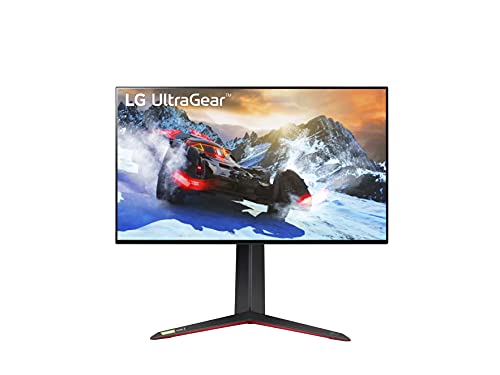 LG UltraGear 27GP950-B |
| Check price on Amazon |
Key takeaways
- Compare the best G-Sync monitors for NVIDIA graphics cards, from a 360Hz esports panel to a G-Sync Ultimate ultrawide and 4K QD-OLED, using listing specs.
Buying a G-Sync monitor is really a decision about which tier of NVIDIA’s sync technology you are paying for. Some screens carry a dedicated G-Sync processor inside, one here is certified G-Sync Ultimate, and others are G-Sync Compatible models that NVIDIA has validated to run variable refresh over Adaptive Sync. The label changes what you get in variable overdrive, HDR handling and low-frame-rate behavior, so the tier matters as much as the headline refresh rate.
This roundup serves NVIDIA graphics card owners in the main buying situations: esports players who want the fastest panel a GeForce card can drive, players building around a 4K flagship card, and ultrawide fans who want the top sync tier. Every pick below states its G-Sync tier exactly as its Amazon listing states it, and the specifications come from the product title and listing details on that page.
Quick Picks
As an Amazon Associate we earn from qualifying purchases
| Product | Best for | Key spec from title |
|---|---|---|
| ASUS ROG Swift OLED PG32UCDM | 4K gaming on a flagship NVIDIA card | 32-inch 4K QD-OLED, 240Hz, G-SYNC Compatible |
| Alienware AW3423DW | Ultrawide immersion with the top sync tier | 34-inch QD-OLED 3440×1440, 175Hz, G-SYNC ULTIMATE |
| ASUS ROG Swift 360Hz PG259QN | Esports shooters at the highest refresh rate | 24.5-inch 1080p, 360Hz, NVIDIA G-SYNC processor |
| LG UltraGear 27GP950-B | 4K IPS gaming with strong HDR for its class | 27-inch 4K Nano IPS, 144Hz, G-SYNC Compatible |
How to Choose
Know which G-Sync tier you are actually buying
NVIDIA sells three levels of this technology, and listings do not always shout the difference. A native G-Sync monitor contains a dedicated NVIDIA processor, which brings variable overdrive and a wide, hardware-controlled refresh range. G-Sync Ultimate adds certification for high-end HDR on top of that processor. G-Sync Compatible monitors have no NVIDIA module; they use Adaptive Sync that NVIDIA has tested and validated on GeForce cards. All three prevent tearing, but the module-based tiers behave better when frame rates fall low or swing widely. Read the exact wording on the listing before assuming two “G-Sync” screens are equal.
Connect over DisplayPort to get the full sync range
G-Sync reaches its widest refresh range and highest rates over DisplayPort, and that is the cable these monitors are designed around. The PG259QN lists DisplayPort 1.4 alongside HDMI 2.0, while the PG32UCDM needs its DisplayPort 1.4 connection with Display Stream Compression to run 4K at 240Hz. HDMI connections on gaming monitors often cap the refresh rate below the panel maximum, and the LG listing, for example, quotes VRR up to 120Hz from its HDMI 2.1 port. Plan the setup around the DisplayPort input, and treat HDMI as the secondary connection for a console or laptop.
Match the panel to the frame rates your card produces
Variable refresh only smooths the frames your graphics card can actually render. A 360Hz screen is an esports tool because competitive titles at 1080p can feed it on a mid-range GeForce card; the same card would leave a 4K 240Hz OLED underused in demanding games. The middle ground in this guide, 4K at 144Hz, suits high-end cards in story titles where frame rates sit between 60 and 120. Check the frame rates your card reaches at each resolution in the games you play most, then buy the panel whose range brackets those numbers instead of the largest figure on the box.
Weigh OLED contrast against IPS brightness and care needs
Panel type decides the picture trade-offs behind the sync label. The two QD-OLED picks here deliver near-instant pixel response and perfect black levels, and the ASUS adds a custom heatsink and graphene film that its listing credits with reducing burn-in risk; static desktop elements still demand sensible habits like hiding the taskbar. The Nano IPS LG answers with a typical brightness of 350 candelas per square meter and no burn-in concern, but its listing’s contrast figures are ordinary IPS numbers. Decide whether deep contrast or a brighter, care-free panel matters more on your desk.
The 4 Best Options
ASUS ROG Swift OLED PG32UCDM
- Best for: 4K gaming on a high-end NVIDIA card, with one screen shared between a PC and a laptop.
- 32-inch QD-OLED panel, 3840 x 2160 resolution
- 240Hz refresh rate, 0.03ms (GTG) response time
- NVIDIA G-SYNC Compatible and AMD FreeSync Premium Pro
- VESA DisplayHDR 400 True Black, 99 percent DCI-P3, true 10-bit
4K gaming on a high-end NVIDIA card, with one screen shared between a PC and a laptop.
4K at 240Hz needs DisplayPort 1.4 with DSC and a powerful card to feed it; as an OLED, it asks for basic burn-in care with static content.
This is the pick for a flagship GeForce card that can push 4K at high frame rates. The 32-inch QD-OLED panel runs 3840 x 2160 at 240Hz with a 0.03ms response time, and ASUS lists NVIDIA G-SYNC compatibility alongside AMD FreeSync Premium Pro, so the screen stays tear-free on either vendor’s hardware. Color coverage is a strength rather than a footnote: the listing quotes 99 percent DCI-P3, true 10-bit color and VESA DisplayHDR 400 True Black compliance. Connectivity is the most complete here, including USB-C with 90W Power Delivery for a laptop on the same desk.
Alienware AW3423DW
- Best for: Ultrawide immersion with the highest G-Sync tier, for racing, flight and open-world games.
- 34.18-inch QD-OLED curved panel (1800R), 3440×1440, 21:9 aspect ratio
- 175Hz refresh rate, 0.1ms gray-to-gray response time
- NVIDIA G-SYNC ULTIMATE certification
- 1,000,000:1 contrast ratio, 1.07 billion colors
Ultrawide immersion with the highest G-Sync tier, for racing, flight and open-world games.
The full 175Hz runs over DisplayPort, and the port list has no USB-C video input, so a one-cable laptop setup is not its strength.
The AW3423DW is the only monitor in this guide with NVIDIA G-SYNC ULTIMATE certification, stated in its listing, which pairs the dedicated G-Sync hardware tier with an HDR-focused spec. Its curved 34.18-inch QD-OLED panel runs 3440×1440 at 175Hz with a true 0.1ms gray-to-gray response time, and the listing quotes a 1,000,000:1 contrast ratio with 1.07 billion colors. The 1800R curve wraps racing and open-world games around your peripheral vision in a way a flat 27-inch screen cannot. Alienware also builds in a five-port USB hub and AlienFX lighting, so it doubles as the hub of a tidy desk.
ASUS ROG Swift 360Hz PG259QN
- Best for: Esports and fast-paced shooters where frame rate matters more than resolution.
- 24.5-inch Full HD (1920 x 1080) Fast IPS panel
- 360Hz refresh rate, 1ms (GTG) response time
- NVIDIA G-SYNC processor (native G-Sync)
- HDR10 support, ULMB motion blur reduction
Esports and fast-paced shooters where frame rate matters more than resolution.
1080p looks coarse for text and story games next to the 1440p and 4K screens here, and the native G-Sync design is aimed at NVIDIA cards.
For competitive players, this 24.5-inch screen is built around one number: 360Hz, driven by the NVIDIA G-SYNC processor the listing names, which is the native hardware tier rather than a compatibility badge. The Fast IPS panel holds a 1ms GTG response time at 1920 x 1080, the resolution at which esports titles can genuinely sustain several hundred frames per second on GeForce hardware. ASUS adds ULMB motion blur reduction, HDR10 support and a custom heatsink for long sessions. The stand adjusts for tilt, swivel, pivot and height, and the monitor is VESA wall mountable if the desk is shared.
LG UltraGear 27GP950-B
- Best for: 4K gaming on an IPS panel with certified HDR, shared between a PC and a console.
- 27-inch UHD (3840 x 2160) Nano IPS panel
- 144Hz refresh rate (overclock to 160Hz with DSC), 1ms (GtG) response time
- NVIDIA G-SYNC Compatible, AMD FreeSync Premium Pro
- VESA DisplayHDR 600, DCI-P3 98 percent
4K gaming on an IPS panel with certified HDR, shared between a PC and a console.
The 160Hz figure is an overclock that needs a DSC-capable graphics card, and IPS contrast cannot match the black levels of the OLED picks.
LG’s 27-inch UltraGear is the IPS route into 4K G-Sync gaming. The listing states NVIDIA G-SYNC Compatible status, officially validated by NVIDIA, plus AMD FreeSync Premium Pro, and the Nano IPS panel runs 3840 x 2160 at 144Hz, overclocking to 160Hz when Display Stream Compression is available from the card. Its VESA DisplayHDR 600 certification and 98 percent DCI-P3 coverage are the strongest HDR figures on an IPS panel in this guide, and typical brightness is 350 cd/m2. HDMI 2.1 carries VRR up to 120Hz, which also makes it the easiest pick here to share with a current console.
Which One Fits Your Situation
You play competitive shooters for rank
Choose the ASUS ROG Swift PG259QN. Ranked play rewards the highest usable frame rate and the lowest delay, and its native G-Sync processor holds 360Hz tear-free at the 1080p resolution your card can actually sustain in titles like tactical and arena shooters. The 24.5-inch size keeps the whole screen in view without head movement, which is why this format dominates tournament desks.
Your flagship card deserves a 4K screen
Choose the ASUS ROG Swift OLED PG32UCDM. A top-tier GeForce card is wasted on a 60Hz or 1080p display, and this QD-OLED pairs 4K resolution with a 240Hz ceiling, G-SYNC compatibility and DisplayHDR True Black contrast. The USB-C input with 90W charging also lets a work laptop share the screen without a second monitor on the desk.
You want one wide screen for racing and open worlds
Choose the Alienware AW3423DW. The 3440×1440 curve fills your peripheral vision in cockpit and open-world games, and its G-SYNC ULTIMATE certification is the highest sync tier in this guide for keeping big frame-rate swings smooth. Pick it when immersion is the priority and your desk has the depth for a 34-inch curved panel.
One screen must serve a PC and a console
Choose the LG UltraGear 27GP950-B. Its HDMI 2.1 port carries VRR up to 120Hz for a current console while DisplayPort handles the PC at 144Hz, and the IPS panel’s brightness suits a living-room desk better than the OLEDs here. It is also the natural choice if you want 4K sharpness without OLED care habits.
Common Mistakes
- Assuming every monitor labeled G-Sync works the same way, when native, Ultimate and Compatible tiers differ in hardware and low-frame-rate behavior.
- Plugging into HDMI out of habit and never seeing the panel’s full refresh rate or widest sync range, which usually requires DisplayPort.
- Buying a 4K 240Hz screen for a mid-range card that renders most games under 100 frames per second at that resolution.
- Leaving G-Sync off in the NVIDIA control panel, or running a game in borderless mode without enabling the setting for windowed applications.
- Judging an OLED and an IPS by the same HDR number, when DisplayHDR True Black and DisplayHDR 600 measure very different panel strengths.
Frequently Asked Questions
What is the difference between G-Sync, G-Sync Ultimate and G-Sync Compatible?
Native G-Sync monitors contain a dedicated NVIDIA processor that controls variable refresh and variable overdrive. G-Sync Ultimate adds certification for premium HDR on top of that hardware. G-Sync Compatible monitors have no NVIDIA module; they run Adaptive Sync that NVIDIA has tested and validated on GeForce cards. All three stop screen tearing, but the hardware tiers handle very low or unstable frame rates more gracefully.
Do I need an NVIDIA graphics card to use these monitors?
G-Sync in any tier requires a GeForce graphics card on the PC side. Two picks here, the ASUS PG32UCDM and the LG 27GP950-B, also list AMD FreeSync Premium Pro, so they keep variable refresh if you later switch card vendors. The two native-tier picks, the PG259QN and the AW3423DW, are built around NVIDIA hardware and make the most sense in an all-NVIDIA setup.
Does G-Sync work over HDMI, or do I need DisplayPort?
Plan on DisplayPort for the full refresh range. These listings center their top rates on DisplayPort, and the LG quotes VRR up to 120Hz from HDMI 2.1 rather than its full 144Hz. The ASUS PG32UCDM also needs DisplayPort 1.4 with Display Stream Compression to reach 4K at 240Hz. HDMI is fine as a second input for a console or laptop, but the gaming PC belongs on DisplayPort.
Is a G-Sync Compatible monitor a bad compromise?
No. NVIDIA validates Compatible models before listing them, and in steady frame-rate ranges the experience is close to the hardware tiers. The differences show up at the edges: frame rates that crash toward the bottom of the range, or heavy HDR use, favor the module-based screens. If your card holds frame rates comfortably inside the panel’s range, a Compatible pick like the PG32UCDM or 27GP950-B is a rational place to spend less on sync and more on the panel.
More from Amazon
Programs that pair well with the guide above. Offers and eligibility are set by Amazon and may change.
Free shipping on eligible items, Prime Video and more. Eligible new members can start with a free trial.
Start a Prime free trialAd-free music streaming. Eligible new subscribers can start with a free trial.
Try Music Unlimited freeA Prime membership for ages 18-24 with a trial period. Eligibility is set by Amazon.
See Prime for Young AdultsAudiobooks and podcasts to listen to on the go. Eligible new members can start with a free trial.
Try Audible freeAs an Amazon Associate we earn from qualifying purchases.









