
Key takeaways
- The best 5 8 wave antennas auto rooftop picks for 2026: four 5/8-wave mobile CB antennas compared by length, power handling, mount type, tuning and range.
The best 5/8 wave antenna for an auto rooftop is the FireStik FS5-B, a 5-foot fiberglass whip rated for 1000 watts with a tunable tip that sets SWR by hand. A 5/8 wave design concentrates energy toward the horizon, which suits highway and open-road driving better than a shorter quarter-wave whip. The four antennas below all use a true 5/8 wave design and mount on a vehicle roof with a standard mount or a magnetic base.
Our top pick: FireStik FS5-B. Runner-up: Sirio Performer 5000 PL. This guide compares published specifications only: every length, power rating, frequency range and mount type below comes from the manufacturer listing or the Amazon product listing for that antenna, not from roadside claims or forum posts. A rooftop antenna lives or dies on three things: a real 5/8 wave electrical length, a mount that holds it vertical at highway speed, and a clean ground plane from the roof itself. The picks below differ mainly in length, power handling and mounting style, so the right choice depends on the vehicle, the roof and the radio behind it.
At a Glance
| Product | Best for | Key specification |
|---|---|---|
| FireStik FS5-B — ASIN B000X3EP7I | Maximum reach from a fiberglass whip | 5 ft, 5/8 wave, 1000 watts, tunable tip |
| Sirio Performer 5000 PL — ASIN B0075S141E | High power handling on a steel whip | 5/8 wave, 27 to 30 MHz, 5000 watts, PL connector |
| K40 K40A — ASIN B000FSADEA | A classic base-loaded whip with a universal mount | 57.25 in, 5/8 wave, 500 watts, stainless steel whip |
| FireStik FS4-B — ASIN B00317HUWU | A shorter 5/8 wave whip for low-clearance roofs | 4 ft, 5/8 wave, 900 watts, tunable tip |
How to Choose
1. Confirm the 5/8 wave design
A 5/8 wave antenna is electrically longer than a quarter-wave whip, which pushes the radiation pattern lower toward the horizon. That low angle is what carries a signal farther across flat ground, and it is the whole point of this category. Check the listing for the words 5/8 wave rather than trusting height alone. A tall antenna with a heavy loading coil at the base is not the same thing as a true 5/8 wave design, and a fiberglass whip that never states its electrical length should be treated with suspicion. All four picks in this guide state 5/8 wave in their published specifications.
2. Match the mount to the roof
A rooftop antenna needs a mount that fits the vehicle and the antenna base. The two FireStik picks use a 3/8 inch by 24 threaded base, which fits the standard mirror, fender and roof mounts sold for CB antennas. The Sirio Performer 5000 PL uses a PL connector, which fits PL mounts and magnetic bases built for that thread. The K40 uses a universal mount that fits a wide range of roof and mirror brackets. Before ordering, confirm the mount thread on the antenna matches the mount already on the vehicle, or budget for a new mount. A mismatched thread is the most common reason a rooftop install stalls.
3. Length and clearance
Length is the main trade-off in this category. A 5-foot whip reaches farther than a 4-foot whip on the same mount, but it also hits more branches, parking structures and garage doors. The FireStik FS5-B at 5 feet is the longest fiberglass pick here, while the FS4-B at 4 feet is the safer choice for vehicles that park indoors every day. The Sirio whip stands close to two meters tall, and the K40 measures 57.25 inches. Measure the tallest point of the vehicle with the antenna fitted, then compare it with the lowest clearance the vehicle meets regularly. A whip that flexes can survive a light branch strike, but a rigid stainless whip transfers the hit straight to the mount.
4. Power handling
Power handling states how much transmitter power the antenna can carry without damage. The Sirio leads this group at 5000 watts, followed by the FireStik FS5-B at 1000 watts, the FS4-B at 900 watts and the K40 at 500 watts. For a standard 4-watt CB radio, every pick here has far more headroom than the radio can produce, so power handling is not the deciding factor for most drivers. It matters more for operators running a high-power amateur setup or an amplifier, where the margin between the radio output and the antenna rating needs to be comfortable. Match the rating to the radio, not to the loudest number on the page.
5. Tuning method
Every antenna in this guide needs SWR tuning after installation, because the roof, the mount position and the cable all change the match. The two FireStik models use a tunable tip under a cap at the top of the whip: loosen the cap, turn the adjustment screw by hand and check SWR again. The Sirio and K40 tune by adjusting the whip length, which takes a wrench and a few more minutes. A tunable tip is the friendlier option for a driver who moves the antenna between vehicles, while a whip-length adjustment holds its setting well once it is set. Either way, plan on owning or borrowing an SWR meter before the first transmission.
6. Ground plane
A 5/8 wave vertical antenna needs a ground plane, and on a vehicle that ground plane is the metal roof. Mounting at the center of a steel roof gives the most even pattern, while a mount at the roof edge or on a fiberglass panel gives a lopsided one. Magnetic mounts only work on steel roofs, so aluminum-body trucks and vehicles with a rooftop tent or a full-length rack need a drilled or clamped mount instead. A roof with a sunroof or a large glass panel still works if the mount sits on a solid metal section. The antenna cannot create a ground plane on its own, so the roof material decides the mount type before anything else.
7. Cable and connector
The cable between the radio and the antenna matters as much as the antenna itself. A short run of RG-58 coaxial cable with a PL-259 connector is standard for mobile CB installs, and the Sirio roof-mount kit versions include a 4-meter RG-58 cable terminated with a PL-259 plug. Keep the cable run as short as practical, route it away from sharp edges and hot exhaust parts, and avoid tight coils of spare cable behind the dashboard. A pinched or kinked cable raises SWR and wastes the range the antenna was bought for. Check the connector on the mount matches the cable, and confirm the radio end matches the radio.
Our Picks
FireStik FS5-B — ASIN B000X3EP7I
The FireStik FS5-B is a 5-foot fiberglass whip built on a 5/8 wave design, rated for 1000 watts, with a tunable tip that adjusts SWR by hand. Its top-loaded coil sits near the tip, and the 3/8 inch by 24 threaded base fits the standard roof, mirror and fender mounts used on cars, trucks and RVs. The solid fiberglass core flexes under branches instead of snapping, and the listing states a 5-year manufacturer warranty. At 5 feet tall it is the longest pick in this guide, which is the main reason it takes the top spot for open-road range.
Best for: Drivers who want the longest practical 5/8 wave whip on a standard mount.
Consideration: The 5-foot length needs attention at parking structures and low branches, and it needs a separate 3/8 inch by 24 roof mount because no mount is included in the box.
Sirio Performer 5000 PL — ASIN B0075S141E
The Sirio Performer 5000 PL is a 5/8 wave mobile antenna for the 10-meter and CB bands, covering 27 to 30 MHz with a power handling rating of 5000 watts. Its tapered stainless steel whip stands close to two meters tall, and the PL connector fits the magnetic and roof mounts built for the Performer range. The whip is made from 17/7 PH stainless steel, which resists bending and corrosion in daily driving. Roof-mount kit versions of this antenna include a 4-meter RG-58 cable terminated with a PL-259 plug, so the run from the roof to the radio is covered.
Best for: Operators who want the highest power handling in this group on a steel whip.
Consideration: The tall stainless whip needs a sturdy mount and careful clearance planning, and tuning is done by adjusting the whip length rather than by a hand-turned tip.
K40 K40A — ASIN B000FSADEA
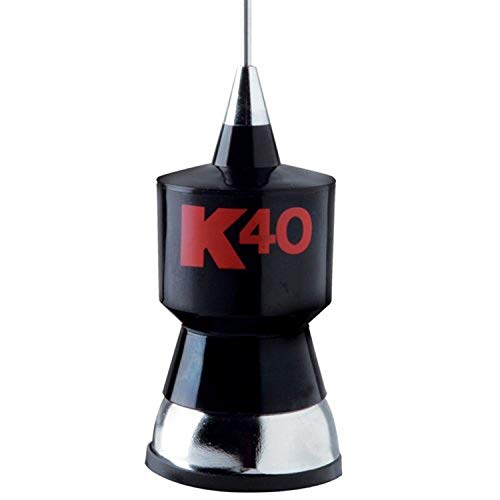
The K40 K40A is a 57.25-inch base-loaded CB antenna built around a 5/8 wave design, rated for 500 watts, with a stainless steel whip. Its universal mount fits a wide range of roof and mirror brackets, and the base rotates 30 degrees so the whip can sit vertical on a sloped mounting surface. The K40 has been sold as a mobile CB antenna for decades, and the listing states a 5-year manufacturer warranty. At just under 5 feet tall it splits the difference between the two FireStik lengths, which makes it a useful middle ground for drivers who want reach without the full 5-foot height.
Best for: Drivers who want a proven base-loaded whip with a mount that fits almost any bracket.
Consideration: The 500-watt rating is the lowest in this group, so it suits standard CB radios and modest amateur setups rather than high-power operation.
FireStik FS4-B — ASIN B00317HUWU

The FireStik FS4-B is a 4-foot fiberglass whip on a 5/8 wave design, rated for 900 watts, with the same tunable tip as its 5-foot sibling. The top-loaded coil, solid fiberglass core and 3/8 inch by 24 threaded base are shared with the FS5-B, and the listing states a 5-year manufacturer warranty. The shorter length gives up some reach compared with the 5-foot model, but it clears more garages and parking structures and puts less leverage on the mount at highway speed. For a daily driver that parks indoors, the 4-foot length is often the smarter compromise.
Best for: Daily drivers and low-clearance vehicles that still want a true 5/8 wave whip.
Consideration: The shorter whip gives up some range against the 5-foot FS5-B, and like the FS5-B it needs a separate 3/8 inch by 24 roof mount.
Which One Is Right for You?
For most drivers, the FireStik FS5-B is the straightforward choice: the longest fiberglass whip here, a hand-turned tunable tip and a 1000-watt rating cover the widest range of vehicles and radios. Choose the Sirio Performer 5000 PL when the radio runs high power or when a stainless steel whip is preferred over fiberglass, and accept the taller profile and the whip-length tuning. Choose the K40 K40A when the mount situation is uncertain, since its universal base and rotating mount fit brackets the other antennas cannot use. Choose the FireStik FS4-B when the vehicle parks indoors or passes under low structures every day, since the 4-foot length is the easiest of the four to live with. In every case, mount the antenna near the center of a steel roof, tune SWR after installation and keep the cable run short and protected.
Frequently Asked Questions
What does 5/8 wave mean on a car antenna?
A 5/8 wave antenna has an electrical length equal to five-eighths of the wavelength at the operating frequency. On the CB band that length concentrates the signal toward the horizon, which carries farther across flat ground than a shorter quarter-wave whip. The physical whip is shorter than the electrical length because a loading coil makes up the difference.
Do I need a metal roof for a rooftop antenna?
A 5/8 wave vertical antenna uses the metal roof as its ground plane, so a steel roof gives the best result. Magnetic mounts only hold on steel, so aluminum-body vehicles need a drilled or clamped mount instead. A mount on a fiberglass panel or a glass roof will not give the antenna the ground plane it needs.
Do these antennas need tuning after installation?
Yes. Every antenna in this guide needs SWR tuning in its final mounting position, because the roof, the mount location and the cable all affect the match. The two FireStik models tune with a hand-turned tip under the cap, while the Sirio and K40 tune by adjusting the whip length. An SWR meter is needed for the job, and the tuning should be checked again if the antenna moves to a different mount.
Can I use one antenna on two vehicles?
A magnetic-mount antenna moves between vehicles in minutes, which is the main advantage of a magnetic base. A whip with a 3/8 inch by 24 base can also move if both vehicles have a matching mount, but the SWR needs checking again on each vehicle because the ground plane changes. A drilled roof mount stays with the vehicle it was fitted to.
Will a taller antenna always reach farther?
A taller 5/8 wave whip generally reaches farther than a shorter one on the same mount, because more of the radiating length sits above the roofline. The gain is not unlimited, and a taller whip also catches more branches and puts more leverage on the mount. The best choice balances height against the clearances the vehicle meets every day.
Bottom Line
The FireStik FS5-B leads this group because it combines the longest fiberglass whip, a 1000-watt rating and a tunable tip that makes SWR adjustment simple. The Sirio Performer 5000 PL is the high-power alternative on a stainless whip, the K40 K40A is the flexible choice when the mount is uncertain, and the FireStik FS4-B is the low-clearance pick that still keeps a true 5/8 wave design. Whichever one fits the vehicle, the install matters as much as the antenna: a centered mount on a steel roof, a careful SWR tune and a protected cable run are what turn a good antenna into a good signal.
Disclosure: As an Amazon Associate, this site earns from qualifying purchases.
More from Amazon
Programs that pair well with the guide above. Offers and eligibility are set by Amazon and may change.
Free shipping on eligible items, Prime Video and more. Eligible new members can start with a free trial.
Start a Prime free trialAd-free music streaming. Eligible new subscribers can start with a free trial.
Try Music Unlimited freeA Prime membership for ages 18-24 with a trial period. Eligibility is set by Amazon.
See Prime for Young AdultsAudiobooks and podcasts to listen to on the go. Eligible new members can start with a free trial.
Try Audible freeAs an Amazon Associate we earn from qualifying purchases.









