
Our Short List of 3

- Best for: A permanent home base station on a small lot where radials and a tuner are not wanted.
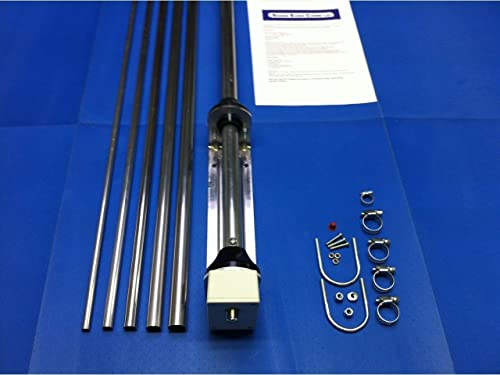
- Best for: A fixed installation where higher power handling and a compact, radial-free footprint matter most.

- Best for: Lightweight portable operation and park activations where the antenna must set up fast and travel light.
All 4 Picks at a Glance
| Product | Specs | Action |
|---|---|---|
| Comet CHA-250HD All Band Vertical Base Antenna — ASIN B001UPVTTA |
| Check price on Amazon |
| Sigma EUROCOM SE-HF-X80 Vertical Radial Free Antenna — ASIN B09YMDRSQG |
| Check price on Amazon |
| Radioddity HF-009 Portable HF Antenna — ASIN B0F4X4517J |
| Check price on Amazon |
 Super Antenna MP1DXTR80 Super-MP Go Bag Antenna Kit — ASIN B0G13JRJW1 |
| Check price on Amazon |
Key takeaways
- Compare the best 60 meter antennas for ham radio on published specs: four verticals covering 5.33 MHz, from a no-radial base antenna to portable field kits.
The best 60 meter antennas are multiband HF verticals whose published frequency range covers 5.33 to 5.41 MHz, the five-channel 60-meter amateur band. Our top pick is the Comet CHA-250HD, a 23.42-foot base vertical that covers 3.5 to 57 MHz with a built-in matching network and no ground radials. For portable operation, the Radioddity HF-009 and the Super Antenna MP1DXTR80 pack down for field use, while the Sigma SE-HF-X80 suits a fixed installation with 400 watts of power handling.
The 60-meter band is a narrow slice of spectrum between 80 meters and 40 meters, and it behaves differently from both neighbors. Signals on 60 meters travel well over regional distances during the day and reach further after dark, which makes the band useful for state-wide nets, emergency communication, and contacts that fall in the gap between local ground-wave coverage and long-haul skip. Because the band is channelized in the United States, with five fixed channels and a 100-watt PEP effective radiated power limit, an antenna that covers 60 meters must be resonant or matchable on those exact channels rather than merely close to them.
Our top pick: Comet CHA-250HD. Runner-up: Sigma EUROCOM SE-HF-X80. This guide compares published specifications only: frequency coverage, power handling, height, mounting hardware, connector type, and radial requirements, drawn from manufacturer listings and retailer specifications. Every antenna below lists 60-meter coverage in its published frequency range, so each one can be set up for the five 60-meter channels.
At a Glance
| Product | Best for | Key specification |
|---|---|---|
| Comet CHA-250HD | Permanent base station with no tuner and no radials | 3.5–57 MHz transmit, 23.42 ft, 250W PEP, SO-239 |
| Sigma EUROCOM SE-HF-X80 | Fixed installation with higher power handling | 3.5–50 MHz transmit, 6 m telescopic, 400W PEP, SO-239 |
| Radioddity HF-009 | Lightweight portable and park operation | 5–50 MHz, SWR 1.0–1.5, 100W CW / 150W PEP SSB |
| Super Antenna MP1DXTR80 | Complete go-bag field kit with tripod and mounts | 80m–6m, 500W SSB / 300W CW and data, SO-239 |
How to Choose
1. Confirm 60-Meter Coverage in the Published Range
The 60-meter band spans 5.33 to 5.41 MHz, so the first check is whether the antenna’s published transmit range includes that slice. A vertical rated 3.5 to 57 MHz or 5 to 50 MHz covers it; an antenna rated only for 40 meters and up does not. Multiband verticals that list 80 meters through 6 meters also span 60 meters, since the band sits between 80 and 40 meters. Read the transmit range rather than the receive range, because several verticals receive far wider than they transmit.
2. Decide Between a Base Station and a Portable Antenna
A permanent base antenna stays mounted on a roof, mast, or tower and is built from aluminum or fiberglass sections that survive weather year-round. A portable antenna breaks down into a carry bag and sets up on a ground spike or tripod in minutes. Base antennas suit operators who work 60 meters from home, while portable antennas suit park activations, field days, and emergency deployments. The four antennas in this guide split evenly across both roles, so match the form factor to where the antenna will actually live.
3. Check Whether the Antenna Needs Radials
Some verticals are ground-independent designs with a built-in matching network, and they work with no radials at all. Others need a radial set or a counterpoise wire laid on the ground to complete the antenna system. Radial-free verticals simplify installation on small lots, rooftops, and balconies, while antennas that use radials often reward the extra setup with a lower radiation angle. If the operating location has no room for wires on the ground, a radial-free design is the practical choice.
4. Match Power Handling to the Transmitter
The United States 60-meter rules limit stations to 100 watts PEP effective radiated power, so most operators run 100 watts or less on this band. Even so, power handling matters, because an antenna rated for 100 watts leaves no headroom while one rated for 250 or 400 watts runs well inside its limits. Portable antennas commonly handle 100 watts CW and 150 watts PEP SSB, which matches a typical 100-watt transceiver. Base verticals rated at 250 or 400 watts PEP give extra margin for amplifiers and digital modes with high duty cycles.
5. Understand Tuner Requirements and Standing Wave Ratio
Some wideband verticals include a transformer matching network that holds standing wave ratio at 1.6 to 1 or less across the band, so no external tuner is needed. Others are designed to work with an antenna tuner, and the operator adjusts a sliding coil or a whip section to reach resonance on each band. A low published standing wave ratio on 60 meters means the transmitter sees a clean load on the five channels. When an antenna needs a tuner, confirm that the station tuner covers 5 MHz and handles the intended power.
6. Consider Height, Mounting, and Available Space
A full quarter wavelength on 60 meters is about 44 feet, so no compact vertical is a full-size antenna on this band. Base verticals in the 20 to 24-foot range use loading and matching networks to work on 60 meters from a manageable height, and they mount on a mast, a roof tripod, or a tower. Portable verticals extend to 7 to 17 feet and trade height for packability. Taller antennas generally perform better on the low bands, so choose the tallest antenna the mounting location and the budget of space allow.
7. Look at Connectors, Coax, and Weather Resistance
Most HF verticals use an SO-239 socket, which mates with a PL-259 plug on standard 50-ohm coaxial cable. Fiberglass and aluminum construction with stainless hardware resists corrosion, and sealed matching units keep moisture out of the feed point. Portable kits add tripods, ground spikes, radial spools, and carrying bags, so the whole station travels as one package. Confirm the connector type and the coax length before ordering, because a short coax run limits where the antenna can stand relative to the radio.
Our Picks
Comet CHA-250HD All Band Vertical Base Antenna — ASIN B001UPVTTA
- Best for: A permanent home base station on a small lot where radials and a tuner are not wanted.
A permanent home base station on a small lot where radials and a tuner are not wanted.
The Comet CHA-250HD is a wideband base vertical that transmits continuously from 3.5 to 57 MHz and receives from 2.0 to 90 MHz, which puts all five 60-meter channels well inside its range. Its built-in transformer matching network holds standing wave ratio at 1.6 to 1 or less across the band, so no external tuner and no ground radials are required. The antenna stands 23.42 feet tall, handles 250 watts PEP, and presents a 50-ohm load through an SO-239 socket. Fiberglass and aluminum construction with a weather-resistant coating suits a permanent roof or mast installation.
Consideration: At 23.42 feet tall, it needs a sturdy mast or roof mount and enough clearance to raise safely.
Sigma EUROCOM SE-HF-X80 Vertical Radial Free Antenna — ASIN B09YMDRSQG
- Best for: A fixed installation where higher power handling and a compact, radial-free footprint matter most.
A fixed installation where higher power handling and a compact, radial-free footprint matter most.
The Sigma EUROCOM SE-HF-X80 is an end-fed vertical that transmits from 3.5 to 50 MHz and receives from 1.8 to 55 MHz, covering the 60-meter band with an antenna tuner. Its telescopic sections extend to 6 meters, and the radial-free design needs no counterpoise wires, which keeps the footprint small. Power handling is rated at 400 watts PEP, the highest in this guide, and the feed point uses an SO-239 socket with a 50-ohm impedance. The telescopic build collapses for transport and storage when the antenna is not in use.
Consideration: The 60-meter band is reached with an antenna tuner, so a tuner that covers 5 MHz is part of the station.
Radioddity HF-009 Portable HF Antenna — ASIN B0F4X4517J
- Best for: Lightweight portable operation and park activations where the antenna must set up fast and travel light.
Lightweight portable operation and park activations where the antenna must set up fast and travel light.
The Radioddity HF-009 is a portable vertical that covers 5 to 50 MHz, which starts just below the 60-meter band and runs through 6 meters. Its quick-tuning slider moves along an internal coil to set resonance, and the published standing wave ratio runs from 1.0 to 1.5 across its range. Power handling is rated at 100 watts CW and 150 watts PEP SSB, matching a standard 100-watt field transceiver. The kit includes a ground spike and works with Xiegu G90, X6100, and X6200 radios as well as Radioddity QT40, QT60, and QT80 transceivers, and it packs down for park operation.
Consideration: The ground spike suits soft ground, so a tripod or other support is needed on pavement or rock.
Super Antenna MP1DXTR80 Super-MP Go Bag Antenna Kit — ASIN B0G13JRJW1
- Best for: Operators who want one complete kit that covers field, vehicle, and home use with no extra parts to buy.
Operators who want one complete kit that covers field, vehicle, and home use with no extra parts to buy.
The Super Antenna MP1DXTR80 is a complete portable kit covering 80 meters through 6 meters, which spans the 60-meter band, with a manual sliding sleeve on the coil for setting resonance by hand. Power handling is rated at 500 watts SSB and 300 watts CW and data, the highest in this guide. The kit includes the MP1C antenna, a titanium Super-Whip, a low-profile tripod, a universal clamp mount, a ground spike, the MC80 coil for 80 meters, three radial sets, an SWR ruler, and a stealth black go bag. Extended, the antenna reaches 7 feet; collapsed, it measures 12 inches, and the full kit in its bag weighs 5 pounds. The feed point uses an SO-239 socket with a 50-ohm impedance, and the manufacturer states efficiency within 1 dB of a full-size quarter-wave vertical on 20 meters as measured at the HF Pack Shootout.
Consideration: Tuning is manual, so each band change means sliding the coil sleeve to a new mark and checking the match.
Which One Is Right for You?
For a permanent home station, choose the Comet CHA-250HD. Its wideband matching network covers every 60-meter channel with no tuner and no radials, and its 23.42-foot height gives it presence on the low bands. Operators who run higher power or who want a telescopic antenna that stores away should look at the Sigma SE-HF-X80, which handles 400 watts PEP and needs no counterpoise wires.
For portable work, the choice comes down to weight and completeness. The Radioddity HF-009 is the lighter kit and the faster setup, with a quick-tuning slider and a ground spike for soft ground. The Super Antenna MP1DXTR80 is the fuller kit, with a tripod, a universal clamp, a ground spike, three radial sets, and a go bag, plus the highest power handling in this guide. Either portable antenna covers the 60-meter band, so pick the HF-009 for the lightest pack and the MP1DXTR80 for the most complete field station.
Frequently Asked Questions
What frequencies are the 60-meter band?
The 60-meter amateur band spans 5.33 to 5.41 MHz. In the United States it is channelized into five fixed channels at 5330.5, 5346.5, 5357.0, 5371.5, and 5403.5 kHz, with voice operation in upper sideband and a limit of 100 watts PEP effective radiated power. An antenna for this band must cover those exact channels.
Do I need a tuner for a 60-meter antenna?
It depends on the antenna. Wideband verticals with a built-in transformer matching network, such as the Comet CHA-250HD, hold a low standing wave ratio across the band with no external tuner. End-fed and coil-tuned verticals, such as the Sigma SE-HF-X80 and the Super Antenna MP1DXTR80, are used with a tuner or adjusted by hand to reach resonance on 60 meters.
Can a multiband HF vertical work on 60 meters?
Yes, when 60 meters falls inside its published transmit range. A vertical rated 3.5 to 57 MHz, 3.5 to 50 MHz, or 5 to 50 MHz covers the band, and a vertical rated 80 meters through 6 meters spans it as well. Check the transmit range rather than the receive range, and confirm the standing wave ratio on the 60-meter channels before operating.
Do I need radials for a 60-meter vertical?
Some verticals are ground-independent and need no radials, including the Comet CHA-250HD and the Sigma SE-HF-X80. Others use a radial set or a counterpoise wire as part of the antenna system, and portable kits such as the Super Antenna MP1DXTR80 include radial sets in the box. When radials are required, laying them out is part of the setup rather than an optional extra.
How high should I mount a 60-meter vertical?
Mount the antenna as high as practical, following the manufacturer’s mounting guidance. A quarter wavelength on 60 meters is about 44 feet, so most verticals for this band are shortened designs that work well at 20 feet and up. Base verticals mount on a mast, a roof tripod, or a tower, while portable verticals stand on a tripod or a ground spike at ground level.
Bottom Line
The best 60 meter antennas cover 5.33 to 5.41 MHz in their published transmit range and match the operator’s station: a base vertical for home, or a portable kit for the field. The Comet CHA-250HD is the strongest all-round choice for a permanent station, with no tuner and no radials, while the Sigma SE-HF-X80 suits higher-power fixed use. For portable work, the Radioddity HF-009 travels lightest and the Super Antenna MP1DXTR80 brings the most complete kit. Whichever form factor fits, confirm the 60-meter coverage and the standing wave ratio on the five channels before the first contact.
Disclosure: As an Amazon Associate, this site earns from qualifying purchases.
…[truncated 3391 chars]
More from Amazon
Programs that pair well with the guide above. Offers and eligibility are set by Amazon and may change.
Free shipping on eligible items, Prime Video and more. Eligible new members can start with a free trial.
Start a Prime free trialAd-free music streaming. Eligible new subscribers can start with a free trial.
Try Music Unlimited freeA Prime membership for ages 18-24 with a trial period. Eligibility is set by Amazon.
See Prime for Young AdultsAudiobooks and podcasts to listen to on the go. Eligible new members can start with a free trial.
Try Audible freeAs an Amazon Associate we earn from qualifying purchases.









