Key takeaways
- Coils: use flat-bottomed pans whose base is close to the coil diameter. Very small pans can heat unevenly; very large pans can overhang and cook slowly at the edges.
- Radiant glass: use smooth, flat bases. Lift pans instead of sliding them, and keep sand or salt crystals off the surface.
- Induction: test the pan with a magnet before purchase. The magnetic area should cover most of the marked zone; a tiny magnetic center may cause reduced performance.
- Glass and ceramic cookware: use only when the cooktop and cookware manufacturer approve it. Compatibility depends on the base design, not just the material name.
Electric Stove Tops for Kitchen: What to Buy
The best electric stove top for your kitchen depends on whether you value low purchase cost, easy cleaning, precise everyday control, or the ability to cook without a permanent installation: choose a coil cooktop for budget durability, a smooth radiant top for a built-in kitchen, or a portable electric model for limited space, backup cooking, and occasional use.
Quick comparison: which type fits your kitchen?
| Type | Typical size | Typical power | Cookware compatibility | Best for | Main compromise |
|---|---|---|---|---|---|
| Coil cooktop | 24, 30, or 36 inches wide; 4 to 6 burners | 1,200–2,600 watts per element | Nearly any flat-bottomed metal pan | Low cost, rentals, heavy daily use | Harder to wipe clean and slower to respond |
| Smooth radiant cooktop | 30 or 36 inches wide; 4 to 5 zones | 1,200–3,000 watts per zone | Flat-bottomed cookware; aluminum usually needs a magnetic or compatible base only if specified | Permanent kitchens and easy surface cleaning | Glass can scratch or crack, and residual heat remains after switching off |
| Portable electric hot plate | 9–24 inches wide; 1 or 2 zones | 900–1,800 watts per zone | Flat-bottomed pans within the marked heating area | Small kitchens, dorm-style spaces, backup cooking | Less cooking area and slower recovery with large pans |
| Portable induction unit | 11–16 inches wide; usually 1 zone | 1,300–1,800 watts | Magnetic cookware only, such as cast iron or magnetic stainless steel | Fast heating and precise portable cooking | Requires compatible pans and can produce fan noise |
Wattage is useful, but it is not a complete speed rating. A cooktop’s controller may cycle power rather than supply the listed wattage continuously, and a large pan may spread heat less effectively than a smaller pan centered on the element. Look for the element diameter as well as wattage.
Our top picks


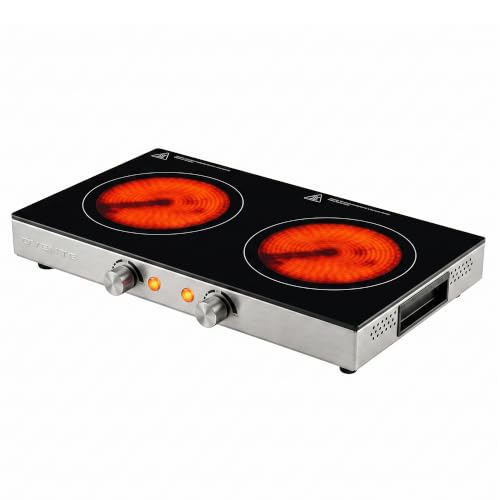
As an Amazon Associate we earn from qualifying purchases at no extra cost to you. Ratings are shown as listed on Amazon.
Coil, smooth-top, or portable: the practical differences
Coil cooktops: the value choice
Exposed metal coils are usually the least expensive permanent electric option. Replacement coils are widely available by size and connector style, and a damaged drip bowl is cheaper to replace than a glass surface. The raised coils also tolerate rougher cookware handling than a glass top.
The drawbacks are mainly control and cleaning. Coils stay hot after the dial is turned down, so delicate sauces can continue cooking unless the pan is moved. Food that spills beneath the coil can smoke until the element is lifted and the drip bowl is cleaned. Coils can also sit unevenly if a pan or bowl is bent.
Choose a coil model when purchase price, repairability, and tolerance for heavy cookware matter more than appearance. For frequent cooking, select a design with removable coils and dishwasher-safe or easily replaceable drip bowls.
Smooth radiant tops: the built-in kitchen compromise
Smooth electric cooktops use heating elements beneath a glass-ceramic surface. Their main advantage is cleanup: once the surface is cool, spills can be removed with a cooktop scraper and cleaner rather than from several separate drip bowls.
They require more careful handling. Sliding cast iron, dragging gritty pans, or allowing sugary spills to bake onto the surface can leave permanent marks or damage. The glass also remains hot after the red heating glow disappears, so a “hot surface” indicator is an important safety feature.
Radiant tops work best with flat cookware. A warped skillet may heat unevenly, while an oversized pan can extend beyond the marked zone and transfer unnecessary heat to the surrounding glass. Confirm the largest element diameter before buying if you regularly use a 12-inch skillet or stockpot.
Portable electric models: useful, but measure the job
A portable unit can add cooking capacity without changing a countertop or electrical circuit. Single-burner models are convenient for boiling, warming, and occasional frying. Two-burner models are more useful for a complete meal, but their controls may share one outlet’s available power and may reduce one element when both are set high.
Conventional portable hot plates use a coil or radiant plate and accept a broad range of cookware. Portable induction is usually faster and more responsive, but a magnet must stick firmly to the bottom of the pan. Glass, copper, aluminum, and many stainless-steel pans will not work unless they have a magnetic base.
Do not place a portable unit on a damp towel, near a sink splash zone, or directly beneath a low cabinet where rising heat can damage the cabinet finish. Use a level, heat-resistant surface with ventilation around the unit, and plug it directly into the outlet unless the manufacturer specifically permits an approved extension arrangement.
Decision matrix by kitchen situation
| Your situation | Best starting choice | Why | Check before purchase |
|---|---|---|---|
| Lowest upfront cost | Single or double coil unit | Simple construction and inexpensive replacement parts | Element diameter, drip-bowl availability, and cord length |
| Daily family cooking | 30-inch smooth radiant or coil cooktop | Four cooking zones provide practical capacity without taking a 36-inch cutout | Electrical circuit rating, large-element size, and control layout |
| Small counter or occasional use | One-burner portable model | Uses little storage space and avoids permanent installation | Base footprint, ventilation clearance, and maximum pan diameter |
| Fast portable cooking | Portable induction | Efficient heat transfer and quick power changes | Magnetic cookware, fan noise, and minimum pan diameter |
| Heavy cast-iron cookware | Coil model, or a protected radiant top | Coils handle impact better; glass requires careful lifting | Weight limits, flatness, and whether the pan can be lifted rather than slid |
| Rental or temporary kitchen | Portable coil or radiant unit | No countertop cutout or permanent wiring | Counter stability, outlet capacity, and storage when cool |
Measurements and installation that prevent expensive mistakes
For a built-in cooktop, measure the existing cutout rather than assuming the nominal width is the actual opening. A model described as 30 inches wide may require a cutout roughly 28 to 29 inches wide, but specifications vary. Record the cutout width, front-to-back depth, countertop thickness, cabinet clearance, and distance to the wall or backsplash.
Also identify the electrical supply before ordering. Many full-size cooktops require a dedicated 208- or 240-volt circuit, while portable units commonly use a standard household outlet. The required amperage, wiring method, and disconnect arrangement vary by model and local code. Have a qualified electrician confirm compatibility and perform any permanent installation; do not assume an existing range circuit is suitable for a different cooktop.
For a portable unit, measure both storage space and operating space. A 12-inch appliance may need several additional inches of clearance for controls, ventilation, and the pan handle. A two-burner unit may physically fit on a counter but leave too little room to safely turn handles away from the edge.
Cookware compatibility and usable heating area
- Coils: use flat-bottomed pans whose base is close to the coil diameter. Very small pans can heat unevenly; very large pans can overhang and cook slowly at the edges.
- Radiant glass: use smooth, flat bases. Lift pans instead of sliding them, and keep sand or salt crystals off the surface.
- Induction: test the pan with a magnet before purchase. The magnetic area should cover most of the marked zone; a tiny magnetic center may cause reduced performance.
- Glass and ceramic cookware: use only when the cooktop and cookware manufacturer approve it. Compatibility depends on the base design, not just the material name.
A simple fit calculation helps with crowded kitchens: if a cooktop has two 7-inch zones side by side, two 10-inch pans cannot both sit fully inside those zones. Pan handles and the distance between heating areas may make only one large pan practical at a time.
Cleaning, heat control, and long-term ownership
Clean a coil unit only after it is cool and disconnected if the design permits element removal. Lift the coil rather than twisting it, wipe the drip bowls, and avoid flooding the electrical connection. Replace distorted drip bowls because they can hold grease against the hot element.
For smooth glass, wipe ordinary spills after cooling, then use a scraper designed for glass cooktops at a shallow angle. Remove sugary spills promptly because caramelized residue can bond strongly to glass. Avoid abrasive powders, steel wool, and cleaners that leave a slippery film.
For any electric model, the components most likely to age are control switches, heating elements, indicator lights, and the power cord or plug on portable units. A coil is usually inexpensive to replace. A failed radiant element beneath a sealed glass surface can be substantially more expensive, sometimes making repair uneconomical on a low-cost cooktop.
Controls also affect durability. Mechanical knobs are simple and usable with wet hands, while touch controls are easier to wipe but can be less responsive when greasy or damp. Whichever style you choose, do not use the cooktop as a countertop, and do not cover a hot surface with foil unless the manufacturer explicitly allows it.
What to buy
Buy a coil cooktop if you want the lowest-cost permanent option and can accept more cleaning. Buy a smooth radiant cooktop if an integrated appearance and quick wipe-down are worth protecting the glass. Buy a portable coil or radiant model for occasional cooking, a rental, or an extra burner. Choose portable induction when speed and responsive control matter most and your cookware passes the magnet test.
Before committing, compare the actual element sizes, electrical requirements, cutout dimensions, cookware rules, replacement-part availability, and clearance instructions. Those details usually matter more to daily satisfaction than the headline burner count.