
Key takeaways
- Our guide to the best mini piano keyboards compares 37-key models for beginners, covering voices, learning modes, and battery power for practice anywhere.
A mini piano keyboard trades full-size keys for a compact frame that fits on a desk, a shelf, or a lap, and that trade shapes every buying decision. The right model still needs enough keys to play simple melodies with both hands, a voice set that keeps practice interesting, and a speaker loud enough to hear clearly in a quiet room. Beginners who pick a keyboard with too few keys or a thin sound run out of room to grow within weeks. A thin sound discourages practice.

This guide is for new players, parents buying a first instrument for a child, and travelers who want a practice keyboard that packs into a bag. Every product below was chosen from the name and specifications shown on its Amazon page, with the key count, voices, and power options checked against the listing. Two models cover the main learning styles.
Quick Picks
As an Amazon Associate we earn from qualifying purchases
| Product | Best for | Key spec from title |
|---|---|---|
| Yamaha PSS-A50 | Creative practice and recording | 37 mini keys, phrase recorder |
| Yamaha PSS-F30 | First lessons and learning modes | 37 mini keys, 120 voices |
How to Choose
Key Count and Key Size
Mini piano keyboards usually carry 37 mini keys, which covers about three octaves and suits simple melodies, chords, and early lessons. Full-size keys feel more like a real piano, yet they double the width and weight, so a mini-key model wins when space or portability matters. Touch-sensitive keys respond to how hard they are pressed, which teaches dynamics from the first lesson. Check the key count on the listing, and confirm the keys are mini rather than full-size before ordering. A 37-key frame also fits on a standard desk beside a laptop, which matters in a small room. Players with large hands should try mini keys in a shop first.
Voices and Sound Quality
The voice count decides how many instrument sounds the keyboard can play, from piano and organ to strings and synth tones. A model with around 40 voices covers the basics well, while 120 voices gives a learner far more to explore across styles. Built-in speakers matter too, since a weak speaker makes even good voices sound thin. Listen for a clean piano voice first, because that is the sound a beginner will hear most often during practice. A piano voice with a natural decay helps a learner judge timing and phrasing, while a thin electronic voice hides mistakes. More voices also mean more styles to try, which keeps practice interesting across months.
Learning Modes and Styles
Built-in learning features turn a keyboard into a teacher. A quiz mode tests note recognition, accompaniment styles add drums and bass behind a melody, and a Smart Chord function lets one finger play full chords while the other hand learns the tune. These modes matter most for self-taught players and children, who stay motivated when the keyboard responds to their playing. Look for the modes named on the listing rather than assuming every model includes them. A quiz mode that tests note names builds reading skills without a workbook, and accompaniment styles let a beginner play along with a band from the first week. These features matter most for self-taught players.
Power and Portability
A mini keyboard earns its keep by going where the player goes, so power options deserve attention. Battery power frees the keyboard from wall outlets for car trips, parks, and practice away from home, while USB power runs it from a laptop or power bank at a desk. Weight matters too: a model near 1.2 kilograms slips into a backpack easily, while heavier boards stay home. Check the battery type and the weight on the listing before deciding. USB power from a laptop is handy at a desk, since it removes the need for a separate adapter. A keyboard that runs on standard batteries is easier to keep going on a trip.
The 2 Best Options
Yamaha PSS-A50
The Yamaha PSS-A50 is a compact 37-key mini keyboard built for players who want to experiment as well as practice. Its phrase recorder captures a short idea and loops it back, so a learner can play along with their own melody, while the arpeggiator turns single notes into flowing patterns. Touch-sensitive keys respond to playing dynamics, and 42 voices cover piano, organ, and synth sounds. Battery or USB power keeps it portable, and the 1.2-kilogram weight makes it easy to carry to lessons or holidays. The recorder turns practice into a creative session rather than a drill. The touch-sensitive keys reward gentle playing with softer notes.
Specs
- 37 mini keys with touch response
- 42 voices
- Phrase recorder for capturing musical ideas
- Arpeggiator for pattern playing
- Battery or USB powered
- Weight of 1.2 kilograms
Best for: Creative beginners who want to record ideas and explore sounds beyond basic practice and want to capture ideas as they play.
Watch out for: The 37-key range suits simple pieces, yet it cannot cover the full span of piano sheet music, so advanced pieces need a larger keyboard.
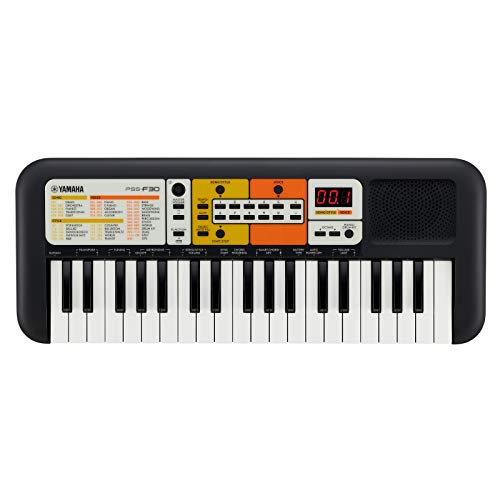
Yamaha PSS-F30
The Yamaha PSS-F30 is the learning-focused sibling in the PSS range, with 120 voices and 114 accompaniment styles that give a beginner plenty of material to explore. Smart Chord lets one finger trigger full chords, so a new player can sound musical while the other hand works on melody. A quiz mode tests note names and ear training, turning practice into a game. The 37 mini keys keep the frame compact, and the same 1.2-kilogram weight makes the keyboard easy to move between rooms or carry to class. The quiz mode keeps children engaged long after the novelty fades. The 114 styles cover many genres for practice.
Specs
- 37 mini keys
- 120 voices
- 114 accompaniment styles
- Smart Chord function
- Quiz mode for note learning
- Weight of 1.2 kilograms
Best for: First-time players and children who learn best with guided modes, accompaniment, and a quiz that rewards progress.
Watch out for: The mini keys feel small for adult hands, so try the key size in a shop first when possible, since mini keys suit smaller hands best.
Which One Fits Your Situation
A Child Starting First Lessons
A child needs a keyboard that responds quickly and rewards every attempt, and the PSS-F30 fits that brief with its quiz mode and Smart Chord function. The 120 voices keep practice fresh across weeks, and the accompaniment styles make simple tunes sound complete. Keep the keyboard on a low table or a lap, and let the learning modes carry the early lessons. Keep sessions short and regular, since ten minutes a day builds skill.
A Player Who Writes Melodies
Players who hum tunes and want to capture them should look at the PSS-A50 first. The phrase recorder loops an idea back instantly, and the arpeggiator turns a few notes into a pattern worth developing. The 42 voices are fewer than the PSS-F30, yet the creative tools matter more for songwriting than voice count alone. Record short ideas often, since a melody forgotten is a melody lost. Hum the tune first.
Practice Away From Home
Both models run on batteries and weigh 1.2 kilograms, so either one travels well in a backpack or a tote bag. The PSS-A50 suits a player who practices on trains or in parks and wants to record ideas on the spot. The PSS-F30 suits a student heading to lessons with a teacher who values the quiz and accompaniment features. Pack spare batteries for trips, since a dead keyboard ends practice early.
A Small Desk or Shared Room
A mini keyboard shines where space is tight, since both models sit comfortably on a desk beside a laptop or on a shelf when not in use. USB power runs either one from a computer without a separate adapter, and the built-in speakers keep the setup simple. Pick the model whose features match the player, since the footprint is the same. A headphone socket keeps practice silent in a shared room.
Common Mistakes
- Buying a keyboard with too few keys and outgrowing it within the first month, which wastes the purchase and the practice time.
- Ignoring touch response, which teaches dynamics that flat keys cannot, since dynamics shape every piece.
- Choosing by voice count alone instead of checking the learning modes, which matter more for a beginner.
- Forgetting to check whether the keyboard runs on batteries for practice away from home, where no outlet is nearby.
- Assuming mini keys suit every hand size without trying them first, since adult hands may find them cramped.
Frequently Asked Questions
Are 37 keys enough for a beginner?
Yes, 37 keys cover about three octaves, which is enough for simple melodies, chords, and the first year of lessons. Most beginner pieces stay within that range, and the compact frame keeps the keyboard portable. Players who move on to full piano repertoire will eventually need 61 or 88 keys, yet 37 is a sound starting point. Ask a teacher to confirm.
What is the difference between the PSS-A50 and the PSS-F30?
The PSS-A50 focuses on creativity, with a phrase recorder and arpeggiator for capturing and developing musical ideas across 42 voices. The PSS-F30 focuses on learning, with 120 voices, 114 styles, Smart Chord, and a quiz mode. Both share the same 37 mini keys and 1.2-kilogram weight, so the choice turns on whether the player values recording or guided learning more.
Do mini piano keyboards need an amplifier?
No, both models in this guide have built-in speakers loud enough for practice in a quiet room. A headphone socket lets a player practice silently, which helps in shared rooms or late evenings. An external speaker can add volume for a small performance, yet it is not required for daily practice. Built-in speakers suit a quiet room best.
Can a mini keyboard run on batteries?
Yes, both Yamaha models run on batteries as well as USB power, which makes them easy to use away from a wall outlet. Battery life depends on volume and playing time, so keep spare batteries handy for trips. USB power from a laptop or power bank is a handy backup when the batteries run low. A power bank also works.
More from Amazon
Programs that pair well with the guide above. Offers and eligibility are set by Amazon and may change.
Free shipping on eligible items, Prime Video and more. Eligible new members can start with a free trial.
Start a Prime free trialAd-free music streaming. Eligible new subscribers can start with a free trial.
Try Music Unlimited freeA Prime membership for ages 18-24 with a trial period. Eligibility is set by Amazon.
See Prime for Young AdultsAudiobooks and podcasts to listen to on the go. Eligible new members can start with a free trial.
Try Audible freeAs an Amazon Associate we earn from qualifying purchases.









