Key takeaways
- Pro: Continuous inverter cooking avoids the pulsing high-low cycle that causes edge overheating in conventional models.
- Pro: Fits standard built-in trim kits, offering installation flexibility most competitors lack.
- Con: The 1.2 cubic foot interior can feel tight for a full dinner plate of lasagna or a whole chicken.
What's inside
Panasonic has built a reputation in the countertop microwave market around one core promise: even, thorough cooking without the cold spots and blown-out edges that plague cheaper models. Their Inverter Technology and Genius Sensor system deliver a more consistent result across a wider range of foods, and the company offers enough model variety that buyers can find a capacity, wattage, and price that fits a real kitchen. The problem is that the lineup overlaps heavily. Several models share the same 1.2 cubic foot cavity and 1200W or 1250W output, making it hard to tell where you are paying for a meaningful upgrade and where you are paying for a finish or a minor button layout change.
This guide compares eight models available for the best panasonic microwave ovens category in 2026, including one non-Panasonic competitor that repeatedly shows up in buyer discussions as a price benchmark. We looked at published wattage ratings, internal capacities, sensor and inverter features, and aggregated owner feedback about noise, door action, and cooking uniformity. The goal is to cut through the spec-sheet similarity and identify which model earns its price for which buyer.
As an Amazon Associate we earn from qualifying purchases at no extra cost to you.




Quick Picks
| Product | Best For | Price |
|---|---|---|
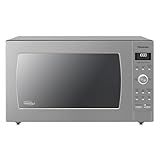
| Panasonic NN-SN686S | Most buyers who want proven value | $259.95 |
| Toshiba Countertop 1.2 Cu.Ft | Shoppers who just need to save money | $129.99 |
| Panasonic NN-SD975S | Families that cook large meals | $474.95 |
| Panasonic NN-SN67QS | Buyers who want 1250W without a price jump | $299.95 |
| Panasonic NN-SN67KS | Stainless kitchens on a moderate budget | $289.95 |
| Panasonic NN-SN65KW | Minimalist kitchens that want a white finish | $249.95 |
| Panasonic NN-SN76LS | People who need more room without going full premium | $318.47 |
| Panasonic NE-1054F | Small cafés, break rooms, and light-duty commercial use | $352 |
How We Picked
We weighted four criteria. First, power delivery: Inverter Technology with a continuous wave matters far more than a raw wattage number because it governs how evenly food heats at reduced settings. Second, internal volume relative to external footprint, since countertop space is the most common constraint. Third, sensor and automation features that actually reduce guesswork, such as Genius Sensor one-touch programs and Turbo Defrost. Fourth, owner-reported build quality, specifically hinge durability, turntable motor noise, and keypad responsiveness after a year of daily use.
The 8 Best Panasonic Microwave Ovens in 2026
Panasonic NN-SN686S
This is the model most reviewers point to as the default recommendation. It pairs Inverter Technology with a Genius Sensor in a 1.2 cubic foot cavity rated at 1200W, and it is designed to fit either on a counter or built into a cabinet cutout. Owners praise its quiet operation and the way the sensor reliably catches steam to end cycles without manual guessing. The stainless finish resists fingerprints better than expected for its price tier.
- Pro: Continuous inverter cooking avoids the pulsing high-low cycle that causes edge overheating in conventional models.
- Pro: Fits standard built-in trim kits, offering installation flexibility most competitors lack.
- Con: The 1.2 cubic foot interior can feel tight for a full dinner plate of lasagna or a whole chicken.
Skip this if you routinely cook for four or more people in one cycle; step up to a larger capacity instead.
Toshiba Countertop 1.2 Cu.Ft
While not a Panasonic, this model earns its place in the comparison because its $129.99 price forces any Panasonic buyer to justify the roughly $130 premium. It offers a matching 1.2 cubic foot cavity but steps down to 1000W and drops the inverter and sensor system entirely. Cooking results are adequate for reheating leftovers and popping popcorn but noticeably uneven on denser foods. Owners report a louder fan and a less refined keypad than any Panasonic on this list.
- Pro: Lowest price in the comparison by a wide margin.
- Pro: Compact footprint suits small apartments and dorm kitchens.
- Con: No inverter or sensor means you rely on a timer and hope for the best on anything beyond simple reheating.
Skip this if even cooking is a priority; the price gap closes to near zero over the appliance’s lifetime once you account for undercooked dishes.
Panasonic NN-SD975S
The Cyclonic Wave Inverter platform is Panasonic’s most advanced consumer cooking system, and the NN-SD975S houses it in a 2.2 cubic foot cavity rated at 1250W. The cyclonic airflow eliminates the turntable entirely, so heat circulates in a spiral pattern that keeps food from clustering at one hot spot. Genius Sensor handles timing, and one-touch cooking programs cover common dishes. Owners call it the most consistent microwave they have used for anything from frozen dinners to fresh vegetables. The tradeoff is size and cost.
- Pro: Turntable-free Cyclonic Wave cooking heats edge-to-edge with no rotation, accommodating rectangular dishes that will not fit round trays.
- Pro: The 2.2 cubic foot interior is roughly 83 percent larger than the 1.2 cubic foot models, handling family-scale portions in one pass.
- Con: The $474.95 price and large external footprint put it out of reach for apartment kitchens or anyone who needs a basic reheater.
Skip this if your household is one or two people and your counter space is limited.
Panasonic NN-SN67QS
This model sits in an awkward middle ground that some buyers will actually prefer. It pushes output to 1250W rather than the 1200W you get from the NN-SN686S, keeps Inverter Technology and Genius Sensor, and holds the same 1.2 cubic foot cavity. The stainless steel finish is cleaner-looking than many competitors. Owners who upgrade from older Panasonic models note the slightly faster cycle times from the added wattage, though the practical difference on most foods is subtle.
- Pro: 1250W output shaves a small amount off cooking times compared to 1200W models.
- Pro: Stainless steel exterior with a well-spaced control panel reduces button-press errors.
- Con: The price premium over the NN-SN686S is hard to justify on the basis of 50 extra watts alone.
Skip this if the $259.95 NN-SN686S is available; the wattage difference is not worth the gap for most use cases.
Panasonic NN-SN67KS
The NN-SN67KS shares the stainless steel/silver design language of the SN67QS at a slightly lower $289.95 price. It offers the same 1.2 cubic foot capacity and inverter-driven cooking with Genius Sensor automation. Owners describe it as a quieter machine with a more responsive touchpad than older Panasonic units they replaced. If your kitchen already has a stainless refrigerator or oven, the matching finish is a real design benefit. At $289.95, it undercuts the SN67QS by ten dollars while looking essentially identical.
- Pro: Matching stainless steel finish integrates cleanly with modern appliance packages.
- Pro: Quiet turntable motor and solid door seal earn consistent praise in owner reviews.
- Con: The 1.2 cubic foot cavity still limits what you can cook in a single pass for a family.
Skip this if you cannot find it in stock, as the NN-SN686S fills the same role at a lower price.
Panasonic NN-SN65KW
For kitchens that run light on color, the NN-SN65KW delivers Panasonic’s Inverter Technology and Genius Sensor in a white exterior at $249.95. It holds the standard 1.2 cubic foot cavity at 1200W and adds a dedicated Popcorn button and Turbo Defrost cycle. Owners with smaller households call it the easiest microwave to operate because the one-touch programs cover the tasks they repeat most. The white enamel finish does show scuffs more readily than stainless options.
- Pro: Popcorn and Turbo Defrost one-touch buttons remove guesswork from the two tasks most households perform daily.
- Pro: Lowest-priced full-inverter Panasonic in this comparison.
- Con: White exterior chips and yellows faster than stainless under direct sunlight or frequent cleaning with abrasives.
Skip this if your microwave sits near a window or if you want a longer cosmetic life without careful handling.
Panasonic NN-SN76LS
The NN-SN76LS occupies a useful middle capacity that most brands ignore. Its 1.6 cubic foot cavity is 33 percent larger than the standard 1.2 cubic foot models, and it uses Cyclonic Inverter Technology at 1250W with Genius Sensor automation. External dimensions measure 19.44 inches deep by 21.88 inches wide by 11.94 inches high, so it fits most counters without dominating them. Owners report it handles casserole dishes and large plates without the rotation constraints of smaller turntables. At $318.47, it undercuts the 2.2 cubic foot NN-SD975S by more than $150.
- Pro: 1.6 cubic foot interior fits full-size dinner plates and medium casserole dishes that larger families need.
- Pro: Cyclonic Inverter cooking at 1250W delivers results closer to premium models without the premium price.
- Con: The wider external footprint requires checking clearance before committing counter space.
Skip this if your counter can only fit a standard-width microwave; measure first and compare against your available space.
Panasonic NE-1054F
This is a commercial-grade unit built for break rooms, cafés, and light-duty food service. The 0.8 cubic foot cavity and 1000W output suit single portions and drinks rather than full meals, but the touch screen control panel with 10 programmable memory keys lets operators store exact power levels and times for repeat recipes. Owners in small food businesses report years of reliable daily service. At $352, it is priced between the mid-range home models and the premium NN-SD975S.
- Pro: 10 programmable memory keys with touch screen control allow one-touch recall of custom power and time settings.
- Pro: Stainless steel commercial construction withstands heavy daily use better than any home model here.
- Con: The 0.8 cubic foot cavity is too small for most home dinner plates and cannot accommodate built-in installation.
Skip this if you need a home kitchen microwave; the small cavity and commercial interface waste money for a household setting.
Buying Guide
Inverter Technology vs. Conventional Cycling
A conventional microwave toggles full power on and off in rapid bursts to simulate lower settings. That pulsing causes the outer layers of a dish to overcook while the center stays cold, especially on defrost cycles. Inverter Technology delivers a continuous, variable power wave, which means the magnetron runs at a steady lower output rather than cycling. The practical result is that you can set 50 percent power and actually get 50 percent heat. Every Panasonic model on this list except the commercial NE-1054F uses an inverter platform, and it is the single most important reason to pay a premium over a generic microwave.
Choosing Capacity Without Wasting Counter Space
Internal volume and external footprint do not scale linearly. The 1.2 cubic foot models share a similar external size, so moving from 1.2 to 1.6 cubic feet on the NN-SN76LS adds meaningful interior room without a dramatic jump in width or depth. The 2.2 cubic foot NN-SD975S, however, demands significantly more counter real estate. Before buying, measure the width, depth, and clearance your space allows, then match the model to that envelope rather than picking the largest number you can fit on a shelf.
Sensor and One-Touch Programs: Worth the Upgrade?
Genius Sensor uses a humidity probe to detect steam coming from food and adjusts run time automatically. For most users this eliminates the trial-and-error of guessing seconds, which is especially valuable for frozen meals, reheating rice, or steaming vegetables. One-touch buttons like the dedicated Popcorn key on the NN-SN65KW reduce the number of steps to zero for common tasks. If you reheat or cook the same handful of foods daily, sensor automation saves time and reduces overcooked dishes far more than an extra 50 watts of power.
Our Verdict
The Panasonic NN-SN686S is the top pick for most households. It delivers Inverter Technology, a Genius Sensor, a 1200W cavity, and built-in flexibility at $259.95, which is the lowest price for a full-feature Panasonic inverter model in this lineup. For the budget pick, the NN-SN65KW at $249.95 matches the 686S in core technology while adding popcorn and turbo defrost buttons, making it the better choice if you want a white finish and a few extra one-touch shortcuts. However, if you cook for a family of four or more and regularly heat casseroles or large plates, the NN-SN76LS at $318.47 wins decisively because its 1.6 cubic foot Cyclonic Inverter cavity saves you from cooking in batches.
FAQ
Are Panasonic microwaves worth the premium over budget brands?
For most households the answer is yes because Inverter Technology eliminates the pulsing power cycle that causes uneven heating in conventional models. The NN-SN65KW at $249.95 narrows the price gap to under $120 over a basic competitor, and owners consistently report longer lifespan and fewer complaints than generic brands.
Can I install a Panasonic countertop microwave built into a cabinet?
Several models, including the NN-SN686S, are designed with mounting provisions that allow built-in installation using trim kits sold separately. Check the specific model’s owner manual for approved kit part numbers and minimum clearance requirements before committing to a cabinet cutout.
What does Cyclonic Wave cooking actually do differently?
Cyclonic Wave microwaves eliminate the turntable and instead circulate energy in a spiral pattern, so rectangular dishes and oversized plates sit still while still receiving even heat. The NN-SD975S and NN-SN76LS both use this approach, though the SN76LS retains a turntable at a smaller footprint.
Is a commercial microwave like the NE-1054F practical for home use?
It is technically usable but impractical for most homes because the 0.8 cubic foot cavity cannot fit a standard dinner plate and the commercial control interface prioritizes speed over household convenience. It is best suited to small offices, cafés, or anyone who needs programmable memory keys for identical repeat cycles all day.