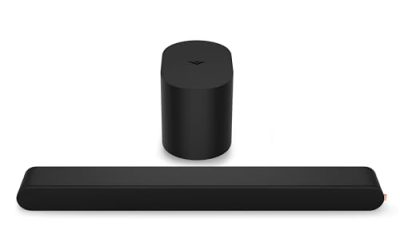
Our Short List of 3

- Best for: The largest rooms and dedicated home theaters that need maximum output and dual-subwoofer bass coverage.
- Channels: 9.2.4
- Speaker maximum output power: 1300 watts max output
- Subwoofers: dual 10 inch wireless subwoofers
- Surround speakers: 4 rear surround effects speakers

- Best for: Big rooms that want flagship power and real surround speakers without permanent rear-speaker placement.
- Channels: 11.1.4
- Total speaker power output: 1170 watts
- Soundbar output power: 650 watts
- Subwoofer: 12 inch wireless subwoofer
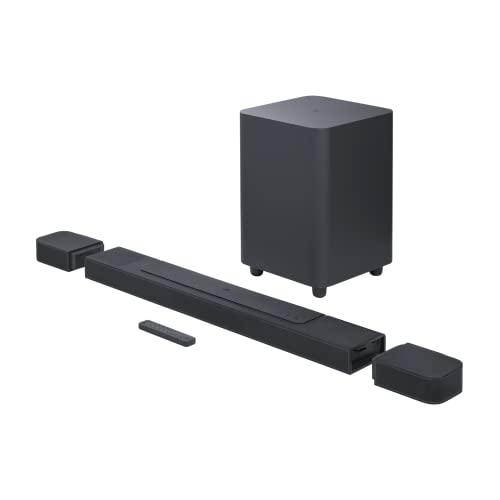
- Best for: Medium-large rooms that want detachable surrounds and strong output without flagship size.
- Channels: 7.1.4
- Total speaker power output: 880 watts
- Soundbar output power: 440 watts
- Subwoofer output power: 300 watts, 10 inch wireless subwoofer
All 4 Picks at a Glance
| Product | Specs | Action |
|---|---|---|
| Nakamichi Shockwafe Ultra 9.2.4 SSE Max |
| Check price on Amazon |
| JBL Bar 1300X |
| Check price on Amazon |
| JBL Bar 1000 |
| Check price on Amazon |
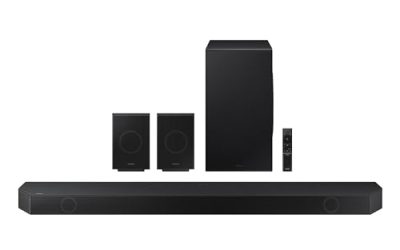
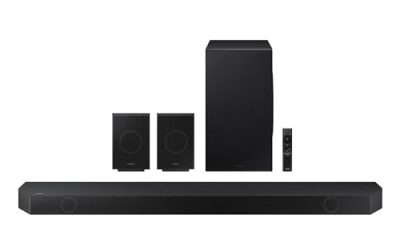
 Samsung HW-Q990D |
| Check price on Amazon |
Key takeaways
- Compare the best high watt soundbars for big rooms, from a 1300W flagship with dual subwoofers to a 656W Atmos system with wireless rear speakers.
A big room swallows the output of an ordinary soundbar. Dialogue that sounds clear in a small den gets lost across a long seating distance, and bass that feels full up close turns thin at the back of an open-plan living space. The real decision is how much total system power, subwoofer support, and channel coverage you need so movies stay clear and forceful at the volume your room actually demands, without paying for output you will never use.
This guide is for owners of large living rooms, open-plan spaces, and dedicated media rooms who want a soundbar system with serious published wattage. The picks run from a 1300 watt flagship with dual subwoofers to a 656 watt Dolby Atmos system, covering Nakamichi, JBL, LG, and Samsung models with wireless subwoofers, rear speakers, and eARC connections.
Quick Picks
As an Amazon Associate we earn from qualifying purchases
| Product | Best for | Key spec from title |
|---|---|---|
| Nakamichi Shockwafe Ultra 9.2.4 SSE Max | Maximum output and dual-sub bass | 1300 watts max output power |
| JBL Bar 1300X | Detachable surrounds and a 12 inch sub | 1170W total system power |
| JBL Bar 1000 | Smaller footprint with real surround | 880W total system power |
| LG S95QR | LG TVs and a center up-firing channel | 810 watts output, 9.1.5 channel |
| Samsung HW-Q990D | Samsung TVs and wireless Atmos | 656W total power, 11.1.4 channel |
How to Choose
Read the wattage figure the right way
Every brand in this guide publishes a total system power figure, but each measures it across a different mix of bar, subwoofer, and surround speakers. Treat the watt number as a rough guide to headroom rather than a promise of loudness, and compare it alongside channel count and subwoofer size. A system rated at 1170 watts with a large subwoofer will usually fill a big room more easily than a higher-rated system driving small drivers, so use wattage to shortlist, then judge the hardware behind it.
Match subwoofer support to the room size
In a large room, bass has the furthest to travel, and a single small subwoofer can sound lost long before the bar runs out of volume. Dual subwoofers, like the pair of 10 inch units in the Nakamichi system, spread low frequencies more evenly across wide seating. A single large driver, such as the 12 inch subwoofer in the JBL Bar 1300X, is the next best option. Check the subwoofer driver size and its share of the total power before assuming two systems with similar wattage will hit equally hard.
Decide how much surround hardware you can place
High watt systems earn their output through extra speakers, and those speakers need somewhere to go. Full kits with separate rear speakers, like the Samsung and LG systems here, deliver the most convincing surround in a big room but need floor or stand space behind the seating. Detachable designs from JBL store the surrounds on the bar and only move them out for movie night. If your room cannot host permanent rears, a detachable layout keeps the power without the furniture commitment.
Check connections for your sources
A powerful bar is wasted if it cannot take the best signal from your TV and players. HDMI eARC is the baseline for uncompressed Dolby Atmos from a modern TV, and every pick here includes it. If you run a game console or a disc player, look for extra HDMI inputs with 4K passthrough so the bar can switch sources without quality loss. Wireless music support such as AirPlay, Chromecast, and Bluetooth also varies, so confirm the streaming options you actually use are on the spec sheet.
The 5 Best Options
Nakamichi Shockwafe Ultra 9.2.4 SSE Max
- Best for: The largest rooms and dedicated home theaters that need maximum output and dual-subwoofer bass coverage.
- Channels: 9.2.4
- Speaker maximum output power: 1300 watts max output
- Subwoofers: dual 10 inch wireless subwoofers
- Surround speakers: 4 rear surround effects speakers
The largest rooms and dedicated home theaters that need maximum output and dual-subwoofer bass coverage.
The four surround speakers and two subwoofers need real floor space and power outlets around the room.
The Shockwafe Ultra is the wattage leader in this guide, with a listing-rated 1300 watts of max output power driving a 9.2.4 channel layout. Two 10 inch wireless subwoofers anchor the low end, and four separate surround speakers handle effects that a single bar cannot place convincingly in a wide room. Dolby Atmos and DTS:X decoding with SSE Max processing aims that power at object-based soundtracks, making this the pick for large media rooms where seating sits far from the screen and lesser systems run out of steam.
Watch out for: The four surround speakers and two subwoofers need real floor space and power outlets around the room.
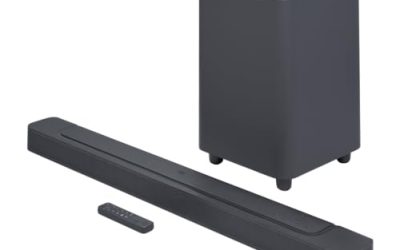
JBL Bar 1300X
- Best for: Big rooms that want flagship power and real surround speakers without permanent rear-speaker placement.
- Channels: 11.1.4
- Total speaker power output: 1170 watts
- Soundbar output power: 650 watts
- Subwoofer: 12 inch wireless subwoofer
Big rooms that want flagship power and real surround speakers without permanent rear-speaker placement.
The detachable speakers run on batteries, so they need docking time between long sessions.
The Bar 1300X publishes 1170 watts of total system power across an 11.1.4 channel layout, with 650 watts in the bar itself and a 12 inch wireless subwoofer handling the low end. Its detachable surround speakers unclip from the ends of the bar for true rear sound, then dock again to recharge, which suits big rooms that cannot keep speakers out permanently. MultiBeam processing, Dolby Atmos and DTS:X support, built-in Wi-Fi with AirPlay and Chromecast, and PureVoice dialogue enhancement round out a system built for long movie nights.
Watch out for: The detachable speakers run on batteries, so they need docking time between long sessions.
JBL Bar 1000
- Best for: Medium-large rooms that want detachable surrounds and strong output without flagship size.
- Channels: 7.1.4
- Total speaker power output: 880 watts
- Soundbar output power: 440 watts
- Subwoofer output power: 300 watts, 10 inch wireless subwoofer
Medium-large rooms that want detachable surrounds and strong output without flagship size.
With fewer channels and a smaller subwoofer than the Bar 1300X, very large open-plan spaces may still stretch it.
The Bar 1000 steps the same JBL formula down to 880 watts of total system power in a 7.1.4 channel layout, which is still firmly in high watt territory for most living rooms. The bar itself accounts for 440 watts, the 10 inch wireless subwoofer adds 300 watts, and two detachable surround speakers contribute 70 watts each. You keep MultiBeam, Dolby Atmos and DTS:X, PureVoice, and Wi-Fi streaming with AirPlay and Chromecast, in a system that asks for less space and less setup than its bigger sibling above.
Watch out for: With fewer channels and a smaller subwoofer than the Bar 1300X, very large open-plan spaces may still stretch it.
LG S95QR
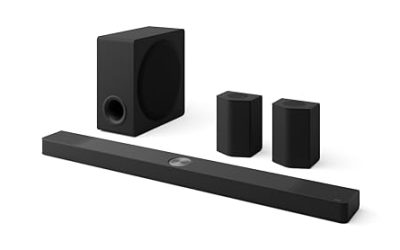
The S95QR delivers 810 watts across a 9.1.5 channel system and stands out for its center up-firing speaker, a layout LG designed to lift dialogue toward the listener in wide rooms where the center channel often gets buried. Six-channel wireless rear speakers with their own up-firing drivers, a wireless subwoofer, Meridian audio technology, and AI Room Calibration Pro help the system adapt its output to the space. Dolby Atmos, DTS:X, and IMAX Enhanced support cover the major formats, and the feature set pairs naturally with LG televisions.
Specs
- Channels: 9.1.5
- Output wattage: 810 watts
- Center channel: center up-firing speaker
- Rear speakers: wireless, with up-firing height channels
- Sound formats: Dolby Atmos, DTS:X, IMAX Enhanced
- Audio technology: Meridian, AI Room Calibration Pro
- Connectivity: HDMI eARC, Bluetooth 5.0, Wi-Fi
Best for: LG TV owners and wide rooms where clear dialogue at distance matters as much as raw power.
Watch out for: Some conveniences, such as full TV integration features, work best when paired with an LG television.
Samsung HW-Q990D
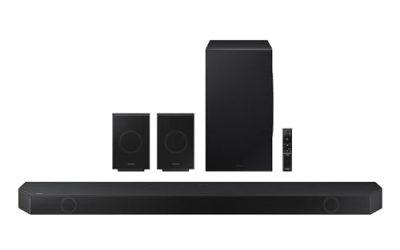
- Best for: Samsung TV owners who want the widest channel coverage and included rear speakers in a big room.
- Channels: 11.1.4
- Total power: 656 watts
- Subwoofer power: 200 watts, wireless subwoofer
- Rear speakers: included, wireless
Samsung TV owners who want the widest channel coverage and included rear speakers in a big room.
Q-Symphony only works with compatible Samsung televisions, and the total wattage trails the leaders here.
The HW-Q990D is the most modest wattage figure here at 656 watts total, yet it runs the widest channel layout in the guide at 11.1.4, spreading that power across 22 speakers including a wireless subwoofer rated at 200 watts and a rear speaker kit included in the box. Wireless Dolby Atmos, Q-Symphony pairing with Samsung TVs, SpaceFit Sound Pro room calibration, Adaptive Sound, and Game Mode Pro make it a polished flagship. For big rooms, its strength is coverage and balance rather than the highest headline watt number.
Watch out for: Q-Symphony only works with compatible Samsung televisions, and the total wattage trails the leaders here.
Which One Fits Your Situation
A dedicated media room with rows of seating
Distance is the enemy in a media room, so output and bass coverage matter most. The Nakamichi Shockwafe Ultra, with its 1300 watt rating, dual 10 inch subwoofers, and four separate surround speakers, is built for exactly this layout. Its separate speakers can be positioned where the room needs them instead of relying on reflections, and the twin subwoofers keep bass even from the front row to the back.
An open-plan living space used for everything
Open-plan rooms leak sound in every direction, and permanent speaker placement is rarely practical. A detachable system such as the JBL Bar 1300X or Bar 1000 fits this life better: surrounds live on the bar day to day, then move behind the sofa for films. Both publish high total wattage, so dialogue and effects still carry across a combined living and dining area at normal listening distances.
A big room where dialogue keeps getting lost
If the complaint is voices rather than volume, look at how a system handles the center channel. The LG S95QR dedicates an up-firing center speaker to dialogue and calibrates itself to the room, while JBL models add PureVoice enhancement for the same problem. Raising total wattage alone will not fix buried voices, so a center-focused design is the smarter spend for news, drama, and sports commentary.
A Samsung or LG TV at the center of the setup
Brand pairing features reward staying in the family. Samsung owners get Q-Symphony, which lets the TV speakers work alongside the HW-Q990D, plus one-remote convenience. LG owners get the S95QR’s TV sound sharing and remote control integration. In a big room, these extras do not add wattage, but they simplify daily use enough that the powerful system actually gets used for everything, not just films.
Common Mistakes
- Comparing wattage figures across brands as if they were measured the same way, when each maker rates total system power differently.
- Buying the highest watt system for a room whose seating sits close to the TV, where a smaller system would already be more than enough.
- Placing a single subwoofer in a corner of a very large room and expecting even bass at every seat.
- Forgetting that rear and detachable surround speakers need power, charging, or floor space planned before the system arrives.
- Feeding a high end bar through a basic ARC or optical connection and losing the uncompressed Atmos signal that eARC carries.
Frequently Asked Questions
How many watts does a soundbar need for a big room?
There is no single threshold, because brands rate power differently, but the systems in this guide publish between 656 and 1300 watts of total system power and are all aimed at large spaces. Subwoofer size, channel count, and seating distance matter as much as the headline figure, so judge the whole system rather than the watt number alone.
Are two subwoofers better than one in a large room?
Two subwoofers spread bass more evenly across a wide seating area, which helps when listeners sit at different distances from the screen. That is why the Nakamichi system pairs its high wattage with dual 10 inch subwoofers. A single large subwoofer, like the 12 inch unit in the JBL Bar 1300X, can still hit hard, but placement becomes more critical.
Do detachable surround speakers sound as good as separate ones?
Detachable speakers are real surround speakers while they are placed behind you, and systems like the JBL Bar 1300X give them their own share of the total power budget. The trade-offs are battery life and the habit of docking them to recharge. Separate wired or wireless rears, as in the Samsung and LG kits, avoid charging but need permanent placement and power access.
Does a high watt soundbar need eARC?
For the best results, yes. eARC carries uncompressed Dolby Atmos and high bitrate audio from the TV to the bar, which is the material these powerful systems are built to reproduce. Every pick in this guide includes eARC. An older ARC or optical connection still works for basic sound, but it limits the formats the bar can receive.
More from Amazon
Programs that pair well with the guide above. Offers and eligibility are set by Amazon and may change.
Free shipping on eligible items, Prime Video and more. Eligible new members can start with a free trial.
Start a Prime free trialAd-free music streaming. Eligible new subscribers can start with a free trial.
Try Music Unlimited freeA Prime membership for ages 18-24 with a trial period. Eligibility is set by Amazon.
See Prime for Young AdultsAudiobooks and podcasts to listen to on the go. Eligible new members can start with a free trial.
Try Audible freeAs an Amazon Associate we earn from qualifying purchases.