Key takeaways
- Pro: Roku’s channel store is vast and consistently maintained by third-party developers.
- Pro: The Voice Remote includes a headphone jack for private listening, genuinely useful at this price.
- Con: Limited to 1080p output, so it is a dead end if you upgrade your TV later.
What's inside
Buying a best tv streaming device in 2026 usually comes down to one question: does your TV’s built-in platform do what you need, or are you stuck with a slow interface, missing apps, or a panel that predates 4K? A streaming stick closes that gap cheaply—plug it into an HDMI port, connect to Wi-Fi, and you get a refreshed interface, the latest apps, and often better picture quality than the TV’s own software delivers. The difference between a good pick and a bad one compounds every night you settle for buffering, a clunky remote, or an upscaled image that never looks right on a large screen.
The devices that separate themselves in this roundup do so on concrete specs: native 4K output, HDR format support, Wi-Fi standard, and the quality of voice-search integration. Price is the last variable. An $18 stick that outputs only 1080p feels fine on a 2018 living-room TV but looks soft on a modern 4K panel. The goal is matching the device to your screen’s actual capabilities so you are not overpaying for resolution your TV cannot show or underpaying and getting a nightly bottleneck.
As an Amazon Associate we earn from qualifying purchases at no extra cost to you. Product prices and availability are accurate as of the date shown and are subject to change.




Quick Picks
| Product | Best For | Price |
|---|---|---|
| Roku Streaming Stick HD | Simplicity on HD TVs | $29.99 |
| Fire TV Stick HD | Lowest price entry | $17.99 |
| Fire TV Stick 4K Plus | Balanced 4K streaming | $39.99 |
| Fire TV Stick 4K Select | Budget 4K | $19.99 |
| Roku Streaming Stick 4K | Dolby Vision on a Roku | $48.66 |
| Roku Ultra | Power users wanting expandability | $94.95 |
| Roku Streaming Stick Plus | HDR10+ without Dolby Vision | $36.47 |
| Fire TV Stick 4K Max | Wi-Fi 6E and top AI search | $49.99 |
How We Picked
We compared published specifications, street prices, and aggregated owner feedback across these eight devices. The criteria that mattered most were output resolution and HDR format coverage, Wi-Fi standard (which governs real-world buffering on congested networks), voice-search quality across subscribed apps, and price-to-feature ratio. We also weighed remote design and setup friction because those affect daily usability far more than any synthetic benchmark will.
The 8 Best Tv Streaming Device in 2026
Roku Streaming Stick HD with Voice Remote
Designed for households with 1080p TVs that need a straightforward interface without any 4K overhead. Roku’s platform remains the easiest to navigate for anyone who does not want to learn a new ecosystem, and the Voice Remote handles searches well enough that you rarely touch the D-pad.
- Pro: Roku’s channel store is vast and consistently maintained by third-party developers.
- Pro: The Voice Remote includes a headphone jack for private listening, genuinely useful at this price.
- Con: Limited to 1080p output, so it is a dead end if you upgrade your TV later.
Skip it if your TV already supports 4K or if you expect a new display within a year or two.
Amazon Fire TV Stick HD
The absolute floor of the category at $17.99. It is powered by the TV’s HDMI port—no wall adapter—and setup is among the fastest in this group. For a bedroom or dorm-room TV, it delivers free and live TV channels with minimal effort, and Alexa+ speeds up content discovery noticeably over older Fire TV software.
- Pro: Lowest price in the roundup with a full app lineup including Netflix and Prime Video.
- Pro: No dangling power cable since the TV supplies power through HDMI.
- Con: No 4K or HDR support limits it to smaller or older displays.
Skip it if you watch primarily on a 4K panel; upscaling will not satisfy.
Amazon Fire TV Stick 4K Plus
The mid-tier choice for most 4K TV owners. Wi-Fi 6 matters if your router is across the house or your network is crowded, and the AI-powered Fire TV Search surfaces relevant results faster than scrolling through rows. It streams hundreds of thousands of movies and shows, and free live TV keeps value strong for cord-cutters.
- Pro: Wi-Fi 6 provides more stable 4K streams than older-generation sticks in congested homes.
- Pro: Alexa+ integration cuts search time compared to manual menu navigation.
- Con: No Dolby Vision support, which matters on high-end TVs that prefer that format.
Skip it if Dolby Vision is a hard requirement or you want the absolute lowest price.
Amazon Fire TV Stick 4K Select
At $19.99 it is the cheapest way into 4K streaming. You get AI-powered search, free live TV, and Alexa+—core features that cost more on the 4K Plus. The trade-off is that you give up Wi-Fi 6 and whatever internal performance headroom the Plus carries.
- Pro: Best price-to-resolution ratio in the category at under twenty dollars.
- Pro: Free and live TV available without a cable subscription lowers total cost of ownership.
- Con: Lacks Wi-Fi 6, so buffering on weak signals is more likely than on the Plus.
Skip it if your Wi-Fi signal is weak where the TV sits or if you stream multiple 4K feeds simultaneously.
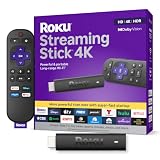
Roku Streaming Stick 4K with Voice Remote
Priced at $48.66, this is Roku’s premium stick for people wanting Dolby Vision and HDR10+ without jumping to the Ultra. The Voice Remote is best-in-class for simplicity, and Roku’s interface remains the cleanest for mixed-app households where one person watches Netflix and another watches Tubi.
- Pro: Supports both HDR10+ and Dolby Vision, covering every major HDR format.
- Pro: Roku’s platform is more neutral in app promotion, showing fewer Amazon-first results.
- Con: The $48.66 price sits close to the Fire TV Stick 4K Max, which offers Wi-Fi 6E.
Skip it if you are already deep in the Alexa ecosystem or want the latest Wi-Fi standard.
Roku Ultra
The flagship at $94.95. A full set-top box rather than a stick, meaning an Ethernet port, expandable storage, and the most powerful Roku hardware available. For a living room with a projector, a soundbar, and multiple sources, wired networking and processing headroom make it the most future-proof Roku you can buy.
- Pro: Ethernet port guarantees stable 4K streaming regardless of Wi-Fi congestion.
- Pro: Expandable storage lets you add local media without a separate player.
- Con: The price is nearly triple the Fire TV Stick 4K Select, which outputs the same resolution.
Skip it if you do not need wired networking or if the box form factor does not suit a slim TV setup.
Roku Streaming Stick Plus with Voice Remote
A middle ground in the Roku lineup at $36.47. It delivers 4K and HDR10+ but does not list Dolby Vision—so if your TV prioritizes that format, the stick defaults to HDR10+. For users who prefer Roku’s interface but want to save over the 4K model, it is a reasonable compromise.
- Pro: HDR10+ means compatible TVs use dynamic metadata even without Dolby Vision.
- Pro: Roku’s platform and Voice Remote remain the simplest to set up day to day.
- Con: Dolby Vision is absent, leaving a gap on displays that favor it.
Skip it if your TV is Dolby Vision-first or you can stretch to the 4K model for the extra format.
Amazon Fire TV Stick 4K Max
The top Fire TV at $49.99. Wi-Fi 6E support sets it apart from every other device here, making it the right call for households with a modern router where streams compete with gaming and downloads. AI-powered Fire TV Search is the most capable in the group, and free live TV without cable remains a core selling point.
- Pro: The only device with Wi-Fi 6E, providing the widest high-speed channel for streaming.
- Pro: Alexa+ and AI-powered search offer the fastest path from deciding to watching.
- Con: No Dolby Vision, and Amazon’s interface is more commercially aggressive than Roku’s.
Skip it if you need Dolby Vision or prefer a neutral home screen without Amazon-first promotion.
Buying Guide
Resolution and HDR Format Support
Match the device to your TV’s capabilities. A 1080p panel only needs the Roku Streaming Stick HD or Fire TV Stick HD and saves money. For 4K TVs, confirm HDR format coverage: HDR10+ is dynamic metadata from Samsung and others; Dolby Vision is dynamic metadata from Dolby. A TV preferring Dolby Vision will still play HDR10+ content, but the picture may be less optimized. In this group, only the Roku Streaming Stick 4K explicitly lists both formats.
Wi-Fi Standard and Network Stability
Wi-Fi 6 adds efficient channel access; Wi-Fi 6E adds the 6 GHz band with more channels and less interference from neighbor networks. The Fire TV Stick 4K Plus carries Wi-Fi 6 and the 4K Max carries Wi-Fi 6E. If your router supports either and your TV sits at a distance where 5 GHz performance drops, the difference between a buffer-free stream and a stuttering one is meaningful. The Roku Ultra eliminates the variable with a wired Ethernet port.
Voice Search and Ecosystem Fit
Fire TV devices lean on Alexa+ and AI-powered search to cross-search subscribed apps and suggest titles. Roku’s Voice Remote searches across channels in a simpler, less predictive way. If you already have Echo devices, Fire TV adds convenience through shared voice recognition. If you want no single content provider pushed aggressively, Roku’s home screen does less promotional steering.
Our Verdict
The top pick is the Fire TV Stick 4K Plus at $39.99: it balances 4K output, Wi-Fi 6, AI-powered search, and free live TV at a price that undercuts the Roku Streaming Stick 4K while delivering a comparable experience. The budget pick is the Fire TV Stick 4K Select at $19.99, the cheapest route to native 4K with usable voice search. If your TV demands Dolby Vision and your network is congested, the Roku Streaming Stick 4K becomes the correct choice; if you want Wi-Fi 6E for the most demanding network environments, the Fire TV Stick 4K Max wins that specific scenario.
FAQ
Do these sticks need a separate HDMI cable?
No. All eight devices plug directly into a TV’s HDMI port. The