Our Short List of 3
- Best for: households that want the TV, turntable, and streaming in one compact box.
- ESS ES9038 Q2M SABRE DAC, 32-bit/384kHz
- 3.5-inch touchscreen and voice remote
- Wi-Fi 6 and Bluetooth 5.3
- HDMI ARC input and subwoofer output

- Best for: listeners building a multiroom system around balanced outputs and a big display.
- Dual ESS SABRE ES9039Q2M DACs
- 5-inch color display
- Balanced XLR and RCA analog outputs
- THX AAA headphone amplifier

- Best for: traditional hi-fi racks built from separate components.
- ESS ES9028Q2M SABRE32 DAC
- StreamMagic Gen 4 platform
- Chromecast built-in and AirPlay 2
- HDMI eARC and Bluetooth aptX HD
All 4 Picks at a Glance
| Product | Specs | Action |
|---|---|---|
| WiiM Ultra |
| Check price on Amazon |
| Bluesound NODE ICON |
| Check price on Amazon |
| Cambridge Audio CXN100 |
| Check price on Amazon |
 Eversolo DMP-A6 |
| Check price on Amazon |
Key takeaways
- Find the best streaming preamplifier for living room audio: touchscreen streamers, BluOS and balanced-output models compared to match amp and speakers.
A living room streaming preamplifier is the box that turns your existing amplifier and speakers into a modern streaming system, so the choice is less about sound quality on paper and more about how the box fits the room. It has to talk to the services you already pay for, feed your amplifier through the right outputs, and sit quietly on a shelf without demanding a second remote or a tangle of cables. Get those three things right and the music simply shows up when you ask for it.
This guide is for people who already have an amplifier or a pair of powered speakers and want streaming without replacing the whole system. It also covers listeners who want the TV and a turntable sharing the same setup, and households that want the same music in more than one room. Every product below was picked from its Amazon title and listing specifications, with an eye on real living room needs rather than specification sheets alone.
Quick Picks
As an Amazon Associate we earn from qualifying purchases.
| Product | Best for | Key spec from title |
|---|---|---|
| WiiM Ultra | TV, turntable, and streaming in one compact box | 3.5-inch touchscreen, ESS ES9038 Q2M DAC, HDMI ARC |
| Bluesound NODE ICON | Balanced outputs and multiroom BluOS | Dual ESS ES9039Q2M DACs, 5-inch display, XLR outputs |
| Cambridge Audio CXN100 | A classic hi-fi rack and StreamMagic control | ESS ES9028Q2M DAC, Chromecast built-in, HDMI eARC |
| Eversolo DMP-A6 | A large local library plus streaming | 6-inch touchscreen, DSD512 playback, M.2 SSD slot |
How to Choose
Match the Outputs to Your Amplifier
Begin with the back of your amplifier, because the preamplifier has to plug into it cleanly. Most living room amplifiers accept RCA inputs, so a streamer with a good analog output covers the common case. If your amplifier has balanced XLR inputs, a streamer with XLR outputs can give you a quieter connection over longer cable runs across a room. Digital outputs matter when you already own a separate DAC you like: optical, coaxial, and USB outputs let the streamer act as a transport. Check that the streamer provides a fixed or variable output mode, since a variable output lets it work as a volume control for powered speakers.
Check the Streaming Services and the App
Every streamer on this list plays music from the internet, but they do not all carry the same services or control them the same way. Before you buy, open the list of supported services and confirm the ones your household actually uses, whether that is Spotify, TIDAL, Qobuz, Amazon Music, or internet radio. Native support inside the streamer app usually works more smoothly than casting from a phone, and it keeps playback going when the phone leaves the room. Also look at how the app handles playlists, favorites, and multiroom grouping, because a clumsy app will annoy you every single day. Roon Ready support matters if you run a Roon core.
Decide How the TV and Turntable Fit In
A living room streamer often shares the shelf with a television and a turntable, so its extra inputs decide whether it becomes the hub of the room or just another source. HDMI ARC or eARC lets the TV send sound through your speakers with the TV remote handling volume, which keeps daily use simple for everyone in the house. A phono input saves you buying a separate phono stage if you play records, while an optical input covers a set-top box or a game console. Count the inputs you need before you order, and leave one spare if you plan to add a CD player or a second source later.
Think About Room Correction and Future Upgrades
Living rooms are rarely kind to sound, with hard floors, glass, and open-plan layouts shaping what you hear as much as any component. Some streamers include room correction that measures the room and adjusts the output, which can tame boomy bass from speakers placed close to a wall. Even without full correction, a built-in equalizer helps you dial back brightness or add warmth for late-night listening. Also consider the upgrade path: a streamer with digital outputs can later feed a better DAC, and one with a subwoofer output makes adding bass straightforward. Buy the box that fits your room today and still has somewhere to grow.
The 4 Best Options
WiiM Ultra
- Best for: households that want the TV, turntable, and streaming in one compact box.
- ESS ES9038 Q2M SABRE DAC, 32-bit/384kHz
- 3.5-inch touchscreen and voice remote
- Wi-Fi 6 and Bluetooth 5.3
- HDMI ARC input and subwoofer output
households that want the TV, turntable, and streaming in one compact box.
no AirPlay support, so Apple users should plan to use Google Cast or the WiiM Home app instead.
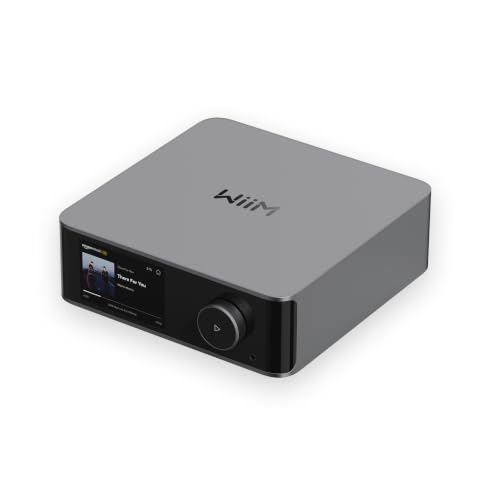
The WiiM Ultra is the most living-room-friendly streamer here, thanks to a color touchscreen, a supplied voice remote, and enough inputs to gather the TV, a turntable, and a phone into one box. Its ESS DAC and room correction features suit listeners who want a clear step up from a smart speaker without assembling a rack of separates. The compact aluminum case sits neatly beside a television, and the app makes switching between streaming services and the HDMI ARC input straightforward. It is the pick for households that want one box doing the work of several.
Watch out for: no AirPlay support, so Apple users should plan to use Google Cast or the WiiM Home app instead.
Bluesound NODE ICON
- Best for: listeners building a multiroom system around balanced outputs and a big display.
- Dual ESS SABRE ES9039Q2M DACs
- 5-inch color display
- Balanced XLR and RCA analog outputs
- THX AAA headphone amplifier
listeners building a multiroom system around balanced outputs and a big display.
Dirac Live room correction needs a separate license and calibration kit, so budget for that if you want it.
The NODE ICON is the flagship of the Bluesound range, built for listeners who want balanced outputs, a large color display, and the mature BluOS multiroom platform in one component. Dual DAC chips and a dedicated headphone amplifier give it the hardware to feed a serious amplifier or a pair of powered speakers with confidence. BluOS groups players around the house and carries a wide set of services, while HDMI eARC brings the television into the same system. It suits a living room that is the center of a wider multiroom setup.
Watch out for: Dirac Live room correction needs a separate license and calibration kit, so budget for that if you want it.
Cambridge Audio CXN100
- Best for: traditional hi-fi racks built from separate components.
- ESS ES9028Q2M SABRE32 DAC
- StreamMagic Gen 4 platform
- Chromecast built-in and AirPlay 2
- HDMI eARC and Bluetooth aptX HD
traditional hi-fi racks built from separate components.
it is a full-width component, so measure your rack shelf before ordering.
The CXN100 is the classic hi-fi choice, a full-width network player with a large color display and the StreamMagic platform behind it. Its preamp mode lets it drive a power amplifier or powered speakers directly, while the ESS DAC and careful signal path suit listeners who value a traditional component look on the rack. Chromecast built-in, AirPlay 2, and HDMI eARC cover the main ways music and TV sound reach the living room. It is a steady pick for a system built around separate components rather than a single compact box.
Watch out for: it is a full-width component, so measure your rack shelf before ordering.
Eversolo DMP-A6
- Best for: listeners with a big local music library who also stream.
- 6-inch HD touchscreen
- DSD512 and PCM 768kHz/32-bit playback
- XMOS XU316 audio interface
- MQA full decode
listeners with a big local music library who also stream.
the original DMP-A6 is an earlier generation now joined by a Gen 2 model, so confirm the exact generation and included accessories before ordering.
The DMP-A6 is the pick for listeners with a large collection of their own music files as well as streaming subscriptions. A 6-inch touchscreen and a slot for an internal SSD turn it into a music library hub that does not depend on a computer being switched on. It streams the major services, plays high-resolution files up to DSD512, and has both XLR and RCA outputs for a power amplifier or powered speakers. The display shows album art and track details clearly from across the room, which suits a living room where the streamer is also a visual centerpiece.
Watch out for: the original DMP-A6 is an earlier generation now joined by a Gen 2 model, so confirm the exact generation and included accessories before ordering.
Which One Fits Your Situation
You already own an amplifier and passive speakers
Choose the WiiM Ultra or the CXN100 and connect through RCA outputs, since both feed a standard integrated amplifier cleanly. The WiiM Ultra adds TV and turntable inputs in a small box, while the CXN100 brings a full-width display and preamp mode to a traditional rack. Either way, set the streamer to fixed output and let your amplifier handle volume.
You run powered speakers on a sideboard
Pick a streamer with a variable output and use it as the volume control, which is where the WiiM Ultra and the NODE ICON shine. The Ultra keeps the setup compact with its touchscreen and remote, while the NODE ICON adds balanced XLR outputs for longer cable runs and a headphone amplifier for late listening. Keep the speaker cables short and the streamer within easy reach.
Your TV is the other main source
HDMI ARC or eARC is the feature that matters most here, and the WiiM Ultra, NODE ICON, and CXN100 all include it. Run the TV sound through the streamer into your speakers and let the TV remote control the volume, which keeps things simple for everyone in the house. The WiiM Ultra also adds a subwoofer output, which helps movie sound without a separate surround system.
You want the same music in more than one room
The NODE ICON leads here because BluOS is built for multiroom grouping, letting you play the same track in the living room and the kitchen or different music in each room. The WiiM Ultra also supports multiroom playback within the WiiM app, which works well if the rest of the house already uses WiiM players. Pick one platform for the whole house rather than mixing systems, since grouping only works inside a single app.
Common Mistakes
- Buying a streamer without checking that its outputs match your amplifier’s inputs.
- Choosing a model that lacks the streaming service your household uses most.
- Forgetting the TV: a streamer without HDMI ARC means juggling two remotes and two volume controls.
- Placing the streamer where Wi-Fi is weak, then blaming the app for dropouts.
- Skipping the subwoofer output and room correction options, then finding the bass boomy in a hard-floored living room.
Frequently Asked Questions
What is a streaming preamplifier?
A streaming preamplifier combines a network music streamer with preamp outputs, so it plays music from streaming services and sends the signal to your amplifier or powered speakers. It usually adds volume control, input switching, and sometimes a DAC, which lets it sit at the center of a living room system without a separate preamp box.
Do I still need an amplifier with a streaming preamplifier?
Yes, in most cases. A streaming preamplifier handles sources and volume but does not drive passive speakers on its own, so it feeds an integrated amplifier, a power amplifier, or a pair of powered speakers. If you already own an amplifier, the streamer simply replaces your old source; if you own powered speakers, it connects straight to them.
Can a streaming preamplifier improve TV sound?
Yes, when it has an HDMI ARC or eARC input. The TV sends its audio to the streamer, which plays it through your speakers instead of the thin drivers built into the television. You keep using the TV remote for volume, and music streaming stays on the same system, so one setup covers both jobs.
Is Wi-Fi or Ethernet better for a living room streamer?
Ethernet is the steadier choice when the router sits near the shelf, since a wired connection avoids dropouts during high-resolution playback. Wi-Fi works well when the signal is strong and the streamer supports modern standards, and most living rooms are fine on Wi-Fi alone. If you notice dropouts, try Ethernet first before changing the streamer.
More from Amazon
Programs that pair well with the guide above. Offers and eligibility are set by Amazon and may change.
Free shipping on eligible items, Prime Video and more. Eligible new members can start with a free trial.
Start a Prime free trialAd-free music streaming. Eligible new subscribers can start with a free trial.
Try Music Unlimited freeA Prime membership for ages 18-24 with a trial period. Eligibility is set by Amazon.
See Prime for Young AdultsAudiobooks and podcasts to listen to on the go. Eligible new members can start with a free trial.
Try Audible freeAs an Amazon Associate we earn from qualifying purchases.