Our Short List of 3
All 5 Picks at a Glance
| Product | Specs | Action |
|---|---|---|
 Logitech G PRO X Superlight 2 DEX | Check price on Amazon | |
 Razer DeathAdder V3 Pro | Check price on Amazon | |
 Razer Basilisk V3 Pro 35K | Check price on Amazon | |
 ASUS ROG Keris II Ace | Check price on Amazon | |
 Keychron M7 8K | Check price on Amazon |
Our Top Picks
- Razer DeathAdder V3 Pro Wireless Gaming Mouse1000 Hz5.01 x 2.65 x 1.69 inches0.1 poundsCheck on Amazon
A symmetrical gaming mouse treats both sides of the hand the same, but most right hands do not work that way. The thumb sits lower than the fingers, the palm slopes toward the pinky side, and the wrist prefers a slight angle rather than a flat shelf. An ergonomic, or ergo, wireless gaming mouse is shaped around those facts. Its shell rises higher on the thumb side, dips where the ring and pinky fingers rest, and usually adds a thumb ledge or rest so the hand can relax instead of gripping a flat-sided shape for hours.
This guide compares five ergonomic wireless gaming mice that take different approaches to the same problem. Two are ultralight esports shapes built for fast flicks in shooters, one is a large feature-rich model with a tilt wheel and many controls, one is a featherweight tri-mode option, and one balances a contoured shell with long battery life and multi-device wireless. Every pick is right-handed, wireless, and built for gaming first, so the real choice comes down to hand size, grip style, weight preference, and how many buttons a game actually needs.
As an Amazon Associate, we earn from qualifying purchases.
How to Choose an Ergonomic Wireless Gaming Mouse
Start with shape, because no sensor can fix a shell that fights a hand. Palm grip players usually want a longer, taller shell with a pronounced hump toward the back and a clear thumb rest. Relaxed claw players want a similar contour in a shorter body, so the fingers can curl without the rear of the shell pushing into the palm. Fingertip players can use ergo shapes too, but they tend to prefer the smaller, lighter models here, since a large sculpted shell limits how much the fingers alone can steer.
Hand size matters as much as grip. The mice below range from about 54 grams to about 112 grams, and their shells range from medium esports shapes to a large desktop-style body. A large hand on a small ergo mouse ends up clawing harder than intended, while a small hand on a large mouse has to reach for the front buttons and the wheel. Checking the listed length against a current mouse is a simple, useful step: a difference of a centimeter changes the grip entirely.
Weight shapes how a game feels over a long session. Lighter ergo mice, roughly in the 54 to 66 gram range here, are easier to lift and reposition during low-sensitivity aiming, and they put less load on the wrist across a long evening. Heavier models trade that ease for stability and features: more buttons, a tilt wheel, RGB lighting, and a larger battery. A player who makes small, controlled movements in strategy or MMO titles may prefer the planted feel of the heavier pick, while a shooter player making constant swipes usually benefits from the lighter end.
Sensor numbers need context rather than a highest-wins ranking. Every mouse here uses a flagship-class optical sensor with maximum sensitivity far beyond what most players set in a game. The practical differences sit elsewhere: polling rate, which describes how often the mouse reports its position, and wireless reliability. Standard gaming wireless reports at 1,000 Hz, while several picks support 4,000 Hz or 8,000 Hz in at least one mode. Higher polling can smooth cursor motion on high-refresh monitors at the cost of battery life, so it is best treated as an optional mode rather than a permanent setting.
Battery claims also need a mode attached to them. Figures for 2.4 GHz gaming wireless are the ones that matter for play, and they drop when RGB lighting is on or polling is raised. Finally, count the buttons a game really uses. Five or six well-placed buttons cover most shooters, while the model here with thirteen customizable controls suits players who bind abilities, macros, or streaming actions to the mouse.
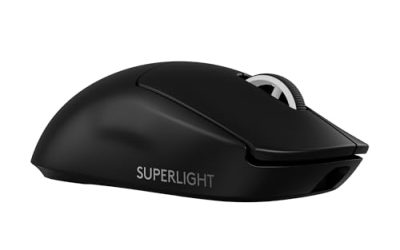
Logitech G PRO X Superlight 2 DEX
The PRO X Superlight 2 DEX takes Logitech’s ultralight esports formula and rebuilds it around an asymmetrical, right-handed shell. Where the standard Superlight shape is symmetrical, the DEX adds a sculpted thumb side and a ring-finger ledge, so the hand rests into the mouse instead of pinching it. At 60 grams it stays firmly in the ultralight class, and the larger shell, measuring 125.8 by 67.7 by 43.9 millimeters, gives palm and relaxed claw grips more surface to work with than most mice at this weight.
Inside, the HERO 2 sensor tracks up to 44,000 DPI at up to 888 IPS and 88 G acceleration, and LIGHTSPEED wireless supports polling up to 8,000 Hz. LIGHTFORCE hybrid switches handle the main clicks, battery life reaches up to 95 hours per charge, and POWERPLAY wireless charging is supported. Five buttons keep the layout focused on aiming rather than macros.
Who It Suits
This mouse suits right-handed shooter players with medium to large hands who want an ergonomic shape without giving up ultralight handling. Palm and relaxed claw grips benefit most. Left-handed players, and anyone who needs many buttons or Bluetooth, should choose another pick, since the DEX is a focused, single-connection esports tool.
Razer DeathAdder V3 Pro
The DeathAdder name has been tied to ergonomic gaming mice for years, and the V3 Pro is the lightest, most stripped-back version of that shape. The shell keeps the familiar flared front and curved right side that suit palm and claw grips, while the weight drops to 63 grams in the black version. There is no RGB and no extra trim, which keeps the focus on the shape and the sensor, and the matte finish gives the fingers a consistent surface during long sessions.
Razer’s Focus Pro 30K optical sensor offers up to 30,000 DPI, paired with HyperSpeed wireless and Gen-3 optical switches. The mouse carries five programmable buttons, measures 128 by 68 by 44 millimeters, and runs for up to 90 hours on a charge over its gaming wireless connection. The standard package already covers the needs of most competitive players, who tend to value the proven shape and low weight over headline polling figures.
Who It Suits
The DeathAdder V3 Pro suits players who like a classic, medium-large ergonomic shape and want it as light as possible. It fits palm and claw grips on medium to large hands, and its simple layout works well for shooters. Players who want a tilt wheel or extra controls will find the Basilisk below a better match, while smaller hands may find this shell long.
Razer Basilisk V3 Pro 35K
The Basilisk V3 Pro 35K sits at the opposite end of the ergo spectrum from the ultralight picks. It is a large, heavily sculpted mouse with a pronounced thumb rest, textured side grips, and a weight of 112 grams that keeps it planted during deliberate movements. The defining feature is the HyperScroll tilt wheel, which clicks side to side as well as scrolling, and can switch between a tactile, notched roll and a smooth free-spin mode suited to long documents and inventory lists in games.
The Focus Pro 35K Optical Sensor Gen-2 raises maximum sensitivity to 35,000 DPI, and the mouse offers thirteen customizable controls, Gen-3 optical switches, and Chroma RGB lighting with underglow along the base. Battery life reaches up to 140 hours on HyperSpeed wireless at standard settings, and Bluetooth plus wired USB-C are also supported. This is the one pick that doubles as a streaming and productivity mouse, since the extra controls can carry scene switches, push-to-talk, or editing shortcuts alongside game abilities.
Who It Suits
This mouse suits palm-grip players with medium to large hands who want maximum controls on the mouse itself: MMO and MOBA players, streamers who bind production actions to the mouse, and anyone who mixes gaming and desk work on one setup. Players chasing the lightest possible aim, or those with small hands, should choose an ultralight pick instead.
ASUS ROG Keris II Ace
The ROG Keris II Ace, covered here in the white listing, is the lightest mouse in this guide at 54 grams, yet its shell is a true ergonomic shape rather than a symmetrical one. The taller, sculpted body supports the palm more fully than most ultralight mice, suiting palm and relaxed claw grips on medium to larger hands. Optical micro switches sit under the main buttons.
The ROG AimPoint Pro optical sensor reaches 42,000 DPI with tracking up to 750 IPS and 50 G acceleration. Connectivity is tri-mode, covering SpeedNova 2.4 GHz wireless, Bluetooth, and wired USB. With the ROG Polling Rate Booster, polling reaches up to 4,000 Hz wireless and up to 8,000 Hz wired, and battery life is rated up to 107 hours depending on mode and settings. That combination of the lowest weight here, a genuinely contoured shell, and flexible polling makes the Keris II Ace the technical ceiling of this roundup.
Who It Suits
The Keris II Ace suits competitive players who want an ergonomic shell at the lowest possible weight, especially palm and relaxed claw players who found symmetrical ultralights too flat. Its tri-mode wireless also suits a desk shared between gaming and work machines. Players who want a thumb wing or a tilt wheel should choose the Basilisk instead.
Keychron M7 8K
The Keychron M7 8K approaches ergonomic gaming from a different direction. Its contoured body includes a shaped thumb rest, a detail borrowed from comfort mice, but the internals are gaming grade: a PixArt PAW 3950 sensor, 8,000 Hz polling, and a weight of 66 grams. That weight sits between the ultralight esports picks and the heavyweight Basilisk, making it a useful middle option for players who also spend long hours at the same desk working.
The sensor reaches 30,000 DPI with tracking up to 750 IPS, and the main clicks use Huano micro switches rated for 80 million clicks. A 600 mAh battery supports up to 140 hours per charge at standard settings, and connectivity covers 2.4 GHz wireless, Bluetooth, and wired USB-C, so one mouse can pair with a gaming PC for play and a laptop for work. Programmable buttons, including a macro button, are configured through Keychron’s software.
Who It Suits
The M7 8K suits players who split desk time between games and work and want one ergonomic wireless mouse for both. Its thumb rest and moderate weight favor relaxed palm and claw grips, and Bluetooth makes it the easiest pick here to move between machines. Esports players chasing the lowest weight may prefer the Keris II Ace or the DEX, but for a mixed-use desk the M7 8K covers the widest range of tasks here.
FAQ
Are ergonomic gaming mice only for palm grip?
No. Palm grip benefits most from a large sculpted shell such as the Basilisk V3 Pro 35K, but relaxed claw players are well served by the DEX, the DeathAdder V3 Pro, and the Keris II Ace, whose humps support the back of the hand while the fingers stay curled. Fingertip players can also use smaller ergo shapes, although a strongly contoured shell gives the fingers less freedom to steer than a symmetrical mouse does.
Does a higher polling rate always improve aim?
Not automatically. Polling rate describes how often the mouse reports its position, and moving from 1,000 Hz to 4,000 Hz or 8,000 Hz can make cursor motion look smoother on a high-refresh monitor. The trade-off is battery life, which falls as polling rises. For most players, standard gaming wireless at 1,000 Hz already tracks reliably, and higher modes are best enabled for competitive sessions rather than left on for everyday use.
How long do these wireless gaming mice last on a charge?
The rated figures in this guide range from up to 90 hours for the DeathAdder V3 Pro to up to 140 hours for the Basilisk V3 Pro 35K and the Keychron M7 8K, with the DEX at up to 95 hours and the Keris II Ace at up to 107 hours. Those figures assume standard polling and, where lighting is fitted, restrained lighting settings. Raising the polling rate or running bright RGB shortens real-world runtime, so the ratings are best read as a comparison between models under similar settings.
Can an ergonomic wireless mouse replace a separate work mouse?
In many setups, yes. The Basilisk V3 Pro 35K adds a free-spinning tilt wheel and Bluetooth for a second device, and the Keychron M7 8K pairs its thumb rest and tri-mode wireless with long battery life, so both handle documents and spreadsheets comfortably. The focused esports models, the DEX and the DeathAdder V3 Pro, can be used for work, but they omit features such as Bluetooth and free-spin scrolling that make long office sessions easier.
Final Verdict
There is no single best pick here, because the five mice solve the comfort problem at different weights and sizes. For competitive shooter play in a sculpted shell, the Logitech G PRO X Superlight 2 DEX and the ASUS ROG Keris II Ace lead the guide: the DEX pairs a 60 gram build with 8,000 Hz LIGHTSPEED polling, while the Keris II Ace is lighter still at 54 grams and adds tri-mode connectivity. The Razer DeathAdder V3 Pro remains the safe classic choice, a proven 63 gram shape with a 90 hour battery and no unnecessary extras.
For players who want the mouse to do more than aim, the Razer Basilisk V3 Pro 35K is the feature pick, with thirteen customizable controls, a tilt wheel that free-spins for work, and up to 140 hours of wireless play. The Keychron M7 8K is the balanced all-rounder, combining a thumb rest, 8,000 Hz polling, and tri-mode wireless at 66 grams. Match the shell to hand size and grip first, then choose the weight and button count that fit the games on the desk.
Product and ASIN Reference
| Product | ASIN |
|---|---|
| Logitech G PRO X Superlight 2 DEX | B0DB5JJTC9 |
| Razer DeathAdder V3 Pro | B0B6XZLNHQ |
| Razer Basilisk V3 Pro 35K | B0DG837JYP |
| ASUS ROG Keris II Ace | B0D3CX3QMD |
| Keychron M7 8K | B0F2FC4VBB |
More from Amazon
Programs that pair well with the guide above. Offers and eligibility are set by Amazon and may change.
Free shipping on eligible items, Prime Video and more. Eligible new members can start with a free trial.
Start a Prime free trialAd-free music streaming. Eligible new subscribers can start with a free trial.
Try Music Unlimited freeA Prime membership for ages 18-24 with a trial period. Eligibility is set by Amazon.
See Prime for Young AdultsAudiobooks and podcasts to listen to on the go. Eligible new members can start with a free trial.
Try Audible freeAs an Amazon Associate we earn from qualifying purchases.