
Our Short List of 3

- Best for: First-time separates buyers building a turntable system around an existing receiver.
- Passive bookshelf speakers, sold as a pair
- 1-inch cloth dome tweeter
- 6.5-inch aramid fiber woofer
- 2-way bass reflex design

- Best for: Smaller rooms and shelf placements where a compact cabinet matters more than maximum bass weight.
- Passive bookshelf speakers, sold as a pair
- 1-inch aluminum LTS tweeter
- 90×90 Tractrix horn
- 5.25-inch spun-copper IMG woofer (one per cabinet)
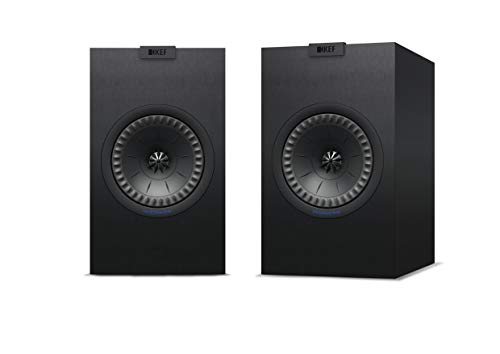
- Best for: Single-seat listeners who prioritise imaging and a coherent soundstage from their records.
- Passive bookshelf speakers, sold as a pair
- 5.25-inch Uni-Q driver array with tweeter at the acoustic centre of the midrange cone
- Tangerine waveguide
- CFD-designed rear port
All 4 Picks at a Glance
| Product | Specs | Action |
|---|---|---|
| ELAC Debut 2.0 B6.2 |
| Check price on Amazon |
| Klipsch R-51M |
| Check price on Amazon |
| KEF Q150 |
| Check price on Amazon |
 Polk Signature Elite ES20 |
| Check price on Amazon |
Key takeaways
- Four passive bookshelf speaker pairs for turntable setups, compared on the drivers and specs stated in their Amazon listings, amp needs included.
Every speaker in this roundup is a passive pair, and that single fact shapes the whole purchase. Passive speakers do not plug into your turntable and play; they need an amplifier or receiver between them and the record player, plus a phono stage somewhere in that chain. Shoppers who skip that realisation end up with silent speakers, so the real decision is not only which pair sounds right for your room, but whether the rest of your system can drive them.
The four pairs below suit three kinds of vinyl listeners: first-time buyers pairing a turntable with a receiver they already own, owners of all-in-one record players upgrading to separate components, and listeners in smaller rooms who want proper stereo imaging from a shelf. Each model was picked from the name and specifications on its Amazon page. No powered pair is included, because none could be verified with full listing content for this comparison.
Quick Picks
As an Amazon Associate we earn from qualifying purchases
| Product | Best for | Key spec from title |
|---|---|---|
| ELAC Debut 2.0 B6.2 | A balanced first separate system | 6.5-inch aramid fiber woofer |
| Klipsch R-51M | Horn-loaded clarity in a compact cabinet | 1-inch aluminum LTS tweeter with 90×90 Tractrix horn |
| KEF Q150 | Precise imaging from a single point source | 5.25-inch Uni-Q driver array |
| Polk Signature Elite ES20 | One pair for records, TV, and movies | 6.5-inch woofer with Power Port bass technology |
How to Choose
Budget for the amplifier as part of the purchase
A passive speaker budget is only half the real budget. Between the turntable and any pair here sits an amplifier or AV receiver, and somewhere in the chain there must be a phono stage to bring a cartridge’s signal up to line level; some turntables and amplifiers include one, many do not. Before comparing drivers, confirm which of those pieces you already own. Buying the speakers first and discovering the missing amplifier later is the most common way a vinyl upgrade stalls halfway.
Woofer size and the size of your room
Driver diameter sets how much air a bookshelf speaker can move, and the listings here split into two camps: 6.5-inch woofers on the ELAC and the Polk, and 5.25-inch drivers on the Klipsch and the KEF. In a small room or a near-desk setup, the smaller drivers are easier to place and less likely to overwhelm the space. In a larger living room, the bigger cones give low notes more presence without a subwoofer. Match the driver to the room first; chasing the largest woofer for a tiny room rarely pays off.
Tweeter design and how records present detail
The four listings take three different approaches to high frequencies. The ELAC uses a 1-inch cloth dome, the Klipsch loads a 1-inch aluminum tweeter into a 90×90 Tractrix horn, the KEF places its tweeter in the acoustic centre of the midrange cone in a Uni-Q array, and the Polk lists a 1-inch tweeter without stating its material. These designs differ in dispersion and imaging character, so think about how you listen: horn and point-source designs reward a defined seating position, while a simple dome spreads sound more forgivingly around the room.
What the listing does not tell you
Treat missing specifications as a genuine buying checkpoint rather than a footnote. The retrieved listing copy for the ELAC states no sensitivity or impedance, the Klipsch copy states no frequency response or sensitivity, and the Polk copy leaves tweeter material, sensitivity, and impedance unstated. Those figures decide how easily a low-powered amplifier can drive the speakers, so if your amplifier is modest, resolve the missing numbers on the live listing or with the manufacturer before ordering instead of trusting figures quoted in reviews of the same model.
The 4 Best Options
ELAC Debut 2.0 B6.2
- Best for: First-time separates buyers building a turntable system around an existing receiver.
- Passive bookshelf speakers, sold as a pair
- 1-inch cloth dome tweeter
- 6.5-inch aramid fiber woofer
- 2-way bass reflex design
First-time separates buyers building a turntable system around an existing receiver.
Confirm a live buy option before relying on this pick; sensitivity and impedance are not stated in the retrieved listing copy, so check them against your amplifier rather than importing figures from reviews.
The B6.2 is the default starting point for a first separate vinyl system: a 2-way bass reflex bookshelf pair built around a 6.5-inch aramid fiber woofer and a 1-inch cloth dome tweeter. The listing states a frequency response extending up to 35,000 Hz, which covers the range a hi-res-minded listener would ask about, and the driver sizes suit medium rooms where a smaller cone might feel thin. Pair it with a receiver that has a phono input, or add a phono stage, and you have the complete chain a turntable needs to reach passive speakers.
Klipsch R-51M
- Best for: Smaller rooms and shelf placements where a compact cabinet matters more than maximum bass weight.
- Passive bookshelf speakers, sold as a pair
- 1-inch aluminum LTS tweeter
- 90×90 Tractrix horn
- 5.25-inch spun-copper IMG woofer (one per cabinet)
Smaller rooms and shelf placements where a compact cabinet matters more than maximum bass weight.
Confirm a live buy option before relying on this pick; frequency response and sensitivity are not stated in the retrieved listing copy, so do not plan amplifier matching around figures from retailer posters or reviews.
The R-51M takes the compact route: a passive pair with a 5.25-inch spun-copper IMG woofer — one per cabinet — under a 1-inch aluminum LTS tweeter loaded into a 90×90 Tractrix horn. That horn-loaded tweeter is the design’s calling card, shaping how the sound projects into the room, and the smaller woofer makes the cabinets easier to place on shelves and stands in tighter spaces. For a vinyl setup in a bedroom, office, or small living room where a 6.5-inch design would crowd the furniture, this is the pair sized for the job.
KEF Q150
- Best for: Single-seat listeners who prioritise imaging and a coherent soundstage from their records.
- Passive bookshelf speakers, sold as a pair
- 5.25-inch Uni-Q driver array with tweeter at the acoustic centre of the midrange cone
- Tangerine waveguide
- CFD-designed rear port
Single-seat listeners who prioritise imaging and a coherent soundstage from their records.
Check availability on the live listing before choosing this pair — recent tracking shows no current Amazon-sold offer for this listing, only third-party sellers, so confirm a live buy option; note the White variant’s listing states different figures, so do not merge variants.
The Q150 is built around KEF’s Uni-Q idea: a 5.25-inch driver array with the tweeter placed in the acoustic centre of the midrange cone, so high and mid frequencies leave the speaker from effectively the same point. The listing adds a tangerine waveguide over the tweeter, a damped tweeter loading tube, and a CFD-designed rear port. For vinyl listeners who sit in one main chair and care about a stable stereo image, that point-source layout is the argument for this pair. Its listing’s spec table states a maximum output power of 200 watts for this Black version.
Polk Signature Elite ES20
- Best for: Living rooms where one pair of speakers serves both a turntable and an AV receiver.
- Passive bookshelf speakers, sold as a pair
- 1-inch tweeter
- 6.5-inch woofer
- Power Port technology for bass
Living rooms where one pair of speakers serves both a turntable and an AV receiver.
Confirm a live buy option before relying on this pick, and order the Black finish if you want this exact listing — the Walnut finish is a different listing; tweeter material, sensitivity, and impedance are not stated in the retrieved copy.
The ES20 is the largest pair here alongside the ELAC, with a 6.5-inch woofer and a 1-inch tweeter in a passive bookshelf cabinet, and it adds Polk’s Power Port technology for its bass venting. Its listing also carries Hi-Res Audio certification and states Dolby Atmos and DTS:X compatibility, which makes it the natural candidate when the same pair of speakers has to cover film and television duty from an AV receiver as well as records. This listing is the Black finish; the model is also sold in other finishes under separate listings.
Which One Fits Your Situation
You already own a receiver with a phono input
Any of the four pairs drops straight into your system. Choose by room and listening style: the ELAC for a straightforward medium-room setup, the KEF if you listen from one fixed seat, the Klipsch for tight shelf space, and the Polk if that receiver also runs your television sound.
Your turntable has a built-in phono stage but no amplifier
You still need amplification, because every pair here is passive. A compact stereo amplifier between the turntable and the speakers completes the chain, and the smaller Klipsch or KEF cabinets pair naturally with a modest desktop or shelf-based amplifier setup in a small room.
You listen in a small room at modest volume
Favour the 5.25-inch designs. The Klipsch R-51M and KEF Q150 take less space, are easier to position away from walls and corners, and their driver size suits near-field and small-room listening better than the larger 6.5-inch pairs, which can sound heavy when the room gives bass nowhere to go.
You want one pair that also handles TV and movies
The Polk ES20 is the pick, since its listing states Hi-Res Audio certification plus Dolby Atmos and DTS:X compatibility, signalling it was designed to sit in an AV receiver system as happily as in a stereo one. The ELAC is the fallback if your setup is music-first with only occasional film use.
Common Mistakes
- Plugging passive speakers straight into a turntable and hearing nothing, because no amplifier sits between them.
- Forgetting the phono stage: a turntable without one, into an amplifier without one, produces a very quiet, thin signal.
- Ordering a different finish from a separate listing and assuming the specifications are identical, when variants can state different figures.
- Matching an amplifier using sensitivity or impedance figures taken from reviews when the product listing itself never stated them.
- Pushing rear-ported cabinets flush against a wall, leaving the port no room to work and muddying the bass.
Frequently Asked Questions
Do I need an amplifier with these speakers?
Yes. All four pairs in this roundup are passive, so none of them contains its own amplification. You need a stereo amplifier or an AV receiver between the turntable and the speakers, plus speaker wire to connect them. If you want speakers that plug in and play on their own, you are looking for a powered model instead.
Do I also need a phono preamp for my turntable?
Somewhere in the chain, yes. A phono stage may be built into your turntable, into your amplifier, or bought as a small separate box, but one of those three must provide it. Check each component you own before buying the speakers, because a missing phono stage is the most common reason a new vinyl setup sounds faint and bass-light.
Can I use these speakers for television and films too?
Through an AV receiver, yes. The Polk ES20 makes the strongest case, with its listing stating Hi-Res Audio certification and Dolby Atmos and DTS:X compatibility. The other pairs also work as front speakers in a receiver-based system; just remember they are sold as stereo pairs, so a centre channel and subwoofer remain separate purchases.
Why are there no powered speakers in this list?
Powered bookshelf speakers exist and suit buyers who want fewer boxes, but for this comparison every pick had to be verified against full listing content tied to its Amazon page, and no powered pair met that bar. Rather than fill the gap with weakly documented models, this roundup covers the four passive pairs that could be properly verified.
More from Amazon
Programs that pair well with the guide above. Offers and eligibility are set by Amazon and may change.
Free shipping on eligible items, Prime Video and more. Eligible new members can start with a free trial.
Start a Prime free trialAd-free music streaming. Eligible new subscribers can start with a free trial.
Try Music Unlimited freeA Prime membership for ages 18-24 with a trial period. Eligibility is set by Amazon.
See Prime for Young AdultsAudiobooks and podcasts to listen to on the go. Eligible new members can start with a free trial.
Try Audible freeAs an Amazon Associate we earn from qualifying purchases.









