Key takeaways
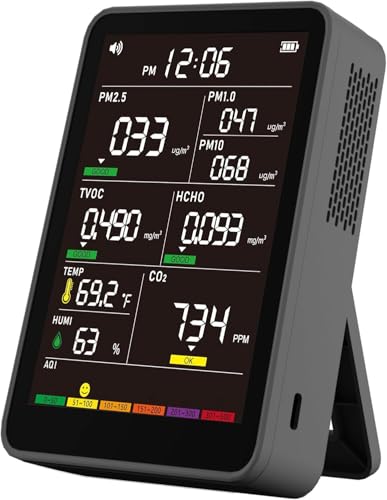
- PM2.5 (fine particles). Tiny particles from cooking, candles, wildfire smoke, and traffic. Laser-based sensors estimate concentration.
- CO2 (carbon dioxide). A common ventilation indicator. High readings suggest stale air in occupied rooms. NDIR sensors are generally more reliable than estimated CO2.
- VOCs (volatile organic compounds). Usually a combined index from a metal-oxide sensor, not a measure of specific chemicals.
- Temperature and humidity. Helpful for comfort and mold-risk awareness.
- Radon. Some models, such as the Airthings Wave Plus family, list radon. Radon readings from consumer devices take time to stabilize, so follow the maker’s guidance and your local health agency for testing.
For most households, a multi-sensor indoor monitor such as the Airthings View Plus, Awair Element, or AirGradient ONE gives the broadest picture of fine particles, carbon dioxide, VOCs, temperature, and humidity, while the Aranet4 is a focused choice for people who mainly care about CO2 in a home office or classroom. An air quality monitor is an information tool; it does not replace smoke alarms or carbon monoxide alarms.
Our top picks



As an Amazon Associate we earn from qualifying purchases at no extra cost to you.
What Home Air Quality Monitors Measure
Consumer monitors typically report a mix of the following. Each sensor type has different strengths, so know what a number represents before acting on it.
- PM2.5 (fine particles). Tiny particles from cooking, candles, wildfire smoke, and traffic. Laser-based sensors estimate concentration.
- CO2 (carbon dioxide). A common ventilation indicator. High readings suggest stale air in occupied rooms. NDIR sensors are generally more reliable than estimated CO2.
- VOCs (volatile organic compounds). Usually a combined index from a metal-oxide sensor, not a measure of specific chemicals.
- Temperature and humidity. Helpful for comfort and mold-risk awareness.
- Radon. Some models, such as the Airthings Wave Plus family, list radon. Radon readings from consumer devices take time to stabilize, so follow the maker’s guidance and your local health agency for testing.
At a Glance
| Monitor | Best for | Stated measurements | Limits |
|---|---|---|---|
| Airthings View Plus | Households wanting radon plus air data | Maker lists radon, PM, CO2, VOC, temperature, humidity | Higher tier; app and cloud features |
| Awair Element | Design-minded buyers wanting a display | Maker lists CO2, VOC, PM2.5, temperature, humidity | Lacks radon; cloud account needed for full features |
| AirGradient ONE | Tinkerers and open-data fans | Maker lists PM, CO2, VOC and NOx indices, temperature, humidity | Setup and community focus; fewer polished smart-home integrations |
| Aranet4 | Anyone focused on CO2 and ventilation | Maker lists CO2, temperature, humidity, pressure, e-ink display | No particle sensor |
| Qingping Air Monitor | Budget to mid-range all-rounder | Maker lists PM, CO2, temperature, humidity and a display | Platform differences by region |
Makers revise product lines periodically, so read the current spec page for the exact sensors in a model.
Airthings View Plus: Radon and Air in One
The View Plus is often named in roundups as a comprehensive home monitor. The maker lists a combination of radon, particulate, CO2, VOC, temperature, and humidity sensors with an app and a wave-to-view display feature on some versions. It suits homeowners in radon-prone areas who also want day-to-day air data. Because radon is a health-agency matter, follow the maker’s instructions and local guidelines, and consider a certified radon test for decisions about mitigation.
Awair Element: Clear Display and Straightforward App
The Awair Element places a score and multiple readings on an on-device display. Reviewers describe it as easy to read and well-designed, and it integrates with common smart-home platforms according to the maker. It sits at mid-range to premium and works best when the app connection is stable.
AirGradient ONE: Open and Transparent
AirGradient is known for publishing its hardware and software approach and focusing on measurement transparency. The ONE model is listed by the maker with PM, CO2, VOC and NOx indices, temperature, and humidity, and can work with open platforms such as Home Assistant. It suits people comfortable with network settings and community documentation.
Aranet4: Dedicated CO2 Monitoring
The Aranet4 focuses on CO2 with a battery-powered e-ink display. Reviewers often use it for home offices, classrooms, and bedrooms to judge when to open windows or ventilate. It does not measure particles or VOC, so it complements a PM-focused device rather than replacing it.
Budget Options
Lower-tier monitors from makers such as Qingping and others add displays and basic sensors at lower tiers. Independent reviewers note that accuracy varies, particularly for VOC and low-cost PM sensors. They can show trends, but do not treat them as laboratory instruments.
How to Read the Numbers
- Use readings as trends: cooking spikes PM2.5, a crowded room raises CO2, and windows open lower both.
- VOC indices are relative. A rise indicates a change, not a specific chemical or health risk.
- Place monitors at breathing height, away from windows, vents, and cooking appliances.
- Give a new sensor time to settle. Some sensors self-calibrate over days.
- If a monitor reports very high readings, ventilate, find the source, and follow guidance from health authorities.
Safety Notes
An air quality monitor does not replace smoke alarms or carbon monoxide alarms. CO alarms are certified safety devices; consumer air monitors that do not list CO detection do not detect it. Install and test certified alarms according to local codes and the manufacturer’s manual. If you suspect a gas or CO issue, leave the area and contact emergency services or a qualified professional. For persistent symptoms or health concerns, consult a doctor.
Smart Home and Data Options
Many monitors integrate with Alexa, Google Home, Apple Home, or Home Assistant. Some store history in a vendor cloud, while others offer local APIs. Decide how much you value data ownership versus convenience, and read each maker’s privacy policy.
Pick X If… Decision Table
| Pick this if you… | Choose | Why |
|---|---|---|
| Want radon plus air data in one device | Airthings View Plus | Combined sensor set listed by the maker |
| Want a readable display and polished app | Awair Element | Clear score and app |
| Like open data and local control | AirGradient ONE | Transparent approach, community support |
| Care mainly about ventilation | Aranet4 | Dedicated CO2 reading |
| Want a lower-tier overview | Qingping-class monitor | Basic sensors with a display |
Alternatives
- Air purifiers with built-in sensors. They show PM readings and adjust fan speed, though sensors may be less precise.
- Dedicated radon detectors. If radon is your only concern, a purpose-built device may be a simpler route.
- Certified CO and smoke alarms. These are the baseline safety devices for every home.
Putting Readings to Practical Use
The most useful habit is watching what changes a reading. Cooking, especially frying or searing, tends to raise fine particles quickly, and running a range hood vented outdoors usually helps. A full bedroom overnight with the door closed can push CO2 up, and cracking a window or running a ventilation system brings it down. Seeing these patterns helps you decide when to ventilate or whether a purifier or filter upgrade would matter.
If you use a portable air purifier, a monitor can show whether it is lowering particles in the room where it runs. Remember that CO2 is not removed by typical purifiers, so ventilation remains the tool for that reading. Likewise, standard HEPA filters capture particles but are not a fix for every gas or odor.
Maintenance and Placement
Dust can build up in sensor inlets. Follow the maker’s cleaning guidance and avoid compressed air or liquids unless the manual allows it. Battery-powered models need periodic recharging or replacement. Keep units out of direct sunlight and away from steam to avoid skewed temperature and humidity readings.
Wildfire and Outdoor Air
During wildfire smoke events, an indoor PM2.5 monitor can show whether closing windows and using filtration is reducing particles. Follow local health agency advice on smoke exposure, and seek medical attention for breathing difficulties. Monitors are informational, and people with asthma or other conditions should discuss air quality plans with their doctor.
What to Look for When Buying
Start with the readings you care about. If ventilation is the main concern, a CO2 sensor is the core need. If you cook often, live near traffic, or face wildfire seasons, add a particle sensor. Radon readings suit homes in areas where local agencies recommend testing. Next, think about the display: an on-device screen is helpful for glancing at readings, while app-only models need a phone.
Consider connectivity and data. Some models store history in the maker’s cloud, others offer local access, and a few allow data export for your own charts. Battery life matters if you want to move the monitor between rooms. Finally, look at calibration notes from the maker: many CO2 sensors self-calibrate by assuming exposure to fresh air periodically, so a unit kept in a constantly occupied room may drift, and the maker’s manual explains how to recalibrate.
Frequently Asked Questions
Do air quality monitors detect carbon monoxide?
Most consumer air quality monitors do not. They measure CO2, particles, and VOC, which are different. Use certified CO alarms for carbon monoxide and follow the maker’s instructions.
How accurate are home air quality monitors?
Accuracy varies by sensor type and price. CO2 NDIR sensors and PM laser sensors are generally useful for trends, while VOC readings are relative. Treat them as indicators rather than lab-grade tools.
Where should I put an air quality monitor?
Place it at breathing height in the room where you spend the most time, away from direct airflow, windows, and cooking appliances. Bedrooms and home offices are common choices.
What CO2 level is a concern?
Makers and health agencies publish guidance on CO2 as a ventilation indicator. Rising readings suggest the room needs fresh air. Read the guidance provided with your device and local authorities.
Do I need Wi-Fi?
Some monitors work standalone with a display, while others need Wi-Fi for the app and history. Choose based on whether you want remote data and smart-home integrations.
Can a monitor tell me what my VOC source is?
No. VOC sensors usually produce a combined index and cannot identify specific chemicals. If readings stay high, ventilate and look for common sources such as cleaning products or new furniture.
More from Amazon
Programs that pair well with the guide above. Offers and eligibility are set by Amazon and may change.
Free shipping on eligible items, Prime Video and more. Eligible new members can start with a free trial.
Start a Prime free trialAd-free music streaming. Eligible new subscribers can start with a free trial.
Try Music Unlimited freeA Prime membership for ages 18-24 with a trial period. Eligibility is set by Amazon.
See Prime for Young AdultsAudiobooks and podcasts to listen to on the go. Eligible new members can start with a free trial.
Try Audible freeAs an Amazon Associate we earn from qualifying purchases.