Key takeaways
- Keep it at breathing height, away from windows, vents, direct sun and kitchen stoves.
- For sleep-related ventilation concerns, put it in the bedroom, not the hallway.
- Allow the sensor to warm up and stabilize for the period stated in the manual before drawing conclusions.
- Do not place it directly beside cleaning products or aerosols; you will just measure the spike.
For most households wanting an all-round indoor air monitor, the Airthings View Plus or Awair Element is the best starting point, the Airthings Wave Plus suits people who care about radon and CO2 more than particles, and a compact monitor from Temtop or Qingping suits budget buyers. A VOC reading is a general indicator, not a safety certification, so treat any monitor as a guide for ventilation habits rather than a replacement for a carbon monoxide alarm or a professional air-quality assessment.
Our top picks


As an Amazon Associate we earn from qualifying purchases at no extra cost to you.
At a Glance: Indoor Air Monitors Compared
| Model | Best for | Key stated measurements | Limits | Tier |
|---|---|---|---|---|
| Airthings View Plus | Detailed whole-picture monitoring including radon | Maker lists radon, PM2.5, CO2, VOC, temperature, humidity and pressure | Premium; radon needs a few days of data before readings are meaningful | Premium |
| Airthings Wave Plus | Bedrooms and basements where radon and CO2 matter | Maker lists radon, CO2, VOC, temperature, humidity and pressure | No particle (PM2.5) sensor | Mid-range to premium |
| Awair Element | Living rooms and home offices wanting a clear display | Maker lists CO2, VOC, PM2.5, temperature and humidity with an on-device display | No radon sensor; plugged in | Mid-range |
| Awair Omni | Bedrooms or offices needing portability | Maker lists additional sensors such as noise and light plus a battery option | Higher cost than the Element | Mid-range to premium |
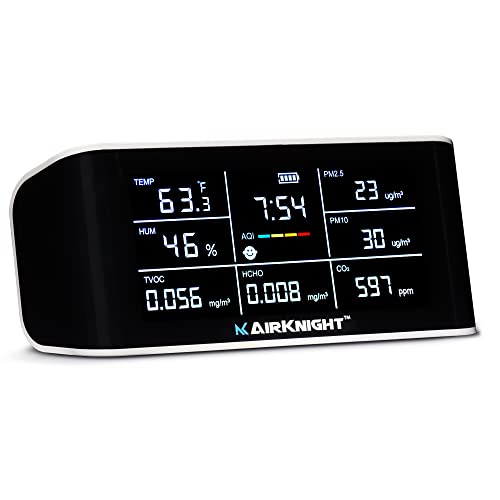
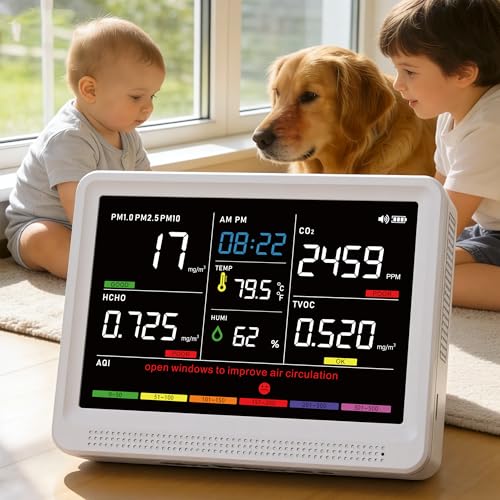
| Temtop and Qingping monitors | Budget buyers wanting several readings | Makers list combinations of CO2, PM2.5, TVOC, formaldehyde (on some models), temperature and humidity | App and long-term accuracy details vary by model | Budget |
| Eve Room | Apple Home users wanting simple VOC trends | Maker lists a VOC index, temperature and humidity with smart-home connectivity | No CO2 or particle sensor | Mid-range |
What VOC Monitors Measure and What They Do Not
Volatile organic compounds are gases released by many everyday items: paints, cleaning products, new furniture, cooking and personal-care products. Consumer monitors usually report a “total VOC” figure or an index score. They generally cannot tell you which compound is present, and different sensors respond differently to different gases. That means readings are best used to see trends: spikes while cooking, after cleaning, or when new furniture arrives, and improvement after ventilation.
A monitor does not diagnose health problems, and a low reading does not guarantee a space is free of every pollutant. If you or someone in your home has symptoms you suspect are connected to indoor air, speak to a doctor. If you have persistent odors or concerns about specific chemicals, a qualified indoor air-quality professional can sample for specific substances.
Safety Note on Carbon Monoxide, Gas Leaks and Smoke
VOC monitors are not carbon monoxide detectors, gas-leak detectors or smoke alarms. Use certified CO and smoke alarms installed according to manufacturer instructions and local codes. If a certified alarm sounds, follow its instructions and leave the building. Do not rely on an air-quality app for emergencies.
Airthings View Plus: The Most Complete Option
The View Plus is a wall-mounted unit that the maker says tracks radon and a broad range of indoor air indicators, with a simple color-coded display. Radon is an additional reason people choose Airthings: it is a naturally occurring radioactive gas that can accumulate indoors, and national health agencies recommend testing. Reviewers note that radon readings take several days to stabilize, and that a continuous monitor complements, rather than replaces, a recognized radon test if you are making decisions about mitigation. It is battery-powered according to the maker, which gives flexibility on placement.
Airthings Wave Plus: Radon and CO2 Without Particles
The Wave Plus lacks the particle sensor of the View Plus but includes radon, CO2 and VOC readings. It suits basements, bedrooms and homes where particulates from outside air are not a main concern. If wildfire smoke or cooking particulates worry you, pick a model with PM2.5.
Awair Element and Omni: Clear Displays and Smart-Home Links
The Awair Element shows a score and individual readings on its face, which makes it handy in a living room or office. The maker lists CO2, VOC, PM2.5, temperature and humidity. The Omni adds features such as noise and light sensing and portability. Reviewers often value the readability and app history; the main limitation is the lack of radon sensing.
Budget Monitors From Temtop and Qingping
These brands sell compact monitors with several sensors at lower cost. Some models list formaldehyde sensing, which can be of interest after renovation or new furniture. Reviewers caution that low-cost sensors may drift or respond less accurately over time, and app experience varies. They are a reasonable way to spot large changes but should not be treated as laboratory instruments.
Eve Room: Simple for Apple Home
The Eve Room is a small battery device focused on VOC index, temperature and humidity. It suits people already using Apple Home who want a simple, private-by-design display. It does not measure CO2 or particles, so it provides less of the picture than the larger monitors.
Where to Place a Monitor
- Keep it at breathing height, away from windows, vents, direct sun and kitchen stoves.
- For sleep-related ventilation concerns, put it in the bedroom, not the hallway.
- Allow the sensor to warm up and stabilize for the period stated in the manual before drawing conclusions.
- Do not place it directly beside cleaning products or aerosols; you will just measure the spike.
Pick X If… Decision Table
| Pick | If you… |
|---|---|
| Airthings View Plus | want radon, particles, CO2 and VOC in one device |
| Airthings Wave Plus | care about radon and CO2 but not particles |
| Awair Element | want a readable display and app history for a main room |
| Awair Omni | need portability or noise and light sensing |
| Temtop or Qingping | want multiple sensors on a tight budget |
| Eve Room | use Apple Home and want simple VOC trends |
Alternatives
- Dedicated CO2 monitor: If stuffy rooms are your main issue, a CO2-only monitor such as an Aranet4 gives a clear ventilation signal.
- Air purifier with built-in sensor: Many purifiers show particle or VOC levels and adjust fan speed automatically, though their sensors are usually simple.
- Radon test kit: A short-term test kit from a recognized supplier is a low-cost way to check radon if that is your main concern.
- Professional assessment: Consider an industrial hygienist or indoor air-quality specialist if you suspect a specific contamination problem.
Frequently Asked Questions
What is a good VOC reading?
There is no single universal number, because different monitors use different units and sensor types. Use the maker’s color bands or scale as a guide, and watch for changes relative to your usual baseline rather than treating one number as a verdict.
Can a VOC monitor tell me which chemical is in my air?
Generally no. Consumer sensors respond to a mix of gases and report a combined value. Identifying specific chemicals needs laboratory sampling.
Do I need a radon monitor?
Radon varies by location and home construction. Health agencies recommend testing, especially in basements and ground-level living areas. A continuous monitor can help track levels, but follow official guidance for testing and any mitigation steps.
How do I reduce high VOC readings?
Ventilate by opening windows if outdoor air is clean, use exhaust fans while cooking and cleaning, store solvents and paints in sealed containers away from living areas, and follow product labels. For persistent issues, consult a professional.
Are these monitors a substitute for a carbon monoxide alarm?
No. VOC and CO2 monitors are not safety alarms. Install certified CO and smoke alarms as your local code and the alarm maker’s instructions require.
How often do monitors need replacing or calibrating?
This varies. Some sensors self-calibrate, and battery models need periodic battery changes. Check the maker’s manual for expected sensor life and calibration guidance.
More from Amazon
Programs that pair well with the guide above. Offers and eligibility are set by Amazon and may change.
Free shipping on eligible items, Prime Video and more. Eligible new members can start with a free trial.
Start a Prime free trialAd-free music streaming. Eligible new subscribers can start with a free trial.
Try Music Unlimited freeA Prime membership for ages 18-24 with a trial period. Eligibility is set by Amazon.
See Prime for Young AdultsAudiobooks and podcasts to listen to on the go. Eligible new members can start with a free trial.
Try Audible freeAs an Amazon Associate we earn from qualifying purchases.