Key takeaways
- Budget: Compact CO2 meters from smaller brands. Check that they use an NDIR sensor and describe calibration.
- Mid-range: Aranet4 Home, AirGradient ONE or Qingping models.
- Premium: Awair Element or Airthings models with extra sensors and smart-home features.
For most people, the Aranet4 Home is the most straightforward CO2 monitor for indoor use, while the Awair Element or AirGradient ONE suits buyers who also want particulate and VOC readings, and the Airthings Wave Plus or View Plus suits those who want radon alongside CO2. A CO2 monitor is mainly a ventilation tool: it shows when a bedroom, classroom or home office is getting stuffy so you can open a window or adjust the airflow.
What a CO2 monitor tells you
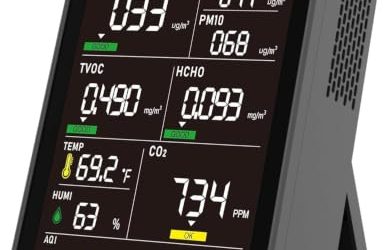
Carbon dioxide builds up indoors when people breathe in a closed room. Because levels rise predictably with occupancy and fall when you ventilate, CO2 is widely used as a proxy for how much fresh air a space is getting. Better CO2 monitors use an NDIR (non-dispersive infrared) sensor, which measures the gas directly. Cheaper devices sometimes estimate CO2 from other sensors and are less trustworthy, so look for the sensor type in the maker’s specifications.
A CO2 monitor does not detect carbon monoxide, which is a different gas and a safety hazard. Keep certified carbon monoxide and smoke alarms installed, follow the manufacturer’s testing schedule, and if an alarm sounds, leave the building and call emergency services. If you have symptoms such as persistent headaches or drowsiness, talk to a doctor.
At a glance
| Model | Best for | Measures (per the maker) | Display and power | Limits |
|---|---|---|---|---|
| Aranet4 Home | Simple CO2 tracking for bedrooms and classrooms | CO2, temperature, humidity, pressure | E-paper screen, replaceable batteries, Bluetooth | No particulate sensor |
| Awair Element | Whole-room air overview | CO2, VOC, PM2.5, temperature, humidity | Wi-Fi, front display, plug-in | Mains powered |
| AirGradient ONE | Open data and customization | CO2, PM, VOC and NOx indices, temperature, humidity | Wi-Fi, local display | Less polished app |
| Airthings Wave Plus | Radon plus CO2 and VOC | Radon, CO2, VOC, temperature, humidity, pressure | Battery, Bluetooth, wave-gesture indicator | No PM sensor; premium tier |
| Qingping Air Monitor models | Compact desk display | CO2 and other readings depending on model | Battery or USB; app support | Specs vary by variant |
Product versions change, so confirm the sensor list and calibration notes on the maker’s current page.
Aranet4 Home: focused and readable
Aranet4 uses an NDIR CO2 sensor and an e-paper display that remains readable in daylight and uses little power. The maker lists long battery life and a Bluetooth link to a phone app for history. Reviewers who cover CO2 monitors often name it as a benchmark for simplicity. It is a good choice for schools, offices and bedrooms where the only question is whether the air is stale.
Awair Element: the multi-sensor option
The Element adds PM2.5 and VOC readings to CO2 and shows a clear score on a display. It connects to Wi-Fi and a range of smart-home services, and offers an app for trends. It is mains powered, so it stays in one place, which suits a living room or study.
AirGradient ONE: open-source flexibility
AirGradient publishes its firmware and encourages custom integrations, including Home Assistant. It measures CO2 and particles along with VOC and NOx indices. It suits people who want to own their data, though the app and setup experience can be less polished than bigger brands.
Airthings Wave Plus and View Plus: radon-aware
If you live in an area with radon concerns, Airthings models combine radon monitoring with CO2 and other readings. Radon is evaluated over weeks and months, not hours, so follow the maker’s guidance on placement and averaging. For high readings, contact a qualified radon professional and follow local health authority guidance.
Budget tiers
- Budget: Compact CO2 meters from smaller brands. Check that they use an NDIR sensor and describe calibration.
- Mid-range: Aranet4 Home, AirGradient ONE or Qingping models.
- Premium: Awair Element or Airthings models with extra sensors and smart-home features.
Placement, calibration and care notes
- Placement. Put it at breathing height in the room where you spend time, away from windows, vents and your breath. Avoid sitting right beside the sensor.
- Calibration. Many units use automatic baseline correction that assumes the room reaches outdoor-level air regularly. In always-occupied spaces, read the manual for manual calibration instructions.
- Interpreting numbers. Health and building authorities publish guideline ranges. Use those and the maker’s colour bands rather than treating any one reading as a diagnosis.
- Batteries. Use the battery type the manual specifies.
- Cleaning. Dust the casing gently and keep liquids away from sensor openings.
Pick X if…
| Your situation | Pick | Why |
|---|---|---|
| Just want to know when to open a window | Aranet4 Home | Readable display, battery power |
| Cooking and dust matter as well | Awair Element | Adds PM2.5 and VOC |
| Home Assistant or open data | AirGradient ONE | Open firmware |
| Radon is a concern | Airthings Wave Plus or View Plus | Adds radon monitoring |
| Small desk unit | Qingping Air Monitor model | Compact with app support |
Alternatives worth considering
- Smart thermostats or air purifiers with CO2 sensors. Convenient, though the sensor is often secondary.
- Handheld CO2 meters. Useful for spot checks but less handy for continuous tracking.
- Eve Room or other HomeKit sensors. Good for Apple Home users, though some models focus on VOC, not CO2.
Frequently Asked Questions
What CO2 level is considered high indoors?
Outdoor air is typically around the 400 ppm range, and indoor readings climb with occupancy. Guidance varies between organizations, so check your local health or building authority and the maker’s colour bands.
Is a CO2 monitor the same as a carbon monoxide alarm?
No. They detect different gases for different purposes. Only a certified CO alarm protects against carbon monoxide, so keep those installed and tested.
Do cheap CO2 monitors work?
Some do, but accuracy varies. Look for an NDIR sensor and a clear calibration description, and avoid devices that estimate CO2 from VOC readings.
How often should I calibrate?
Many monitors self-calibrate by tracking the lowest readings over several days. If the space is always occupied, follow the manual for manual calibration.
Where should I put the monitor in a bedroom?
At around bed height, a short distance from your face and away from windows and vents. Placing it too close to where you breathe exaggerates readings.
Can a CO2 monitor help with allergies or illness?
It shows ventilation, not allergens or infections. If you have health concerns, talk to a doctor.
More from Amazon
Programs that pair well with the guide above. Offers and eligibility are set by Amazon and may change.
Free shipping on eligible items, Prime Video and more. Eligible new members can start with a free trial.
Start a Prime free trialAd-free music streaming. Eligible new subscribers can start with a free trial.
Try Music Unlimited freeA Prime membership for ages 18-24 with a trial period. Eligibility is set by Amazon.
See Prime for Young AdultsAudiobooks and podcasts to listen to on the go. Eligible new members can start with a free trial.
Try Audible freeAs an Amazon Associate we earn from qualifying purchases.