Key takeaways
- Pro: Lightweight at 13 lbs, genuinely portable without feeling flimsy.
- Pro: Mechanical simplicity means fewer things to break and a gentle learning curve.
- Con: No automatic needle threader or thread cutter, so detail work on small projects gets tedious.
Choosing an Elna sewing machine means navigating a lineup that stretches from a $199 mechanical workhorse to a $1,999 computerized quilting platform with over ten inches of flatbed space. The concrete problem most buyers face is not whether Elna makes capable machines—Swiss heritage since 1940 largely settles that—but whether they are paying for features they will actually use or under-buying and hitting a ceiling within a year.
What separates a smart purchase from a regrettable one comes down to three things: stitch count matched to your real workload, workspace width appropriate for your fabric type, and whether built-in helpers like needle threaders or automatic thread cutters save you time across thousands of seams. Owner feedback consistently flags that the gap between a 13-stitch machine and a 170-stitch machine is enormous in practice, yet some buyers pay triple for decorative options they never touch. The eight models below cover the full Elna range currently available, and we ranked them by value within each price tier.
Our top picks




As an Amazon Associate we earn from qualifying purchases at no extra cost to you.
Quick Picks
| Product | Best for | Price |
|---|---|---|
| Elna eXplore 120 | Beginners and mending | $199 |
| Elna eXplore 320 | Casual sewists wanting a step up | $399 |
| Elna Elnita ef72 | Quilters needing large workspace | $1,999 |
| Elna Elnita ec60 | Home sewists who want computerized convenience | $749 |
| Elna eXcellence 580+ | Fashion sewists and garment makers | $1,299 |
| Elnita EC30 | Small apartments and travel | $399 |
| Elna eXperience 530 | Style-conscious home sewists | $569 |
| Elna Explore 340 | Intermediate users wanting mechanical simplicity | $499 |
How We Picked
We evaluated each machine on stitch utility (how many stitches cover real tasks versus novelty), workspace and build quality relative to price, convenience features that reduce friction over hundreds of hours of use, and the ratio of published specifications to owner-reported satisfaction. A machine with 120 stitches but only a narrow bed fails quilters; a lightweight portable model excels for travel but frustrates anyone piecing a queen-size quilt. We weighted value within each price band rather than comparing a $199 model against a $1,999 model head-to-head.
The 8 Best Elna Sewing Machine in 2026
Elna eXplore 120
The eXplore 120 is the entry point for anyone who wants to learn on a reliable mechanical machine without a four-figure commitment. At 13 lbs it moves easily between rooms, and the 13 built-in stitches cover utility seams, stretch stitches for knits, and a small decorative selection—enough for hemming, mending, and basic garment construction. Owners praise the straightforward tension dial and the portability that lets them sew at a kitchen table rather than a dedicated craft room.
- Pro: Lightweight at 13 lbs, genuinely portable without feeling flimsy.
- Pro: Mechanical simplicity means fewer things to break and a gentle learning curve.
- Con: No automatic needle threader or thread cutter, so detail work on small projects gets tedious.
Skip this if you plan to sew quilts or garments weekly; you will outgrow 13 stitches quickly and miss a wider bed.
Elna eXplore 320
The eXplore 320 occupies the middle of the portable range at $399, offering a step up in stitch selection without jumping into full computerization. It suits casual sewists who have moved past their first mending phase and want more decorative options for home projects, pillow covers, or simple garments. The price is identical to the EC30, so the question becomes whether you prefer the mechanical familiarity of the eXplore line or the digital display of the EC30.
- Pro: Bridges the gap between beginner mechanical and computerized without a steep learning curve.
- Pro: Reasonable stitch variety for the price tier compared to the eXplore 120’s 13 stitches.
- Con: Lacks the large workspace that quilters need, and some owners note the machine feels underpowered on dense multi-layer seams.
Skip this if your primary project is quilting or heavy upholstery; the limited bed and mid-range motor will slow you down.
Elna Elnita ef72
The ef72 is Elna’s flagship quilting machine and the clear answer for anyone piecing and binding full-size quilts. With over 10 inches of seamless aluminum flatbed and 170 built-in stitches, it provides both workspace and pattern variety that smaller models simply cannot match. The two alphabets make applique and custom lettering practical without swapping accessories. At $1,999 it demands a serious commitment, but owner feedback consistently notes that the aluminum bed eliminates the fabric drag issues that plague narrower machines on large projects.
- Pro: Over 10 inches of flatbed space removes the bottleneck for quilt piecing and free-motion work.
- Pro: 170 stitches plus two alphabets eliminate the need for external accessories for most decorative tasks.
- Con: The $1,999 price places it out of reach for sewists who are still deciding between quilting and garment work as their primary focus.
Skip this if you sew garments more than quilts; the eXcellence 580+ delivers comparable stitch variety at a lower price with a narrower but sufficient bed.
Elna Elnita ec60
The ec60 targets the home sewist who wants computerized convenience without the four-figure price tag. Sixty built-in stitches cover utility, stretch, and a generous decorative range, while the thread cutter, needle threader, and locking stitch buttons address the small frustrations that add up over hundreds of projects. At $749 it sits between the eXperience 530 and the eXcellence 580+, offering a balanced feature set for mixed sewing and quilting work.
- Pro: The combination of automatic needle threader and thread cutter at this price saves meaningful time on every project.
- Pro: 60 stitches cover 90 percent of common sewing tasks without overwhelming a user who prefers simplicity.
- Con: Some owners note that the workspace width, while adequate for garments and small quilts, feels tight for larger piecing.
Skip this if you primarily quilt; the ef72’s aluminum bed is the better investment for that workload.
Elna eXcellence 580+
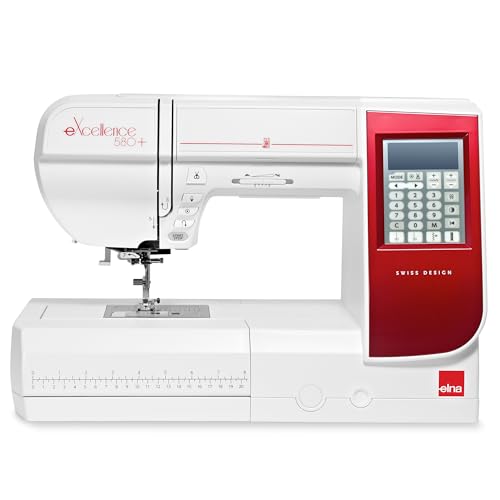
The eXcellence 580+ is Elna’s garment and fashion specialist, pairing 120 built-in stitches with an 8.2-inch workspace and a generous 13 presser feet in the box. The extra-wide extension table transforms the machine into a stable platform for sewing sleeves, bodices, and draping fabric without the drag that causes uneven seams. At $1,299 it undercuts the ef72 by $700 while offering nearly double the stitch count of the ec60.
- Pro: Thirteen included presser feet plus the extension table remove the accessory shopping that inflates ownership costs on other models.
- Pro: The 8.2-inch workspace and 120 stitches make it versatile enough for both garment construction and medium quilts.
- Con: At $1,299 it is the second most expensive option here, and sewists focused only on basic mending are paying for capability they will not use.
Skip this if your budget caps at $600 or your only projects are simple hemming and tote bags.
Elnita EC30
The EC30 is the best portable computerized option in this lineup at $399, matching the eXplore 320’s price while adding an LED display, needle threader, and start/stop button that eliminates the foot pedal for controlled detail work. Its lightweight build and 30-stitch selection make it ideal for apartment dwellers or sewists who move their machine between rooms daily.
- Pro: Start/stop button with speed control gives precise management for cuffs, collars, and curved seams.
- Pro: LED display simplifies stitch selection and length/width adjustments compared to dial-based machines.
- Con: Thirty stitches will feel limiting for anyone exploring decorative work or specialty fabrics beyond basic cotton and linen.
Skip this if you want more than 30 stitches; the eXperience 530 costs only $170 more and adds smart function buttons with a comparable footprint.
Elna eXperience 530
The eXperience 530 brings Swiss design sensibility to the mid-range with 30 stitches, smart function buttons, and quick stitch selection that reduces button-pressing compared to older Elna computerized models. At $569 it is the most style-forward option in the lineup, and owners appreciate the clean interface and compact housing that looks at home on a living room side table rather than hidden in a craft closet.
- Pro: Smart function buttons and quick stitch selection make changing settings genuinely fast during a project.
- Pro: The design is compact enough for small spaces while still feeling substantial and vibration-free at speed.
- Con: The $170 premium over the EC30 buys interface refinement but not additional stitches, so the value proposition narrows if you only need 30 stitches anyway.
Skip this if you need decorative variety or alphabets; the ec60 or eXcellence 580+ deliver those features instead.
Elna Explore 340
The Explore 340 is the heaviest option here at 6.5 kg, which signals a more rigid internal frame that resists vibration on thick seams. Its white housing and mechanical operation suit sewists who prefer tactile dial control over screens, and the $499 price places it squarely between the portable eXplore 320 and the computerized eXperience 530.
- Pro: The 6.5 kg weight provides stability that lighter portables lack when sewing multiple layers or dense denim.
- Pro: Mechanical operation means the machine works identically whether or not you understand a digital interface.
- Con: At $499 it is priced close to the computerized eXperience 530, making the lack of an automatic needle threader or stitch display a harder compromise to accept.
Skip this if convenience features matter to you; the extra cost buys mechanical robustness but no time-saving automation.
Buying Guide
Match Stitch Count to Your Actual Workload
Thirteen stitches handle all essential seams, hems, and basic stretch work. Thirty covers decorative accents on home projects. Sixty to 120 serves garment makers who vary stitch types for different fabrics and finishes. 170-plus suits quilters and embroiderers. Buying 170 stitches for hemming curtains means paying $1,800 more than necessary, while buying 13 stitches for garment construction means you will hit the ceiling within months.
Workspace Width Determines Your Ceiling
Anything under 6 inches of right-side workspace forces fabric bunching during piecing or when sewing wide garment panels. The eXcellence 580+ at 8.2 inches and the ef72 at over 10 inches are the only options here that let you work comfortably on quilts and full garment pieces simultaneously. If you sew only small projects, a narrower bed costs less and stores easier.
Convenience Features Compound Over Time
An automatic needle threader saves roughly ten seconds per threading event. A thread cutter eliminates reaching for scissors on every seam finish. A locking stitch button replaces the backstitching that takes three to five seconds per seam. None of these features seems decisive individually, but across a year of weekly sewing they remove hundreds of small interruptions. The ec60 and EC30 include the highest value of these per dollar.
Our Verdict
Our top pick is the Elna eXcellence 580+ at $1,299, which delivers 120 stitches, an 8.2-inch workspace, and thirteen included presser feet with an extension table—making it the most capable machine for sewists doing varied work without the $1,999 flagship price. Our budget pick is the eXplore 120 at $199, which covers genuine beginner and mending needs honestly at the lowest cost in the range. The ef72 wins decisively if your primary project is a full-size quilt on a regular schedule, because no other model here offers ten inches of seamless aluminum bed space.
FAQ
Are Elna sewing machines suitable for beginners?
Yes, particularly the eXplore 120 and EC30, which offer mechanical or simple digital interfaces that do not overwhelm a first-time user. The eXplore 120’s thirteen stitches eliminate the decision paralysis that comes with computerized models showing 170 options to someone still learning to sew a straight line.
What is the difference between mechanical and computerized Elna machines?
Mechanical models like the eXplore 120 use dials and levers with fewer stitches but zero electronic failure points. Computerized models like the ec60 and eXcellence 580+ add automatic needle threaders, speed control, start/stop buttons, and larger stitch libraries managed through a display, which reduces physical effort and expands creative options.
How much workspace do I need for quilting?
For piecing quilt blocks you need at least 6 inches of clearance to the right of the needle, and for binding or free-motion quilting on a full-size quilt you will benefit from 10 inches or more. The ef72 with its over-10-inch aluminum bed is specifically designed for this task, while the eXcellence 580+ at 8.2 inches handles quilts up to medium size comfortably.
Is the price difference between the EC30 and eXperience 530 worth it?
Both offer 30 stitches at similar weight, so the $170 gap buys the eXperience 530’s smart function buttons, faster stitch selection, and Swiss-designed housing. If you change stitch settings frequently or value aesthetics in your workspace, the upgrade pays dividends; if you set up a project and sew for hours without adjustments, the EC30 delivers identical functionality at lower cost.