Key takeaways
- Pro: Black surface improves perceived contrast without requiring a high-end projector.
- Pro: 80-inch diagonal at 16:9 is a sweet spot for rooms where the viewing distance is roughly eight to ten feet.
- Con: At $109.99 it costs more than comparable white-surface options, and the black finish can make the screen area look like a dark void when not in use.
A pull down projector screen is one of those purchases that looks simple until you start comparing options and realize the gap between a good one and a frustrating one is enormous. The core problem every buyer faces is the same: you need a flat, wrinkle-free surface that extends to a usable size, stays taut while in use, and retracts cleanly when you’re done. Cheap options sag, crease, and refuse to lock at the right height. Overly expensive ones often add features you’ll never use, like motorized operation or ultra-wide aspect ratios that don’t match your projector’s native output.
What separates a worthwhile pull down projector screen from a waste of money comes down to three things: the tension mechanism that keeps the fabric flat, the surface material’s ability to handle ambient light, and whether the screen size actually fits your viewing distance and projector throw. A screen that’s too small forces your audience to squint; one that’s too large looks dim because your projector can’t fill it brightly enough. The models in this roundup cover the full range from budget-friendly manual pull-downs for casual use to larger-format screens for dedicated home theaters and professional presentations.
Our top picks




As an Amazon Associate we earn from qualifying purchases at no extra cost to you.
Quick Picks
| Product | Best for | Price |
|---|---|---|
| VIVOHOME 80″ Black | Dark-room home theaters needing contrast | $109.99 |
| VIVOHOME 100″ White | Larger rooms with standard throw projectors | $127.99 |
| 72″ ALR Screen | Tight spaces and ambient-light rooms | $33.67 |
| Pyle 84″ | Classrooms and offices needing auto-lock | $100.99 |
| SUPER DEAL 80″ | Portable setups on a strict budget | $46.99 |
| SUPER DEAL 100″ | Budget buyers wanting maximum size | $82.99 |
| VIVOHOME 80″ White | General-purpose use in controlled light | $109.99 |
| VIVOHOME 120″ 1:1 | Square-format business or art displays | $129.99 |
How We Picked
We evaluated every pull down projector screen on this list using published specifications and recurring themes from owner feedback rather than hands-on measurement. The criteria that mattered most were size-versus-room compatibility (does the screen fill a reasonable portion of a wall without overwhelming it), surface tension and crease behavior over repeated use, mounting flexibility for wall or ceiling installation, and value relative to price. We also weighed whether the aspect ratio matched common projector outputs, since a mismatched format wastes pixels and reduces perceived sharpness.
The 8 Best Pull Down Projector Screen in 2026
VIVOHOME 80 Inch 16:9 Black
This screen targets home theater owners who project in darkened rooms and want deeper blacks than a white surface provides. The black fabric absorbs more ambient stray light, which can make images appear more contrasty with projectors that have lower native contrast ratios.
- Pro: Black surface improves perceived contrast without requiring a high-end projector.
- Pro: 80-inch diagonal at 16:9 is a sweet spot for rooms where the viewing distance is roughly eight to ten feet.
- Con: At $109.99 it costs more than comparable white-surface options, and the black finish can make the screen area look like a dark void when not in use.
Skip this one if you primarily watch in rooms with uncontrolled daylight; the black surface won’t overcome ambient light the way a dedicated ALR fabric would.
VIVOHOME 100 Inch 16:9 White
A step up in size for buyers with moderate throw distances who feel an 80-inch image is too cramped. The white matte surface is forgiving and works well with most mid-range projectors. Owner feedback highlights the ease of extension and the taut surface when locked.
- Pro: Hundred-inch diagonal gives meaningful size advantage over 80-inch options without demanding a dedicated theater room.
- Pro: Standard 16:9 format matches virtually every modern projector and TV broadcast source.
- Con: The $127.99 price puts it in territory where some motorized alternatives become available, and it requires more wall clearance than smaller screens.
Pass on this if your projector sits closer than six feet from the screen plane, as the image may appear too large for comfortable viewing.
72 Inch ALR Projection Screen
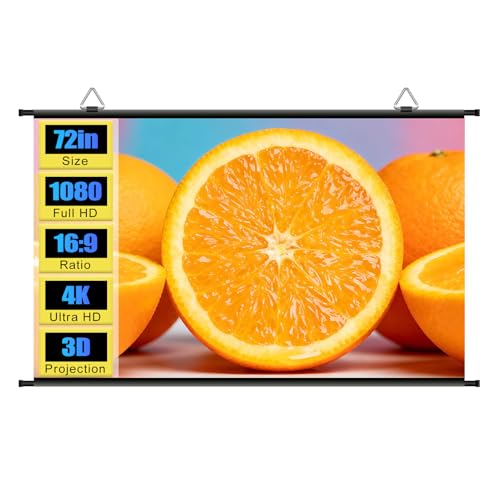
The lowest-priced option here at $33.67, and the only screen built around ambient light rejecting fabric. ALR material reflects projector light back toward the viewer while absorbing overhead and side light, making it viable for living rooms or outdoor evening setups where you cannot fully control illumination.
- Pro: ALR surface dramatically outperforms standard white or gray screens in rooms with windows or ceiling lights.
- Pro: Underwhelming price for a specialized surface technology.
- Con: The 72-inch diagonal limits its usefulness in rooms where the seating area is more than eight feet from the screen.
Skip this if image size matters more than brightness performance in your space; the surface advantage evaporates once you need a larger format.
Pyle 84-Inch Pull Down Projector Screen
Pyle positions this for institutional users like classrooms, conference rooms, and small offices. The auto-locking height mechanism lets you stop the screen at any point without manually adjusting a clasp, and the matte white surface suits standard projector pairings. Wall or ceiling mounting is supported.
- Pro: Auto-locking height adjustment removes a fiddly step during setup, useful in shared spaces where multiple people deploy the screen.
- Pro: Matte white surface is versatile and pairs well with the wide range of projectors found in office environments.
- Con: At $100.99 it offers no size or surface advantage over the similarly priced VIVOHOME 80-inch models, and owner feedback notes the casing feels plasticky.
Choose something else if you want the best image quality per dollar; this screen is more about mechanism convenience than surface performance.
SUPER DEAL 80-Inch HD Projection Screen
This foldable, anti-crease model at $46.99 is designed for portability rather than permanent installation. The fabric can be folded without permanent creasing, making it practical for teachers, sales reps, or outdoor movie hosts who transport their setup. The 16:9 format keeps compatibility broad.
- Pro: Foldable anti-crease design means you can stow it in a bag and deploy it at a venue without ironing or waiting for wrinkles to relax.
- Pro: Less than half the price of fixed-mount options with similar diagonal size.
- Con: Lacks a rigid casing or spring-loaded retraction; the manual pull-down mechanism feels less refined, and long-term durability is a concern based on recurring owner complaints about edge wear.
Skip this if you’re looking for a permanent installation; the folding design sacrifices the structural rigidity that keeps a surface perfectly flat during extended use.
SUPER DEAL 100-Inch HD Projection Screen
The larger sibling of the 80-inch SUPER DEAL, this $82.99 model gives you a full hundred-inch diagonal in a portable, foldable format. For a budget-conscious buyer who needs maximum image size without a fixed mount, it fills a genuine gap.
- Pro: 100-inch screen area at this price is unmatched in this roundup for pure value per square inch.
- Pro: Still folds for transport despite the large size, keeping it viable for mobile presentations.
- Con: The tension system struggles to keep a 100-inch surface perfectly flat; some owners report visible ripples near the bottom edge after extended use.
Look elsewhere if image uniformity is critical for your content; a permanently mounted screen at similar price points delivers better surface stability.
VIVOHOME 80 Inch 16:9 White
Functionally identical in size and format to the black VIVOHOME above, this white-surface version at $109.99 suits buyers in rooms where they can control ambient light but want a brighter, more neutral image. White surfaces push more reflected light back to the viewer, making the image appear more luminous.
- Pro: Higher gain than the black version, meaning the same projector appears brighter on this surface.
- Pro: Neutral color reproduction without the slight warmth some black surfaces introduce at lower viewing angles.
- Con: The $109.99 price is the same as the black variant despite offering no mechanical advantage, and in rooms with uncontrolled light the surface will wash out quickly.
Consider the $33.67 ALR screen instead if ambient light is a recurring issue in your space.
VIVOHOME 120 Inch 1:1 Pull Down Projector Screen
A 120-inch square-format screen that serves a different niche than the rest of this list. The 1:1 aspect ratio suits legacy slide projectors, certain presentation software defaults, and art installation setups. At $129.99 it is the largest option here.
- Pro: Square format is genuinely useful for specific presentation and display scenarios where a widescreen wastes vertical space.
- Pro: 120-inch diagonal provides a commanding image that 80 and 100-inch screens cannot match.
- Con: Most modern projectors output 16:9 natively; using them with a 1:1 screen means black bars top and bottom, reducing effective image size and brightness.
Skip this entirely unless you have a specific reason for square output. The aspect ratio mismatch will frustrate most buyers who assumed 120 inches means 120 inches of active image.
Buying Guide
Match Screen Size to Throw Distance and Room Depth
The most common mistake buyers make is choosing a pull down projector screen based on how big they want the image rather than how far away the projector will sit and how deep the room is. A rough rule is that comfortable viewing distance should be about two to four times the screen height. An 80-inch diagonal 16:9 screen is roughly 39 inches tall, meaning your audience sits between six and thirteen feet back. A 100-inch screen pushes that window to seven and a half to sixteen feet. If your room is smaller, a large screen forces everyone into an uncomfortably close seating row. If your room is deep, a small screen wastes wall space and makes detail hard to resolve.
Surface Type and Ambient Light Tolerance
White matte surfaces have the highest gain, bouncing the most light back to the viewer, but they reflect ambient room light equally well, causing washed-out images. Black and gray surfaces lower gain but improve perceived contrast in controlled-light environments. ALR (ambient light rejecting) fabric is the best-performing option for rooms with windows or overhead lighting because its microstructured surface reflects projected light directionally while scattering and absorbing off-axis room light. If you cannot darken your room, prioritize ALR or gray surfaces. If you project in a dedicated theater or a bedroom at night, white or black matte works fine.
Mounting, Tension, and Retraction Mechanism
A pull down projector screen is only as good as the spring and latch system that controls it. Cheap screens use a simple hook or clasp that loosens over time, causing the bottom bar to droop and introducing visible ripples. Look for models with a self-locking mechanism that engages at any height without requiring you to re-clip a separate fastener. The casing should be rigid enough to prevent the screen from flexing laterally when fully extended. Wall mount versus ceiling mount depends on your room layout; wall mounting is simpler and more stable, while ceiling mounting saves wall space in multi-purpose rooms.
Our Verdict
The VIVOHOME 100 Inch 16:9 White at $127.99 is the top pick for most home theater buyers. It delivers the size-to-price ratio and surface quality that covers the widest range of room configurations without requiring a specialized projector or light-controlled environment. For budget-conscious portable use, the SUPER DEAL 80-Inch at $46.99 is the clear value leader, offering anti-crease foldability at a fraction of fixed-mount pricing. If ambient light control is impossible in your space, the 72-Inch ALR Screen at $33.67 wins outright because no standard white or black surface can match its light-rejection performance at any price point.
FAQ
Do I need a 16:9 screen if my projector is 16:9?
Yes, a 16:9 screen matches a 16:9 projector’s native output exactly, filling the entire surface with active image and delivering maximum brightness and resolution. Any other aspect ratio introduces unused border space that reduces effective image size.
Can a pull down projector screen work outdoors?
It can, but only in the evening or at night. Pull down screens designed for outdoor use typically feature weather-resistant housings and heavier bottom bars that resist wind. A standard indoor model will flutter, wrinkle, or be damaged by a light breeze, so match the product’s stated rating to your environment.
How far from the wall should a pull down screen hang?
Most manual pull down screens mount flush to the wall or hang within a few inches of it. The exact offset depends on the casing depth and whether you use a wall bracket or flush-mount hardware. Keep the screen as close to the projector’s throw path as possible to maximize image size without obstruction.
Are ALR screens worth the premium over standard white?
If you project in a room you cannot fully darken, yes. An ALR surface can make a mid-brightness projector appear vivid where a white screen looks washed out. In a fully controlled dark room, however, the advantage shrinks, and a standard white matte surface at the same size often delivers a brighter image.