Our Top Picks


Top 3 Picks
The best Olympic weight set for serious lifters is the REP Fitness Rubber Bumper Plates 260 LB Set. It is the only set on this list that pairs a full 260 lb of calibrated-quality bumper plates with the low-bounce, shock-absorbing rubber construction that survives years of dropping from overhead — which is what serious lifters actually do to their equipment. It suits anyone building a permanent garage or basement platform who plans to snatch, clean, and jerk rather than just bench and squat.
For lifters on a tight budget who still need real 2-inch Olympic plates, the BalanceFrom Olympic Rubber Bumper Weight Plate Set with Steel Hub Inserts is the value pick. It gives you rubber bumper construction and steel insert hubs at a price tier that normally buys bare iron, making it the smart entry point before you commit to a full premium set.
If you want iron density and maximum load per square foot of storage, the CAP 200lb Elite Olympic Cast Iron Grip Weight Plate Set is the premium iron choice. It is the set to buy when plates will live on a rack in a low-ceiling basement and never touch a floor from height.
Quick Comparison
Every set below is built around a 2-inch (50 mm) center hole, the Olympic standard. The differences that matter are plate material, claimed total load, bar inclusion, and whether the plates are safe to drop.
| Product | Best for | Key specs | Price tier |
|---|---|---|---|
| HULKFIT 2-Inch Olympic Rubber Weight Plates Set, 180LB with 7ft Bar | All-in-one colored bumper starter kit | 180 lb total; rubber bumper plates; includes 7 ft Olympic bar; colored plates for easy identification | Mid-range |
| CAP 200lb Elite Olympic 2-Inch Cast Iron Grip Weight Plate Set | Maximum iron load, minimal footprint | 200 lb total; cast iron; 2-inch hole; grip cutouts; no bar or collars included | Premium |
| CAP 110lb Elite Olympic 2-Inch Cast Iron Grip Weight Plate Set | Iron plates on a smaller budget | 110 lb total; cast iron; 2-inch hole; grip cutouts; no bar included | Mid-range |
| CAP Barbell 160 lb PRO Olympic Weight Set with 7ft Chrome Barbell & Black Bumper Plates | Buyers who want bar and bumpers together | 160 lb total; black bumper plates; includes 7 ft chrome barbell; PRO line | Premium |
| CAP Barbell Starter Olympic Weight Set | First Olympic set on a budget | Complete starter set; 2-inch Olympic plates; includes bar; iron construction | Mid-range |
| CAP Barbell 2-Inch Olympic Grip Weight Plate, 5 lb, Set of 4 (OPHWIS-005) | Filling small jumps between big plates | Four 5 lb plates = 20 lb added; cast iron, 2-inch hole; grip design | Budget |
| BalanceFrom Olympic Rubber Bumper Weight Plate Set with Steel Hub Inserts | Cheapest real bumper plates | Rubber bumper plates; steel hub inserts; 2-inch hole; sold as a set | Budget |
| XMARK Texas Star Rubber Coated Weight Plate Sets with Crowbar 7′ Olympic Bar | Lifters who want a bar and rubber-coated iron in one buy | Rubber-coated iron plates; includes 7 ft Crowbar Olympic bar; Texas Star plate line | Premium |
| Logest Pair Olympic Plates | Topping up plates you already own | Sold as a pair; 2-inch Olympic hole; designed for Olympic bars | Budget |
| RitFit Olympic Rubber Grip Weight Plates, 2-Inch Barbell Set | Rubber-coated plates with easy handling | Rubber grip coating; 2-inch barbell set; multiple plate weights available | Mid-range |
| REP Fitness Rubber Bumper Plates, 260 LB Set | Dropping from overhead, forever | 260 lb total; Olympic standard; shock-absorbing low-bounce rubber; sold as a set | Premium |
| Micro Gainz Olympic Fractional Weight Plates, 8-Piece, with Bag | Micro-loading presses and pulls | 8 fractional plates; carry bag included; 2-inch Olympic fit | Budget |
How We Chose
This roundup is research-based. It was assembled by comparing published listing specifications and well-established facts about Olympic plate and bar construction, not by unboxing or handling any of these products. The criteria, in order of weight:
- Barbell tensile strength and sleeve design compatibility. Every set here is built for a 2-inch Olympic shaft. We noted which sets include a bar and which do not, because a set without a bar means an immediate second purchase, and a bar with a low tensile rating will whip or bend before the plates wear out.
- Plate accuracy and material class. Iron and rubber-coated iron hold tighter tolerances and are cheaper per pound; bumper plates trade some accuracy for drop tolerance. We grouped products by material class so buyers compare like with like.
- Bumper versus iron construction. If a lifter is going to drop the bar, iron is the wrong answer regardless of price. Construction determined which categories a set could even be considered in.
- Total load and upgrade path. A 110 lb set and a 260 lb set serve different lifters. We favored sets that leave room to add plates rather than sets that top out immediately.
- Category fit. Full sets, single pairs, and accessory plates were kept in their own lanes so a 20 lb plate add-on is not judged against a full 260 lb kit.
1. HULKFIT 2-Inch Olympic Rubber Weight Plates Set – Best for a Complete Colored Bumper Starter Kit
As an Amazon Associate we earn from qualifying purchases at no extra cost to you.

The HULKFIT 180 lb set is the cleanest answer for someone who wants a functioning Olympic platform on day one without assembling three separate orders. It bundles rubber bumper plates with a 7-foot Olympic bar in a colored plate format, which means you get bar, plates, and a color-coded system in one box. It suits the lifter upgrading from a 1-inch standard set or a fixed dumbbell collection who is now committed to Olympic lifting and wants equipment that can be dropped.
Key specs
- Total load: 180 lb as listed, before any bar allowance
- Plate type: rubber bumper plates, colored by weight
- Center hole: 2-inch Olympic standard
- Bar included: 7 ft Olympic bar
- Construction: rubber over a 2-inch sleeve fit, ideal for platform use
Strengths
The colored plates are more than cosmetic. In a crowded garage gym, grabbing the right plate by color reduces the misload errors that turn into a badly unbalanced bar, which is one of the most common serious-lifter mistakes. The rubber bumper construction means the plates can be dropped from the top of a clean or a snatch without cracking, and the bumper diameter keeps the bar at a consistent starting height off the platform. Because it is a complete kit, the buyer does not have to solve bar compatibility separately — the listed 7 ft bar is already matched to 2-inch plates.
The 180 lb figure is worth thinking about carefully. If you weigh 180 lb and want to squat, 180 lb of plates plus an unloaded bar gets you into a working range for early intermediate strength, but it will not carry a lifter past a bodyweight squat for long. Treat this as an entry point with an upgrade path rather than a terminal set.
Pros
- Bar and plates arrive together, so there is no compatibility guessing
- Rubber bumpers tolerate drops from overhead
- Color coding speeds up plate changes between sets
- 7 ft bar matches full-width squat rack and platform dimensions
Cons
- 180 lb total leaves limited headroom for stronger lifters
- Colored bumper plates typically show chalk and scuffing more than black plates
- Rubber bumper plates take up more rack space than iron per pound
- No listed collars, so those are usually a separate purchase
Nearest alternative: the CAP Barbell 160 lb PRO Olympic Weight Set with 7ft Chrome Barbell & Black Bumper Plates. Both are bar-included bumper kits in the premium and mid-range tiers respectively. HULKFIT wins on color coding and 20 lb more total load; the CAP PRO set appeals to buyers who prefer a chrome bar finish and black bumpers that hide chalk better over years of use.
2. CAP 200lb Elite Olympic Cast Iron Grip Weight Plate Set – Best for Maximum Iron Load in Minimum Space

This is the set for the lifter whose plates live on a rack, not on a platform. It is 200 lb of cast iron with grip cutouts and a 2-inch hole, and it is the most space-efficient way on this list to store serious load. It suits the bench-and-squat-locked lifter, the lifter in a low-ceiling basement where a bumper plate’s larger diameter and bounce are liabilities, and anyone whose training is built around a power rack rather than a lifting platform.
Key specs
- Total load: 200 lb as listed
- Plate type: cast iron with grip cutouts
- Center hole: 2-inch Olympic standard
- Bar included: no
- Collars included: no
- Finish: cast iron, typically with a protective coating on Elite-line plates
Strengths
Cast iron is the densest practical plate material. A 45 lb iron plate is dramatically thinner than a 45 lb bumper, which means a loaded bar for a heavy squat can actually fit inside the sleeves without spilling past the collar groove. Grip cutouts matter more than beginners expect: on a plate-loaded leg press, a landmine attachment, or a weighted dip belt, you handle the plate directly, and cutouts make that possible with one hand.
Iron also gives the tightest weight accuracy per dollar in most cases, because there is no thick rubber layer where density varies. If your program is percentage-based, matching plates that actually weigh what they say reduces the drift between prescribed and performed loads.
Pros
- Highest load per square inch of rack space on this list
- Cast iron typically holds weight accuracy better than thick rubber
- Grip cutouts make off-bar handling safe and easy
- Iron plates essentially do not wear out; the finish is the only real consumable
Cons
- Never drop these on a platform; iron cracks and chips concrete
- No bar or collars included, so plan for those costs
- Iron plates make a great deal of noise and vibration in a shared building
- Loading heavy squats requires care because thin iron plates stack tightly on the sleeve
Nearest alternative: the CAP Barbell 110 lb Elite Olympic Cast Iron Grip Weight Plate Set. Same Elite grip-iron family, roughly half the load, one price tier down. The 200 lb version is the one to take if you already squat near bodyweight or above; the 110 lb version is a reasonable starting iron set but will need a second purchase sooner.
3. CAP 110lb Elite Olympic Cast Iron Grip Weight Plate Set – Best for a First Iron Olympic Set

This is the same Elite cast iron grip design as the 200 lb set, scaled down to 110 lb. It suits the lifter who wants iron — for accuracy, for rack density, for the feel of a loaded bar — but does not yet need 200 lb on the sleeve, and would rather spend the difference on a quality bar. It is also the better pick for a lifter adding a second set of iron to a program that already has a main set and needs more mid-weight plates.
Key specs
- Total load: 110 lb as listed
- Plate type: cast iron with grip cutouts
- Center hole: 2-inch Olympic standard
- Bar included: no
- Recommended pairing: 20 kg (44 lb) Olympic bar with a tensile rating appropriate for powerlifting loads
Strengths
The advantage of buying the smaller iron set deliberately is that it frees budget for the bar, and the bar is the part that matters most for long-term durability. A cheap bar with a low tensile strength will whip under a heavy squat and can take a permanent bend, at which point no plate set on earth will help you. Buyers who pick the 110 lb set and put the savings into a better shaft get a better total system than buyers who buy the 200 lb set and a bargain bar.
110 lb is also a genuinely useful increment set for an experienced lifter. If you already own 45s and 25s, a compact set in this range pairs well for loading progression and for second-bar setups — a dedicated bar for pulls, for example, so you stop stripping and reloading a single bar between movements.
Pros
- Frees budget for a better barbell, which is the higher-value upgrade
- Same grip cutouts and cast iron accuracy as the larger Elite set
- Works well as a second set alongside existing heavier plates
- Compact to store and easy to transport
Cons
- 110 lb will be limiting quickly for squats and deadlifts
- No bar, no collars, no rack — it is plates only
- Same iron limitations: not drop-safe
- Owners often end up buying the larger set anyway, which can mean duplicate weights
Nearest alternative: the CAP 200lb Elite Olympic Cast Iron Grip Weight Plate Set. Same design language, more load, higher tier. If your working squat is already above 135 lb before the bar, skip straight to the 200 lb set; take the 110 lb version only if the bar budget genuinely trades against it.
4. CAP Barbell 160 lb PRO Olympic Weight Set – Best for a Bar-Included Bumper Kit Without the Color Premium

The CAP PRO 160 lb set combines black bumper plates with a 7 ft chrome barbell. It suits the lifter who wants a drop-safe setup and a bar in one order, but prefers a neutral black plate set over colored bumpers — usually because black hides chalk, rust bloom, and gym grime far better over a decade of use. It is the practical choice for a humid garage or an unconditioned basement gym.
Key specs
- Total load: 160 lb as listed
- Plate type: black bumper plates
- Bar included: 7 ft chrome barbell
- Center hole: 2-inch Olympic standard
- Line: CAP PRO
Strengths
Black bumpers are the low-maintenance choice. Colored bumper plates look sharp on a showroom floor, but every color except black shows chalk dust, scuffs, and sun fading more obviously, and a colored set that has been dropped a few thousand times looks older than a black set of the same age. For a garage gym that will not be photographed, black is the right call.
The chrome bar finish resists rust noticeably better than bare steel in a damp space, which matters if your gym is a basement, a shed, or a garage that sees temperature swings. The 160 lb total is a modest load, comparable in class to the HULKFIT 180 lb set, and enough for most intermediate pressing and pulling programs when combined with a 44 lb bar.
Pros
- Bar and plates arrive matched in a single order
- Black bumpers hide wear better than colored plates
- Chrome bar finish is more humidity-tolerant than bare steel
- Drop-safe for cleans, snatches, and overhead work
Cons
- 160 lb tops out faster than the 260 lb premium set
- Bumper plates are bulkier to store than iron
- Chrome can flake on low-quality bars, so the finish is a cosmetic, not structural, benefit
- No collars listed
Nearest alternative: the HULKFIT 180 lb set. HULKFIT offers 20 lb more load and color-coded plates; the CAP PRO offers a black, chalk-hiding finish and a chrome bar. Pick on aesthetics and bar finish, not on load, because the difference is small.
5. CAP Barbell Starter Olympic Weight Set – Best for a First Olympic Set on a Budget

The CAP Barbell Starter Olympic Weight Set is the no-drama entry point: a complete 2-inch set with a bar, aimed at the lifter moving up from standard 1-inch plates. It suits a teenager or new lifter building a first home setup, a lifter who wants a second kit for a second location, or a buyer assembling a set for a home strength program who does not want to research bar compatibility. It is honest starter equipment.
Key specs
- Configuration: complete set with a bar
- Plate type: iron Olympic plates, 2-inch hole
- Center hole: 2-inch Olympic standard
- Intended use: general strength training, not drop training
Strengths
Buying a complete starter set removes the single most common first-time mistake: ordering plates with a 2-inch hole and a bar with a 1-inch shaft, then discovering the mismatch on delivery day. Everything here is designed to fit together. The iron construction is accurate and durable by nature, and the 2-inch standard means every plate you buy from here forward will fit the same bar — this is the real value of starting Olympic rather than standard.
It is also a low-risk way to discover whether home training sticks. Many people buy a starter set, train for a year, and then either upgrade or sell it; buying a mid-range complete kit rather than a premium one limits the money parked in equipment you might outgrow.
Pros
- Complete, compatible set — no mismatched parts
- 2-inch standard means future plate purchases will fit
- Iron construction holds weight accuracy well
- Low financial commitment if home training does not stick
Cons
- Starter bars typically have lower tensile strength and will not survive heavy squatting forever
- Iron plates are not drop-safe
- Total load is modest, so intermediate lifters will outgrow it
- Grip and finish quality is a step below the Elite or PRO lines
Nearest alternative: the CAP 110lb Elite Olympic Cast Iron Grip Weight Plate Set. The Elite set gives you better plates but no bar; the Starter set gives you the whole package but plain plates. If you already own a bar, the Elite 110 lb is the better buy. If you own nothing, the Starter set gets you training sooner.
6. CAP Barbell 2-Inch Olympic Grip Weight Plate, 5 lb, Set of 4 – Best for Micro-Loading With Iron
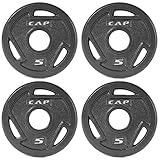
This is not a set for a beginner — it is a precision tool for a lifter who already has a rack full of plates. Four 5 lb cast iron Olympic plates with grip cutouts let you add 20 lb to a bar in small, even increments. It suits the intermediate or advanced lifter running a linear progression who has hit the point where 10 lb jumps no longer work and 5 lb jumps on each side are the difference between a completed session and a failed one.
Key specs
- Quantity: set of four plates
- Weight per plate: 5 lb (2.27 kg)
- Total added: 20 lb when all four are loaded
- Plate type: cast iron with grip design
- Center hole: 2-inch Olympic standard
- Model: OPHWIS-005
Strengths
The math here is the point. With a pair of 5 lb plates you add 10 lb to the bar; with all four you add 20 lb. That covers the gap between a 2.5 lb and a 10 lb increment on each side, which is exactly the zone where most plateaus occur. Small 5 lb iron plates also fit comfortably outside heavier plates on a sleeve without consuming much space, so you can run a full progression on an already-loaded bar without stripping it down.
Cast iron means these plates will match the wear characteristics of the rest of an iron collection. If your main plates are iron, adding iron 5s keeps the set visually and physically consistent, and there is no rubber smell or bulk to work around on the rack.
Pros
- Fills the exact increment gap that stalls linear progression
- Grip cutouts make one-handed loading easy
- Iron construction matches an existing iron plate collection
- Cheap per pound and effectively permanent
Cons
- Not a standalone set — it is an accessory purchase
- 20 lb total is irrelevant for a lifter who needs main plates
- Iron, so it is not meant to be dropped
- Buyers sometimes order these expecting a full set and are disappointed
Nearest alternative: the Micro Gainz Olympic Fractional Weight Plates, 8-Piece. Micro Gainz goes finer — fractional plates are designed for increments smaller than 5 lb per side — while the CAP 5 lb set operates at the 5–20 lb range. Serious lifters often end up owning both: Micro Gainz for the last few pounds of a peak, CAP 5s for everyday loading.
7. BalanceFrom Olympic Rubber Bumper Weight Plate Set – Best Budget Bumper Plates

BalanceFrom’s bumper set with steel hub inserts is the lowest-cost way to get genuine rubber bumper plates with a metal sleeve interface on this list. It suits lifters who need drop-safe plates but cannot justify a premium bumper set, and lifters building a second platform in a shared space where rubber’s quieter impact matters.
Key specs
- Plate type: rubber bumper plates
- Hub: steel hub inserts at the center hole
- Center hole: 2-inch Olympic standard
- Sold as: set
- Drop tolerance: designed for bumper-style use
Strengths
The steel hub insert is the detail that separates real bumper plates from rubber-coated iron. On a bumper plate, the bar sleeve rides on the metal insert, not on rubber, so the plate slides on and off smoothly and the hole does not deform under repeated loading. A rubber-only hub will grip and gall the sleeve, which is a fast route to a ruined bar. Steel inserts also mean the plate’s structural load path runs through metal, not rubber, which is where drop durability comes from.
Rubber bumpers are also substantially quieter than iron. In a thin-walled garage or a second-floor room, the difference between a dropped iron plate and a dropped bumper plate is the difference between a complaint and no complaint. This set gives the beginner drop capability without the premium tier price.
Pros
- Genuine bumper construction at a budget tier
- Steel hub inserts protect the bar sleeve
- Quieter and floor-friendlier than iron
- Low-risk way to find out whether Olympic lifting suits you
Cons
- Budget bumpers typically have looser weight tolerance than premium sets
- No bar included
- Budget rubber formulations can harden and crack faster under heavy drops
- Set load is limited, so heavier lifters will need to add plates
Nearest alternative: the REP Fitness 260 LB Rubber Bumper Plate Set. Both are rubber bumpers with a metal interface. BalanceFrom is the entry point; REP is the long-term answer for a lifter who drops from overhead weekly. If your training is going to be serious, the REP set costs more up front and less per year.
8. XMARK Texas Star Rubber Coated Weight Plate Sets with Crowbar 7′ Olympic Bar – Best for a Bar and Plates in One Premium Buy

XMARK’s Texas Star set pairs rubber-coated iron plates with a 7-foot Crowbar Olympic bar. It suits the lifter who wants one order, one delivery, and a known bar — the Crowbar is a well-established XMARK product with a reputation for handling real training loads — plus plates that are quieter and more floor-friendly than bare iron without the bulk of full bumpers. This is a good fit for a powerlifter or general strength lifter who rarely drops from overhead but wants reasonable impact tolerance.
Key specs
- Plate type: rubber-coated iron, Texas Star line
- Bar included: 7 ft Crowbar Olympic bar
- Center hole: 2-inch Olympic standard
- Construction: iron core with rubber coating — denser than bumpers, quieter than bare iron
Strengths
Rubber-coated iron is an underrated middle path. It keeps much of iron’s density — so more weight fits on a sleeve — while cutting the noise and surface damage of bare metal. For a lifter doing heavy squats, benches, and deadlifts in a garage, this is often the better trade than bumpers, because you are not paying for a bounce characteristic you will never use. The rubber coating also protects the plates themselves from chipping when they knock together on the rack, which is where most iron plates actually get damaged.
Including the Crowbar matters because the bar is where cheap sets fail. Buying a set that ships with a known, reputable bar removes the single highest-risk component of the purchase.
Pros
- Bar and plates in one order from a reputable bar line
- Rubber coating reduces noise and plate-to-plate chipping
- Denser than bumpers, so more load fits on the sleeve
- Better long-term value than a cheap set plus a cheap bar
Cons
- Rubber-coated iron is not a substitute for bumpers if you drop from overhead
- Premium tier pricing
- Coating can peel at the edges after years of hard rack contact
- Heavier to handle than bumper plates of the same weight
Nearest alternative: the REP Fitness 260 LB Rubber Bumper Plate Set. If you drop the bar from overhead — snatches, cleans, jerks — REP’s bumpers are the correct tool. If you rack every rep, the XMARK rubber-coated iron plus Crowbar is the stronger all-around buy.
9. Logest Pair Olympic Plates – Best for Topping Up an Existing Set

Logest sells Olympic plates as pairs, which matters because a single plate is useless on a bar — you need one per side. This is the add-on purchase: it suits a lifter who already owns a set and needs a specific weight to extend their loading range, or a lifter who wants to build a set upward in controlled increments rather than buying everything at once.
Key specs
- Sold as: pair (two plates)
- Center hole: 2-inch Olympic standard
- Compatibility: designed for Olympic bars
- Intended use: strength training, adding load to an existing set
Strengths
Buying in pairs is the correct unit of purchase for barbell training, and it is surprisingly easy to get wrong when ordering singles. Two plates of the same weight are exactly what a loaded bar needs to stay balanced. For a lifter building a home set slowly, pair-by-pair purchasing spreads cost over months and lets you buy only the increments you actually use — most home lifters need far more 45s and 25s than 10s, and buying to your actual ratios saves real money.
Pairs are also the right way to extend a stalled set. If your 160 lb kit has topped out and your next squat target needs 20 more pounds, two 10 lb plates solve it without a full new set purchase.
Pros
- Correct purchase unit for barbell loading — two plates, one per side
- Extends an existing set without buying a whole new kit
- Lets you build to your own weight ratios instead of a fixed bundle
- Low cost per purchase
Cons
- Not a complete set — no bar, no base plates
- Buying incrementally usually costs more in total than a bundled set
- A single pair adds limited range on its own
- Material and accuracy depend on the specific weight selected
Nearest alternative: the RitFit Olympic Rubber Grip Weight Plates Set. RitFit sells plates as a set with rubber grip coating, so it suits a lifter who wants a coordinated product line rather than piecemeal pairs. Logest wins on flexibility; RitFit wins on handling comfort and set consistency.
10. RitFit Olympic Rubber Grip Weight Plates – Best for Rubber-Coated Plates With Easy Handling
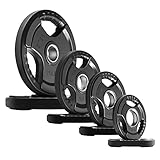
RitFit’s rubber grip plates are a 2-inch Olympic barbell set with a rubber coating and a grip-friendly profile. They suit lifters who handle plates constantly — off the rack, onto a sled, onto a belt — and want the noise and chip resistance of a coating without premium-tier pricing. It is a good middle path for a garage lifter doing general strength work rather than a competitive Olympic program.
Key specs
- Plate type: rubber-coated, grip design
- Center hole: 2-inch Olympic standard
- Sold as: set, with multiple plate weights available
- Intended use: general strength training
Strengths
Grip design is the specification that separates usable plates from annoying ones. A smooth iron plate is awkward to carry across a gym floor or to load onto a sleeve with one hand; a plate with cutouts or a molded grip is easy. Over an entire training year, that is thousands of handling events, and it is the difference between a set you enjoy using and one you resent. RitFit pairs that with a rubber coating that deadens noise and stops the plate edges from chipping.
Because RitFit offers multiple plate weights within a set line, a buyer can match plate sizes to their actual training loads rather than accepting whatever ratios a fixed bundle includes.
Pros
- Grip profile makes plate handling genuinely easier
- Rubber coating reduces noise and edge chipping
- Multiple plate weights available for customizing load distribution
- Mid-range pricing with better handling than bare iron
Cons
- Rubber-coated plates are not intended for high drops
- Coating adds bulk compared with bare iron of the same weight
- No bar included
- Coating can degrade over years of rack contact, though not structurally
Nearest alternative: the XMARK Texas Star Rubber Coated set. Both are rubber-coated plates; XMARK includes a 7 ft Crowbar bar and a premium tier price, while RitFit is the mid-range option if you already own a bar. RitFit is the better buy for someone upgrading plates, XMARK for someone starting from nothing.
11. REP Fitness Rubber Bumper Plates, 260 LB Set – Best Overall for Serious Lifters

The REP Fitness 260 lb bumper set is the best overall pick on this list for a serious lifter, and the reason is simple: 260 lb is enough load to train real strength for a long time, and the low-bounce shock-absorbing rubber construction is designed for the thing serious lifters actually do — drop the bar from overhead. It suits the Olympic weightlifter, the CrossFit-style athlete, and any strength lifter with a platform or a stall mat setup who plans to still be using the same plates in ten years.
Key specs
- Total load: 260 lb as listed
- Plate type: rubber bumper plates
- Standard: Olympic standard, 2-inch center hole
- Design: shock-absorbing, low-bounce formula
- Applications: platform work, overhead drops, Olympic lifts
Strengths
Low bounce is not a marketing detail — it is a safety feature and a durability feature. A bumper plate with a hard, high-rebound rubber compound will bounce the bar unpredictably after a heavy drop, which is a genuine injury risk on a snatch or a jerk. A low-bounce formulation keeps the bar close to where it landed. It also reduces the shock load that travels back into the plate’s hub, which is the part that fails first on any bumper plate.
At 260 lb, this set covers a lot of ground. Loaded on a 44 lb bar, it puts over 300 lb on the platform, which is enough to carry a lifter through years of intermediate and into advanced work before another plate purchase is required. That extended runway is what makes the premium tier price rational: the cost per year of ownership is lower than a cheaper set that needs replacing or expanding within eighteen months.
Pros
- 260 lb provides a genuinely long upgrade runway
- Low-bounce rubber is safer and kinder to the plate hub
- Bumper construction tolerates drops from overhead indefinitely
- Consistent Olympic standard fit on standard bars
Cons
- Premium tier price
- Bumper plates are bulky — 260 lb occupies significant rack or floor space
- Bumper plates have looser weight tolerance than calibrated competition plates
- No bar included
Nearest alternative: the BalanceFrom Olympic Rubber Bumper Weight Plate Set with Steel Hub Inserts. Both are rubber bumpers with steel at the bar interface. BalanceFrom is the budget entry to bumper training; REP is the set you buy when you know you are going to keep doing this. If you are still deciding whether Olympic lifting is for you, buy the cheaper one. If you already know, buy the REP set and skip the intermediate step entirely.
12. Micro Gainz Olympic Fractional Weight Plates, 8-Piece – Best for Breaking Plateaus

Micro Gainz sells fractional plates — small, sub-5 lb increments designed to let you add weight slower than any standard plate allows. Eight pieces with a carry bag, in a 2-inch Olympic fit. It suits the intermediate lifter whose linear progression has stalled, the older lifter who needs to progress carefully, and the press-focused lifter for whom a 5 lb jump per side is simply too large. The product line exists for exactly one purpose and does it well.
Key specs
- Configuration: 8-piece set with carry bag
- Purpose: fractional micro-loading
- Center hole: 2-inch Olympic standard
- Use case: press, bench, and any lift with a small progressive overload ceiling
Strengths
The reasoning behind fractional plates is a real training principle. Overhead press, in particular, has a low absolute ceiling: a 5 lb jump per side is a 10 lb increase, which for a lifter pressing 100 lb is a 10% jump — too large to sustain. Fractional plates let the same lifter add, for example, 1 lb per side, extending progression by many more sessions. That is not a gimmick; it is how lifters keep making progress on lifts where big jumps stop working.
The included carry bag is a small but real convenience, because fractional plates are small, light, and easy to lose. A dedicated bag keeps eight pieces together, and because these plates are handled constantly at the end of a set, having them organized saves time on every session.
Pros
- Enables progress on lifts where standard jumps no longer work
- Useful for older or returning lifters progressing cautiously
- Carry bag keeps the small plates organized
- Compact and inexpensive relative to their training impact
Cons
- Not a substitute for main plates — an accessory only
- Tiny plates are easy to lose or leave on a bar
- Only useful once you are past beginner loading jumps
- Adds negligible total load
Nearest alternative: the CAP Barbell 2-Inch Olympic Grip Weight Plate, 5 lb, Set of 4. CAP gives you a 20 lb range in 5 lb steps; Micro Gainz goes finer below that. Most plateaued lifters benefit from both — CAP 5s for weekly loading, Micro Gainz for the final push before a peak.
How to Choose
The right Olympic weight set depends on four variables: what you will do with the bar, how much load you need, what material suits your space, and how the bar and plates interact. Work through them in that order and the shortlist builds itself.
Start with whether you drop the bar
This is the first and most important filter, and it is binary. If you snatch, clean, or jerk — or do any Olympic-style work, or any training where the bar leaves your hands from above your head — you need bumper plates. Full stop. Iron plates and rubber-coated iron plates are not built for repeated drops: the iron cracks, the coating deforms, and the floor takes the damage. If you rack every rep at chest or shoulder height and do not drop from overhead, iron is the better material and always will be, because it is denser, more accurate, and cheaper per pound.
A useful test: think about your last ten training sessions. Did the bar touch the floor from a height above your waist more than a few times? If yes, buy bumpers. If no, buy iron.
Match total load to your actual training numbers, not your goals
A common mistake is buying for the lifter you intend to be in five years. That usually produces an under-loaded set you outgrow in eight months. A better rule: buy enough plates to load your current working weight plus roughly 30–40%, and no more. At that ratio, the set lasts about a year of consistent linear progression before you order more plates.
Here is how the sets on this list map to that math. A typical 20 kg (44 lb) Olympic bar weighs about 44 lb. Add it to each set’s listed plate load to get the maximum loaded bar:
| Set (listed load) | Max loaded bar with a 44 lb bar | Realistic training ceiling |
|---|---|---|
| CAP 110 lb Elite Iron | About 154 lb | Beginner to early intermediate |
| CAP Barbell Starter Set | Depends on included plate load | Beginner |
| CAP Barbell 160 lb PRO Bumper | About 204 lb | Early to mid intermediate |
| HULKFIT 180 lb Bumper | About 224 lb | Mid intermediate |
| CAP 200 lb Elite Iron | About 244 lb | Mid intermediate, iron programs |
| REP Fitness 260 lb Bumper | About 304 lb | Intermediate through advanced |
If your current working squat or deadlift is above roughly 225 lb, start at the 200 lb iron set or the 260 lb bumper set and skip the smaller kits. Buying a small set first and then expanding usually costs more than buying the right set once.
Tensile strength, bar diameter, and why the bar is half the decision
Tensile strength is the specification that determines how much a bar can take before it bends permanently. As a general class guide, budget bars typically carry the lowest tensile ratings, general-purpose training bars sit in the middle, and dedicated power and Olympic bars carry the highest ratings with the tightest tolerances.
Two practical consequences.
- Whip. A bar with lower tensile strength and a thinner shaft flexes and oscillates more under a heavy load. In a squat or a bench press this feels unstable and forces you to fight the bar instead of the weight. In a clean or a snatch, some whip is desirable, but only when the bar is designed for it.
- Permanent bend. A bar loaded beyond its capacity will bend and not return. Once bent, the bar rolls on your back and the sleeves no longer sit true, and no set of plates can compensate. A bent bar is a total loss. This is why buying a set that includes a reputable bar — the XMARK Crowbar, for instance — is often smarter than buying plates and sourcing a bar separately on price.
If you buy a set without a bar, put more of your budget into the bar than feels comfortable. Plates almost never fail. Bars do.
Sleeve design, sleeve length, and plate-fitting realities
The “sleeve” is the portion of the bar the plates slide onto, and it is where plate and bar engineering meet. Three things matter.
- Diameter and hole fit. All the sets here use the 2-inch Olympic standard, which is why they are interchangeable. A 2-inch plate fits any 2-inch bar, with minor manufacturing variance. This is the strongest argument for buying Olympic equipment: the ecosystem is standardized, so plates bought in 2026 will fit a bar bought in 2036.
- Bumper versus iron on the sleeve. Bumper plates are thick, so a set of bumpers takes up more sleeve length than the same load in iron. On a short sleeve, a heavy squat with bumper plates may run out of room before you reach your target weight. Iron solves this by density. If you squat heavy and rack every rep, iron gets more load on a standard sleeve.
- Sleeve with or without a bushing or bearing. Sleeves that rotate freely — on bearings or bushings — are important for Olympic lifts, where the bar must spin during a snatch or a clean. For powerlifting movements, a non-rotating or stiff sleeve is fine and sometimes preferred. If the set you are considering includes a bar, that bar’s sleeve design is a real factor, not a detail.
Plate accuracy and why it matters more as you get stronger
Weight accuracy describes how close a plate is to its marked weight. As a general hierarchy: calibrated competition plates hold the tightest tolerances, cast iron typically holds tighter tolerances than thick rubber, and budget bumper plates have the widest variation of the group.
This matters more than beginners think. If you train at 80% of a maximum and your 45 lb plate actually weighs 43 lb, your working weight is off by about 4% on a single plate — and if several plates are off in the same direction, the error compounds. For a lifter chasing small percentage progressions, that drift makes a program hard to trust. If accuracy is a priority, iron is the better choice. If drop tolerance is a priority, accept the tolerance trade and stay consistent with the same plates so any error is at least constant.
Storage, floor protection, and space — the costs beyond the plates
Budgets usually stop at the plates, but three additional items determine whether the equipment survives.
- A platform or mats. Bumper plates protect themselves far better than they protect your floor. A concrete slab will crack under repeated heavy impacts; a wooden subfloor will delaminate. If you drop the bar, budget for a lifting platform or at minimum dense rubber stall mats. This is not optional with bumper plates.
- Collars. Most sets do not include them. Loose plates shift on the sleeve during a squat and create a dangerous imbalance. Buy quality collars.
- A plate tree or rack. A 260 lb bumper set left on the floor occupies a footprint you will trip over. A rack keeps plates vertical, protects the hub edges, and — for iron especially — prevents the rust that comes from plates sitting in a damp corner.
What wears first, and how to make a set last a decade
Every component of an Olympic set has a known failure order.
- First to fail: the bar’s knurling and finish. Chalk, sweat, and storage in a humid space will dull knurling and bloom rust on bare steel within a year or two. Wipe the bar down after sessions and store it horizontally; this alone roughly doubles its service life.
- Second: bumper plate hubs. On bumper plates, the metal insert is where stress concentrates. Low-bounce formulations reduce that stress considerably, which is the real reason the REP set’s low-bounce feature matters for durability and not just safety.
- Third: plate coatings. Rubber coatings on iron plates will scuff and eventually peel at the edges where plates contact each other. This is cosmetic, not structural — the iron underneath is unchanged.
- Last: the plates themselves. Cast iron plates essentially do not wear out in a home gym. A 45 lb plate from 1980 weighs 45 lb today. This is why iron is a lifetime purchase and why the sensible upgrade path is often “keep the iron, upgrade the bar.”
A quick decision matrix
| Your situation | Best choice | Why |
|---|---|---|
| Drop the bar from overhead; committed long term | REP Fitness 260 LB Bumper Set | Drop-safe, 260 lb runway, low-bounce protects the hub |
| Drop the bar; tight budget; still deciding | BalanceFrom Bumper Set | Real bumpers and steel hubs at the lowest tier |
| Rack every rep; want iron density and accuracy | CAP 200lb Elite Iron Set | Densest load, grip cutouts, lifelong plates |
| Rack every rep; small budget; need a bar | CAP Barbell Starter Set | Complete and compatible; low financial risk |
| Want one premium order with a known bar | XMARK Texas Star with Crowbar | Reputable bar plus quieter rubber-coated iron |
| Want a bar plus drop-safe plates in one buy | HULKFIT 180 lb or CAP 160 lb PRO | Complete kits; choose color-coded or black |
| Stalled on presses or squats | Micro Gainz 8-Piece or CAP 5 lb Set of 4 | Fills the increment gap standard plates cannot |
| Extending an existing set | Logest Olympic Plate Pair | Sold as a pair — the correct loading unit |
Frequently Asked Questions
Do I need bumper plates or iron plates for serious lifting?
It depends entirely on whether the bar leaves your hands from above your waist. If you do Olympic lifts, snatch, clean, jerk, or any training where you drop the bar from overhead, you need bumper plates — iron will crack and eventually shatter under that treatment, and it will damage your floor. If you rack every rep and train primarily squat, bench, and deadlift, iron is the better buy: denser, more accurate, and effectively permanent.
What does the 2-inch Olympic standard actually mean?
The 2-inch figure describes the diameter of the plate’s center hole, measured in inches, which matches the sleeve diameter of an Olympic barbell. It is the global standard for barbell plates, which is why plates from one brand fit a bar from another. Any plate and bar that both state the 2-inch Olympic standard will work together.
How much total load should I buy for a home gym?
As a working rule, buy enough plates to load your current working weight plus about 30–40%. That typically lasts a year of consistent progression before you need more. If your working squat or deadlift is already above 225 lb, start with a 200 lb iron set or a 260 lb bumper set rather than a smaller kit, because expanding a small set piecemeal usually costs more than buying the right set once.
How much does the barbell itself weigh, and does it count toward my total?
A standard Olympic barbell weighs 20 kg, which is about 44 lb. That weight absolutely counts toward the load on the bar — 200 lb of plates on a 44 lb bar is roughly 244 lb of total resistance. Always include the bar in your load math when deciding which set to buy.
Can I mix bumper plates and iron plates on the same bar?
Yes, physically — both use the same 2-inch hole and they will fit the same bar. But there are two cautions. First, mixing plate diameters changes the starting height of the bar off the floor, which affects your pull position. Second, and more importantly, if you are dropping the bar, iron plates in the mix will take impact damage even if the bumpers absorb most of it. Mixing is fine for racked training and best avoided for drop training.
What wears out first on an Olympic weight set?
The bar, not the plates. Knurling dulls and finishes rust before plates show real wear, especially in a humid garage. Next are the metal hub inserts on bumper plates, where impact stress concentrates. Plate coatings on rubber-coated iron will scuff and peel cosmetically, but cast iron plates themselves essentially last forever in a home setting.
How much space do I need for an Olympic weight set?
At minimum, plan for a footprint slightly larger than the loaded barbell plus clearance for plates on both ends, plus a place to store plates off the floor. A 7-foot bar with plates loaded occupies over 8 feet of length, and safety during a squat or a failed rep requires a rack with a similar width. A 260 lb bumper set also needs upright storage — a plate tree takes substantially less floor area than stacked plates.
Are fractional plates worth buying?
Yes, but only once standard loading jumps stop working. For a lifter pressing around 100 lb, a 5 lb plate per side is a 10% jump, which is too large to sustain week over week. Fractional plates reduce that increment and extend a progression by several sessions. Beginners do not need them; intermediate and older lifters frequently do.
Final Recommendations by Situation
If you are serious and plan to drop the bar for years: buy the REP Fitness 260 LB Rubber Bumper Plate Set. The load, the low-bounce formulation, and the drop tolerance make it the only set here that will not need replacing.
If you are serious about iron and never drop from overhead: buy the CAP 200lb Elite Olympic Cast Iron Grip Weight Plate Set. Densest load, tightest accuracy of the group, and plates that will still weigh what they say in twenty years.
If budget is the binding constraint: start with the BalanceFrom Olympic Bumper Set for drop work, or the CAP Barbell Starter Olympic Weight Set if you rack every rep. Both get you training without locking you into a dead end.
If you want one premium order with a known bar included: the XMARK Texas Star set with the 7 ft Crowbar, or the HULKFIT 180 lb colored set if you prefer bar-included bumpers at a lower tier.
Whatever you buy, add two things: proper collars and a way to get the plates off the floor. Those two accessories do more for the lifespan of a set than any upgrade you can make to the plates themselves.