Key takeaways
- Delivers noticeably deeper blacks than competing white formulas in dim rooms
- True single-coat performance reduces labor and material waste
- Cost per square foot is among the highest in this roundup
A projector screen paint promises a large, crisp image on any flat wall without the cost and bulk of a traditional screen. The pitch is simple: roll it on, let it dry, and get a surface that rivals dedicated screens at a fraction of the price. In practice, the category is crowded and uneven. Some products deliver a genuinely bright, contrast-rich surface with even coverage in a single coat. Others produce a mottled, reflective mess that makes every imperfection in your wall visible under the beam of a 300-lumen projector.
What separates the best projector screen paint from the mediocre ones comes down to three things: the optical formulation that controls gain and hot-spotting, the coverage claim per container size relative to your actual wall area, and whether the product lives up to its single-coat promise on real drywall rather than a pristine test panel. We compared published specs, price-per-square-foot math, and aggregated owner feedback across eight leading options available in 2026. Here is where each one lands.
Our top picks



As an Amazon Associate we earn from qualifying purchases at no extra cost to you.
Quick Picks
| Product | Best for | Price |
|---|---|---|
| Paint on Screen S1 Ultimate Contrast | High-end dedicated home theater rooms | $249 |
| COATEZ Projector Screen Paint (1 QT) | Small accent walls or testing before committing | $64.99 |
| Mollor 16 Fl Oz | Tight budgets with very small surfaces | $50.99 |
| Mollor 32 Fl Oz | Short-throw setups needing a slightly larger area | $65.99 |
| High Definition Ultra White (Quart) | Mid-range single-coat projects up to standard screen sizes | $80 |
| Paint on Screen Silver Gallon | Ambient-light rooms where contrast matters more than peak white | $205 |
| High Definition Ultra White (Gallon) | Large walls without the premium brand markup | $180 |
| COATEZ 35 oz | Medium walls where you want maximum coverage per dollar | $64.99 |
How We Picked
We narrowed this list using four criteria. First, single-coat coverage claims supported by owner reports rather than just marketing language. Second, price-per-square-foot math normalized across container sizes so a quart and a gallon can be compared honestly. Third, suitability for common home projector types, including short-throw units that demand different surface behavior than long-throw models. Fourth, the availability of finish options (white versus silver or contrast-enhanced) for rooms with ambient light that a pure white coat cannot tame.
The 8 Best Projector Screen Paint in 2026
Paint on Screen S1 Ultimate Contrast Projector Screen Paint
This is the flagship of the Paint on Screen line, aimed squarely at dedicated home theater owners who refuse to compromise on black levels. The S1 formulation targets high ambient light rejection and deeper contrast than standard white paints, which owners in semi-dark rooms report is a meaningful step up. Single-coat application on a gallon container covers a full wall without roller marks when surface prep is done right. The premium price reflects that positioning.
- Delivers noticeably deeper blacks than competing white formulas in dim rooms
- True single-coat performance reduces labor and material waste
- Cost per square foot is among the highest in this roundup
Skip it if your room has no light control and you are simply trying to project on a living room wall for casual viewing. The contrast advantage shrinks in bright spaces.
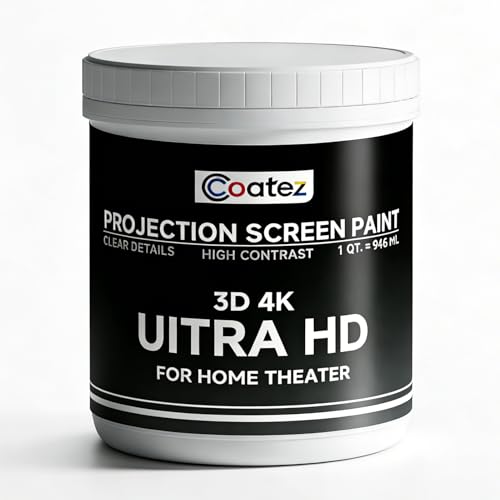
COATEZ Projector Screen Paint (1 QT / 946 ML)
COATEZ in the quart size works well as a low-risk entry point. The smaller container lets you treat an accent wall or a kids room without committing to a full gallon investment. Owners report acceptable brightness and color neutrality for casual movie watching, though surface prep remains critical with any paint product. The formulation is straightforward and does not require specialty rollers or primers beyond basic wall cleaning.
- Lowest entry price in the COATEZ lineup for trying the product
- Straightforward application without specialty tools
- Quart volume limits usable area to small walls or test patches
Skip it if your target surface exceeds roughly the size of a standard 70-inch screen area, where the coverage math becomes unfavorable.
Mollor Projector Screen Paint 16 Fl Oz
Mollor’s smallest container is genuinely the cheapest projector screen paint on this list by dollar amount. It is designed for short-throw projectors and claims 1080p and 4K UHD compatibility. At sixteen fluid ounces, however, the realistic coverage area is limited. This makes sense for a compact desk projection surface or a very small wall in a bedroom. Owners who used it on appropriately sized surfaces report clean, even results.
- Lowest absolute price makes it accessible for first-time experimenters
- Works cleanly within its small coverage envelope
- The tiny volume means you will likely need two or three containers for any standard viewing wall
Skip it if you are planning anything beyond a novelty surface. The per-square-foot cost when you need multiple bottles erodes the savings quickly.
Mollor Projector Screen Paint 32 Fl Oz
The double-sized Mollor container addresses the coverage limitation of its smaller sibling while keeping the price relatively modest. It remains positioned for short-throw setups and casual home use. Owners comparing it to pricier brands note that color accuracy holds up well for streaming content and standard-definition sources, though it lacks the contrast-enhancing chemistry of dedicated theater paints. The single-coat promise is generally fulfilled on smooth, properly primed walls.
- Best value within the Mollor line for typical bedroom or game room walls
- Reliable single-coat finish on well-prepared surfaces
- White finish offers no ambient light rejection, so dark rooms are essential
Skip it if your viewing space has large windows or open floor plans that flood the wall with daylight.
High Definition Ultra White Projector Screen Paint (Quart)
Positioned as a mid-range option, this quart promises 4K and 8K compatibility on a pure white surface. The formulation targets high-definition clarity without tinting or color shift that some cheaper paints introduce. Owners report a bright, neutral image that pairs well with projectors that already have strong native contrast. The quart volume suits rooms where the wall area falls between what a 16-ounce bottle handles and what a full gallon covers.
- Bright, color-neutral surface that preserves projector calibration
- Quart size offers a practical middle ground for medium walls
- Priced higher per ounce than COATEZ or Mollor equivalents
Skip it if budget is your primary driver. You can reach comparable brightness from the COATEZ 35 oz option for less money.
Paint on Screen Silver Projector Screen Paint (1 Gallon)
The silver variant is a different tool than the white S1. Silver finishes gain brightness by reflecting more light back toward the viewer, which is useful in rooms where total darkness is unrealistic. It is not a contrast-enhancing product; it is a brightness-preserving one. Owners in family rooms with ambient light report that this paint keeps the image watchable where a white coat would look washed out. Coverage on a gallon handles a full theater wall.
- Higher brightness than white formulas in rooms with ambient light
- Gallon coverage handles large walls in one application
- Silver surface can introduce visible grain or sparkle at short viewing distances
Skip it if you sit close to the wall or have a short-throw projector where surface texture becomes obvious from the viewing angle.
High Definition Ultra White Projector Screen Paint (Gallon)
The gallon version of the High Definition Ultra White offers the same bright, neutral surface in a container sized for a full wall. When you run the per-square-foot numbers, this gallon undercuts the Paint on Screen Silver on price while delivering a cleaner white finish. Owners with dark-managed rooms get a crisp, uniform surface that does not compete for attention with the projected image.
- Most cost-effective gallon option in this roundup for large dark rooms
- Consistent white tone without sparkle or grain issues
- Requires near-dark viewing conditions to show its best results
Skip it if your room cannot achieve a dark viewing environment. In that scenario, the silver Paint on Screen option handles ambient light better despite the higher price.
COATEZ Projector Screen Paint (35 oz, Covers 100-120 sf)
With a published coverage range of 100 to 120 square feet, this COATEZ container makes the best coverage-per-dollar argument in the entire list. At under $65 it paints more wall than anything else except the two full-gallon options. The formulation delivers a solid white surface that owners describe as bright and even on properly primed walls. The container size is convenient for a standard 100-inch diagonal screen area.
- Best price-per-square-foot value in the entire roundup
- Coverage claim matches or beats larger containers from premium brands
- Surface finish quality, while good, does not quite match Paint on Screen premium lines
Skip it if you demand the absolute finest optical performance for a reference-quality home theater. For everyday viewing, it punches above its price.
Buying Guide
Match the Finish to Your Room’s Light Conditions
White projector screen paint performs best in rooms where you can achieve near-total darkness. Silver or contrast-enhanced formulations sacrifice some color neutrality to maintain image punch when ambient light is present. Before choosing a product, assess how much light hits your wall during typical viewing times. If you cannot control windows with blackout curtains, a silver or gray-tinted option will keep your image watchable where white would disappear.
Calculate Coverage Per Square Foot Before Comparing Prices
A 16-ounce container at fifty dollars and a 35-ounce container at sixty-five dollars are not the same purchase. The COATEZ 35 oz covers 100 to 120 square feet, meaning its effective rate is well under fifty cents per square foot. Mollor at sixteen ounces likely covers a fraction of that. Divide the published coverage by the price to get your true cost, then measure your wall to know how many containers you actually need.
Surface Preparation Determines Outcome More Than Paint Quality
Every product in this category applies the same requirement: the wall must be smooth, clean, and free of texture. Orange-peel drywall, nail holes, and patch marks will show through any projector screen paint once the beam hits them at an angle. Budget time for sanding, filling, and priming before you open a can. A $50 paint on a perfectly prepped wall will outperform a $249 paint on a neglected surface.
Our Verdict
Our top pick for dedicated home theater rooms is the Paint on Screen S1 Ultimate Contrast at $249 per gallon. It delivers the deepest blacks and cleanest single-coat finish of any product in this comparison, and if you are building a purpose-made viewing room, that difference justifies the cost. For budget-conscious buyers who still want a large, bright surface, the COATEZ 35 oz container at $64.99 offers unmatched value per square foot with solid results on dark walls. One condition changes the answer entirely: if your room has windows you cannot cover, the Paint on Screen Silver Gallon at $205 handles ambient light better than any white product here, making it the correct choice despite the premium.
FAQ
Can I use regular white wall paint instead of dedicated projector screen paint?
Regular white paint will produce an image, but the finish quality is noticeably inferior. Dedicated formulations control reflectivity, minimize hot-spotting at the center of the beam, and reduce the visible grain or roller texture that standard wall paints amplify under projection. The difference is subtle at casual distances but obvious in a dark room with a calibrated projector.
How many coats does projector screen paint actually need?
All products in this list claim single-coat coverage, and owner feedback broadly supports that on properly primed, smooth surfaces. Walls with existing color or heavy texture may need a primer coat first, which adds labor but does not change the topcoat requirement. Expect one coat of the projector screen paint itself in typical installations.
Does projector screen paint work with short-throw projectors?
Short-throw projectors cast light at a steep angle, which makes surface imperfections more visible than with long-throw setups. The Mollor and Paint on Screen lines explicitly design formulations for short-throw compatibility, and they tend to produce a finer surface texture that holds up under oblique light angles. Verify the product description before purchasing for a short-throw application.
How long does a painted screen last before it needs repainting?
Owner reports suggest several years of consistent image quality on interior walls that are not exposed to direct sunlight or physical abrasion. Dust accumulation affects appearance more than the paint degrading. A dry microfiber wipe restores brightness. Walls in high-traffic areas or rooms with pets may need touch-up sooner than a dedicated theater space.