A decent projector can turn a blank wall into something passable, but anyone who has tried to watch a dark scene on a textured paint surface knows the difference between “passable” and “actually good.” The right indoor projector screen flattens that texture, protects contrast from ambient light, and delivers a genuinely uniform image without dominating your room when you are not using it. The market is packed with options spanning from an eleven-dollar foldable sheet to a full motorized drop-screen, and the gap between them is wider than the price difference alone suggests.
What separates a screen you will leave up year-round from one that goes back in a closet after a single movie night comes down to surface material, frame rigidity, and whether the size matches your actual throw distance. A cheap PVC sheet creases permanently and looks rough under side lighting. A thin panel on a lightweight tripod can wobble and introduce visible distortion. And a 120-inch diagonal is useless if your projector sits three feet from the wall. We compared published specifications and owner feedback on every model below to sort the genuinely usable options from the ones that look good in product photos but fail in a real living room.
Our top picks
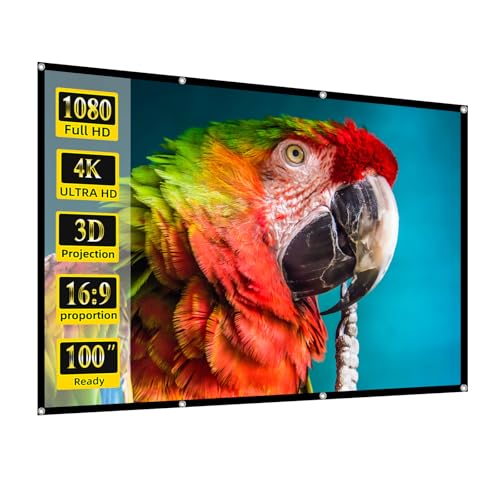
 Mdbebbron 120 inch Projector Screen 16:9 Foldable
- Compact one-piece,lightweight and folding design
- Ideal choice for home theater movie,office,education, conference room…
- Made with natural Polyester fabric that The projection…



 120inch Projector Screen with Stand: Portable Projector
- UNWAVERING STABILITY & REINFORCED BASE:Say goodbye to wobbly…
- Built for the outdoors
- Immerse yourself in stunning picture quality
As an Amazon Associate we earn from qualifying purchases at no extra cost to you.
Quick Picks
| Product | Best for | Price |
|---|---|---|
| Mdbebbron 120″ Foldable | Best value for large portable surfaces | $20.39 |
| Projector Screen with Stand, 80″ | Small rooms and tight spaces | $69.99 |
| Portable with Stand 80″ Camping | Dual indoor and outdoor flexibility | $45.59 |
| IOLIEO 120″ Black Backing | Ambient light control without a stand | $36.99 |
| Motorized 120″ | Dedicated home theater installations | $149.99 |
| TOWOND 100″ with Stand | Mid-size rooms wanting front and rear projection | $59.99 |
| 120″ with Stand | Backyard-to-indoor versatility at full size | $99.99 |
| Projector Screen 100″ Foldable | Ultra-budget pick for occasional use | $11.99 |
How We Picked
We evaluated every screen in this roundup across four criteria drawn from published specs and recurring themes in owner feedback: surface quality (material, gain rating, and whether black backing is present to protect contrast in lit rooms), size appropriateness for typical indoor throw distances rather than maximum possible diagonal, portability (foldability, included stand, carrying solution, and weight), and build durability over repeated setup and teardown cycles. Price was factored in relative to the combination of those four attributes, never in isolation.
The 8 Best Projector Screen Indoor in 2026
Mdbebbron 120 Inch Foldable
Best for anyone wanting a large surface without committing to a stand or permanent installation. The anti-crease treatment holds the matte white face flatter than unprotected fabric, and double-sided projection lets you use it as a room divider between a projector and two viewing areas. At just over twenty dollars, the size-to-cost ratio is the best on this list.
- Double-sided design enables rear projection or room-divider placement that single-sided screens cannot match.
- Anti-crease surface treatment resists permanent wrinkles far better than untreated fabric at a similar price.
- No stand or mounting hardware is included, so you must supply your own wall, hooks, or frame.
Skip this if you need a freestanding setup. Without a way to hang it, the bottom edge will sag and crease during use, undermining the very flatness the fabric promises.
Projector Screen with Stand, 80 Inch Fiberglass
Best for owners in compact bedrooms or studio apartments where 80 inches fills the available wall space without overwhelming the seating distance. The 1.2 gain fiberglass surface is a meaningful step up from matte white fabric, retaining more light from the projector so dark scenes remain readable even with some ambient glow.
- Fiberglass surface holds its shape flat after years of folding, resisting the permanent creases that PVC sheets develop.
- The 1.2 gain rating compensates for brightness loss at shorter throw distances common in tight rooms.
- At 80 inches, the image width is roughly 70 inches on a 16:9 panel, which feels modest for dedicated theater viewing.
Skip this if your room gives you more than six feet of throw distance. You will want the extra visual impact of a 100 or 120-inch panel, and the budget saved here is better spent on size.
Portable Projector Screen with Stand, 80 Inch Camping
Best for the owner who wants one screen that lives in a closet during cold months and gets pulled out for a backyard movie in summer. The integrated carry case and tripod stand make it genuinely transportable in a single motion, and at under fifty dollars it undercuts most comparable all-in-one models.
- The collapsible frame fits into a compact bag small enough for a car trunk or under a bed.
- Priced noticeably below other tripod-mounted options with similar feature sets without obvious material shortcuts.
- Owner feedback indicates the frame flexes in wind, limiting outdoor reliability to calm evenings.
Skip this if you are buying primarily for indoor use. The 80-inch size and basic surface offer no clear advantage over better-valued indoor-focused options at or below this price point.
IOLIEO 120 Inch with Black Backing
Best for anyone whose living room has windows that cannot be fully covered or recessed lighting that cannot be turned off completely. The black backing blocks stray projector light from passing through the surface and washing out the image, which is the single most effective way to protect contrast without full darkness.
- Black backing noticeably improves perceived contrast in rooms where you cannot control all ambient light sources.
- The foldable 120-inch panel stores flat behind a door or in a closet, offering large-image impact in a thin package.
- Ships as a bare sheet with no stand, so mounting requires separate hardware like hooks, Velcro strips, or a tension frame.
Skip this if you want a grab-and-go setup with zero extra purchases. A tripod-mounted alternative eliminates the mounting problem even if it costs a few dollars more.
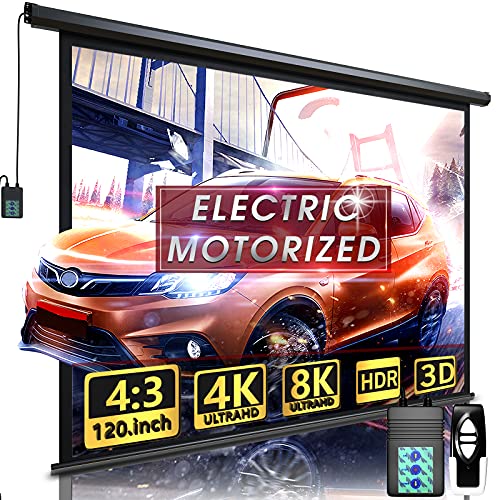
Motorized Projector Screen 120 Inch
Best for a dedicated media room or living room where you want the screen to vanish completely when not in use. The remote-controlled electric drop mechanism is the only option here that gives you a clean wall in seconds, and the motorized tension system holds the surface flatter than any foldable fabric.
- One-button deployment means zero setup friction and no carrying, folding, or frame assembly.
- The motorized tension keeps the surface uniformly flat across the entire panel, producing the most consistent image on this list.
- At nearly $150, it costs roughly seven times a foldable screen and the motor mechanism is a long-term failure point that simpler designs lack.
Skip this if your viewing is occasional. For a spare room used twice a month, a twenty-dollar foldable screen delivers a nearly identical image with none of the mechanical complexity or wall-mounting requirement.
TOWOND 100 Inch with Stand
Best for buyers who want a complete front-and-rear-capable screen on a proper tripod for a mid-size room. At 100 inches, it hits the sweet spot where the image feels genuinely immersive without requiring the seating distance that a 120-inch panel demands.
- Front and rear projection capability makes it workable in unusual layouts, such as when a projector sits behind the screen between two rooms.
- The included carry bag turns storage and transport into a one-step process without separate packaging.
- Some owner reports mention tripod leg joints loosening after repeated folding, gradually introducing wobble during projection.
Skip this if you will set the screen up and leave it for weeks or months at a time. A wall-mounted or motorized option avoids the repeated joint-wear concern entirely.
120 Inch Projector Screen with Stand
Best for someone who wants the largest possible freestanding image without a wall mount or permanent installation. The included sandbag anchor is a practical wind-stabilization detail that separates it from cheaper tripod screens that topple in a slight breeze during outdoor-to-indoor transitions.
- The included sandbag provides a small but genuinely useful wind anchor for anyone using this outdoors before moving it inside.
- At 120 inches on a stand, it delivers near-wall-sized impact with zero mounting hardware required.
- The full package is bulky and heavy, making quick closet-to-room setups a physical effort in a multi-use space.
Skip this if your room comfortably seats viewers at 80 to 100 inches. The extra size and weight are not worth the storage and transport penalty unless you genuinely need the full diagonal.
Projector Screen 100 Inch Foldable
Best for one-off presentations, a first projector purchase, or anyone testing what size and brightness their projector can actually deliver before spending more. At just under twelve dollars, it costs less than a single movie ticket for two people and provides a roughly comparable visual experience for casual viewing.
- The price is absurdly low for a 100-inch 16:9 surface, making it a low-risk starting point to learn your projector’s real capabilities.
- Lightweight and genuinely compact when folded, easy to store in a drawer or slide behind furniture.
- The fabric quality does not match any other screen on this list; dark scenes will show uneven light response across the surface.
Skip this if you plan to watch content with real contrast — dark thrillers, games with shadow detail, or nature documentaries. The surface quality will frustrate you within a single session and you will end up replacing it anyway.
Buying Guide
Surface Material and Gain Rating
Matte white fabric scatters light broadly, which means wide viewing angles but lower peak brightness on screen. High-gain surfaces (1.1 and above) push more light back toward the viewer, recovering brightness in rooms where you cannot fully control ambient light — but they narrow the optimal viewing cone. Fiberglass panels hold their shape and resist permanent creasing, making them the best surface option in the sub-$75 tier. PVC sheets are cheaper but crease easily and rarely recover their flatness after storage. For indoor use in a typical living room with a window or two, prioritize either a black-backed surface or a gain rating above 1.0, because these two features directly counteract the ambient light that flattens your image.
Matching Size to Room and Throw Distance
The biggest mistake in this category is buying a screen that is larger than your room can support. Measure from the lens of your projector to the wall where the screen will sit. Most short-throw projectors require about 4 to 6 feet for an 80-inch image, and 7 to 10 feet for 100 inches. If your throw distance is fixed and shorter than what a 120-inch screen needs, that screen is simply wasted space. Also check seating distance: for 4K content, the recommended viewing distance is roughly 1 to 1.5 times the screen diagonal, so a 120-inch screen works best when viewers sit about 10 to 15 feet back.
Portability Versus Permanence
Decide how often you will set the screen up and take it down. Foldable screens without stands are cheapest and thinnest but require a mounting method you provide yourself. Tripod-mounted screens are complete systems you can deploy in minutes but take up significant storage space when folded. Motorized screens disappear into a housing or ceiling mount and deploy with a button, which makes them the only practical choice for a living room where the screen would otherwise be an eyesore when not in use. If you watch more than once a week, the convenience gap between foldable and motorized compounds rapidly and justifies the price difference for some owners.
Our Verdict
The IOLIEO 120-inch with black backing is our top pick for most indoor buyers because the black backing directly addresses the single most common indoor complaint — ambient light destroying contrast — and at $36.99 the size-to-performance ratio is unmatched. Pair it with a simple tension wire or a set of hooks and you have a large, contrast-protected surface for less than the cost of most tripod screens here. Our budget pick is the Mdbebbron 120-inch at $20.39, provided you already have a wall or method to hang it. Finally, the Motorized 120-inch becomes the clear winner when the screen must disappear: if you share the room with family who do not care about movies and want a clean wall the rest of the day, no foldable or tripod option comes close to one-button deployment.
FAQ
Do I really need a screen, or can I project onto a white wall?
You can project onto a wall, but any texture, bump, or imperfection in the paint will scatter projector light unevenly and visibly degrade dark scenes. A proper screen provides a perfectly flat, uniformly white surface that makes a real difference once your projector exceeds a basic entry-level model. If you have a smooth matte-painted wall with zero texture, you can get away with it for casual viewing.
What does “gain” mean and does a higher number always help?
Gain measures how much light the surface reflects back toward the viewer relative to a perfectly diffuse white reference. A gain of 1.2 means 20 percent more reflected brightness in the center of the image. Higher gain helps in rooms with ambient light but narrows your optimal viewing angle, so side seats get noticeably dimmer. Match your gain to your seating layout rather than just buying the highest number available.
Can I use an outdoor projector screen indoors?
Yes. Outdoor screens are typically designed to be more weather-resistant and rigid, so they work perfectly fine indoors. The only concern is that some outdoor models use higher-gain surfaces that create a hot-spot in the center of the image, which becomes more noticeable in a small enclosed room with close seating. For purely indoor use, look for a matte white or moderate gain surface instead.
Is a black backing worth the trade-offs?
If you watch in a room with windows you cannot fully cover or lights you cannot turn off completely, yes. Black backing prevents projector light from transmitting through the screen and reflecting off the wall behind it, which is one of the main causes of a washed-out, flat-looking image in a lit room. The trade-off is that the screen cannot be used for rear projection unless both sides are properly finished, and some cheap versions use painted-on backing that chips.