Key takeaways
- USB microscope cameras for insects, plants, circuit boards, minerals and coins. They focus within millimetres and include built-in LEDs.
- Planetary and solar-system imagers that replace an eyepiece in a telescope for the Moon, planets and, with a proper solar filter, the Sun.
- Standard webcams used as lab or document cameras, to broadcast an experiment or a demonstration to a class.
The best science webcam depends on what you want to look at: for close-up specimens in a classroom or at a hobby bench, a USB digital microscope such as the Plugable 250x or the Dino-Lite AM4113T works like a webcam with a lens built for tiny things, and for the Moon and planets, a small planetary camera such as the ZWO ASI120MC-S gives far more detail than any ordinary webcam. A normal 1080p webcam like the Logitech C920 is still a good choice for streaming lab demonstrations, but it cannot focus closer than a few centimetres or resolve distant planets.
Our top picks



As an Amazon Associate we earn from qualifying purchases at no extra cost to you.
Three kinds of science webcam
- USB microscope cameras for insects, plants, circuit boards, minerals and coins. They focus within millimetres and include built-in LEDs.
- Planetary and solar-system imagers that replace an eyepiece in a telescope for the Moon, planets and, with a proper solar filter, the Sun.
- Standard webcams used as lab or document cameras, to broadcast an experiment or a demonstration to a class.
Quick comparison of science webcams
| Pick | Best for | Sensor and magnification | Price tier |
|---|---|---|---|
| Plugable USB2-MICRO-250X | Classroom and beginners | 2MP, 1600×1200 at 30Hz, 40x to 250x digital, 4 LEDs, stand included | Budget |
| Celestron Handheld Digital Microscope Pro | Students and hobbyists | 5MP-class sensor, 20x to 200x, 8 LEDs, stand and software | Mid |
| Dino-Lite AM4113T | Professional-grade handheld | 1.3MP, 20x to 50x and up to about 220x, 8 LEDs, calibrated measurement software | Upper-mid |
| ZWO ASI120MC-S | Moon and planets | 1280×960 colour sensor, 3.75 micron pixels, USB 3.0, 1.25 inch fit | Mid |
| Celestron NexImage 10 | Higher-resolution lunar views | 3856×2764 colour sensor, 1.67 micron pixels, USB 3.0 | Mid |
| Logitech C920 | Streaming classroom demos | 1080p at 30fps, autofocus | Mid |
Some of these planetary cameras are listed as discontinued by retailers, so check availability and look at newer models from the same makers.
Best for beginners: Plugable USB2-MICRO-250X
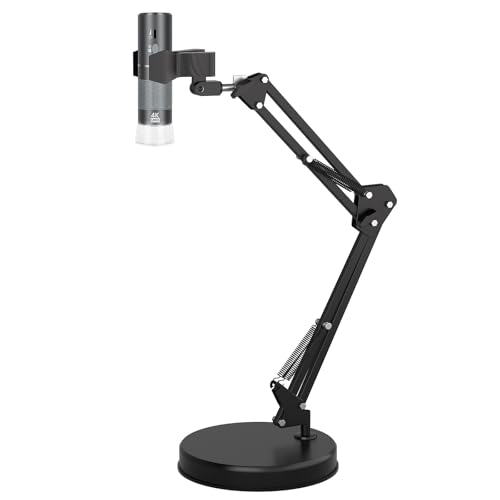
This is a 2MP camera that captures 1600×1200 video at 30Hz over USB 2.0 and runs on bus power alone. It has four LEDs, a flexible arm stand and works through ordinary webcam software on Windows, Mac and Linux, according to Plugable’s specifications. Because it behaves like a webcam, it also works in Zoom or OBS, which makes it handy for remote lessons. The limits are the modest sensor and a stand that can wobble at higher magnification.
Best for students: Celestron Handheld Digital Microscope Pro
This model pairs a 5MP-class sensor with a glass lens, 8 adjustable LEDs, an adjustable-height stand and MicroCapture Pro software for Windows and Mac. It quotes 20x to 200x magnification depending on monitor size. Retailers list different sensor versions (1600×1200 on older units, and a newer 5MP version), so confirm the version you are buying. It is a good all-round pick for biology and geology projects.
Best professional handheld: Dino-Lite AM4113T
The AM4113T has a 1.3MP sensor producing 1280×1024 video, 8 white LEDs, a MicroTouch button to capture without shaking the camera, a magnification lock, and DinoCapture software with calibrated measurement, per Dino-Lite. Its official ranges are 20x to 50x and 200x, with a practical top near 220x. It is more expensive than basic scopes, but the build and measurement software justify it for labs and inspection work.
Best for planets: ZWO ASI120MC-S
The ASI120MC-S is a colour planetary camera with a 1/3 inch sensor at 1280×960 resolution, 3.75 micron pixels and USB 3.0. ZWO states it can run at 60fps at full resolution and far higher at smaller crops, which lets you capture thousands of frames and stack the sharpest ones. It slides into a standard 1.25 inch focuser. It is a single-purpose tool: you also need a telescope and a mount.
Best for higher resolution on the Moon: Celestron NexImage 10
The NexImage 10 uses a 10MP colour sensor, 3856×2764 pixels at 1.67 microns, to capture large lunar mosaics. It connects by USB 3.0 and is designed for a 1.25 inch focuser. Its small pixels demand good seeing and a steady mount to be useful.
How to choose: a worked example for astronomy
Image scale in arcseconds per pixel equals 206.265 x pixel size in microns divided by telescope focal length in millimetres. With the ASI120MC-S (3.75 micron pixels) on a 2,000mm focal length telescope, the scale is 206.265 x 3.75 / 2000 = about 0.39 arcseconds per pixel. Typical atmospheric seeing is one to two arcseconds, so that sampling is already finer than the sky allows, and a Barlow lens will not add real detail. The same maths shows why tiny pixels, like the NexImage’s 1.67 microns, often make sense only with short focal lengths.
- Microscope cameras. Higher claimed magnification is not higher detail. A 2MP sensor limits real detail, so choose a camera for its sensor, lens and lighting rather than the 250x label.
- Lighting. Adjustable LEDs reduce glare on shiny specimens. Polarised light helps with metals and coins.
- Software. Check calibrated measurement and time-lapse features if you plan to measure specimens.
- Safety. Never point any camera at the Sun without a certified solar filter on the front of the telescope.
Decision matrix
| Your goal | Pick |
|---|---|
| Look at leaves, insects, coins | Plugable 250x or Celestron Handheld Pro |
| Measure parts, inspect circuit boards | Dino-Lite AM4113T |
| Photograph the Moon and planets | ZWO ASI120MC-S or NexImage 10 |
| Show a class an experiment live | Logitech C920 on a stand |
Using a science webcam well
Good technique matters as much as the camera. For microscope work, keep the camera still, because at 200x a tiny vibration turns into a large blur. A sturdy stand, a weighted base and the MicroTouch or software capture button instead of a hand press all help. Use diffuse light and avoid putting the LEDs too close to shiny objects, which creates glare. For flat specimens, adjust the height until the focus ring is near the middle of its range, which leaves room to fine tune.
Planetary imaging workflow
- Align the telescope and centre the planet at low power in an eyepiece first.
- Swap the eyepiece for the camera and focus on the planet’s edge or on a bright star nearby.
- Record short videos of 1-3 minutes with fast exposures, because the planet rotates and the atmosphere shifts.
- Stack the best frames with free software such as AutoStakkert and RegiStax. Combining hundreds or thousands of frames reduces noise and atmospheric blur.
- Sharpen gently with wavelets and finish with colour balance.
In class, a USB microscope also doubles as a measuring device. If the software supports calibration, you can measure leaf cells, fibre thickness or coin details in micrometres. Compare results across a group and discuss the uncertainty, which is part of the scientific method. For data logging, save images with the date and magnification in the filename so results can be repeated and compared later.
Frequently Asked Questions
Can a normal webcam work as a microscope?
Not well. Standard webcams cannot focus closely enough. A USB microscope has the right lens and lighting.
Can I use a webcam on a telescope?
Yes, with a modified camera or a planetary imager designed for a 1.25 inch focuser. Planetary cameras give better results.
Is higher magnification always better?
No. Beyond the sensor’s resolution, higher numbers only enlarge a blurry image.
Do USB microscopes need special software?
Basic models work with standard webcam apps. Dino-Lite and Celestron provide software for measuring and capture.
Are USB microscopes good for kids?
They are a safe and popular science tool for supervised use, and the inexpensive models suit younger students.