Key takeaways
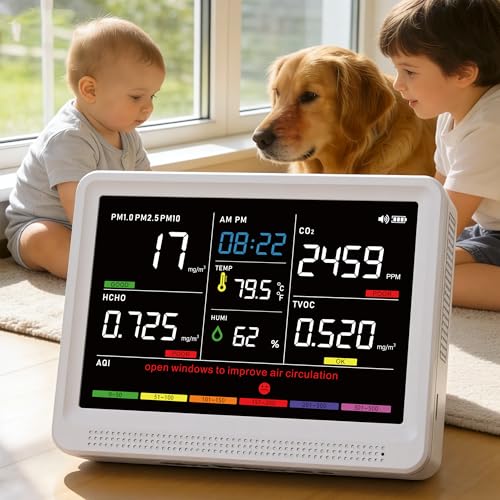
- Budget: Portable handheld or desktop meters in the Temtop class. They give a PM2.5 figure and some comfort data, and they are useful for spot checks around the house. Expect simpler software, and make sure the model you pick lists the sensor type in its specifications.
- Mid-range: Awair Element and similar Wi-Fi monitors. This tier adds long-term history, app alerts and smart-home hooks.
- Premium: Airthings View Plus and IQAir AirVisual Pro, which add either radon sensing or a stronger outdoor-comparison ecosystem and a more developed display.
For most households, a Wi-Fi indoor monitor that tracks PM2.5 alongside CO2 and humidity, such as the Awair Element or IQAir AirVisual Pro, is the sensible starting point, while people who also care about radon should look at the Airthings View Plus, and anyone who wants outdoor smoke data should consider a PurpleAir unit. The right choice depends on where the monitor will live, whether you want a screen on the device or an app, and which other gases matter to you besides fine particles.
Our top picks



As an Amazon Associate we earn from qualifying purchases at no extra cost to you.
What a PM2.5 monitor actually measures
PM2.5 refers to airborne particles smaller than 2.5 micrometers across. Sources include cooking, candles, wildfire smoke, vehicle exhaust drifting indoors and some cleaning or hobby activities. Consumer monitors count these particles with a small laser-scattering sensor: a fan draws air through a chamber, a laser lights the particles, and a photodiode converts the scattered light into a concentration reading in micrograms per cubic meter. Sensor families made by companies such as Plantower and Sensirion appear in many consumer devices, and several makers name the sensor they use in their specification pages.
Reviewers and independent air-quality researchers generally note that these sensors are good at showing trends and relative changes, such as a spike when a pan starts smoking, but are not laboratory instruments. Humidity can inflate readings, and very small or very large particles are counted less accurately. Treat the number as a guide to when to ventilate or run a purifier, not as a diagnostic result.
At a glance: current options compared
| Monitor | Best for | Key stated measurements | Limits |
|---|---|---|---|
| Awair Element | Living rooms and bedrooms where a clean look matters | The maker lists PM2.5, CO2, VOCs, temperature and humidity | Wi-Fi app is the main interface; no radon sensing |
| IQAir AirVisual Pro | Users who want a built-in screen and local plus outdoor comparison | The maker lists PM2.5, CO2, temperature and humidity, with outdoor data in the app | Larger body than minimalist rivals |
| Airthings View Plus | Homes concerned about radon as well as particles | The maker lists radon, PM2.5, CO2, VOCs, humidity, temperature and pressure | Premium tier; radon readings take days to settle |
| PurpleAir Flex or Zen | Wildfire regions and outdoor monitoring | Laser particle sensing with a public map option | Focused on particles; fewer gas sensors |
| Temtop series (for example the M10 class) | Budget-minded buyers who want a portable meter | Typically PM2.5 plus other particle sizes and basic comfort readings | Less polished apps; accuracy details vary by model |
Model lineups change, so confirm the exact variant sold under each name before buying. Where a maker has released a newer revision, the older one may still circulate as a previous generation.
Indoor monitors: the three that cover most needs
Awair Element
The Element is a wall or shelf device with a light bar that shows overall air quality at a glance. The maker lists PM2.5, CO2, total volatile organic compounds, temperature and humidity. Reviewers tend to praise its design and its app history charts, and its integration with common smart-home platforms. The trade-off is that you depend on the app for detail, and VOC readings are an index rather than a measurement of specific chemicals.
IQAir AirVisual Pro
IQAir is better known for purifiers and its outdoor air-quality map, and that heritage shows. The AirVisual Pro has a front display and pairs indoor readings with local outdoor air-quality information in its app, which helps answer the question of whether opening a window is a good idea. The maker lists PM2.5, CO2, temperature and humidity. It suits buyers who want a number visible across the room without opening a phone.
Airthings View Plus
Airthings built its name on radon detection, and the View Plus adds particle sensing. Radon is a long-term exposure concern, and national health agencies advise that results from home devices be interpreted using the guidance in their official materials; if readings look elevated, speak with a qualified radon professional. The device is a good fit for basements, lower-level bedrooms and homes in higher-radon regions, but it is more than you need if you only care about smoke and cooking particles.
Outdoor and wildfire use
PurpleAir sensors are widely used for neighborhood smoke monitoring because owners can share data on a public map. The maker offers indoor-oriented and outdoor-oriented models, so pick the one that matches where you will mount it. Several outlets that cover wildfire seasons note that raw readings from these sensors tend to read high in heavy smoke unless a correction is applied, and the maker and map provider describe correction options on their pages. If your main goal is deciding when to close windows, trend direction matters more than the absolute figure.
Budget, mid-range and premium tiers
- Budget: Portable handheld or desktop meters in the Temtop class. They give a PM2.5 figure and some comfort data, and they are useful for spot checks around the house. Expect simpler software, and make sure the model you pick lists the sensor type in its specifications.
- Mid-range: Awair Element and similar Wi-Fi monitors. This tier adds long-term history, app alerts and smart-home hooks.
- Premium: Airthings View Plus and IQAir AirVisual Pro, which add either radon sensing or a stronger outdoor-comparison ecosystem and a more developed display.
Placement, size and power notes
- Place the monitor at breathing height, away from direct airflow from vents, fans and purifiers, which can skew readings.
- Keep it a few feet from the stove if you want a representative room reading rather than a cooking-spike reading, and place a second unit in the kitchen if that is your concern.
- Most Wi-Fi units use mains power through a cable; some, like the Airthings View Plus, can run on batteries with a different refresh cadence according to the maker. Check the manual for how battery operation changes update frequency.
- Laser sensors with fans need occasional gentle cleaning of the intake. Follow the manufacturer’s instructions rather than opening the sensor chamber.
- Wi-Fi bands matter: several monitors only connect to 2.4 GHz networks according to their setup guides.
Pick X if…
| Pick this | If you want |
|---|---|
| Awair Element | A tidy, app-driven indoor monitor with CO2 and VOC trends in the bedroom or living room |
| IQAir AirVisual Pro | A readable display and indoor versus outdoor comparison in one place |
| Airthings View Plus | Radon tracking on top of particles, CO2 and VOCs |
| PurpleAir Flex or Zen | Outdoor smoke awareness or contributing to a neighborhood map |
| Temtop-class meter | A low-cost handheld for checking different rooms and sources |
Alternatives worth a look
- Dedicated CO2 meters such as the Aranet4: excellent for ventilation, but they do not measure PM2.5, so they complement rather than replace a particle monitor.
- Air purifiers with built-in particle sensors: many purifiers from Dyson, Coway, Blueair and others show a PM2.5 reading on the unit. These are convenient, but a separate monitor placed elsewhere in the room can show whether the purifier is actually helping.
- Smart-home hubs with air sensors: some ecosystems offer sensor add-ons that report into their own dashboards, which can be the simplest path if you already use that platform.
Interpreting the numbers
The World Health Organization’s 2021 air quality guidelines set an annual PM2.5 level of 5 micrograms per cubic meter and a 24-hour level of 15 micrograms per cubic meter. Many national air-quality indexes use higher thresholds for their color bands, so a monitor app may show green when a reading is still above the WHO guideline. Short spikes from cooking are common and fade with ventilation. Persistently elevated readings are a reason to look for the source, such as an unvented gas stove, a smoking appliance or outdoor smoke entering the home.
These devices do not diagnose health conditions. If anyone in the household has asthma, a heart or lung condition, or symptoms that worsen indoors, speak with a doctor about how to use air-quality information alongside medical advice.
Frequently Asked Questions
Are consumer PM2.5 monitors accurate?
They are good at showing relative changes and trends, such as a jump after frying food or the effect of a purifier. Independent evaluations of low-cost laser sensors report that accuracy varies with humidity, particle type and calibration. Use the reading as a practical guide rather than a certified measurement.
Do I need a monitor if I already own an air purifier with a display?
Not necessarily, but a separate monitor gives a second opinion from a different spot in the room. A purifier’s sensor sits next to its own intake, so it can read lower or higher than the rest of the room.
Where is the best place to put a PM2.5 monitor?
Choose a spot at roughly breathing height, away from windows, vents, fans and the purifier outlet. A bedroom is a popular location because of the time spent there, while a second device near the kitchen helps identify cooking sources.
Should I buy one with CO2 and VOC sensing too?
If you care about ventilation, CO2 is a helpful extra because it rises when rooms are crowded and closed up. VOC readings are generally an index, so treat them as a prompt to ventilate rather than as a precise chemical measurement.
Can a PM2.5 monitor detect carbon monoxide or gas leaks?
No. Particle monitors do not replace certified carbon monoxide, smoke or gas alarms. Keep those safety devices installed and maintained according to their manuals and local rules.
How often should I clean or replace the sensor?
Makers generally say to keep the intake free of dust and to follow the care instructions in the manual. Laser sensors have a stated service life by manufacturer, so consult the specification sheet for the model you own.
More from Amazon
Programs that pair well with the guide above. Offers and eligibility are set by Amazon and may change.
Free shipping on eligible items, Prime Video and more. Eligible new members can start with a free trial.
Start a Prime free trialAd-free music streaming. Eligible new subscribers can start with a free trial.
Try Music Unlimited freeA Prime membership for ages 18-24 with a trial period. Eligibility is set by Amazon.
See Prime for Young AdultsAudiobooks and podcasts to listen to on the go. Eligible new members can start with a free trial.
Try Audible freeAs an Amazon Associate we earn from qualifying purchases.