Key takeaways
- Kodak Luma 75 review: a pocket DLP projector with 1080p input, a 100-inch display, and a two-hour battery. See who it fits and what to check first.
A pocket projector asks a buyer to accept a real trade. The Kodak Luma 75 is small enough to slip into a jacket pocket, yet it promises a picture up to 100 inches wide, so the decision is not really about size. It is about whether a palm-sized DLP projector can throw an image bright and sharp enough for the rooms and trips where it will actually be used. Buyers who expect a living-room television replacement will be disappointed, while buyers who want a portable screen for dark rooms may find it fits.
This article is written for travelers who pack light, renters and students in small rooms, and anyone who wants casual movie nights without a permanent screen. It looks at the Luma 75 on its own terms, using the specifications and features listed on its Amazon product page, and it explains where the projector works well, where it struggles, and what to check before choosing it over a larger mains-powered model.
Quick Picks
As an Amazon Associate we earn from qualifying purchases
| Product | Best for | Key spec from title |
|---|---|---|
| Kodak Luma 75 Portable Pocket Projector | Travel movie nights in dark rooms | 1080p input DLP, up to 100-inch display |
How to Choose
Brightness and Room Light
The first thing to understand about any pocket projector is that brightness decides where it can be used. The Luma 75 is built for dark or dim rooms, and its picture looks best after sunset or with curtains drawn. In a bright living room with sunlight coming through windows, the image washes out and fine detail disappears, no matter how close the projector sits to the wall. Before buying, think about the rooms where the projector will run most often. If evening viewing in a bedroom, a hotel room, or a backyard after dark is the plan, the brightness is workable. If daytime viewing in a sunlit room matters, a larger mains-powered projector with higher light output will serve better.
Resolution and Image Size
Resolution determines how clean the picture looks once the image grows large, and the Luma 75 accepts a 1080p input signal, which keeps films and shows looking smooth on a wall or screen. The projector can expand the picture up to 100 inches, but bigger is not always better with a pocket-sized light source. At modest sizes, roughly the width of a large television, text and faces stay crisp and colors hold up well. Push the image toward the full 100 inches in anything but a dark room and softness creeps in at the edges. Match the screen size to the room: a smaller throw in a dark space gives a sharper result than a giant image fighting ambient light.
Battery Life and Power
A pocket projector earns its keep when it runs without a wall outlet, and the Luma 75 carries a rechargeable battery rated for up to two hours of playback. That covers most films and a couple of television episodes, but it will not carry a full evening of back-to-back viewing without a recharge or a power bank nearby. Plan around that limit by keeping the charging cable in the travel case. The projector also runs while plugged in, so a long film night at home is easy to manage with an outlet close by. For flights, road trips, and camping, confirm the battery is fully charged before leaving, since there may be no outlet at the destination.
Connections and Built-in Sound
Versatility matters more than any single feature in a projector this small, because it will meet a different source device in every room it visits. The Luma 75 connects through HDMI, USB, and MicroSD, so it works with laptops, streaming sticks, game consoles, flash drives, and memory cards loaded with media. The built-in media player reads files directly from a card or drive, which means a phone or laptop is not always required. Sound comes from a built-in speaker that suits a quiet room, and a 3.5mm audio output allows headphones or an external speaker when the room is larger or noisier. Check that the cables and adapters for the intended source device are packed with the projector.
The 1 Best Option
Kodak Luma 75 Portable Pocket Projector

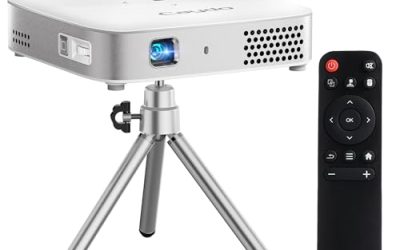
The Kodak Luma 75 is the smallest and lightest DLP projector in its line, weighing 150 grams and measuring 3.1 by 3.1 by 0.79 inches, so it fits in a pocket or a small bag compartment. It accepts a 1080p input and projects an image up to 100 inches wide with 16.7 million colors and a 1300:1 contrast ratio, which gives films a warm look in a dark room. HDMI, USB, and MicroSD inputs cover most source devices, the built-in speaker handles quiet rooms, and the rechargeable battery runs up to two hours. An EVA travel case is included, so the projector, cables, and accessories travel as one kit.
Specs
- DLP projection technology
- 1080p input
- 16.7 million colors
- 1300:1 contrast ratio
- Up to 100-inch display
- Weighs 150 grams
- Measures 3.1 x 3.1 x 0.79 inches
- Built-in speaker with 3.5mm audio output
- HDMI, USB, and MicroSD inputs
- Built-in media player
- Rechargeable battery, up to 2 hours of playback
- EVA travel case included
Best for: Travelers and renters who want a pocket-sized projector for films and shows in dark rooms.
Watch out for: The picture fades in bright rooms, and the two-hour battery limit needs planning for longer viewing sessions.
Which One Fits Your Situation
Frequent Traveler Who Wants Movies on the Go
For a traveler, the Luma 75 makes sense because it weighs only 150 grams and packs into its EVA case with cables and accessories. In a hotel room after dark, it turns a blank wall into a screen far larger than any laptop or tablet. The two-hour battery covers a film, and HDMI and USB inputs connect to a laptop or streaming stick. Pack the charging cable and a small speaker for better sound in a larger room.
Renter or Student in a Small Room
Renters and students who cannot mount a television or drill into walls get a screen without any permanent setup from the Luma 75. It sits on a desk or shelf, projects onto a bare wall, and goes back in a drawer when the evening ends. The 1080p input keeps shows looking clean at the modest image sizes a bedroom allows. Keep the room dark for the best picture and use headphones through the 3.5mm output when housemates are nearby.
Backyard Movie Nights
A backyard screening after sunset is one of the best uses for the Luma 75, since darkness solves its main weakness. Set the projector on a table or tripod, point it at a white sheet or a screen, and run films from a MicroSD card or a laptop over HDMI. The built-in battery avoids trailing a power cable across the yard, though an external speaker helps the sound carry outdoors. Bring the projector inside promptly if dew or rain threatens.
Classroom or Meeting Room Presentations
For small-group presentations, the Luma 75 works as a portable display that fits in a bag alongside a laptop. Slides and short clips project clearly in a dimmed room, and the HDMI input connects to almost any laptop without adapters. The built-in speaker is adequate for a handful of listeners, while the 3.5mm output feeds a room speaker for larger groups. It suits informal sessions and study groups rather than bright conference rooms with large audiences.
Common Mistakes
- Expecting a television replacement: The Luma 75 is a portable projector for dark rooms, not a bright living-room display. Buyers who plan to watch films at midday with curtains open will find the image washed out, so judge it on evening viewing, where it performs far better.
- Projecting too large in a lit room: Pushing the image toward the full 100 inches spreads the light thin and softens detail. A smaller image in a dark room looks sharper and more colorful than a giant image fighting lamps and daylight, so size the picture to the room.
- Forgetting the battery limit: The rechargeable battery runs up to two hours, which covers one film but not a full evening of viewing. Pack the charging cable and a power bank, or keep an outlet within reach, to avoid the projector shutting down mid-film.
- Relying on the built-in speaker outdoors: The built-in speaker suits a quiet bedroom, but it struggles to fill a backyard or a noisy room. Bring headphones or an external speaker through the 3.5mm output whenever the audience grows or the setting moves outside.
- Leaving cables and adapters behind: The projector connects through HDMI, USB, and MicroSD, but the right cable for a phone, laptop, or streaming stick is easy to forget. Keep every adapter in the EVA travel case so the kit is complete whenever it leaves the house.
Frequently Asked Questions
Can the Kodak Luma 75 replace a television?
It can replace a television only for casual evening viewing in a dark room. The Luma 75 projects a large image from a pocket-sized body, which suits films and shows after sunset. It cannot match a television for brightness in daylight or for all-day viewing, so anyone who watches mostly during the day should keep a television as the main screen.
How long does the battery last?
The rechargeable battery runs up to two hours on a full charge, which covers most films and a couple of television episodes. Actual runtime depends on brightness, volume, and the age of the battery, so longer sessions need a recharge or a power bank. The projector also works while plugged in, which removes the limit entirely for viewing at home near an outlet.
What devices can I connect to it?
The Luma 75 connects through HDMI, USB, and MicroSD, covering laptops, streaming sticks, game consoles, flash drives, and memory cards. Its built-in media player reads video files directly from a card or drive, so a separate source device is not always needed. A 3.5mm audio output allows headphones or an external speaker for better sound in larger rooms.
Does it work outdoors?
It works outdoors after dark, when the lack of ambient light lets the image hold up. A backyard film night with a white sheet or portable screen is a strong use case, and the battery avoids running a power cable across the yard. Bright daylight and even dusk will wash the picture out, and the projector should be brought inside after the film ends if rain or dew threatens.
More from Amazon
Programs that pair well with the guide above. Offers and eligibility are set by Amazon and may change.
Free shipping on eligible items, Prime Video and more. Eligible new members can start with a free trial.
Start a Prime free trialAd-free music streaming. Eligible new subscribers can start with a free trial.
Try Music Unlimited freeA Prime membership for ages 18-24 with a trial period. Eligibility is set by Amazon.
See Prime for Young AdultsAudiobooks and podcasts to listen to on the go. Eligible new members can start with a free trial.
Try Audible freeAs an Amazon Associate we earn from qualifying purchases.