Our Short List of 3

All 5 Picks at a Glance
| Product | Specs | Action |
|---|---|---|
| 1. Panasonic eneloop AA 8-Pack — Best Overall Rechargeable Battery for a Roku Remote | Check price on Amazon | |
| 2. Amazon Basics AA 8-Pack — Best Rechargeable Battery for Most Roku Households | Check price on Amazon | |
 3. Amazon Basics AA High-Capacity 8-Pack — Most Capacity per Cell | Check price on Amazon | |
 4. Duracell Rechargeable AA 4-Pack — Best Small Pack for a Single Remote | Check price on Amazon | |
 5. Energizer Recharge Power Plus AA 4-Pack — Best Spare Set for a Second Remote | Check price on Amazon |
Key takeaways
- Find the best rechargeable batteries for Roku remotes. Compare capacity, recharge cycles, and AA and AAA fit before you buy.
A Roku remote is a small device with a steady appetite. It wakes up dozens of times a day, and every press draws a little power. Voice remotes draw more, because the microphone and the wireless link need power between presses. Sooner or later the remote misses presses, the battery warning appears, and another pair of disposable cells goes into the bin.
Rechargeable batteries change that routine. A set of nickel-metal hydride cells can be recharged hundreds of times, so one pack covers years of remote use. This guide compares five rechargeable AA battery packs for Roku remotes. Every pick is a pack of nickel-metal hydride AA cells, batteries only, with no charger in the pack. The five cover the longest recharge life, the highest capacity per cell, the smallest pack for a single remote, and the two best-known battery brands. Before any pick, check the size your remote takes, because that single detail decides whether a pack fits at all.
Which Size Does a Roku Remote Take
Most Roku remotes take two AA batteries: the standard infrared remote bundled with Roku Express and Roku Premiere players, and the Roku Voice Remote bundled with Roku Ultra and other full-size players.
The slimmer remote bundled with Roku Streaming Stick models takes two AAA batteries instead. It has the same voice button and shortcut keys, but the body is narrower and the battery compartment is built for the smaller cell. A pack of AA cells will not fit it, no matter how good the cells are.
One Roku remote takes no replaceable cells at all. The Roku Voice Remote Pro has a built-in rechargeable battery that charges over a USB cable. If the remote has a USB charging port, it needs a cable, not a pack of cells.
For a household with both kinds of remote, the answer is one pack of AA cells for the full-size remotes and one pack of AAA cells for the stick remote. The brands in this guide sell AAA versions of the same cells.
What to Look for in Rechargeable Batteries for a Remote
A remote is a low-drain device: it draws a small current in short bursts, then sits idle for hours. That pattern makes some battery specifications matter more than others.
Capacity comes first, and it is measured in milliamp-hours, written as mAh. A higher mAh figure means the cell runs the remote longer between recharges. In this guide the figures run from 2000 mAh to 2400 mAh.
Recharge cycles come second. A cycle is one full charge and discharge, and the cycle figure states how many times the cell can be recharged before its capacity falls away. Capacity and cycle life pull in opposite directions: the highest-capacity cells are stated for the fewest cycles, and the longest-lived cells hold a little less charge per cycle.
Low self-discharge comes third. A rechargeable cell loses a little charge every month it sits unused, and a remote can sit for days between sessions. A low self-discharge cell holds most of its charge on the shelf, so the spare pair in the drawer is still ready when the pair in the remote runs down. The figures differ between packs: one holds 80 percent after two years, another holds 50 percent after one year, and the longest-lived cell holds 70 percent after ten years.
Voltage comes fourth, and it is the detail that surprises first-time buyers. A rechargeable nickel-metal hydride AA cell is rated at 1.2 volts, while a disposable alkaline AA cell is rated at 1.5 volts. Roku remotes run on nickel-metal hydride cells without difficulty, because a remote is a low-drain device and its electronics work across that voltage range. The practical effect is that a battery indicator may read a little lower, a little sooner, with rechargeable cells than with fresh alkaline cells. That is a property of the chemistry, not a fault in the cell.
The charger is the last item on the list. Every pack in this guide is batteries only, with no charger in the box. If the house already has a nickel-metal hydride charger, any of these packs works with it. If it does not, a charger is a separate purchase, and one that charges each cell on its own channel is worth having.
Pack size is a smaller decision. A remote takes two cells, so a four-pack covers the remote plus one spare pair, and an eight-pack covers two remotes plus spares.
Comparison at a Glance
| Battery Pack | Size | Capacity | Recharge Cycles | Pack Count |
|---|---|---|---|---|
| Panasonic eneloop AA | AA | 2000 mAh typical | Up to 2,100 | 8 |
| Amazon Basics AA | AA | 2000 mAh | Up to 1,000 | 8 |
| Amazon Basics AA High-Capacity | AA | 2400 mAh | Up to 400 | 8 |
| Duracell Rechargeable AA | AA | Not stated on the listing | Not stated on the listing | 4 |
| Energizer Recharge Power Plus AA | AA | Not stated on the listing | Not stated on the listing | 4 |
1. Panasonic eneloop AA 8-Pack — Best Overall Rechargeable Battery for a Roku Remote
The Panasonic eneloop AA 8-pack is the strongest all-round pick in this guide, and the one to buy when the goal is to stop thinking about remote batteries for years. It is an eight-pack of pre-charged nickel-metal hydride AA cells, model BK-3MCCA8BA, rated at 2000 mAh typical and 1900 mAh minimum. The cells are stated for up to 2,100 recharge cycles, the longest recharge life in this guide by a wide margin. They hold up to 70 percent of their charge after ten years in storage, are made in Japan, and arrive pre-charged at the factory using solar power.
What makes the eneloop right for a remote is that combination of cycle life and shelf life. A remote is recharged every few weeks, so a cell that survives 2,100 cycles will outlast the remote it powers, and a spare pair that still holds 70 percent of its charge after ten years is always ready. The 2000 mAh capacity is the standard figure for this class: the cell trades a little capacity for a much longer working life.
Two cells go into the remote, two stay charged as the spare pair, and four remain for a second remote or for the next two swaps. When the remote warns, swap the pair and charge the flat pair.
Choose the eneloop if the household has more than one Roku remote, or if the aim is to buy once and recharge for years. Its weakness is capacity: the high-capacity pack below stores more charge per cell. But that pack is stated for far fewer cycles, and for a device that is recharged over and over, the eneloop’s cycle life is worth more than the extra capacity.
Link: https://www.amazon.com/dp/B00JHKSN5I
2. Amazon Basics AA 8-Pack — Best Rechargeable Battery for Most Roku Households
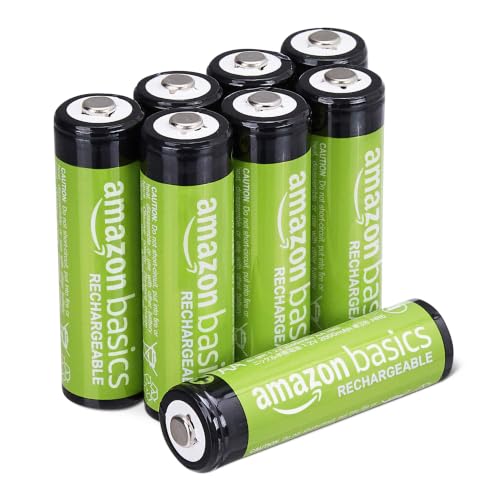
The Amazon Basics 8-pack is the straightforward pick, and the one that fits most Roku households without a second thought. It is an eight-pack of pre-charged nickel-metal hydride AA cells, model HR-3UTG-AMZN, rated at 2000 mAh and 1.2 volts, and stated for up to 1,000 recharges. The cells hold 80 percent of their charge for up to two years, and they arrive pre-charged and ready to use.
The case for this pack is the balance of its figures. Two thousand milliamp-hours is the same capacity as the eneloop, and 1,000 recharge cycles is half the eneloop’s figure but still far more than a remote will use in years of service. A remote recharged once a month would take more than eighty years to reach 1,000 cycles, so the cycle figure is not a limit in practice. The 80 percent retention after two years is the strongest short-term shelf figure in this guide, which is the figure that matters for the spare pair in the drawer.
The eight-pack covers the same ground as the eneloop pack: two cells in the remote, two charged as spares, and four in reserve for a second remote or for later swaps. The eneloop is stated for twice as many cycles and holds its charge for far longer in storage, which is why it leads this guide. The Amazon Basics pack matches it on capacity and beats it on short-term shelf retention.
Choose this pack if the house has one or two Roku remotes and a charger, and the aim is a simple, capable set of cells. Its weakness is that it is a general-purpose cell: it does not hold the highest capacity in this guide, and it does not last the most cycles.
Link: https://www.amazon.com/dp/B00CWNMV4G
3. Amazon Basics AA High-Capacity 8-Pack — Most Capacity per Cell
The Amazon Basics high-capacity 8-pack is the pick for the household whose remote seems to eat cells. It is an eight-pack of pre-charged nickel-metal hydride AA cells, model HR-3UTHA-AMZN, rated at 2400 mAh and 1.2 volts, and stated for up to 400 recharges. The cells hold 50 percent of their charge after one year, and they arrive pre-charged and ready to use.
The 2400 mAh figure is the highest capacity in this guide, and it is the whole point of this pack. A remote with a voice microphone that listens all day will run longer on a 2400 mAh cell than on a 2000 mAh cell before the next swap. In a remote that translates into fewer swaps across a year.
The trade-off is stated plainly on the listing. Four hundred recharge cycles is the lowest cycle figure in this guide, and 50 percent retention after one year is the weakest shelf figure. Neither figure is a problem for a remote: 400 cycles at one recharge a month is more than thirty years of use. But the trade-off is real, and it is the reason this pack sits third rather than first.
Choose this pack if the remote in the house drains cells fast, or if the household would rather swap cells less often. Its weakness is longevity: the standard-capacity packs above are stated for more cycles and hold their charge longer on the shelf.
Link: https://www.amazon.com/dp/B00HZV9WTM
4. Duracell Rechargeable AA 4-Pack — Best Small Pack for a Single Remote
The Duracell Rechargeable AA 4-pack is the pick for a household with one Roku remote and no wish to keep a drawer full of spares. It is a four-pack of pre-charged nickel-metal hydride AA cells. Four cells cover the remote and one spare pair: one pair in the remote, one pair on the charger or in the drawer, and nothing more.
Duracell is the battery brand most households already know, and that familiarity is the practical case for this pack. The cells are pre-charged and ready to use. Two pairs, one in use and one ready, is a routine anyone can follow.
The listing for this pack does not state a capacity figure or a cycle figure, so this guide states neither. The choice here rests on the brand and the pack size, not on a published capacity number. In a low-drain device like a remote, the missing figures matter less than they would in a camera flash or a game controller, because the remote draws so little current that any modern nickel-metal hydride cell will run it for weeks.
Choose this pack if the house has a single Roku remote, a charger, and a preference for a familiar brand in the smallest useful pack size. Its weakness is the pack itself: four cells leave no margin for a second remote.
Link: https://www.amazon.com/dp/B00007ISWA
5. Energizer Recharge Power Plus AA 4-Pack — Best Spare Set for a Second Remote
The Energizer Recharge Power Plus AA 4-pack is the pick for the second remote, the bedroom Roku, or the spare set that lives in the drawer. It is a four-pack of nickel-metal hydride AA cells, sold as the Recharge Power Plus line. Four cells keep a second remote running with one pair in use and one pair charged.
Energizer is the other battery brand every household recognises, and the Recharge Power Plus line is its standard rechargeable AA. Like the Duracell pack above, this listing does not state a capacity figure or a cycle figure in the sources for this guide, so this guide states neither. The pick rests on the same logic: a known brand, a four-pack that matches one remote’s needs, and nickel-metal hydride chemistry that suits a low-drain device.
The difference between this pack and the Duracell pack is small: a household choosing between them is choosing between two familiar brands in the same size. The Duracell leads because its pre-charged state is stated on the listing. The Energizer earns its place as the spare-set pick because a second remote needs a pair of cells that works, a charged pair behind it, and nothing more.
Choose this pack for a second Roku remote, or as the spare set for a household that already runs one of the eight-packs above on the main remote. Its weakness mirrors the Duracell: four cells cover only one remote with its spare pair.
Link: https://www.amazon.com/dp/B00000J47L
Getting the Most from Rechargeable Batteries in a Roku Remote
The routine matters more than the brand. Keep two pairs in rotation: one pair in the remote, one pair charged and waiting. When the remote warns or misses presses, swap the pairs and put the flat pair on the charger straight away.
Charge on a nickel-metal hydride charger, not on a charger built for another chemistry. A charger that charges each cell on its own channel is worth having, because it lets a single pair be charged without waiting for four cells.
Store spare cells charged, cool, and dry, and keep the charged pair separate from the flat pair, so a swap never means guessing which cells are ready.
Missed button presses, a delayed response to the voice button, and the on-screen low-battery warning are the usual signals that a pair is due for a swap. Swapping early costs nothing, because the flat pair goes straight onto the charger and comes back ready.
Replace a pair when it stops holding a useful charge. A cell that runs the remote for days instead of weeks has reached the end of its working life, and with the eight-packs in this guide, a retired pair can be replaced from the reserve cells already in the drawer.
Frequently Asked Questions
Can I use rechargeable batteries in a Roku remote?
Yes. Roku remotes that take loose cells run on standard AA or AAA cells, and rechargeable nickel-metal hydride cells in the right size work in them. The one exception is the Roku Voice Remote Pro, which has a built-in rechargeable battery and charges over a USB cable instead of taking loose cells.
Will the lower voltage of rechargeable batteries cause problems?
A rechargeable nickel-metal hydride AA cell is rated at 1.2 volts, while a disposable alkaline AA cell is rated at 1.5 volts. Roku remotes work with rechargeable cells. The visible effect is that a battery indicator may read lower sooner than it would with fresh alkaline cells. That is a property of the chemistry, not a fault in the cell or the remote.
How long do rechargeable batteries last in a Roku remote?
That depends on the remote and on how much it is used. A basic infrared remote draws very little power and can run for months on a pair of cells. A voice remote with an always-listening microphone draws more, and its cells will need swapping sooner. A 2400 mAh cell runs longer per charge than a 2000 mAh cell.
Do I need a separate charger?
Yes, if the house does not already have one. Every pack in this guide is batteries only, with no charger in the box. Any charger built for nickel-metal hydride AA cells will charge them.
Which size do I need, AA or AAA?
Most Roku remotes take two AA batteries. The slimmer remote bundled with Roku Streaming Stick models takes two AAA batteries. Open the battery compartment on the back of the remote: the size is printed inside it next to the polarity markings. If the remote has a USB charging port and no battery compartment, it is a Voice Remote Pro.
The Shortlist
For most Roku households, the Panasonic eneloop AA 8-pack is the pick to buy first. Its 2,100-cycle life and ten-year charge retention are the strongest figures in this guide, and the eight-pack covers two remotes with spares to spare. The Amazon Basics 8-pack at 2000 mAh is the straightforward alternative, matching the eneloop on capacity. The Amazon Basics high-capacity 8-pack at 2400 mAh is the pick when the remote drains cells fast and fewer swaps matter more than total cycle life. The Duracell and Energizer four-packs cover a single remote, or a second remote, from the two best-known battery brands.
Disclosure: As an Amazon Associate, we earn from qualifying purchases.
More from Amazon
Programs that pair well with the guide above. Offers and eligibility are set by Amazon and may change.
Free shipping on eligible items, Prime Video and more. Eligible new members can start with a free trial.
Start a Prime free trialAd-free music streaming. Eligible new subscribers can start with a free trial.
Try Music Unlimited freeA Prime membership for ages 18-24 with a trial period. Eligibility is set by Amazon.
See Prime for Young AdultsAudiobooks and podcasts to listen to on the go. Eligible new members can start with a free trial.
Try Audible freeAs an Amazon Associate we earn from qualifying purchases.