Our Short List of 3
All 5 Picks at a Glance
| Product | Specs | Action |
|---|---|---|
 Logitech MX Brio | Check price on Amazon | |
 Razer Kiyo Pro Ultra | Check price on Amazon | |
 Insta360 Link 2 | Check price on Amazon | |
 Elgato Facecam Pro | Check price on Amazon | |
 OBSBOT Tiny 2 | Check price on Amazon |
Our Top Picks
The best webcams ever made share a simple trait: they stop looking like webcams. Instead of the soft, washed-out picture from a built-in laptop camera, a flagship model brings a large sensor, a bright lens, and processing that holds detail in mixed light, so a face stays sharp, skin tones stay natural, and a background reads as a real room rather than a blur of noise. That jump matters for anyone who spends serious time on camera, whether the day is filled with client calls, recorded lessons, live streams, or a mix of all three.
This roundup ignores use-case labels and ranks webcams on pure merit. Every pick below is a current flagship from a major maker, chosen for image quality first and then for the extras that separate a great camera from a merely good one, such as true 4K60 output, a motorized tracking gimbal, or manual controls that behave like a dedicated camera. If the goal is simply the finest webcam available, regardless of niche, the five models here are the short list worth comparing.
As an Amazon Associate, we earn from qualifying purchases.
How to Choose
Start with the sensor, because sensor size drives almost everything else. A larger sensor collects more light per pixel, which means cleaner shadows, less digital noise in a dim room, and a more natural separation between subject and background. Among the picks here, sensor sizes range from a half-inch class sensor in the tracking models to the unusually large 1/1.2-inch sensor in the Razer Kiyo Pro Ultra. A small webcam sensor can still look good in bright, even light, but the advantage of a large sensor shows up the moment lighting becomes ordinary rather than ideal.
Resolution and frame rate come next, and they should be read together. All five cameras record in 4K, yet they differ in how fast they can do it. The Elgato Facecam Pro reaches 4K at 60 frames per second, which keeps motion smooth even at full resolution. The other flagships top out at 4K at 30 frames per second and step up to 60 frames per second at 1080p, a trade-off that suits seated calls and most streams well. Buyers who move a lot on camera, demonstrate products, or record fast action should weigh frame rate heavily, while buyers who mostly sit and talk can prioritize sensor and lens quality instead.
Lens aperture and field of view shape the look just as much. A brighter lens, expressed as a lower f-number, lets in more light and supports a softer background. An adjustable or moderately wide field of view, roughly in the 78 to 90 degree range, frames one person at a desk without pulling in the whole room, while a wider setting suits two people or a whiteboard. Fixed-focus and autofocus designs also differ: autofocus follows a presenter who leans in and out, while a well-set fixed focus keeps everything in a defined zone sharp without hunting.
Finally, consider tracking, microphones, and software. Two picks here use motorized pan and tilt gimbals with AI tracking to follow a moving presenter automatically, which no fixed camera can match. Microphone provision varies widely, from dual beamforming or noise-canceling arrays to the Facecam Pro, which omits a microphone entirely on the assumption that creators already own a dedicated mic. Software matters too, because exposure, white balance, zoom, and framing controls determine how much of the hardware quality reaches the call. A flagship webcam should offer a mature companion app on both Windows and macOS.
Logitech MX Brio
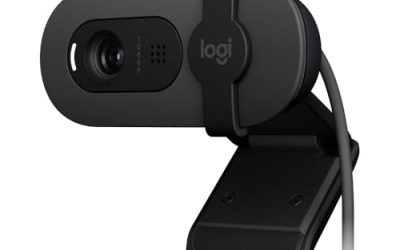
The Logitech MX Brio is the most balanced flagship in this group, combining a large-for-Logitech sensor, polished software, and a design that fits a professional desk without drawing attention to itself. Its 8.5 megapixel Sony STARVIS sensor uses pixels that Logitech describes as 70 percent larger than those in its earlier Brio, and the practical result is a cleaner image in the uneven light of a home office. Autofocus, auto light correction, and adjustable field of view presets make it easy to dial in a tight head-and-shoulders frame or a wider shot.
A distinctive extra is Show Mode, which tilts the camera down toward the desk so sketches, documents, and physical products can be shared on a call without a second camera. Dual beamforming microphones with noise reduction handle everyday calls competently, and the built-in privacy shutter closes with a simple twist. For buyers who want one flagship that excels at meetings, streaming, and recorded video alike, the MX Brio is the safest all-round recommendation in this roundup.
Who It Suits
The MX Brio suits professionals and creators who want flagship image quality with the least friction. It is the pick for hybrid workers who present, streamers who record between calls, and anyone upgrading from a built-in camera who wants the new camera to handle exposure and framing automatically while still allowing manual control when needed.
Razer Kiyo Pro Ultra
The Razer Kiyo Pro Ultra makes the boldest hardware claim of any webcam here: a 1/1.2-inch Sony STARVIS 2 sensor, far larger than the sensor in a typical webcam and paired with a bright f/1.7 lens. That combination gathers a great deal of light, which supports clean low-light video and a genuine, optical softening of the background behind the subject, without relying on software blur. For image quality in a dim studio or evening-lit room, this is the camera to beat.
Razer pairs that sensor with an adjustable field of view, autofocus, HDR support, and auto light correction, plus a built-in microphone and a physical privacy shutter. The cylindrical body is larger than most webcams, a direct consequence of the sensor and lens it carries, and it mounts on a monitor or a tripod. Buyers who treat the webcam as a primary camera, rather than a convenience accessory, will appreciate that the Kiyo Pro Ultra was designed with exactly that priority order.
Who It Suits
The Kiyo Pro Ultra suits creators, streamers, and executives who film in less-than-perfect light and want the most camera-like image a webcam can produce. It is the pick for a dedicated studio desk where size is no obstacle and low-light clarity plus natural background separation matter more than tracking or portability.
Insta360 Link 2
The Insta360 Link 2 takes a different route to flagship status: it puts a 4K camera with a half-inch sensor on a two-axis motorized gimbal, then uses AI tracking to keep the presenter framed while moving around. Stand up, step to a whiteboard, hold a product toward the lens, or move across a small studio, and the camera pans and tilts to follow, with gesture controls for starting tracking and zooming without returning to the keyboard. No fixed webcam in this roundup can reproduce that freedom of movement.
Image quality remains the priority, with HDR, phase detection autofocus, and low-light processing supporting the tracking features rather than replacing them. The built-in microphone uses AI noise canceling to reduce background sounds during calls, and privacy is handled by the camera tilting down when idle. Desk, whiteboard, and overhead-style framing modes broaden its range further. For presenters and teachers, the Link 2 is less a webcam and more a compact camera operator.
Who It Suits
The Link 2 suits teachers, coaches, presenters, and demonstrators who move while they talk. It is the pick for anyone who stands, gestures, writes on a board, or shows physical items on camera, and for solo creators who want subject tracking without adding a separate camera operator or a complex software setup.
Elgato Facecam Pro
The Elgato Facecam Pro is the frame-rate flagship. It was the first webcam to offer true 4K at 60 frames per second, delivering that resolution without compression over USB 3.0, so motion stays fluid and detail stays intact even when the subject moves quickly. Its Sony sensor and f/2.0 lens are tuned for a clean, color-accurate image, and the fixed-focus design keeps a subject sharp across a defined working range without focus hunting during a stream.
Control is the other half of its appeal. Elgato Camera Hub provides DSLR-style manual adjustment of exposure, shutter, ISO, white balance, and zoom, with settings stored on the camera itself. One deliberate omission defines the product: there is no built-in microphone, because Elgato assumes the target buyer already uses a dedicated microphone or headset. Buyers should budget for separate audio if they do not already own it, and in return they get the smoothest 4K picture in this group.
Who It Suits
The Facecam Pro suits streamers, video producers, and gaming creators who prioritize smooth motion and manual control above convenience features. It is the pick for a studio desk with a dedicated microphone already in place, where 4K60 output and camera-like settings matter more than tracking, a built-in mic, or autofocus.
OBSBOT Tiny 2
The OBSBOT Tiny 2 is the other tracking flagship here, and it pushes the concept further with voice control alongside gesture control and multi-mode AI tracking. Its 1/1.5-inch CMOS sensor is larger than the sensor in the Link 2, and dual native ISO helps it hold a clean image as room light changes. The compact PTZ body pans, tilts, and zooms to follow a subject, with tracking modes for a full body, an upper body, or a close-up, plus auto zoom framing.
Voice commands allow hands-free control during a presentation or workout session, and HDR with light correction supports use in bright or backlit rooms. Dual microphones are built in, and the camera pairs with the OBSBOT Center app and an optional remote for finer control. Between the two gimbal cameras in this roundup, the Tiny 2 is the choice for buyers who want the larger sensor and the widest set of hands-free controls.
Who It Suits
The Tiny 2 suits presenters, fitness instructors, streamers, and meeting hosts who move around a room and want the camera to follow without manual adjustment. It is the pick for hands-free operation, larger-sensor image quality in a tracking body, and flexible framing for both seated calls and standing demonstrations.
FAQ
Is 4K worth it on a webcam if most calls are 1080p or lower?
Yes, for two reasons. A 4K sensor gives the camera more detail to work with when it crops or zooms digitally, so a tighter frame still looks sharp, and it future-proofs the purchase for platforms and recording workflows that accept higher resolutions. Recorded video, streams, and content captured locally benefit immediately, even if a given meeting app sends a lower resolution to other participants.
Which of these webcams is best in low light?
The Razer Kiyo Pro Ultra has the strongest low-light hardware on paper, pairing the largest sensor in this group with the brightest lens. The OBSBOT Tiny 2 follows with its 1/1.5-inch sensor and dual native ISO, and the Logitech MX Brio also performs well thanks to its large pixels. Any of the three will hold a cleaner image in a dim room than a typical built-in laptop camera.
Do I need a separate microphone with a flagship webcam?
It depends on the model. The Elgato Facecam Pro has no microphone at all, so a dedicated microphone or headset is required. The other four picks include built-in microphones suitable for everyday calls, although presenters who record or stream regularly often still prefer a separate microphone placed closer to the speaker for fuller, more consistent audio.
Should I choose a tracking gimbal webcam or a fixed flagship?
Choose a tracking model, such as the Insta360 Link 2 or OBSBOT Tiny 2, if presentations involve standing, moving, writing, or demonstrating objects. Choose a fixed flagship, such as the MX Brio, Kiyo Pro Ultra, or Facecam Pro, if the camera will stay aimed at a seated subject, where sensor size, lens quality, and frame rate deliver more benefit than movement.
Final Verdict
There is no single winner here, because the finest webcams ever made excel in different directions, but there is a clear pick for each priority. The Logitech MX Brio is the best all-rounder, balancing a strong sensor, refined software, capable microphones, and everyday ease of use. The Razer Kiyo Pro Ultra wins on raw image quality and low-light hardware, while the Elgato Facecam Pro stands alone for true 4K60 smoothness and manual, camera-style control.
For movement, the choice narrows to the two gimbal models. The Insta360 Link 2 offers polished AI tracking, gesture control, and presenter-friendly framing modes in a compact body, and the OBSBOT Tiny 2 answers with a larger sensor, voice control, and more tracking modes. Any of these five represents a major step beyond a built-in camera, and choosing among them is mostly a matter of matching the standout strength to the way the camera will actually be used each day.
Product and ASIN Reference
| Product | ASIN |
|---|---|
| Logitech MX Brio | B0BFJ4CRKD |
| Razer Kiyo Pro Ultra | B0CT6FFK4R |
| Insta360 Link 2 | B0DDTH3HX8 |
| Elgato Facecam Pro | B0BJL7Q3SR |
| OBSBOT Tiny 2 | B0C3B6ZR1V |
More from Amazon
Programs that pair well with the guide above. Offers and eligibility are set by Amazon and may change.
Free shipping on eligible items, Prime Video and more. Eligible new members can start with a free trial.
Start a Prime free trialAd-free music streaming. Eligible new subscribers can start with a free trial.
Try Music Unlimited freeA Prime membership for ages 18-24 with a trial period. Eligibility is set by Amazon.
See Prime for Young AdultsAudiobooks and podcasts to listen to on the go. Eligible new members can start with a free trial.
Try Audible freeAs an Amazon Associate we earn from qualifying purchases.