Key takeaways
- Budget: Marine-rated, basic sound, limited output at high volume. Good for casual cruising.
- Mid-range: Better materials, more output, lighting options and matched amplifiers. Best value for most owners.
- Premium: Highest output, clearest sound and most robust hardware, aimed at watersports and frequent use.
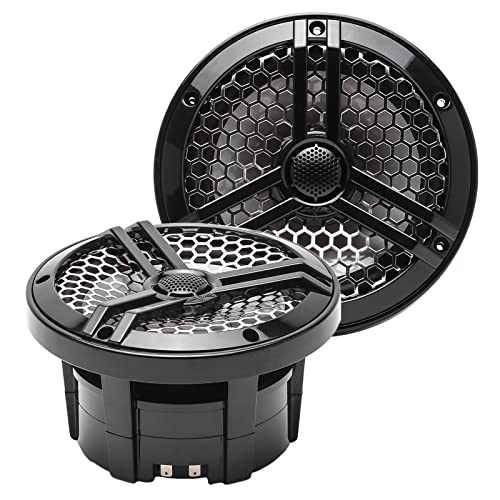
The best marine speakers for most boat owners are a pair of 6.5-inch or 7.7-inch coaxial speakers from a boat-focused brand such as Fusion, JL Audio, Wet Sounds or Kicker, chosen for water and UV resistance first and sound second: Fusion and Polk suit smaller budgets, JL Audio and Wet Sounds suit owners who want louder, clearer sound on open water, and tower or cockpit speakers suit wakeboard and pontoon boats. The sections below explain how to read the maker’s ratings, which type fits which boat, and where each approach falls short.
Our top picks



As an Amazon Associate we earn from qualifying purchases at no extra cost to you.
Why Marine Speakers Differ From Car Speakers
A boat exposes speakers to sun, spray, salt, humidity and temperature swings. Marine models use materials such as UV-stable plastics, stainless-steel hardware, water-resistant cones and sealed or coated components. Car speakers can corrode or warp quickly in this environment, so makers of marine audio build their products specifically for it.
Open water also changes how sound behaves. Wind, engine noise and the lack of walls mean speakers must be louder and more efficient than a typical living-room setup. Many marine models are designed to stay clear at high volume for this reason.
At a Glance: Popular Marine Speaker Families
| Brand and line | Best for | Maker-stated highlights | Trade-offs |
|---|---|---|---|
| Fusion Signature and XS series | Mid-range and entry-level cruising boats | Marine-rated build; some versions include LED lighting options | Sound is balanced rather than extreme in output |
| JL Audio M-series (M3, M6) | Owners who want high-quality sound and a premium finish | Marine-rated drivers; M6 is the higher-grade line | Premium tier |
| Wet Sounds Revo and Stealth lines | Wakeboard, tower and watersports boats | Designed for loud, high-output use on open water | Higher cost; some lines need an external amplifier |
| Kicker KM series | Mid-range upgrades from factory marine speakers | Marine-rated build, often with LED options | Needs a matched amplifier for best results |
| Polk Ultramarine and DB series | Budget-conscious boaters | Marine-certified build with UV-resistant materials | Less output at maximum volume than premium lines |
| Rockford Fosgate Prime and Punch Marine | Users who want bass-forward sound | Marine-grade build, lighting options on some models | Check size fit for your existing cutouts |
Specific model names, wattage figures and lighting options vary by year, so confirm the exact version on the maker’s page before ordering.
How to Read Marine Speaker Specifications
Water and dust protection ratings
Ingress ratings such as IPX6 or IPX7 describe how well a product resists water. Higher numbers mean greater protection, but a speaker rated for splashes is not rated for submersion. Makers publish the rating for each model. Open-deck boats benefit from higher ratings than speakers placed inside a covered cabin.
Power handling: RMS and peak
RMS power is the continuous power a speaker can handle, and peak is the brief maximum. RMS is the number to match with an amplifier. A head unit’s built-in amplifier often delivers modest power, so louder listening usually calls for an external marine amplifier.
Size and mounting
Common sizes are 6.5 inches and 7.7 inches, with larger 8-inch and 10-inch options for towers and subwoofers. Replacing factory speakers is easiest when the new ones match the existing cutout. Makers list mounting depth and hole diameter, and the depth matters when the speaker sits in a shallow panel or wake tower.
Impedance
Most marine speakers are 4-ohm models. Check the amplifier or head unit’s supported impedance before connecting. Mismatched impedance can reduce sound quality or stress the amplifier.
Lighting and grille styles
Many marine speakers include RGB lighting that connects to a remote or the boat’s network. This is a styling choice and does not affect sound. Grilles come in white, black or stainless-style finishes. White is the common choice because it reflects heat on sunny decks.
Picks by Boat and Budget
Cruisers, runabouts and fishing boats
For a small to mid-size boat, a pair of 6.5-inch coaxial speakers from Fusion, Polk or Kicker usually fits the existing cutouts. The budget tier handles background music and radio. Mid-range options add better UV resistance, lighting and cleaner mid-range sound.
Pontoon boats
Pontoon boats have more seating spread across a larger deck, so owners often add four to six speakers plus a subwoofer. Fusion and JL Audio both sell kits and matched sets. Place speakers so that sound reaches the seating areas evenly rather than pointing everything toward the helm.
Wakeboard and tower boats
Tower speakers need to cut through engine noise, wind and wake spray. Wet Sounds and JL Audio build dedicated tower speakers with heavy-duty clamps and wide coverage. These usually call for an external amplifier, and many owners add a subwoofer in the cabin or under a seat.
Sailboats and cabin cruisers
Interior speakers are somewhat shielded, but cockpit speakers still face spray and sun. Compact marine models with low mounting depth suit tight spaces. Look for corrosion-resistant hardware if the boat is used in salt water.
Premium upgrades
Premium systems add a separate marine amplifier, a subwoofer and a marine head unit. Reviewers who cover marine audio point to the amplifier and subwoofer as the upgrade that most changes the sound, more than the speakers themselves.
Pick X If… Decision Table
| Pick this | If you… |
|---|---|
| Fusion or Polk 6.5-inch coaxial pair | want a straightforward replacement for factory speakers at a lower cost |
| Kicker KM series | have an amplifier and want louder mid-range sound |
| JL Audio M6 or M3 | want a premium finish and detailed sound |
| Wet Sounds Revo or tower speakers | use the boat for watersports with a tower |
| Rockford Fosgate Punch Marine | prefer more bass response |
| Marine kit with amplifier and subwoofer | want a full system without choosing each part |
Installation, Wiring and Safety Notes
Use marine-grade tinned copper wire, which resists corrosion better than ordinary copper. Seal connections with heat-shrink connectors or marine-rated terminals. Keep power wiring away from fuel lines and moving parts, and fuse the amplifier power cable close to the battery as the amplifier’s instructions state.
Boat electrical systems are different from car systems, and mistakes can cause fires or drain batteries. If you are unsure about wiring, a marine electrician or authorized dealer should handle the amplifier and battery connections. Follow the manual for each product.
Seal screw holes with a marine-grade sealant where the manual calls for it, and avoid mounting speakers where water can pool behind them. Rinse speakers with fresh water after use in salt water, and let them dry before storage.
In cold climates, remove speakers or cover them during winter storage if the manual advises it. UV exposure and temperature cycles shorten the life of any outdoor audio gear, so a boat cover helps.
Trade-offs by Budget Tier
- Budget: Marine-rated, basic sound, limited output at high volume. Good for casual cruising.
- Mid-range: Better materials, more output, lighting options and matched amplifiers. Best value for most owners.
- Premium: Highest output, clearest sound and most robust hardware, aimed at watersports and frequent use.
Alternatives to Standard Marine Speakers
Portable waterproof Bluetooth speakers
Portable speakers from brands such as JBL or Ultimate Ears are easy to use on small boats, kayaks and paddle boards. They are not meant to fill a large deck with sound, and battery life limits long outings.
Soundbars made for marine use
Marine soundbars from makers such as Fusion and Wet Sounds mount in one place and cover a seating area with fewer wires. They suit pontoon and cabin layouts but are less powerful than multi-speaker systems.
Waterproof powered speakers
Some marine speakers include built-in amplifiers and connect through Bluetooth or a network app. They cut down on wiring, which suits owners who do not want a separate amplifier, though power is lower than a full system.
Frequently Asked Questions
Can I use regular car speakers on a boat?
Car speakers are not made for sun, spray and salt, so they tend to corrode and fail sooner. Marine speakers use water-resistant materials and corrosion-resistant hardware. If the boat is kept in a dry, covered space, car speakers might last longer, but marine models remain the safer choice.
Do marine speakers need an amplifier?
Not always. A marine head unit can drive small speakers at moderate volume. For louder listening, towers or large boats, an external marine amplifier is common. Match the amplifier’s RMS output to the speakers.
What size marine speaker should I buy?
The right size is the one that fits your existing cutout. Most boats use 6.5-inch or 7.7-inch speakers. Measure the opening and mounting depth, and read the maker’s dimensions before buying.
Are marine speakers waterproof?
They are water-resistant, as stated by the ingress rating. Many are built to handle splashes and rain, but few are designed to stay underwater. Check the rating for the model you pick.
How many speakers do I need?
Small boats often do well with one pair. Larger boats and pontoons may use four to six, plus a subwoofer. Place them so every seating area receives sound without needing very high volume.
How do I maintain marine speakers?
Rinse them with fresh water after use in salt water, let them dry, and keep them covered when the boat is stored. Inspect wire connections each season for corrosion and replace any that look green or crusty.