Key takeaways
- Five outdoor subwoofers for patio and garden systems, from buried in-ground models to a down-firing deck pick, with notes on IP codes and bass outdoors.
Disclosure: As an Amazon Associate, I earn from qualifying purchases.
Outdoor speakers are already covered on this site, twice over: one guide rounds up full-range patio pairs and portables for backyard movie nights, and another covers rock and landscape speakers that hide in planting beds. Both leave the same gap. Small outdoor speakers, however they are disguised, move very little air, and the low end of a film soundtrack or a bass line evaporates in an open yard. An outdoor subwoofer fills that gap, and it is a different purchase from an indoor sub in almost every way that matters.
This guide covers the subwoofer layer only: five passive models built to live outside full time, from in-ground units that bury in a garden bed to an above-ground cabinet that sits on a deck. Every one needs an amplifier and a run of burial-rated speaker wire; there is no battery or Bluetooth shortcut at this end of an outdoor system. What changes between the picks is how they install, how much weather their enclosures are genuinely built for, and how honestly their published figures should be read. Bass outdoors behaves nothing like bass in a living room, and maker figures flatter every model here.
How to Choose
In-ground vs above-ground
In-ground subwoofers bury most of the enclosure in soil and vent sound through a short exposed port or cap. Buried, they disappear into landscaping and the soil loads the cabinet, which helps low output. The trade is commitment: you dig once, and moving the sub later means digging again. Drainage matters more than any enclosure claim, because a buried box in a bed that floods after storms lives a harder life than the same box in raised, well-drained soil. Above-ground models sit on a patio or deck: easier to place, reposition, and bring under cover in winter, but visible, with cabinets taking direct sun and rain on every face.
All five picks are passive, and that shapes the whole job
There is no powered shortcut in this roundup. Each sub needs an amplifier channel or a dedicated subwoofer amplifier in a weather-protected spot, plus direct-burial speaker wire rated for underground runs; ordinary indoor wire jackets break down in soil within a few seasons. Long runs also lose power, so heavier gauge wire is the sensible default beyond a short patio hop. One pick below softens the wiring job with a built-in crossover and satellite outputs: the amplifier feeds the sub, and the sub passes a filtered signal on to a pair of full-range speakers, keeping a simple garden system to one wire run home.
Read the IP code, then read past it
Most of these models carry an IP66 code. The first digit means the enclosure is sealed against dust; the second means it withstands powerful water jets, which covers rain and sprinklers. What the code does not test is standing water, freeze and thaw cycles, ultraviolet exposure over years, or insects moving into a port. A sub under eaves or a covered patio lives an easier life than the same sub in an open bed, whatever the code says, and shelter extends any outdoor speaker’s life more than any coating. Models described with general all-weather language and no code make a weaker, untested claim, and this guide says plainly which kind each pick carries.
Bass outdoors is not bass indoors
A living room reinforces low frequencies: walls, floor, and ceiling bounce them back and pile them up at the seats. A yard has one boundary at most, usually just the ground, so low bass radiates away and thins out fast with distance. That is why maker frequency figures need a skeptical read: a response figure quoted to a low number often rests on a generous tolerance, and it describes test conditions, not your chair twelve feet away across open lawn. Place the sub near a wall, fence, or corner when you can, because each nearby surface adds reinforcement; expect to need more sub, or a closer sub, than the same space would need indoors; and treat headline wattage as a handling limit, not a promise of loudness.
Comparison Table
| Product | Install style | Driver | Power handling (maker figure) | Weather claim | Extra |
|---|---|---|---|---|---|
| TIC GS50 | In-ground or surface | 8-inch dual voice coil | 250 W peak | Sealed weather-resistant build, no IP code published | Built-in crossover, satellite outputs |
| OSD Audio GLS8 | In-ground | 8-inch | 500 W max | IP66 | Omnidirectional dispersion |
| OSD Audio XSUB12 | In-ground | 12-inch | 600 W max | IP66 | Omnidirectional dispersion |
| Dayton Audio IOSUB | Above-ground, down-firing | 10-inch | 150 W RMS / 300 W peak | IP66 | Security eyebolt anchor |
| Polk Audio Atrium Sub100 | Above-ground | 10-inch | 200 W | All-weather enclosure, no IP code published | Plantable garden housing |
The 5 Best Outdoor Subwoofers
1. TIC GS50

The GS50 is the flexible installer of the group. TIC builds it as an omnidirectional in-ground subwoofer with an 8-inch dual voice coil woofer, and it can sit on the surface if digging is not an option, though the maker is plain that sinking it gives better stability and resonance. Its shrub-green cap is meant to vanish into a planting bed rather than imitate a rock.
The wiring is the interesting part. A built-in crossover lets the GS50 take a stereo feed and pass the higher frequencies on to two satellite speakers, so one amplifier and one wire run can carry a small garden system of sub plus pair, making it the natural partner for the landscape speakers this site has already covered. TIC describes a sealed, weather-resistant build but publishes no IP code, so the claim is maker language rather than a tested standard; a well-drained bed is part of the deal.
Specs:
– Driver: 8-inch dual voice coil woofer
– Power handling: 250 W peak (maker figure)
– Install: in-ground or surface mount
– Crossover: built-in, with outputs for two satellite speakers
– Finish: shrub green
– Weather claim: sealed weather-resistant construction, no published IP code
2. OSD Audio GLS8

The GLS8 is OSD’s compact in-ground option: an 8-inch woofer in an ABS polymer enclosure that buries in a bed or lawn edge and radiates sound in every direction from its exposed top. OSD publishes an IP66 code for this one, which is the stronger, test-based kind of weather claim, covering dust sealing and powerful water jets from sprinklers or storms.
The listing’s 500 W figure is a maximum handling number, not an output promise, and the quoted low reach deserves the tolerance skepticism described above; in a real yard, placement near a wall or fence does more for perceived bass than any figure on the page. What the GLS8 genuinely offers is the smallest dig in this roundup and a formal weather code, suiting a modest patio system where the sub supplements a pair of wall-mounted speakers.
Specs:
– Driver: 8-inch woofer
– Power handling: 500 W max (maker figure)
– Install: in-ground, omnidirectional
– Enclosure: ABS polymer
– Weather claim: IP66
– Frequency response: 28 Hz to 200 Hz (maker figure)
See the OSD Audio GLS8 on Amazon
3. OSD Audio XSUB12

The XSUB12 is the big-dig option, a 12-inch in-ground subwoofer for larger yards where an 8-inch unit would work too hard. The enclosure buries with its port at the surface, disperses omnidirectionally, and carries the same IP66 code as its smaller sibling, so the weather claim rests on the same tested standard rather than adjectives.
A 12-inch cone moves more air per stroke, which is the honest way to get low end across an open space: not deeper on paper, but less strained at the volume a garden actually asks for. The trade-offs are practical. The hole is bigger, the amplifier needs to match a hungrier load, and the 600 W headline is again a handling ceiling, not a loudness figure. For a large landscape system with speakers spread over distance, this is the pick sized for the job; for a small patio it is more sub than the space can use.
Specs:
– Driver: 12-inch woofer
– Power handling: 600 W max (maker figure)
– Install: in-ground, omnidirectional
– Enclosure: ABS polymer
– Weather claim: IP66
– Frequency response: 20 Hz to 150 Hz (maker figure)
See the OSD Audio XSUB12 on Amazon
4. Dayton Audio IOSUB
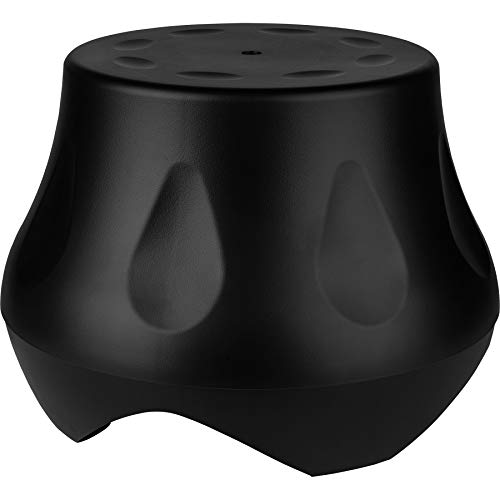
The IOSUB takes the opposite approach to the buried picks: nothing goes in the ground. It is a down-firing 10-inch subwoofer in a composite enclosure standing on short legs on a deck or patio, firing into the surface below. Down-firing placement is forgiving about exact position, and the cabinet carries an IP66 code, the tested kind of claim.
Dayton’s manual frames this as a passive sub that wants a proper subwoofer amplifier or an amplifier stable into its 4-ohm load, and its published figures are the most conservative here: 150 W RMS handling with a 300 W peak, and a stated response of 50 Hz to 300 Hz that does not pretend to be a cinema sub. A built-in security eyebolt lets you anchor it against theft, a real consideration for a visible, liftable box. Under a covered patio, where shelter does half the weather work, it is the easiest install here.
Specs:
– Driver: 10-inch polypropylene woofer, down-firing
– Power handling: 150 W RMS / 300 W peak (maker figures)
– Impedance: 4 ohms
– Install: above-ground, on legs
– Weather claim: IP66 composite enclosure
– Frequency response: 50 Hz to 300 Hz (maker figure)
See the Dayton Audio IOSUB on Amazon
5. Polk Audio Atrium Sub100

The Atrium Sub100 hides in plain sight. Its rounded, heavy enclosure is styled to sit in a garden bed like a planter, in a grey finish on this version, with a 10-inch long-throw driver inside doing the low work for a pair of outdoor satellite speakers. It is passive, so the amplifier and burial-rated wire requirements above apply in full.
Polk describes the enclosure as all-weather but publishes no IP code, so by the standard this guide applies, that is the weaker kind of claim: maker language without a tested figure behind it. The Sub100 has been sold for this job for years and the cabinet is built to live in beds and borders, but the honest reading is that some shelter and decent drainage are a sensible precaution rather than an optional extra. Choose it when blending into planting matters more than a formal weather code.
Specs:
– Driver: 10-inch long-throw woofer
– Power handling: 200 W (maker figure)
– Install: above-ground, garden housing
– Finish: grey (this version)
– Model: AM4384
– Weather claim: all-weather enclosure, no published IP code
See the Polk Audio Atrium Sub100 on Amazon
FAQ
Do I need a separate amplifier for an outdoor subwoofer?
For every pick here, yes. All five are passive, so the amplifier or receiver running your outdoor speakers must have a suitable output, or you add a dedicated subwoofer amplifier. Plan for that, and for direct-burial speaker wire, as part of the same purchase.
Will one outdoor subwoofer cover a whole yard?
It depends on distance more than on the sub. Bass thins quickly in open air with no walls to reinforce it, so one sub near the main seating, ideally close to a wall or fence, covers a patio well. Large yards with spread-out seating are better served by a bigger in-ground model, or by accepting that bass will be strongest near the sub.
What does IP66 actually protect against outdoors?
The code means the enclosure is sealed against dust and withstands powerful water jets, covering rain and sprinklers. It does not test for standing water, flooding in a buried pit, freeze and thaw cycles, or years of sun. Drainage and shelter still decide how long an outdoor sub lasts.
Can an outdoor subwoofer run my full-range speakers too?
Some can. The TIC GS50 has a built-in crossover with satellite outputs, so it can sit between an amplifier and a pair of outdoor speakers on one wire run. The other picks here are sub-only connections: they take their own feed and leave the full-range speakers wired to the amplifier separately.
Conclusion
An outdoor subwoofer is the missing layer under the patio and landscape speakers this site has already covered, and it rewards a buyer who reads past the headline figures. Pick the install style first: in-ground models like the OSD GLS8 and XSUB12 and the TIC GS50 disappear into the garden and suit permanent systems, while the Dayton IOSUB and Polk Atrium Sub100 sit above ground where they are easier to place and shelter. Then weigh the weather claim honestly, an IP66 code over adjectives, and remember that placement near a surface and a dry, drained spot do more for sound and lifespan than any number on a spec sheet.
More from Amazon
Programs that pair well with the guide above. Offers and eligibility are set by Amazon and may change.
Free shipping on eligible items, Prime Video and more. Eligible new members can start with a free trial.
Start a Prime free trialAd-free music streaming. Eligible new subscribers can start with a free trial.
Try Music Unlimited freeA Prime membership for ages 18-24 with a trial period. Eligibility is set by Amazon.
See Prime for Young AdultsAudiobooks and podcasts to listen to on the go. Eligible new members can start with a free trial.
Try Audible freeAs an Amazon Associate we earn from qualifying purchases.