Key takeaways
- Compare the best speaker selector switches for whole-home audio, with impedance protection, per-room volume controls, and zone counts from four to seven.
Disclosure: As an Amazon Associate, I earn from qualifying purchases.
A speaker selector switch is the simplest way to spread one stereo amplifier or receiver across several rooms. Every pair of speakers in the house wires back to the box, the amplifier wires into the box, and front-panel buttons decide which rooms play. It is an old, proven layout for kitchens, patios, and bedrooms, and it avoids buying a separate amplifier for every room.
The catch is electrical, not musical. Speakers wired in parallel divide the load the amplifier sees, and a selector puts pairs in parallel every time another room switches on. Two 8-ohm pairs present 4 ohms; four pairs present 2 ohms, below the minimum most receivers accept. That is why the deciding feature in this guide is impedance protection: what the box does to keep the combined load inside the amplifier’s safe range. The five picks cover four to seven pairs: knobs on the box, a remote model, and a knob-free model for systems that control volume in the rooms. One honest limit applies to all of them: a selector adds no power. It divides the output of the one amplifier feeding it, so more rooms playing means less power for each.
How to Choose
Work through the impedance math first
Parallel wiring divides impedance. One 8-ohm pair alone is an 8-ohm load. Add a second pair and the amplifier sees 4 ohms. Add two more and it sees 2 ohms, while most AV receivers and stereo amplifiers are built for loads of 6 or 8 ohms and up. Run a load below the rated minimum and the amplifier runs hot, its own protection may shut it down mid-song, and over time the strain can damage it. Four-ohm speakers make the arithmetic worse, halving again at every step. Any selector worth buying answers this math somehow, with the answer printed in its manual as a minimum load figure.
Know the three kinds of protection
Resistor-based protection puts a fixed resistance in series with the speakers so the total load stays in a safe band, automatically, with nothing to set. The trade is efficiency: some of the amplifier’s output is burned off as heat in the resistor instead of reaching the speakers, so maximum volume drops a little.
Autoformer protection, also called impedance matching, uses a small transformer per zone to multiply the impedance the amplifier sees. It wastes far less power as heat and is the approach in most installer-grade boxes. Some are automatic; others use jumpers or dials that must be set for the number of pairs connected, and a jumper at the wrong setting quietly removes the protection.
The third kind is none. A few selectors are plain switches with no protection at all, safe only when something else does the matching, usually impedance-matching volume controls in the rooms. That layout has to be planned, not discovered after the amplifier shuts down.
Decide where volume will be controlled
Volume knobs on the selector box are the simplest layout: one trip to the equipment shelf sets every room. It is a poor fit when the rack sits in a basement and the listeners are two floors up.
The alternative puts a volume control on the wall in each room and reduces the selector to on/off switching. In-wall controls come in resistor and autoformer types, and the autoformer versions can supply the impedance matching for the whole system, which is what makes a protection-free selector safe. Choose before you buy: a box full of knobs you will never reach is wasted, and a knob-free box in a house with no wall controls leaves the receiver’s single volume knob running every room at once.
Count pairs, then count sources
Buy for the pairs you will actually wire, with one spare zone if the house might grow. Then look at amplifier inputs. Single-input boxes play the same program in every room that is on. Dual-source boxes take two amplifiers or receivers and let zones choose between them, with one master switch for the whole house or a separate A/B choice per zone. That is still not different music per room from one source; it is two sources, shared.
Read power figures as maker figures
Every watt number in this guide is a figure published by the maker, under conditions the maker chose, and they are not comparable across brands to the last digit. Treat them as a rough size class. Two cautions matter more. First, the stated handling usually assumes the impedance protection is engaged; switch it off or set its jumpers wrong and the safe figure no longer applies. Second, handling is what the box can pass without damage, not what reaches your speakers.
Quick Comparison
| Selector | Speaker Pairs | Amp Inputs | Per-Zone Volume | Impedance Protection | Power Handling (Maker Figure) |
|---|---|---|---|---|---|
| Monoprice SSVC-4.1 | 4 | 1 | Knob per zone | Automatic, resistor-based | 100 W per channel |
| Niles SSVC-4 | 4 | 1 | Knob per zone | Autoformer matching | 100 W per channel |
| Pyle PLSHVC612 | 6 | 2 | Knob per zone | Autoformer matching | 100 W RMS per channel max input |
| OSD Audio ATM-7 | 7 | 2 | None on the box | None built in | Not published |
| Niles SS-6 | 6 | 1 | None | Protection button, impedance correction | 100 W per channel |
The 5 Best Speaker Selector Switches
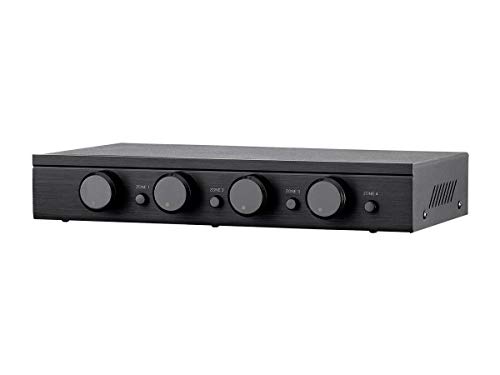
1. Monoprice SSVC-4.1
See the Monoprice SSVC-4.1 on Amazon
Specs:
– Speaker pairs: 4, each with volume knob and on/off button
– Amplifier inputs: 1
– Protection: resistor-based impedance matching, automatic, nothing to set
– Minimum load (maker figure): 5 ohms with four 4-ohm pairs playing, 6 ohms with 8-ohm pairs
– Power handling: 100 W RMS per channel, 200 W peak (maker figures)
– Terminals: removable blocks, up to 12-gauge wire; isolated left/right grounds for bridged amplifiers
The SSVC-4.1 is the straightforward pick for one receiver and up to four rooms. Its protection is the fit-and-forget kind: internal resistors hold the combined load at or above the maker’s stated floor no matter which rooms are playing, so there is no jumper to mis-set and no button to forget. The limits follow from the design: resistor protection trades a little maximum volume for its simplicity, the single input means one program everywhere, and four pairs is the ceiling. For a typical receiver and four rooms, it covers the job with the least to get wrong.
2. Niles SSVC-4

See the Niles SSVC-4 on Amazon
Specs:
– Speaker pairs: 4, each with its own volume control
– Amplifier inputs: 1
– Protection: impedance-matching transformers (autoformers)
– Power handling: 100 W per channel (maker figure)
– Terminals: removable connectors accepting up to 14-gauge wire
The SSVC-4 does the same four-room job with the other protection technology. Its volume controls work through impedance-matching transformers, which step the load up for the amplifier while stepping volume down for the room, so far less output is lost as heat than in a resistor design. That efficiency is why autoformer boxes have been the installer default for decades. The connectors unplug for bench wiring. It remains a one-amplifier, one-program box. Choose it over the resistor design when the amplifier is modest and you want as much of its output as possible reaching the speakers.
3. Pyle PLSHVC612

See the Pyle PLSHVC612 on Amazon
Specs:
– Speaker pairs: 6, each with volume control, on/off switch, and its own A/B source selector
– Amplifier inputs: 2
– Protection: autoformer-based impedance matching
– Volume control: 10 steps, up to 39 dB attenuation per zone
– Maximum amplifier input: 100 W RMS per channel (maker figure)
– Terminals: up to 14-gauge wire
– Dimensions: 16.92 x 6.29 x 3.03 in; weight 9.3 lb; aluminum housing with heat sink
The PLSHVC612 is the step up: six pairs instead of four, and two amplifier inputs with a per-zone choice between them, so the living room can take the receiver while a bedroom takes the second amp. The maker’s own impedance chart is worth reading before you wire it: with six 4-ohm pairs playing, it shows the amplifier still seeing about 4.8 ohms. Matching here softens the parallel math rather than erasing it, so an amplifier rated only for 8-ohm loads is a poor partner for a full six-zone, 4-ohm setup. Kept to 8-ohm speakers or a 4-ohm-capable amplifier, it is the most flexible box in this guide.
4. OSD Audio ATM-7

See the OSD Audio ATM-7 on Amazon
Specs:
– Speaker pairs: 7
– Amplifier inputs: 2
– Control: IR remote control plus front-panel buttons; automatic switching between sources
– Power: powered design, 12V DC adapter included
– Impedance protection: none built in — the maker directs users to impedance-matching volume controls in the zones
The ATM-7 is the convenience outlier: seven zones, two sources, and switching from the couch by remote. It is also the one pick here with no impedance protection of its own, and OSD says so plainly, directing buyers to pair it with impedance-matching volume controls at the speakers. Read that as a different system plan, not a defect: wall controls handle volume and matching; the ATM-7 handles routing. Budget and wire for those controls from the start, because seven unprotected pairs in parallel would drag almost any amplifier far below its safe load. If your rooms already have matching volume controls, this is the only box here that saves you the walk to the rack. Check current availability before planning a build around it.
5. Niles SS-6

Specs:
– Speaker pairs: 6, each with an on/off button; no volume controls
– Amplifier inputs: 1
– Protection: impedance correction circuit, engaged by a front-panel Protection button
– Power handling: 100 W per channel, continuous music power (maker figure)
– Amplifier: must tolerate a 4-ohm load
– Terminals: removable connectors accepting 14- to 22-gauge wire
– Weight: 2.25 lb
The SS-6 is the plain switcher for the other layout: six pairs, buttons only, and volume handled by controls in the rooms. Niles’ own guidance is to engage the Protection button whenever the combined load might fall below 4 ohms — in practice, whenever more than a pair or two plays at once — and leave it on. The correction circuit is the switchable kind rather than the always-on kind, so that button discipline is part of owning it. In return you get a slim, simple box with nothing to drift out of adjustment. Availability on this older model is thin, so confirm a listing before committing to it.
FAQ
Can a speaker selector damage my amplifier?
Only through impedance. Every pair switched on lowers the load, and a load below the amplifier’s rated minimum makes it overheat or shut down. A selector with working protection, engaged and set correctly, keeps the load in the safe band. The risky setups are protection switched off, jumpers at the wrong setting, or an unprotected box with nothing else matching.
Does a speaker selector add power or make rooms louder?
No. A selector is passive routing: it divides the output of the single amplifier feeding it among the rooms that are on. Four rooms playing share the same watts one room would get, so each plays quieter than it would alone. If several rooms need real volume at once, the fix is a stronger amplifier or separate amplifiers, not a different selector.
Should volume knobs live on the box or in the rooms?
Both layouts work; they are different wiring plans. Knobs on the box centralize control at the equipment shelf. In-wall controls put adjustment where people listen and can supply the system’s impedance matching, which is what an unprotected selector depends on. Pick based on where people will actually stand when they reach for the volume.
Can different rooms play different music through one selector?
Not from one amplifier. Every zone fed by the same amplifier hears the same program. Dual-source selectors let each zone choose between two amplifiers or receivers, giving two programs in the house, shared zone by zone. A different program in every room at once calls for a multi-zone amplifier or a streaming amplifier per room.
Conclusion
Buy the protection first and the zone count second. For one receiver and up to four rooms, the Monoprice SSVC-4.1 asks nothing of you after wiring, and the Niles SSVC-4 adds more efficient autoformer matching in the same footprint. Six rooms or two sources point to the Pyle PLSHVC612, provided your amplifier tolerates the loads its own chart shows. The OSD Audio ATM-7 earns its place only in systems with impedance-matching controls in the rooms. And where volume already lives on the walls, the Niles SS-6 is the minimal switcher. Whichever you choose, keep the protection engaged: the box is cheap insurance for your amplifier.
More from Amazon
Programs that pair well with the guide above. Offers and eligibility are set by Amazon and may change.
Free shipping on eligible items, Prime Video and more. Eligible new members can start with a free trial.
Start a Prime free trialAd-free music streaming. Eligible new subscribers can start with a free trial.
Try Music Unlimited freeA Prime membership for ages 18-24 with a trial period. Eligibility is set by Amazon.
See Prime for Young AdultsAudiobooks and podcasts to listen to on the go. Eligible new members can start with a free trial.
Try Audible freeAs an Amazon Associate we earn from qualifying purchases.