Key takeaways
- Pro: 4K HDMI output with broad codec support handles modern signage files without transcoding.
- Pro: Physical USB and SD slots make content swaps fast even in tight installations.
- Con: Owner feedback notes the remote control range is limited, requiring line-of-sight operation in larger rooms.
A media player legacy device solves a stubbornly simple problem: you have video files on a USB drive or SD card, and you need them to play on a TV or monitor without Wi-Fi, accounts, app stores, or firmware updates that break compatibility. Digital signage operators, small businesses running promotional loops, and anyone archiving security footage or family recordings on physical media has relied on these players for years. The category is narrow but uneven — the gap between a good unit and a bad one shows up in codec support, loop reliability, and whether the device actually resumes where it left off after a power interruption.
What separates the best media player legacy options from the disappointing ones in 2026 comes down to a few concrete specs. Decoding 4K H.265 versus stopping at 1080p H.264 is a meaningful dividing line. Storage ceiling matters if you are rotating multi-gigabyte playlists. Auto-play and auto-loop behavior is the single feature that determines whether a device works unattended for weeks or requires a technician to press a button every morning. Owner feedback on these budget players consistently flags the same issues: inconsistent file-type handling, sluggish boot times, and USB ports that fail after repeated insertion cycles. The units below address those pain points to varying degrees.
Our top picks




As an Amazon Associate we earn from qualifying purchases at no extra cost to you.
Quick Picks
| Product | Best for | Price |
|---|---|---|
| Micca 4K Ultra-HD | Reliable signage with 4K output | $54.99 |
| NEUMI Atom 4K Lite | Digital trigger workflows | $45.99 |
| Black Mini 1080p | Lowest price entry point | $39.99 |
| 4K USB/microSD Signage | 4K playback on a budget | $43.99 |
| 4K Auto Resume Player | Unattended long-term loops | $49.99 |
| NEUMI Atom 1080P | Simple HD signage on a tight budget | $37.99 |
| ACEMAX 4K Signage | Large-capacity USB and SD storage | $39.99 |
| 4K Ultra HD Multi-format | Broadest file-type compatibility | $42.99 |
How We Picked
We narrowed this category using three criteria: output resolution and codec support (a player that handles 4K H.265 covers more content than one limited to 1080p), storage flexibility (maximum USB and SD card capacity determines how many hours of footage a single deployment can hold without swapping media), and autonomy features (auto-play on power, loop mode, and resume-after-outage behavior are what make a media player legacy device truly unattended). Owner-reported reliability with physical ports and firmware consistency rounded out the selection.
The 8 Best Media Player Legacy in 2026
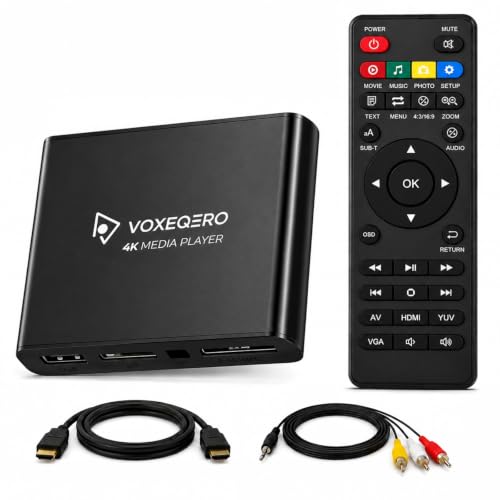
Micca 4K Ultra-HD USB and microSD Media Player
This unit targets signage operators and small businesses that need dependable 4K output without a learning curve. Micca has built a reputation for solid build quality in this bracket, and the dual-input design (USB plus microSD) gives you two independent media slots for redundant content delivery.
- Pro: 4K HDMI output with broad codec support handles modern signage files without transcoding.
- Pro: Physical USB and SD slots make content swaps fast even in tight installations.
- Con: Owner feedback notes the remote control range is limited, requiring line-of-sight operation in larger rooms.
Skip this if you need a digital trigger signal rather than simple looping — it is not designed for that workflow.
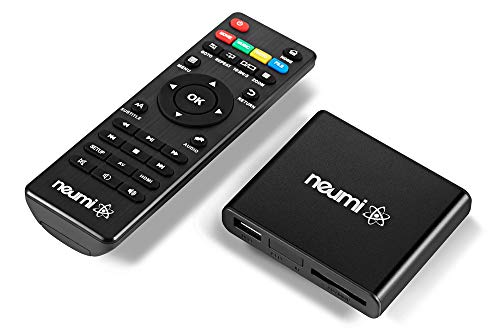
NEUMI Atom 4K Lite Digital Trigger Media Player
NEUMI’s Atom Lite is built for installations where a media player legacy unit needs to start playback when an external signal fires — common in museum exhibits, retail end-caps, and interactive kiosks. The trigger input eliminates manual button presses entirely.
- Pro: Digital trigger input allows automated start-stop behavior tied to door sensors or motion detectors.
- Pro: USB and SD card slots provide flexible content loading without proprietary file formats.
- Con: The “Lite” designation means codec support is narrower than the full 4K flagships; some newer formats may not decode.
Skip this if your use case is a simple overnight loop with no external trigger logic — you are paying for a feature you will not use.
HDMI Media Player, Black Mini 1080p Full-HD
At the lowest entry point in this roundup, the Black Mini serves buyers who need basic 1080p looping for small signage displays, old flat-panel monitors, or security camera review stations. It is a no-frills media player legacy device that prioritizes simplicity over resolution.
- Pro: Very low cost makes it practical to deploy in multiples across several locations.
- Pro: Compact form factor hides easily behind a TV or inside a small enclosure.
- Con: Stuck at 1080p output; on a modern 4K panel you will see noticeable softness, especially with text-heavy signage.
Skip this if your displays are 4K and your content includes fine text or high-resolution imagery.
4K Full-HD USB and microSD Digital Media Player for TV Digital Signage
This mid-range option delivers 4K output at a price under $45, making it a strong value proposition for buyers who want high resolution without paying the premium of branded units. It targets the same signage and loop-playback market as the Micca but undercuts it on cost.
- Pro: 4K HDMI output at this price point makes it competitive with units costing ten dollars more.
- Pro: Dual media slots (USB and microSD) allow simultaneous content sources or backup loading.
- Con: Owner reports mention inconsistent performance with very large USB drives; keeping media under the rated ceiling is important.
Skip this if you plan to push massive storage volumes or need verified reliability reports across many deployment sites.
4K Media Player for TV, USB SD Playback, HDMI AV Output, Auto Resume
The auto-resume function is the headline here. For any deployment where power cuts are expected — outdoor kiosks, buildings with unreliable circuits, or multi-day unattended signage — this media player legacy unit restarts playback at the last position rather than from the top of the playlist. That single feature saves significant maintenance time.
- Pro: Auto-resume after power loss prevents content gaps in long-running loops.
- Pro: Combined HDMI and AV output supports both modern panels and older CRT or composite-connected displays.
- Con: AV output is limited to lower resolutions, so you lose 4K benefit if using the analog port.
Skip this if your environment has stable power and you do not need analog fallback connectivity.
NEUMI Atom 1080P Full-HD Digital Media Player
The 1080P Atom shares the NEUMI build philosophy but drops to full HD output, which also drops the price. It suits schools, churches, and offices running 1080p signage on older or secondary displays where 4K is unnecessary.
- Pro: The most affordable option in this roundup, well under forty dollars.
- Pro: NEUMI’s interface design keeps menu navigation intuitive for non-technical users.
- Con: No 4K path means it will feel dated quickly as display prices continue to fall.
Skip this if you expect to upgrade your displays within two or three years.
ACEMAX 4K Digital Signage Media Player
ACEMAX stands out in the media player legacy category by advertising USB support up to 8TB and microSD up to 1TB. That storage headroom is genuinely rare at this price and matters for operations that rotate large video files — retail chains, airports, or facilities with multi-week content calendars.
- Pro: 8TB USB ceiling and 1TB SD support far exceed what competitors offer at this price.
- Pro: No Wi-Fi dependency means zero network configuration and no vulnerability to connectivity drops.
- Con: Some owners report that extremely large USB volumes increase initial scan time noticeably before playback begins.
Skip this if your content library is small; you will not benefit from the storage advantage.
HDMI Media Player, 4K Ultra HD, USB/SD Card Expansion
This unit’s strength is format breadth. It explicitly lists MP4, MKV, MP3, AVI, TS, RMVB, MOV, ISO, and JPG support alongside H.265, H.264, and AVC decoding at 4K@30Hz. For buyers with mixed legacy archives — old DVD rips in various containers, security DVR exports, and photo slideshows — this codec-and-container matrix is the most complete in the group.
- Pro: Widest documented format list handles nearly any file you throw at it without conversion.
- Pro: 4K@30Hz H.265 decoding covers current signage content without transcoding.
- Con: 30Hz ceiling means 60fps video content will stutter; not ideal for motion-heavy promotional loops.
Skip this if your content is exclusively 4K at 60fps or you need smooth high-motion playback.
Buying Guide
Resolution and Codec Support
The first decision is whether you need 4K or whether 1080p suffices. If your target display is 4K and your content includes text overlays or high-detail imagery, H.265 decoding at 4K@30Hz or higher is essential. A 1080p-only unit will work on a 4K panel through upscaling, but the result is visibly softer. Check whether the player supports H.265 specifically, not just H.264, because modern camera systems and encoding pipelines default to the newer codec.
Storage Ceiling and Port Quality
A USB port rated for 8TB handles a fundamentally different workload than one rated for 128GB. For unattended deployments lasting weeks without a technician visit, match the player’s maximum supported capacity to your actual content volume. Port durability also matters: several media player legacy units fail not in electronics but in the physical USB connector after dozens of insertions. Look for owner commentary on long-term port wear before committing to high-turnover use cases.
Autonomy: Auto-Play, Loop, and Resume
A player that requires a button press after every reboot is not truly unattended. The three autonomy features to verify are: auto-play on power (starts playback without remote input), continuous loop (restarts the playlist when it ends), and resume position (returns to the exact frame after a power interruption). Not every unit offers all three. For signage that runs 24/7, resume-after-outage is the most important feature because it eliminates content gaps that viewers will notice.
Our Verdict
The Micca 4K Ultra-HD is the top pick overall: it balances 4K output, dual media slots, and a brand with established reliability records in this niche. For buyers on the tightest budget, the NEUMI Atom 1080P at $37.99 is the most affordable entry that still carries a name buyers trust. If your deployment involves very large content libraries and you want a single device that handles them without swapping drives, the ACEMAX 4K wins that specific case outright thanks to its 8TB USB ceiling at a price under forty dollars.
FAQ
Do media player legacy devices need an internet connection?
No. These players operate entirely from local storage (USB drives or SD cards) and do not require Wi-Fi, Ethernet, or any network connection. That is one of their core advantages over smart TV apps for signage and archival playback.
Can I play ripped DVD or Blu-ray ISO files directly?
Some units, like the 4K Ultra HD Multi-format player listed above, explicitly support the ISO container format. Many others do not and will require you to extract the video stream to a standard file like MKV or MP4 before loading it onto the drive.
Will a 1080p media player work on a 4K TV?
Yes, the TV will upscale the signal. The image will be viewable but noticeably softer than native 4K content, particularly with small text or fine detail. For signage with readable typography, 4K output is strongly preferred.
How long do these players typically last in continuous operation?
Owner feedback suggests units from established brands last several years in 24/7 deployments, while no-name players may experience port failures or thermal throttling sooner. Keeping the device ventilated and avoiding oversized drives beyond the rated capacity extends lifespan meaningfully.