A built-in TV speaker can produce dialogue, but it cannot produce a room. When you compare surround sound system for tv options on a shopping site, the numbers that matter are not wattage alone or marketing adjectives—they are whether the system delivers actual discrete rear channels, whether the subwoofer is wireless or tethered to an outlet, and whether the brand commits to post-purchase firmware support. Buyers who skip these checks end up with a bar that throws sound forward and calls it surround.
The eight products below span $59.99 to $309.99 and range from a compact 5.1 channel setup to a 7.1 virtual surround bar. What separates the strong picks from the weak ones is channel count honesty, Atmos implementation, and whether the included accessories—rears, sub, remote, app—arrive complete. Owner feedback consistently penalizes systems with underpowered rear satellites, confusing pairing sequences, and Dolby logos on boxes that contain only virtual processing. This roundup weighs published specs and verified owner reports to sort that noise.
Our top picks


 ULTIMEA 5.1CH Surround Sound Bar System with
- Simplified 5.1ch Dolby Atmos Setup: Enjoy immersive 4D…
- Voice Clarity Enhancement: VoiceMX technology uses advanced DSP…
- 300W Output with 6-Driver System: Featuring five precision-tuned…

 ULTIMEA 5.1.2ch Sound Bar with Dolby Atmos
- 5.1.2ch Surround Sound System: A 5.1.2-channel system featuring…
- Up-Firing Drivers with Neodymium Core: The up-firing channels…
- 360° SurroundX Audio: SurroundX technology combines two rear…

 TCL S65K S Series 5.1 Channel Soundbar
- 5.1 S-Series Sound Bar Fill your room with…
- Ray Danz Technology: Experience an expansive soundstage that…
- Dolby Atmos and DTS:X: Spatial sound from above…
As an Amazon Associate we earn from qualifying purchases at no extra cost to you.
Quick Picks
| Product | Best for | Price |
|---|---|---|
| ULTIMEA 7.1ch w/Subwoofer | Virtual surround on a budget | $129.99 |
| LG S40TR | Trusted brand with real rears | $199.99 |
| ULTIMEA Poseidon M60 | Dolby Atmos under $160 | $158.58 |
| ULTIMEA Aura A40 | App control and 330W peak | $129.99 |
| ULTIMEA 5.1.2ch Atmos | Height channels plus rears | $309.99 |
| ULTIMEA 5.1 w/Subwoofer | Simple 5.1 without rears clutter | $129.99 |
| Saiyin Sound Bar | Lowest entry price with a sub | $59.99 |
| TCL S65K | Auto room calibration and DTS:X | $249.99 |
How We Picked
We filtered this category on four criteria: discrete channel count versus virtual processing (and whether the listing is transparent about it), subwoofer power relative to room size, inclusion and practicality of rear speakers, and the presence of Dolby Atmos or DTS:X decoding rather than cosmetic branding. Owner-reported reliability over 6-12 months served as the tiebreaker when specs were equivalent.
The 8 Best Surround Sound System For Tv in 2026
ULTIMEA 7.1ch Sound Bar with Subwoofer
This bar pairs a center channel bar with four small surround satellites and a wireless sub, marketed as a 7.1 virtual surround system. Owners praise the sense of lateral width for the price and the fact that the sub is wireless, which simplifies placement behind a couch. The main limitation is that rear speakers are powered by a single wired hub, not individual wireless links, so cable management still requires planning. Skip this if your room is larger than roughly 250 square feet; rear volume drops noticeably at distance from the bar.
- Four discrete rear satellites included
- Wireless subwoofer for flexible placement
- Rear satellites share one wiring harness, limiting flexibility
LG S40TR
LG brings its Wow Interface ecosystem to a 4.1 channel package that includes two rear surround speakers and a wireless sub. The Dolby Audio and AI Sound Pro processing handle dialogue clarity well, a point owners frequently confirm when switching from TV speakers. Rear speakers are compact and pair wirelessly to the main unit, removing the hub problem found in the ULTIMEA 7.1. The tradeoff is fewer channels: only two rears, and no Atmos. Buyers who want height effects should look elsewhere, but for straightforward surround with a trusted support chain, this is the safest pick.
- Wireless rear pairing, no hub box
- LG app and firmware support longevity
- No Dolby Atmos or height channels
ULTIMEA 5.1CH Poseidon M60
The Poseidon M60 adds Dolby Atmos to ULTIMEA’s budget surround system, combining a 5.1 channel layout with upward-firing drivers in the bar for virtual height. At $158.58 it undercuts most Atmos-enabled systems by a wide margin. Owners note the Atmos effect is directional rather than enveloping—useful for overhead action moments but not equivalent to dedicated ceiling drivers. The wireless sub delivers adequate bass for medium rooms. Skip this if you demand true object-based height; the 5.1.2 model below handles that role better.
- Dolby Atmos at an entry price
- Wireless sub included
- Height effect is virtual, not dedicated drivers
ULTIMEA 7.1ch Aura A40
The Aura A40 mirrors the first ULTIMEA in channel layout but adds app control, 330W peak power, and multiple input options including optical, AUX, and Bluetooth. Owners highlight the app as genuinely useful for EQ tuning and surround-level adjustment without hunting for a small remote. The peak power figure is marketing-oriented—continuous power is lower—but the bar drives rooms up to 300 square feet without clipping. The same rear-hub wiring limitation applies. Choose this over the base ULTIMEA 7.1 if you value software control and slightly higher headroom.
- App control for EQ and surround levels
- 330W peak power provides volume headroom
- Rear wiring hub limits placement options
ULTIMEA 5.1.2ch with Dolby Atmos
This is ULTIMEA’s flagship surround sound system for tv in the lineup, adding two dedicated height channels on top of 5.1, giving a true 5.1.2 configuration with Atmos decoding. At $309.99 it costs more than the TCL S65K, but it delivers more channels and a larger sub. Owners report a noticeable jump in immersion versus the Poseidon M60’s virtual approach. The con is that rear satellites are still modest in output, and the unit lacks a built-in streaming platform—everything routes through the TV or an optical/HDMI-ARC source. If your priority is maximum channel count per dollar, this earns it.
- True 5.1.2 with dedicated height drivers
- Larger subwoofer than budget ULTIMEAs
- No native streaming, external source required
ULTIMEA 5.1 Sound Bar for Smart TV w/Subwoofer
This model drops the rear satellites entirely, offering a 5.1 virtual surround bar with a wireless sub at the same $129.99 price as ULTIMEA’s 7.1. It suits buyers who cannot run wires behind a sofa or who have a narrow room where rear speakers would cluster. Virtual surround from the bar alone creates a decent soundstage but lacks true behind-the-listener localization. Owners who had limited space report high satisfaction; those expecting theater-style envelopment find it lacking. A logical skip for anyone with room for discrete rears.
- Cleanest setup, no rear wiring at all
- Wireless sub included
- No discrete rear channels
Saiyin Sound Bar with Subwoofer
At $59.99, Saiyin provides a 2.1 surround system with a wireless sub and basic virtual surround processing. It is the cheapest option here and a legitimate step up from TV speakers for bass and dialogue clarity. The surround effect is minimal—mostly a wide stereo image with sub reinforcement. Owners who wanted to upgrade a bedroom or dorm TV without spending over a hundred dollars rate it well. Skip this if rear localization or Atmos matters to you; it is a bar-plus-sub, not a surround system in the discrete-channel sense.
- Lowest price with a wireless sub
- Simple single-cable setup
- Virtual surround only, no rears
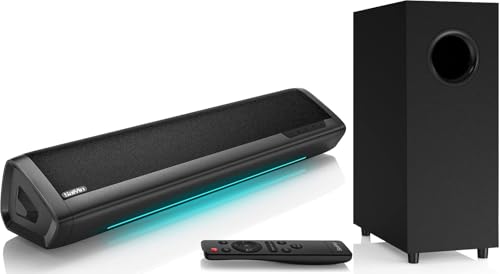
TCL S65K S Series 5.1 Channel Soundbar System
The TCL S65K rounds out the list with Dolby Atmos, DTS:X, wireless rear speakers, a wireless sub, and AI Sonic Auto Room Calibration at $249.99. The auto-calibration feature is the standout differentiator: a built-in microphone measures your room’s reflections and adjusts delay and EQ per channel, something most competitors skip. Owners consistently rate the rears as more powerful than ULTIMEA’s satellites and note the wireless pairing is genuinely wireless. The con is that the bar is physically wider, which may conflict with slim TV stands. For calibration-driven setup without manual guesswork, this is the strongest choice.
- Auto room calibration adjusts all channels
- Wireless rears pair independently
- Wide bar body limits stand compatibility
Buying Guide
Discrete Channels vs. Virtual Surround
A 5.1 or 7.1 system with physical rear speakers localizes sound behind you. A virtual surround bar bounces sound off walls using phase tricks, which works in rectangular rooms under 300 square feet but collapses in open-plan spaces or rooms with vaulted ceilings. Check whether the listing says “virtual” next to the rear count; ULTIMEA’s 7.1 is virtual surround processing fed to physical satellites, which is a middle ground worth understanding.
Dolby Atmos Implementation
Atmos branding on a $150 bar usually means upward-firing drivers bouncing sound off the ceiling, producing virtual height. True object-based height in a surround sound system for tv requires either dedicated up-firing drivers in a 5.1.2 or 5.1.4 layout or physical in-ceiling speakers. The TCL S65K and ULTIMEA 5.1.2 offer the best Atmos within this list; the others deliver spatial cues without full Atmos decode.
Subwoofer Power and Room Size
A sub rated below 100W RMS fills a bedroom but struggles in a living room over 200 square feet. Wireless subs give placement freedom—corner or behind a side table—but still need a power outlet. If your couch sits more than eight feet from the sub’s best position, consider whether the included unit has enough low-end extension or plan for an upgrade path later.
Our Verdict
The TCL S65K is the top pick. Auto room calibration eliminates the single most common owner complaint—uneven rear levels—and wireless rears plus Dolby Atmos and DTS:X cover every format a modern TV or streamer outputs. The $249.99 price is justified by the feature set relative to anything else here. For the budget floor, the Saiyin at $59.99 is the best first surround sound system for tv anyone can buy if the goal is simply escaping flat TV audio with added bass. However, if you already own a ULTIMEA-compatible smart TV app and want 330W peak headroom for movie nights in a mid-size room, the Aura A40 delivers more raw output per dollar than any competitor at $129.99.
FAQ
Do I need a surround sound system for tv with real rear speakers?
If you want sound that originates behind you during action scenes or ambient audio, yes. Virtual surround creates a wider front image but cannot convincingly place audio behind the listener in rooms with open floor plans or non-parallel walls.
Is Dolby Atmos worth it on a budget soundbar?
It depends on your ceiling. Virtual Atmos relies on a flat, reflective ceiling at standard height (8-9 feet). In rooms with vaulted ceilings or exposed beams, the upward-firing effect largely disappears, and you are paying for processing your room cannot render.
How far can wireless rear speakers sit from the bar?
Most systems in this price range maintain a reliable connection up to approximately 30 feet from the bar, though walls and interference reduce that. The TCL S65K pairs rears independently, which simplifies placement compared to systems using a central hub box.
Can I add a second sub to any of these systems?
Generally no. Each system here is designed around its included sub, and the DSP calibration does not support a second unit. If you need deeper bass in a large room, upgrade to a higher-wattage system rather than adding a sub.