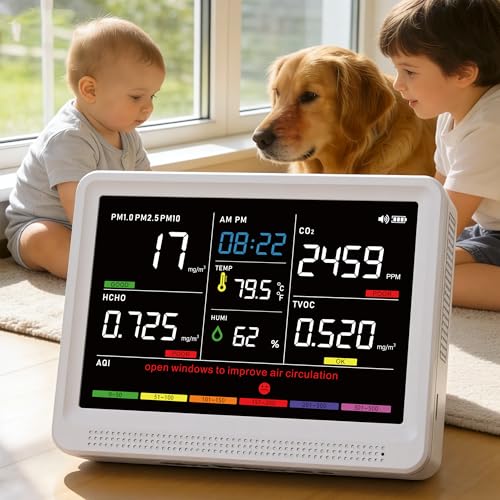
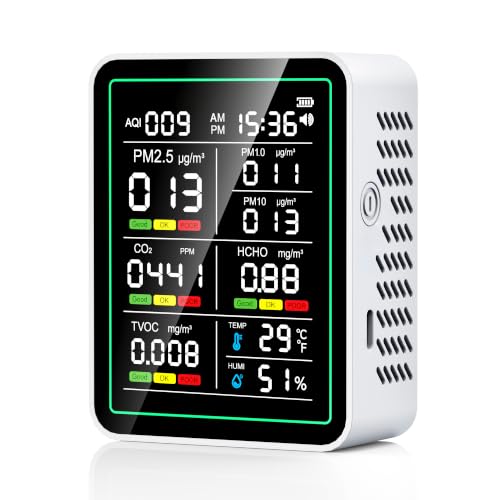
For most households, a monitor that tracks CO2, fine particles (PM2.5), VOCs, temperature and humidity in one unit, such as the Awair Element or the Airthings View Plus, is the most useful choice, while the Aranet4 suits people who only care about CO2 and ventilation, and the Airthings Wave Plus or View Plus suit people who also want radon readings. This guide compares those and a few alternatives, explains what each sensor actually measures, and notes the limits of consumer devices. An air quality monitor is an information tool. It does not replace smoke alarms, carbon monoxide alarms or a professional radon test, and it should not be used to diagnose a health problem.
Our top picks


As an Amazon Associate we earn from qualifying purchases at no extra cost to you.
At a Glance
| Monitor | Best for | Key stated measurements | Limits |
|---|---|---|---|
| Awair Element | Whole-room overview with a clear display | Maker lists CO2, VOCs, PM2.5, temperature and humidity; display on the unit and an app | Mains powered; no radon sensor |
| Airthings View Plus | Households that also want radon data | Maker lists radon, PM1/PM2.5, CO2, VOCs, temperature, humidity and pressure; display and app | Premium tier; radon readings need time to settle |
| Airthings Wave Plus | Radon and indoor air basics, battery powered | Maker lists radon, CO2, VOCs, temperature, humidity and pressure; wave-to-view display | No particulate sensor |
| Aranet4 | CO2 and ventilation tracking in offices or classrooms | NDIR CO2 sensor, temperature, humidity and pressure; e-ink display; battery operated | Does not measure particles or VOCs |
| IQAir AirVisual Pro | Detailed particle and CO2 monitoring with outdoor comparison | Maker lists PM2.5, CO2, temperature, humidity and AQI display, with network data features | Higher cost; some features rely on the maker’s app |
| Temtop and Qingping models | Lower-cost multi-sensor monitors | Makers list PM2.5, CO2, TVOC, temperature and humidity on selected models | Accuracy and calibration vary; less detail about long-term support |
What Each Sensor Tells You
CO2 (carbon dioxide)
Carbon dioxide itself is not a pollutant at typical indoor levels, but it is widely used as a proxy for how well a room is ventilated. When many people share a closed room, CO2 rises, and a rising number suggests that stale air is building up. Many guidance documents treat readings around 800 to 1,000 ppm as a prompt to ventilate, though thresholds differ between authorities. Look for monitors that state they use a non-dispersive infrared (NDIR) sensor, because it is the more reliable type compared with estimated CO2 from VOC sensors. The Aranet4 and Airthings units use true CO2 sensors according to their makers.
PM2.5 (fine particles)
Particle sensors use light scattering to estimate the concentration of tiny particles from cooking, candles, outdoor smoke and dust. They are helpful for seeing the effect of a gas stove, wildfire smoke, or an air purifier. Consumer particle sensors are good at showing trends and spikes, but they are not laboratory instruments, and they may read differently across brands.
VOCs and TVOC
Volatile organic compounds come from cleaning products, paints, furniture and some building materials. Consumer VOC sensors typically report a relative index or a TVOC number rather than identifying specific chemicals. Use them to spot changes, such as a spike after cleaning, rather than as proof that air is safe or unsafe.
Temperature and humidity
These matter for comfort and for managing damp. Many guides suggest keeping indoor relative humidity roughly between 30 and 50 percent, which helps limit mold growth and dryness, though specific advice depends on climate and your home.
Radon
Radon is a radioactive gas that can enter homes from the ground. Airthings states that its radon sensors provide short-term and long-term averages. Health agencies recommend following official radon testing guidance, and a consumer monitor may be a useful screen, but if you see elevated long-term averages, contact a qualified radon professional or your local health authority. Radon readings need days to weeks to stabilize.
The Main Picks
Awair Element: Balanced Everyday Choice
The Element is a plug-in monitor with a front display showing a score and key readings. Awair lists CO2, VOCs, PM2.5, temperature and humidity, and the monitor connects to an app for history and to supported smart home systems. Reviewers like its readable display and focus on the sensors most households care about. As a mains-powered unit, it is best placed on a shelf near an outlet in a bedroom or living room.
Airthings View Plus: Most Complete
This is the pick if you want radon and particles in one device. Airthings lists radon, PM1 and PM2.5, CO2, VOCs, temperature, humidity and pressure. It has a display on the front and uses a wave-to-view gesture, and it can run on batteries or USB power as the maker describes. It sits in the premium tier, but it combines functions that otherwise require two devices.
Airthings Wave Plus: Radon on a Budget
The Wave Plus is a battery-powered unit without a screen that you check via a smartphone app or wave-to-view gesture. It measures radon, CO2, VOCs, temperature, humidity and pressure, according to the maker. It is a smart choice for a basement or lower floor where radon is of concern, and it is cheaper than the View Plus because it lacks the particle sensor and display.
Aranet4: Best for Ventilation Checks
The Aranet4 focuses on CO2, along with temperature, humidity and pressure. Its e-ink display is easy to read at a glance and the batteries last a long time according to the maker. Reviewers like it for classrooms, home offices and meeting rooms where the question is simply whether the room needs fresh air. It will not show particles or VOCs.
IQAir AirVisual Pro: Particle-Focused
IQAir has a long history in air filtration and particle measurement. The AirVisual Pro displays PM2.5, CO2, temperature and humidity and can show local outdoor air quality from the company’s network. It suits people in smoke-prone or high-pollution regions who want to compare indoor and outdoor readings.
Lower-Cost Options
Brands such as Temtop and Qingping sell compact monitors with PM2.5, CO2 and TVOC sensors at budget tiers. They can be a good starting point, but consumer reviews differ on accuracy and software quality, so treat the numbers as trends.
What to Look For
- Sensor type: Prefer true NDIR CO2 over estimated eCO2 values.
- Particle size coverage: PM2.5 is the most common and useful; PM1 and PM10 add detail.
- Power: Battery models are flexible in placement, plug-in models offer continuous readings without battery changes.
- Display versus app: A screen helps for quick checks; an app is better for history and trends.
- Smart-home and data export: Useful if you want to trigger a purifier or fan.
- Placement: Keep monitors at breathing height, away from windows, vents and direct sunlight, and not next to a stove or humidifier outlet.
- Warm-up and calibration: Some sensors need hours or days to stabilize. Follow the maker’s instructions.
Safety Notes
An air quality monitor is not a smoke or carbon monoxide detector. Install certified smoke and CO alarms as required by your local rules and the manufacturer’s manual, and test them on schedule. If an alarm sounds, leave the building and call emergency services. If you suspect gas leaks, mold problems or high radon, contact a qualified professional. If anyone in your home has asthma or another health condition, speak to a doctor about managing air quality instead of relying on a consumer monitor alone.
Budget Tiers
- Budget: Compact PM2.5, CO2 and TVOC monitors from lower-cost brands.
- Mid-range: Aranet4 and Airthings Wave Plus, depending on whether you want CO2 only or radon too.
- Premium: Awair Element, Airthings View Plus and IQAir AirVisual Pro.
Pick X If You Want…
| Pick this | If you want |
|---|---|
| Awair Element | A clear all-round monitor for a living room or bedroom |
| Airthings View Plus | Radon, particles and CO2 in one device |
| Airthings Wave Plus | Radon and CO2 without a screen |
| Aranet4 | A simple CO2 and ventilation reader |
| IQAir AirVisual Pro | Strong particle tracking and indoor-outdoor comparison |
| Budget Temtop or Qingping | A low-cost starting point for trends |
Alternatives
- Air purifiers with built-in sensors: Many purifiers display PM2.5 readings, which can be enough if you only want to see particles.
- Standalone radon test kits: Short-term and long-term kits are inexpensive and follow official testing methods.
- Smart thermostats with air sensors: Some models include basic humidity or air quality readings.
Frequently Asked Questions
Which air quality readings matter most at home?
CO2 helps show whether a room is ventilated, PM2.5 shows particles from cooking and smoke, and humidity helps with comfort and mold prevention. VOC and radon readings add extra context if those are concerns for your home.
Are consumer air quality monitors accurate?
They are good for showing trends and comparing rooms, but they are not laboratory instruments. Readings can differ between brands, so use them to see changes rather than as exact measurements.
Can an air quality monitor replace a CO alarm?
No. Carbon monoxide alarms are certified safety devices with specific requirements. Install them according to your local rules and the manufacturer’s manual.
Where should I place the monitor?
Place it at about breathing height in the room you use most, away from windows, vents, stoves and direct sunlight. A bedroom is a common first choice.
What CO2 level means I should ventilate?
Guidance varies, but many sources treat readings above roughly 1,000 ppm as a sign to open a window or increase ventilation. Use the guidance from your local health or building authority.
Do I need radon monitoring?
It depends on where you live and the type of home. Health agencies suggest testing in many regions. A consumer radon monitor is a useful starting point, and a professional should help if the long-term numbers are elevated.
More from Amazon
Programs that pair well with the guide above. Offers and eligibility are set by Amazon and may change.
Free shipping on eligible items, Prime Video and more. Eligible new members can start with a free trial.
Start a Prime free trialAd-free music streaming. Eligible new subscribers can start with a free trial.
Try Music Unlimited freeA Prime membership for ages 18-24 with a trial period. Eligibility is set by Amazon.
See Prime for Young AdultsAudiobooks and podcasts to listen to on the go. Eligible new members can start with a free trial.
Try Audible freeAs an Amazon Associate we earn from qualifying purchases.