Key takeaways
- Hide your cable box and receiver behind closed doors and still use your remotes. Five wired IR repeater kits compared, with placement tips that work.
Disclosure: As an Amazon Associate, I earn from qualifying purchases.
A closed cabinet door is all it takes to make a perfectly good remote useless. Infrared is light, and light does not pass through wood, so the cable box, receiver and disc player behind doors or in a closet go deaf the moment the door shuts. An IR repeater kit fixes this with wiring: a receiver eye sits where your remote can see it, a distribution block relays the signal, and stick-on emitter heads pasted over each component’s IR window deliver the command inside the cabinet. No network, no app, no account: the remote you already own keeps working, just through a wire.
This guide covers wired repeater kits with emitters only — not the app-connected hubs in this site’s remote hub guide, and not wireless extenders that hop rooms by radio. One limit applies to everything below: a repeater repeats infrared and nothing else. Remotes that pair by Bluetooth or radio — most current streaming stick remotes among them — gain nothing from any kit here, because there is no infrared signal to repeat.
How to Choose an IR Repeater Kit
Check that your remotes actually speak infrared
Before counting emitters, confirm each device you want to hide still listens for IR. TVs, AV receivers, soundbars, disc players and most cable and satellite boxes do. Streaming sticks are the common trap: their remotes usually pair by Bluetooth, so the stick never sees infrared at all. The test takes seconds: cover the front of the remote with your hand and press a button — an IR remote does nothing with its light path blocked, while a radio remote keeps working. Hide only gear that passes, and plan on HDMI-CEC or the maker’s app for the rest.
Find the IR eye before you buy anything
The number-one cause of repeater failure is not the kit; it is an emitter pasted a few millimeters away from the device’s IR eye. Behind dark smoked-plastic front panels, the eye is often invisible. The flashlight test finds it: shine a bright flashlight slowly across the front panel and look for the small round or oval sensor window behind the plastic. Mark that spot, because the emitter head has to sit directly on it. An emitter slightly off target may work with the door open and fail with it closed, which is why so many setups seem haunted. Placement patience matters more than which kit you buy.
Dual band is not a luxury feature
Infrared remotes modulate their signal at different carrier frequencies. Most gear uses the band around 38 kHz, but many cable and satellite boxes use frequencies up near 56 kHz, and a single-band repeater can pass one group flawlessly while silently dropping the other. Dual-band kits repeat both ranges and remove the guesswork. If a cable box is in your rack, treat dual-band support as a requirement rather than an upgrade, and treat any kit that does not state its frequency coverage as a gamble. Every frequency and range figure in this guide is a maker figure.
Receiver placement decides reliability
The receiver eye has its own enemies. Plasma TVs, bright sunlight and some LED and backlit displays flood the room with stray infrared that can swamp an inexpensive receiver, leaving commands ignored or doubled. Keep the receiver out of direct sun, away from the face of a plasma panel, and angled toward your seating rather than toward a window or the TV screen itself. A receiver with a confirmation light earns its keep here: the blink tells you the eye saw your remote, which separates a placement problem from a dead kit in seconds.
Count emitters, then measure the cables
A dual-head emitter serves two devices, so a four-emitter kit covers up to eight components — provided the cables reach. Measure the run from the block’s hiding place to the farthest shelf before ordering, and check receiver cable length too — the eye must reach a spot your remote can hit. Expansion ports matter if the rack grows: better kits accept extra emitters and a second receiver.
The 5 Best IR Repeater Kits
1. BAFX Products IR Repeater Kit
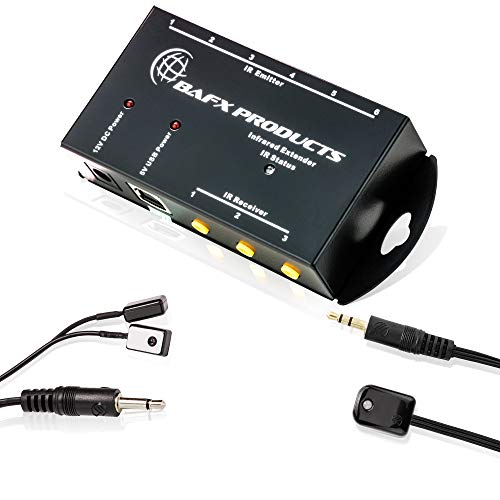
The BAFX kit is the straightforward full-rack answer: a distribution block, one receiver on a five-foot cable, and four dual-head emitters on roughly eight-and-a-half-foot cables, covering eight devices out of the box and twelve with add-ons. It is dual band — 38 kHz and 56 kHz — so a cable box and a receiver can share the block without one going deaf. The maker quotes a 25-foot receiver range, generous for most rooms, since the eye only needs a clear view of the couch. The block runs from the included adapter, or over USB with a suitable cable. Emitters and the receiver can be lengthened with ordinary stereo extension cables, which keeps long closet runs simple. For a typical cabinet with three to six components, this is the kit that asks the fewest questions.
Specs:
– Type: Wired distribution block kit
– Emitters: 4 dual-head cables, 8 devices (expandable to 12)
– Frequency: Dual band, 38 kHz and 56 kHz (maker figures)
– Cables: Receiver about 5 ft, emitters about 8.5 ft (maker figures)
– Range: Up to 25 ft (maker figure)
– Power: 12V adapter included; USB power option
See the BAFX Products IR Repeater Kit on Amazon
2. Sewell BlastIR SW-29311

The BlastIR is the installer-grade take on the same idea. Its four emitter cables are Y-shaped, splitting into two heads over their final three feet, which makes landing a head precisely on an IR eye easier, without slack cable bunching in the cabinet. It repeats both 38 kHz and 56 kHz, and the compact receiver, about two and a quarter inches long, carries a bright confirmation LED so you can watch each press land before blaming the wiring. Sewell has sold this kit for years, and its appeal is dull reliability: a wired block, standard 3.5 mm emitter connections, and no software in the chain to age out. For a mixed rack of older and newer gear, it is the kit built for the afternoon spent hunting IR eyes with the flashlight test.
Specs:
– Type: Wired distribution block kit
– Emitters: 4 dual-head Y-cables, splitting over the last 3 ft
– Frequency: Dual band, 38 kHz and 56 kHz (maker figures)
– Receiver: About 2.25 x 0.5 in, with confirmation LED (maker figures)
– Expansion: Block expandable to 12 devices (maker figure)
– Model: SW-29311
See the Sewell BlastIR SW-29311 on Amazon
3. ICESPRING Infrared Repeater System

ICESPRING’s kit leads with head count: five dual-head emitters in the box, enough for ten devices before any expansion, driven by a single main unit with a 12V power adapter. That makes it the natural pick for a full rack — receiver, disc player, cable box, streamer with an IR remote, game console — where a four-emitter kit would run out of heads on day one. The layout is the familiar one — receiver eye in view of the seating, emitters pasted over each component’s window — and the maker’s notes are blunt about the category boundary: no radio or Bluetooth remotes. Treat the ten-device figure as a maker figure; every added emitter is another placement job for the flashlight test, not just another plug to fill.
Specs:
– Type: Wired distribution block kit
– Emitters: 5 dual-head cables, up to 10 devices (maker figure)
– Frequency: Dual band IR (maker figure)
– Power: 12V DC adapter included
– Model: 4330159445
– Note: Infrared remotes only, per maker
See the ICESPRING Infrared Repeater System on Amazon
4. HDTVHookup Deluxe IR Repeater System

This deluxe kit is built around cable length. The receiver sits on a ten-foot cable and the two included dual emitters run ten feet each, so the hideaway controller — a box of three and a half by two inches — can live deep in a closet while the eye still reaches the front of the room. Two dual emitters cover four devices out of the box, and the controller accepts up to six dual emitters for twelve devices. The receiver flashes a blue LED to confirm each command, which speeds up eye-hunting. One honest maker note: the kit is stated not to work with AT&T U-verse equipment, a reminder that a few services use IR variants some repeaters miss, and that checking your exact box against the maker’s compatibility notes beats assuming.
Specs:
– Type: Wired hideaway controller kit
– Emitters: 2 dual-head cables, 4 devices (expandable to 12)
– Cables: Receiver 10 ft, emitters 10 ft, power 6 ft (maker figures)
– Receiver: About 2 x 0.5 in, blue confirmation LED (maker figures)
– Controller: About 3.5 x 2 in (maker figure)
– Note: Not for AT&T U-verse, per maker
See the HDTVHookup Deluxe IR Repeater System on Amazon
5. Cable Matters Infrared Remote Extender Cable

Not every problem needs a distribution block. When one cable box hides behind a door, or a soundbar blocks a TV sensor, this cable is the whole solution: a receiver bulb at one end, a single emitter at the other, and a six-foot USB Y-cable for power in between. The maker quotes pickup up to 15 feet within a 30-degree cone and a wide 30 to 60 kHz range, both maker figures, so the little receiver still has to face the seating. One maker warning deserves emphasis: many TV USB ports switch off with the TV, leaving the hidden box uncontrollable until the set wakes, so power it from a wall charger instead. It controls exactly one device, and for that one device it is the simplest install in this guide.
Specs:
– Type: Single-device wired extender cable
– Emitters: 1 emitter head, 1 device
– Frequency: 30 to 60 kHz (maker figure)
– Pickup: Up to 15 ft within 30 degrees (maker figure)
– Cable: 6 ft, USB powered (5V)
– Model: 203002-6
See the Cable Matters IR Extender Cable on Amazon
Comparison Table
| Kit | Emitters in box | Devices covered | Bands | Best for |
|---|---|---|---|---|
| BAFX Products Repeater Kit | 4 dual-head | 8, expandable to 12 | 38 and 56 kHz | Most cabinets and racks |
| Sewell BlastIR SW-29311 | 4 dual-head Y-cables | Expandable to 12 | 38 and 56 kHz | Precise emitter placement |
| ICESPRING Repeater System | 5 dual-head | 10 | Dual band | Full racks with many boxes |
| HDTVHookup Deluxe System | 2 dual-head | 4, expandable to 12 | Dual band | Long runs to a deep closet |
| Cable Matters Extender Cable | 1 single head | 1 | 30 to 60 kHz | One hidden cable box |
FAQ
Why does my repeater work with the cabinet door open but fail when it closes?
That pattern almost always means an emitter head is slightly off the device’s IR eye, catching it at an angle when extra light leaks in with the door open. Redo the flashlight test, mark the exact sensor spot, and re-stick the emitter directly over it. Also check the receiver eye still faces your seating with the doors shut; receivers get nudged during installation.
Will an IR repeater control a streaming stick with a Bluetooth remote?
No. A repeater can only repeat an infrared signal, and a Bluetooth remote sends none. If the stick’s remote pairs wirelessly, your options are HDMI-CEC control through the TV, the maker’s phone app, or a hub that also speaks Bluetooth. Repeaters remain right for the cable box, receiver and disc player beside the stick.
What does dual band mean, and do I need it?
It means the kit repeats both common infrared carrier ranges, 38 kHz and 56 kHz. Most components use the lower band, but many cable and satellite boxes use the higher one, and a single-band kit may control everything in the rack except that box. If any cable or satellite hardware is involved, dual band is the safe default.
Can I make the receiver or emitter cables longer?
Usually, yes. Most wired kits use standard 3.5 mm stereo connections, and makers such as BAFX note that emitters and receivers can be extended with ordinary stereo extension cables. Keep extensions as short as the run allows, seat every plug fully, and re-test each device afterward — a half-seated plug imitates a dead emitter.
Conclusion
A wired IR repeater is unglamorous technology that solves the hidden-gear problem when installed with care: find each IR eye with the flashlight test, place the receiver away from sunlight and screen glare, and choose dual band if a cable box is in the rack. The BAFX and Sewell kits cover most cabinets, ICESPRING feeds a full rack, HDTVHookup reaches a deep closet, and the Cable Matters cable handles the single hidden box. None of them will help a Bluetooth remote — but for infrared gear behind a closed door, nothing simpler works.
More from Amazon
Programs that pair well with the guide above. Offers and eligibility are set by Amazon and may change.
Free shipping on eligible items, Prime Video and more. Eligible new members can start with a free trial.
Start a Prime free trialAd-free music streaming. Eligible new subscribers can start with a free trial.
Try Music Unlimited freeA Prime membership for ages 18-24 with a trial period. Eligibility is set by Amazon.
See Prime for Young AdultsAudiobooks and podcasts to listen to on the go. Eligible new members can start with a free trial.
Try Audible freeAs an Amazon Associate we earn from qualifying purchases.