Our Short List of 3

- Best for: bright living rooms where the projector runs with the lights on Watch out for: the built-in speaker suits casual viewing, so a soundbar helps for movie nights
- Specs:
- Resolution: 1080p Full HD
- Brightness: 3,400 lumens color and white
- Technology: 3LCD

- Best for: dedicated movie rooms where color and a dark picture matter most Watch out for: 2,300 lumens needs a dark room, so it is not the pick for a bright living room
- Specs:
- Resolution: 1080p HDR, LED light source
- Brightness: 2,300 ANSI lumens
- Color: DCI-P3, 98 percent Rec.709
- Best for: big-screen movie nights and sports on a modest budget Watch out for: the picture is brightest at the center of the throw range, so measure the room first
- Specs:
- Resolution: 1080p Full HD
- Brightness: 3,500 ANSI lumens
- Color: SuperColor
All 4 Picks at a Glance
| Product | Specs | Action |
|---|---|---|
| Epson Home Cinema 1080 |
| Check price on Amazon |
| BenQ HT2060 |
| Check price on Amazon |
| ViewSonic PX701HD |
| Check price on Amazon |
 Optoma HD146X |
| Check price on Amazon |
Key takeaways
- The best reviewed 1080p video projectors bring bright, sharp home theater without a 4K budget. Compare four well-reviewed Full HD models for movies and gaming.
A 1080p projector still makes sense for a home theater when the screen is large, the room is dark, and the budget does not stretch to 4K. Full HD looks sharp from a normal viewing distance, the lamps and LED light sources last for years, and these projectors cost far less than their 4K siblings. The trick is picking a model with enough brightness for your room, a contrast ratio that keeps dark scenes readable, and a throw distance that fits the space.
This guide compares four well-reviewed 1080p projectors for different rooms and uses. One is a bright 3LCD model for living rooms, one is an LED home cinema projector with wide color, one is a bright DLP model for big screens, and one is a gaming-friendly DLP with fast response. All four were chosen from the names and specifications on their Amazon product pages, and the sections below match each one to a bright room, a dark theater, casual gaming, or a big-screen sports night.
Quick Picks
As an Amazon Associate we earn from qualifying purchases
| Product | Best for | Key spec from title |
|---|---|---|
| Epson Home Cinema 1080 | Bright living rooms | 3,400 lumens, 3LCD |
| BenQ HT2060 | Dedicated movie rooms | 1080p HDR LED, 2,300 lumens |
| ViewSonic PX701HD | Big screens on a budget | 3,500 lumens, 300-inch screen |
| Optoma HD146X | Gaming and fast response | 3,600 lumens, 16ms gaming mode |
How to Choose
Brightness versus room light
Brightness, measured in lumens, decides whether the picture survives ambient light. A projector rated at 3,400 to 3,600 lumens holds up in a living room with lamps on or curtains open, while a 2,300-lumen model needs a darker room to show its best. Remember that makers measure brightness differently — ANSI lumens are the more consistent figure — and that a bright picture in a dark room can look washed out. Match the lumen rating to the room, not to the biggest number on the page. A white wall or a light screen also affects the picture, so test the setup before mounting anything permanently.
Contrast and color
Contrast decides how dark the dark scenes look, and color decides how natural skin tones and landscapes appear. A 16,000-to-1 contrast ratio keeps shadows readable in a movie, while a 25,000-to-1 ratio digs deeper into blacks. Three-chip LCD designs like the Epson’s 3LCD tend to deliver strong color brightness, while single-chip DLP models like the Optoma’s use a color wheel. Wide color coverage, such as the BenQ’s DCI-P3 support, matters most in a dedicated theater where the picture is the point. In a bright room, contrast matters less than brightness, since ambient light washes out blacks before the ratio can help.
Gaming lag and refresh
Input lag is the delay between a controller input and the picture responding, and it matters the moment you play anything fast. A 16-millisecond lag is quick enough for most console games, and an 8.3-millisecond lag at 120 hertz is better still for competitive play. Check the lag figure at the refresh rate you actually use, since some projectors only reach their fastest response at 120 hertz. A projector with a dedicated gaming mode usually trades a little image processing for speed. A wired controller usually responds faster than a wireless one, which can shave a few more milliseconds off the total delay.
Lamp life and throw distance
Lamp life decides how long the projector runs before a replacement is needed, and throw distance decides how far back the projector must sit. A lamp rated for 12,000 to 20,000 hours lasts years of evening viewing, and an LED light source rated for 20,000 hours lasts longer still. Measure the room before buying: a projector with a 1.3-times zoom and vertical lens shift, like the BenQ, forgives an imperfect mount, while a fixed-throw model needs the distance worked out in advance. A ceiling mount keeps the projector out of the way, but a shelf mount is easier to adjust when the room layout changes.
The 4 Best Options
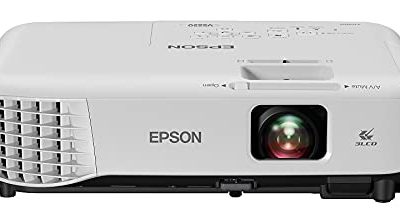
Epson Home Cinema 1080
- Best for: bright living rooms where the projector runs with the lights on Watch out for: the built-in speaker suits casual viewing, so a soundbar helps for movie nights
- Specs:
- Resolution: 1080p Full HD
- Brightness: 3,400 lumens color and white
- Technology: 3LCD
bright living rooms where the projector runs with the lights on Watch out for: the built-in speaker suits casual viewing, so a soundbar helps for movie nights
the built-in speaker suits casual viewing, so a soundbar helps for movie nights
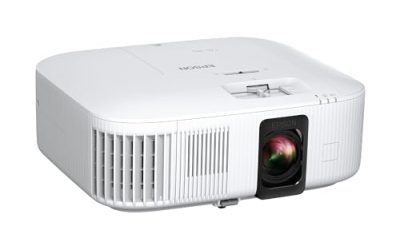
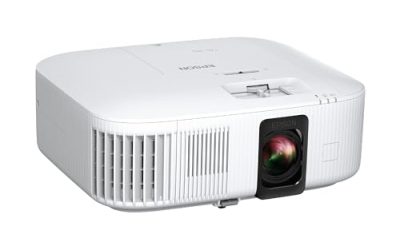
The Epson Home Cinema 1080 is the living-room pick, with 3,400 lumens of color and white brightness that hold up when the lights are on. Its 3LCD design keeps colors bright, the 16,000-to-1 contrast ratio keeps dark scenes readable, and a built-in speaker covers casual viewing without extra hardware. Dual HDMI inputs take a streaming stick and a console at once, auto picture skew straightens the image, and the lamp lasts up to 12,000 hours. At 8.2 pounds it is easy to move between rooms or mount on a shelf. The 3LCD design keeps colors bright even in Eco mode, which stretches the lamp further.
BenQ HT2060
- Best for: dedicated movie rooms where color and a dark picture matter most Watch out for: 2,300 lumens needs a dark room, so it is not the pick for a bright living room
- Specs:
- Resolution: 1080p HDR, LED light source
- Brightness: 2,300 ANSI lumens
- Color: DCI-P3, 98 percent Rec.709
dedicated movie rooms where color and a dark picture matter most Watch out for: 2,300 lumens needs a dark room, so it is not the pick for a bright living room
2,300 lumens needs a dark room, so it is not the pick for a bright living room
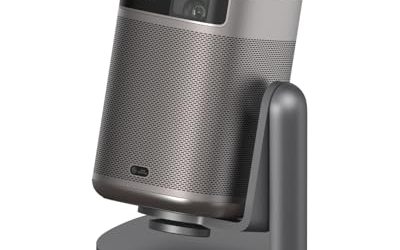
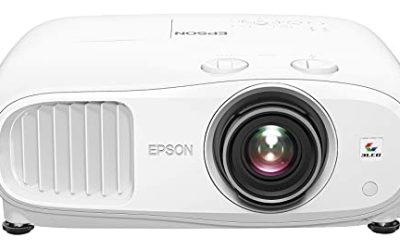
The BenQ HT2060 is the dedicated theater projector here, built around color and a long-lived LED light source. Its 1080p HDR picture covers the DCI-P3 color space, the 2,300 ANSI lumens suit a dark room, and the LED light source lasts 20,000 hours without a lamp change. An 8.3-millisecond input lag at 120 hertz makes it quick enough for gaming, vertical lens shift and a 1.3-times zoom forgive an imperfect mount, and two 5-watt speakers cover casual viewing. It is the pick when the room is dark and the picture quality is the priority. The 20,000-hour LED life means no lamp changes for years of evening viewing.
ViewSonic PX701HD
- Best for: big-screen movie nights and sports on a modest budget Watch out for: the picture is brightest at the center of the throw range, so measure the room first
- Specs:
- Resolution: 1080p Full HD
- Brightness: 3,500 ANSI lumens
- Color: SuperColor
big-screen movie nights and sports on a modest budget Watch out for: the picture is brightest at the center of the throw range, so measure the room first
the picture is brightest at the center of the throw range, so measure the room first
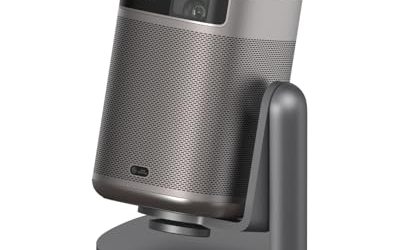
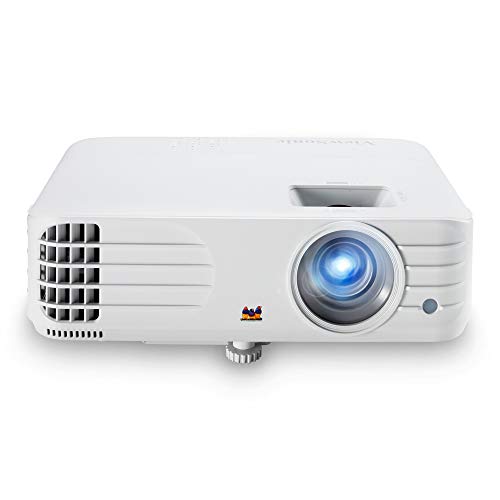
The ViewSonic PX701HD is the big-screen value pick, with 3,500 ANSI lumens and a picture that stretches to 300 inches for a true theater feel on a modest budget. Its SuperColor technology keeps colors vivid, vertical lens shift helps with placement, and dual HDMI inputs cover a streaming device and a console. A 10-watt speaker handles casual viewing, the 16-millisecond input lag is quick enough for console games, and the SuperEco lamp mode stretches lamp life to 20,000 hours. At 5.7 pounds it is the lightest projector here. The 300-inch maximum screen size suits a dedicated theater wall.
Optoma HD146X
- Best for: console gaming and bright-room viewing with deep contrast Watch out for: DLP rainbow artifacts bother a small number of viewers, so check sensitivity before a long session
- Specs:
- Resolution: 1080p Full HD
- Brightness: 3,600 lumens
- Contrast: 25,000 to 1
console gaming and bright-room viewing with deep contrast Watch out for: DLP rainbow artifacts bother a small number of viewers, so check sensitivity before a long session
DLP rainbow artifacts bother a small number of viewers, so check sensitivity before a long session
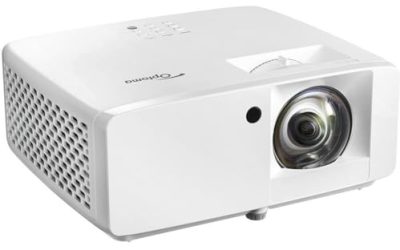
The Optoma HD146X is the gaming pick, with a 16-millisecond Enhanced Gaming Mode and a 3,600-lumen picture that stays bright in a room with some light. Its 25,000-to-1 contrast ratio is the deepest here, the six-segment color wheel keeps colors accurate, and the single-chip DLP design delivers a sharp image. The lamp lasts up to 15,000 hours, and the 1080p resolution is a natural match for consoles that output Full HD. It is the projector to choose when the screen doubles as a gaming display most evenings. The single-chip DLP design delivers a sharp image with no convergence issues to adjust.
Which One Fits Your Situation
Bright living room
The Epson Home Cinema 1080 suits a bright living room best, because its 3,400 lumens of color and white brightness hold the picture together with lamps on. The 3LCD design keeps colors strong, the built-in speaker covers casual viewing, and auto picture skew straightens the image on a shelf. The Optoma HD146X is the alternative when gaming matters as much as brightness. A light-colored wall works as a screen in a pinch.
Dedicated movie room
The BenQ HT2060 is the theater pick, with DCI-P3 color, an LED light source rated for 20,000 hours, and a picture tuned for a dark room. Its vertical lens shift and zoom make mounting forgiving, and the 8.3-millisecond lag at 120 hertz means it can game too. Keep the room dark to get the most from its 2,300 lumens. A dark ceiling and dark walls improve the picture further.
Casual gaming
The Optoma HD146X fits gaming best, with a 16-millisecond Enhanced Gaming Mode, 3,600 lumens, and the deepest contrast ratio here. The BenQ HT2060 is the faster option at 120 hertz, with an 8.3-millisecond lag for competitive play. Either one pairs well with a console that outputs 1080p. A dark room helps both models show their best contrast, and a soundbar adds the audio weight a built-in speaker cannot match.
Big-screen sports nights
The ViewSonic PX701HD is the sports-night pick, with a picture that stretches to 300 inches and 3,500 lumens that hold up with friends in the room. Its 10-watt speaker covers the commentary, dual HDMI inputs take a streaming stick and a cable box, and the SuperEco lamp mode stretches lamp life to 20,000 hours. A bright picture keeps the game readable with friends in the room.
Common Mistakes
- Buying lumens without checking how much ambient light the room actually has
- Ignoring throw distance and discovering the projector must sit where the sofa is
- Forgetting the screen size limit, then wondering why the picture looks soft at the edges
- Assuming the built-in speaker replaces a sound system for a real movie night
- Skipping the lamp-life figure, which decides how soon a replacement is needed
Frequently Asked Questions
Is 1080p enough for a home theater?
Yes, for most rooms. From a normal viewing distance, a 1080p picture on a 100-inch screen looks sharp, and the projectors here cost far less than 4K models. Step up to 4K only when the screen is very large, the seating is close, or the source material is mostly 4K. For movies, sports, and console games, 1080p remains a solid choice.
How bright should a projector be?
A dark theater works well at 2,000 to 2,500 lumens, while a living room with lamps on or curtains open needs 3,000 lumens or more. The Epson, ViewSonic, and Optoma models here all clear 3,400 lumens, which suits a bright room. Check whether the figure is ANSI lumens, since that measurement is the most consistent across brands.
How far from the screen should a projector sit?
Throw distance depends on the model and the screen size, so check the throw ratio in the manual before mounting. A projector with a 1.3-times zoom and vertical lens shift forgives placement errors, while a fixed-throw model needs the distance worked out in advance. Measure the room, choose the screen size, then place the projector to match.
How long does a projector lamp last?
Lamp life for these models runs from 12,000 to 20,000 hours, depending on the mode — eco modes stretch it further. An LED light source like the BenQ’s lasts 20,000 hours without a lamp change. At a few hours of evening viewing, that is years of use before a replacement is needed. A lamp is a separate purchase.
More from Amazon
Programs that pair well with the guide above. Offers and eligibility are set by Amazon and may change.
Free shipping on eligible items, Prime Video and more. Eligible new members can start with a free trial.
Start a Prime free trialAd-free music streaming. Eligible new subscribers can start with a free trial.
Try Music Unlimited freeA Prime membership for ages 18-24 with a trial period. Eligibility is set by Amazon.
See Prime for Young AdultsAudiobooks and podcasts to listen to on the go. Eligible new members can start with a free trial.
Try Audible freeAs an Amazon Associate we earn from qualifying purchases.