Key takeaways
- Compare the best 4K HDR projectors on verified listings: a bright Optoma DLP model with HDR10 and HLG, and a smart XGIMI model with Dolby Vision and HDR10.
As an Amazon Associate we earn from qualifying purchases.
A 4K HDR projector has to do two demanding jobs at once. It must place a 3840 by 2160 image on your wall or screen, and it must interpret high dynamic range content, which carries a wider span of brightness and colour than standard video. Projectors handle that second job differently from televisions, because their brightness is spread across a very large image, so tone mapping, the way the projector translates HDR highlights and shadow detail into its own brightness range, shapes the result as much as the headline resolution does. That is why the honest way to shop this category is specification by specification: resolution method, HDR formats supported, stated brightness, contrast approach, light source and placement flexibility.


This guide covers two verified 4K HDR projectors sold on Amazon US that take contrasting approaches. The Optoma UHD38 is a bright, lamp-based DLP projector built around raw light output, HDR10 and HLG support, and fast response for mixed movie and game use. The XGIMI Horizon S Max is a smart DLP projector with Dolby Vision alongside HDR10 and HLG, automatic setup features, a built-in flexible stand and integrated Harman Kardon speakers. Two projectors is a deliberately short list: several well-known 4K HDR models were checked and excluded because their Amazon US listings currently show no featured buying option, and only listings that pass that check belong in a buying guide. The sections below explain how to read the specifications, then examine each projector in turn.
Disclosure: This article contains affiliate links. If you buy through these links, we may earn a commission at no additional cost to you.
How to Choose a 4K HDR Projector
Resolution: Native and Pixel-Shifted 4K
Both projectors here state a display resolution of 3840 by 2160. DLP projectors commonly reach that figure with a fast-shifting imaging chip that presents the full pixel count of a 4K frame, while some LCD designs use pixel shifting between lower-resolution panels. In practice, what matters for the viewer is that the projector accepts and displays a full 4K signal with the detail that format carries, and that its lens is sharp enough to render that detail evenly across a large screen. Sit closer to a very large image and lens quality shows; sit at a normal viewing distance and both approaches here deliver the step up from 1080p that most buyers are looking for.
HDR Formats: HDR10, HLG and Dolby Vision
HDR10 is the baseline HDR format for projectors, carried by most 4K discs and streaming titles. HLG, short for Hybrid Log-Gamma, is used mainly by broadcasters. Dolby Vision is a dynamic format that adjusts tone mapping scene by scene using metadata in the content, and it is much less common in projectors than in televisions. The Optoma in this guide supports HDR10 and HLG. The XGIMI supports HDR10 and HLG and adds Dolby Vision, plus an IMAX Enhanced designation. If a large share of your viewing comes from services and discs that carry Dolby Vision titles, that extra format support is a genuine point of difference; if your sources are mainly HDR10, both projectors cover your library.
Brightness and Room Light
Brightness figures are stated differently across brands, which makes direct comparison tricky. The Optoma lists 4,000 lumens, a high figure aimed at rooms where some light remains on. The XGIMI lists 3,100 ISO lumens, measured under the ISO standard its listing names. The numbers come from different measurement approaches, so treat them as indications of intent rather than a precise head-to-head score: both projectors are positioned for living-room use rather than only for fully darkened theatres, and both will still look their best, with the deepest HDR shadow detail, when you dim the room and control light falling directly on the screen.
Light Source and Lifespan
The Optoma uses a lamp, rated on its page at up to 15,000 hours of life, with a stated lamp wattage of 125 watts and a one year limited parts and labour warranty on the projector with a shorter lamp warranty. Lamps dim gradually and are replaceable. The XGIMI lists a light source operating life of 20,000 hours, consistent with a solid-state light engine that is not designed around user lamp swaps. For a projector used a few hours most evenings, either lifespan spans many years; the practical difference is maintenance style, not longevity anxiety.
Placement, Throw and Setup
Throw distance decides where a projector can sit. The Optoma lists a minimum throw of 4 feet and a maximum of 32 feet, image sizes from 33 to 300 inches, digital keystone correction, and support for ceiling, tabletop and tripod mounting. The XGIMI lists throw distances from 1.3 to 5.3 metres, image sizes from 40 to 200 inches, a built-in flexible stand for tabletop use, and automatic features including auto focus, auto keystone, auto screen alignment and obstacle avoidance. A manual projector rewards a fixed, measured installation. An automatic projector rewards being moved between rooms and set up quickly each time.
Sound and Sources
Neither projector replaces a dedicated sound system for a large room, but their built-in provisions differ. The XGIMI carries two 12 watt Harman Kardon speakers and Bluetooth and Wi-Fi connectivity, making it a self-contained viewing unit. The Optoma lists a 10 watt specification and focuses on wired inputs, including dual HDMI, for consoles, players and streaming devices you supply. Decide whether you want the projector to be the whole system or the picture engine of a system you already own.
Optoma UHD38
- View on Amazon: https://www.amazon.com/dp/B08WTSV4JY
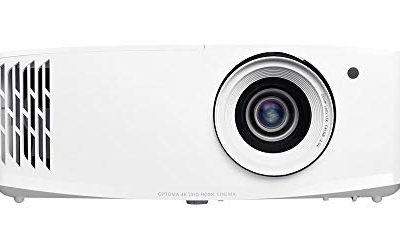
The Optoma UHD38 is a DLP projector with a native resolution listed as 3840 by 2160 and a maximum display resolution of the same figure. Its headline specification is brightness: 4,000 lumens, which the manufacturer presents for lights-on viewing in living rooms, game rooms and bedrooms as well as in a darkened theatre. The stated contrast ratio is 1,000,000 to 1, achieved with the dynamic black technology the description describes as part of its HDR tone mapping approach. Image size runs from 33 to 300 inches, with throw distances listed from 4 to 32 feet.
HDR support is stated clearly on the page: HDR10 and HLG compatibility, with Optoma HDR tone mapping and Dynamic Black technology presenting brighter whites, deeper black levels and realistic colour from HDR sources. The imaging uses an eight-segment colour wheel, which the manufacturer credits with vivid, cinematic colour. For viewers whose 4K library is delivered in HDR10, which covers most 4K Blu-ray discs and the standard HDR tier of major streaming services, this projector speaks the right language, and its brightness gives HDR highlights more headroom than dimmer projectors can manage in a room that is not fully dark.
The UHD38 also carries a strong secondary identity as a fast projector. Its page lists Enhanced Gaming Mode with response as low as 4.2 milliseconds at 1080p and 240 hertz, and 16 milliseconds at 4K UHD, alongside console support for 1080p at 120 hertz and 4K at 60 hertz. Connectivity listed includes two HDMI 2.0 inputs with HDCP 2.2, VGA, audio in and out, optical S/PDIF output, USB power and a 12 volt trigger, which suits a fixed installation wired to a receiver and screen. The unit measures 12.4 by 10.6 by 4.64 inches and weighs about 9.3 pounds. In the box are the projector, a quick start manual, a remote with batteries and a power cable.
Choose the UHD38 if your room cannot or will not be fully darkened, if you want a ceiling-mounted or shelf-mounted installation fed by your own sources and sound system, and if fast response for games matters alongside films. Its lamp will eventually need replacement, it has no built-in smart platform or meaningful built-in audio, and its HDR support stops at HDR10 and HLG. Within those boundaries, it is a bright, flexible and unusually quick 4K HDR projector.
XGIMI Horizon S Max
- View on Amazon: https://www.amazon.com/dp/B0DDQ66B6L
The XGIMI Horizon S Max is a DLP projector with a native and maximum display resolution listed as 3840 by 2160, brightness listed at 3,100 ISO lumens, and a stated contrast ratio of 10,000 to 1. Its HDR provision is the broadest in this guide: the product information lists HDR10, HLG and Dolby Vision among its picture quality enhancement technologies, together with an IMAX Enhanced designation and colour coverage described with a wide BT.2020 figure. Dolby Vision support remains rare among projectors, so for viewers with a Dolby Vision heavy streaming library, this model removes a format compromise that most of the category still asks buyers to accept.
Setup automation is the second headline. The listed special features include auto focus, uninterrupted auto keystone, auto screen alignment and auto obstacle avoidance, under XGIMI’s Intelligent Screen Adaption system, and the body stands on a built-in flexible stand for tabletop placement. Throw distances are listed from 1.3 to 5.3 metres with image sizes from 40 to 200 inches. The unit measures 10.74 by 6.85 by 9.64 inches and weighs 4.81 kilograms. Connectivity listed covers Bluetooth, Wi-Fi, HDMI and USB, and audio comes from two built-in 12 watt Harman Kardon speakers, the strongest built-in sound provision in this guide.
The box contains an adaptor, a power cord, a remote, a user manual and a warranty card, and the listing names a one year warranty. The Amazon listing shows the projector sold by the XGIMI Official Store and shipped from Amazon, with Add to Cart and Buy Now options on the page. Recommended uses listed by the manufacturer span home cinema, gaming, education and business, which reflects its portable, self-contained design: this is a projector you can carry to another room, set on a table, and let it square its own picture.
Choose the Horizon S Max if you want Dolby Vision alongside HDR10, if automatic setup matters more than a permanent installation, and if built-in speakers and wireless connectivity will genuinely be used rather than bypassed. Its stated contrast figure is more modest than the Optoma’s dynamic figure, its image size ceiling is lower, and it is a tabletop design rather than a ceiling-first one. As an all-in-one 4K HDR viewing unit for a living room, it is the most complete package in this guide.
Comparison Table
| Projector | Resolution | HDR formats stated | Brightness stated | Light source life stated | Max image |
|---|---|---|---|---|---|
| Optoma UHD38 (B08WTSV4JY) | 3840 x 2160 DLP | HDR10, HLG | 4,000 lumens | Up to 15,000 hours (lamp) | 300 inches |
| XGIMI Horizon S Max (B0DDQ66B6L) | 3840 x 2160 DLP | HDR10, HLG, Dolby Vision, IMAX Enhanced | 3,100 ISO lumens | 20,000 hours | 200 inches |
Frequently Asked Questions
Why does this guide list only two projectors?
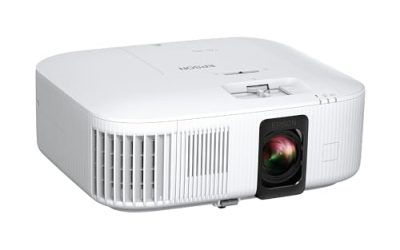
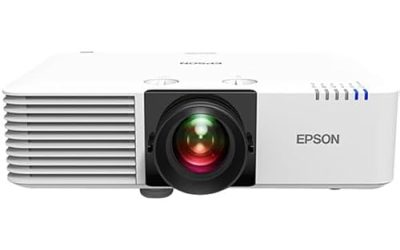
Because verification came first. Several prominent 4K HDR models were checked on Amazon US and excluded after their listings showed no featured buying option at the time of checking, including Epson Home Cinema models that appear in many roundups. A shorter list of projectors with listings that pass that check serves a buyer better than a longer list padded with models whose listings currently fail it. Availability changes, so a model excluded today may qualify on a later check.
Is Dolby Vision important in a projector?
It depends on your sources. Dolby Vision adjusts tone mapping scene by scene, and the XGIMI Horizon S Max supports it alongside HDR10 and HLG. If your streaming services and discs are rich in Dolby Vision titles, that support is a real advantage. If most of your 4K viewing is HDR10, the Optoma UHD38 covers it fully, and its higher stated brightness may matter more in a lit room.
Can these projectors work with some light in the room?
Yes, within limits. Both are positioned for living-room use, the Optoma with 4,000 stated lumens and the XGIMI with 3,100 stated ISO lumens. Either will hold a watchable picture with modest ambient light, but HDR shadow detail and black depth always improve when light is kept off the screen and the room is dimmed for films.
Which projector suits a permanent ceiling installation?
The Optoma UHD38. It lists ceiling mounting among its mounting types, provides a wide throw range up to 32 feet and a 300 inch maximum image, and provides installation-friendly connections including a 12 volt trigger. The XGIMI is designed around a built-in stand and tabletop placement with automatic setup, which favours flexibility over permanence.
Which projector is better for games?
On stated figures, the Optoma UHD38. Its page lists response as low as 4.2 milliseconds at 1080p with a 240 hertz refresh rate and 16 milliseconds at 4K, plus console support at 1080p 120 hertz and 4K 60 hertz. The XGIMI lists gaming among its recommended uses but does not centre its specification on response times in the same way.
Do I need a separate sound system?
For the XGIMI, not immediately: its two 12 watt Harman Kardon speakers make it usable as a self-contained unit, and Bluetooth is available for external audio. For the Optoma, plan on external sound through its audio outputs or a receiver, since its design assumes it will serve as the picture engine of a larger setup.
Conclusion
The best 4K HDR projector is the one whose HDR formats, brightness and placement style match your room and your library. The Optoma UHD38 is the bright, fast, installation-friendly choice: 4,000 stated lumens, HDR10 and HLG, a wide throw range, a 300 inch ceiling for image size and response times that keep games in the conversation. The XGIMI Horizon S Max is the self-contained, format-complete choice: Dolby Vision beside HDR10 and HLG, automatic focus, keystone and screen alignment, a flexible built-in stand and Harman Kardon speakers, all in a unit that moves from room to room. Decide whether your projector is a fixed picture engine or a portable viewing system, check that its HDR formats cover the titles you actually watch, and either of these two verified projectors will deliver the 4K HDR step up you are paying for.
More from Amazon
Programs that pair well with the guide above. Offers and eligibility are set by Amazon and may change.
Free shipping on eligible items, Prime Video and more. Eligible new members can start with a free trial.
Start a Prime free trialAd-free music streaming. Eligible new subscribers can start with a free trial.
Try Music Unlimited freeA Prime membership for ages 18-24 with a trial period. Eligibility is set by Amazon.
See Prime for Young AdultsAudiobooks and podcasts to listen to on the go. Eligible new members can start with a free trial.
Try Audible freeAs an Amazon Associate we earn from qualifying purchases.