Our Short List of 3

- Best for: Esports and 1080p-class gaming at high refresh rates
- Graphics: NVIDIA GeForce RTX 5060 Laptop GPU, 8GB GDDR7, DLSS 4, ray tracing
- Processor: Intel Core i7-14650HX, 16 cores, 24 threads, up to 5.2GHz
- Display: 16-inch FHD+ 1920 x 1200, 16:10, 165Hz, 3ms
- Memory: 32GB DDR5 5600MT/s

- Best for: 1440p gaming on a fast OLED screen, with streaming or recording on the side
- Graphics: NVIDIA GeForce RTX 5070 Ti, 12GB GDDR7
- Processor: Intel Core Ultra 9 275HX
- Display: 16-inch OLED, 240Hz, glossy
- Memory: 32GB DDR5-6400

- Best for: 1440p at high settings, plus video editing and 3D work on the same machine
- Graphics: NVIDIA GeForce RTX 5080, 16GB GDDR7 dedicated
- Processor: AMD Ryzen AI 9 HX 375, up to 5.1GHz, 12 cores, 24 threads
- Display: 16-inch WQXGA 2560 x 1600 IPS, 240Hz, 500 nits, 100% sRGB
- Memory: 32GB DDR5
All 4 Picks at a Glance
| Product | Specs | Action |
|---|---|---|
| ASUS ROG Strix G16 (RTX 5060) |
| Check price on Amazon |
| Lenovo Legion Pro 7 (RTX 5070 Ti) |
| Check price on Amazon |
| HP OMEN MAX 16 (RTX 5080) |
| Check price on Amazon |
 MSI Titan 18 HX AI (RTX 5090) |
| Check price on Amazon |
Key takeaways
- Compare gaming laptops by the graphics card inside, from the RTX 5060 up to the RTX 5090, with VRAM, wattage and display specs from each listing.
A laptop graphics card is not a part you can swap later, so the GPU you pick on day one is the ceiling for the whole life of the machine. The real decision is which tier matches the screen you will actually play on: an RTX 5060 is plenty for a 1080p panel, while a 1440p or 4K display needs the memory and wattage of the tiers above it. Picking one tier too high wastes money and battery; one tier too low cannot be fixed with a settings tweak.
This guide is organized by graphics card rather than by brand, for buyers comparing across ASUS, Lenovo, HP and MSI, students who need one machine for class and play, and desktop replacers who want the strongest mobile GPU available. Every pick below is a complete laptop chosen to represent its GPU tier, and the specs quoted come from the product names and details on each Amazon listing, including VRAM and, where the listing states it, graphics wattage.
Quick Picks
As an Amazon Associate we earn from qualifying purchases
| Product | Best for | Key spec from title |
|---|---|---|
| ASUS ROG Strix G16 (RTX 5060) | High-refresh 1080p and 1200p play | RTX 5060, 8GB GDDR7 |
| Lenovo Legion Pro 7 (RTX 5070 Ti) | 1440p gaming with headroom | RTX 5070 Ti, 12GB GDDR7 |
| HP OMEN MAX 16 (RTX 5080) | 1440p high settings and creative work | RTX 5080, 16GB GDDR7 |
| MSI Titan 18 HX AI (RTX 5090) | No-compromise desktop replacement | RTX 5090, 24GB GDDR7 |
How to Choose
Match the GPU tier to the screen resolution
The panel in front of the GPU decides how much graphics card you need. A 1920 x 1200 screen asks the GPU to draw about 2.3 million pixels per frame, while a 2560 x 1600 panel asks for roughly 4.1 million, close to double the work. That is why the RTX 5060 tier pairs naturally with FHD+ displays, the RTX 5070 Ti suits 1440p-class panels, and the RTX 5080 and RTX 5090 earn their place when the internal screen is 1600p or you plan to drive a 4K monitor. Buying a top-tier GPU behind a 1080p screen leaves performance unused; buying an entry GPU behind a 1600p screen forces you to lower settings or resolution from the start.
Check the graphics wattage, not just the GPU name
Two laptops can carry the same GPU name and perform differently, because each manufacturer sets its own power limit, listed as TGP. A higher TGP lets the GPU hold higher clock speeds under sustained load; a lower one favors thin designs and quieter fans. Listings do not always print the figure, so treat its absence as a question to answer on the product page before ordering. Where a listing does state wattage, compare like with like: the Legion Pro 7i configuration of the RTX 5080, for example, is listed at a 175W TGP, and the RTX 5090 in the Legion 9i is also listed at 175W, which shows how the top mobile tiers converge on similar power envelopes in big chassis.
Count the VRAM before you count the cores
Video memory is the spec that ages fastest. The tiers in this guide step from 8GB of GDDR7 on the RTX 5060, to 12GB on the RTX 5070 Ti, 16GB on the RTX 5080 and 24GB on the RTX 5090. Modern games at 1440p with high texture settings, and creative apps that load large assets, press hardest against the smaller pools. If you keep a laptop for four or five years, the extra memory of the Ti and above tiers is what keeps texture settings from becoming the first thing you turn down. Every VRAM figure quoted in this article comes from the Amazon listing for that machine, so check the exact configuration on the page, since the same model name can ship with different GPUs.
Make sure the rest of the machine keeps up
A strong GPU needs a balanced system around it. Look for a current high-performance processor with enough cores for gaming plus background tasks, at least 32GB of DDR5 memory in the configurations listed here, and fast NVMe storage so large game installs do not become the bottleneck. Cooling design matters just as much: thicker 16-inch and 18-inch chassis sustain GPU clocks better than slim designs, at the cost of weight. Finally, check the port selection for the monitor, capture gear or dock you already own, and remember that none of these GPUs can be upgraded later, so the supporting specs should be chosen for the laptop’s whole lifespan, not just its first year.
The 4 Best Options
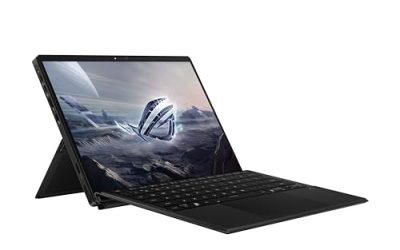
ASUS ROG Strix G16 (RTX 5060)
- Best for: Esports and 1080p-class gaming at high refresh rates
- Graphics: NVIDIA GeForce RTX 5060 Laptop GPU, 8GB GDDR7, DLSS 4, ray tracing
- Processor: Intel Core i7-14650HX, 16 cores, 24 threads, up to 5.2GHz
- Display: 16-inch FHD+ 1920 x 1200, 16:10, 165Hz, 3ms
- Memory: 32GB DDR5 5600MT/s
Esports and 1080p-class gaming at high refresh rates
This listing is a seller-upgraded configuration, and the listing states the original seal is opened to fit the upgrades, so confirm the exact memory and storage fitted before ordering.
The Strix G16 is the sensible entry point into the current GPU ladder. Its RTX 5060 with 8GB of GDDR7 is matched to a 165Hz FHD+ panel, which is exactly the resolution this tier handles best, and DLSS 4 support gives it extra life in demanding titles. The 16-core Intel HX processor means the GPU is not held back when you stream, record or keep voice chat and a browser running alongside a game. For students and esports players who want high frame rates at the panel’s native resolution without paying for unused 1440p power, this is the configuration that spends the budget where it shows.
Lenovo Legion Pro 7 (RTX 5070 Ti)
- Best for: 1440p gaming on a fast OLED screen, with streaming or recording on the side
- Graphics: NVIDIA GeForce RTX 5070 Ti, 12GB GDDR7
- Processor: Intel Core Ultra 9 275HX
- Display: 16-inch OLED, 240Hz, glossy
- Memory: 32GB DDR5-6400
1440p gaming on a fast OLED screen, with streaming or recording on the side
The glossy OLED panel can reflect overhead lighting, so it suits controlled room lighting better than bright offices or outdoor use.
The Legion Pro 7 represents the tier most 1440p players should aim at. The RTX 5070 Ti steps up to 12GB of GDDR7, which is the meaningful jump in this lineup: more memory for high textures at 2560 x 1600, on a 240Hz OLED panel that can actually display the frame rates the GPU produces. The Core Ultra 9 275HX is Intel’s flagship mobile processor class, and the dual-drive 2TB storage setup suits a large rotating game library. If you play a mix of competitive titles and demanding single-player games on the internal screen, this is the tier where neither the GPU nor its memory becomes the limiting factor.
HP OMEN MAX 16 (RTX 5080)
- Best for: 1440p at high settings, plus video editing and 3D work on the same machine
- Graphics: NVIDIA GeForce RTX 5080, 16GB GDDR7 dedicated
- Processor: AMD Ryzen AI 9 HX 375, up to 5.1GHz, 12 cores, 24 threads
- Display: 16-inch WQXGA 2560 x 1600 IPS, 240Hz, 500 nits, 100% sRGB
- Memory: 32GB DDR5
1440p at high settings, plus video editing and 3D work on the same machine
This model is sold in several configurations on Amazon, so check that the variant selected on the page is the RTX 5080 one and not a lower GPU configuration of the same laptop.
The OMEN MAX 16 carries the RTX 5080, the tier that serious 1440p players and creators step up to for its 16GB of GDDR7 and the headroom it gives at maximum settings. The listing pairs it with AMD’s Ryzen AI 9 HX 375 and a 240Hz WQXGA IPS panel rated at 500 nits and 100 percent sRGB, a combination that works for color-sensitive editing as well as gaming. With 32GB of memory and a 2TB drive in this configuration, nothing else in the spec sheet undercuts the GPU. Choose this tier if you intend to keep settings high for years, or plug into a high-resolution external monitor at a desk.
MSI Titan 18 HX AI (RTX 5090)
- Best for: A stationary setup where the laptop replaces a gaming desktop entirely
- Graphics: NVIDIA GeForce RTX 5090, 24GB GDDR7
- Processor: Intel Core Ultra 9 285HX
- Display: 18-inch UHD+ Mini LED, 120Hz
- Memory: 64GB DDR5-6400
A stationary setup where the laptop replaces a gaming desktop entirely
At 7.93 lbs before the power adapter, this is a machine that lives on a desk; check your bag and your back before planning to carry it daily.
The Titan 18 HX AI is built around the strongest graphics card sold in a laptop. The RTX 5090 brings 24GB of GDDR7, the largest memory pool in this guide, aimed at 4K-class gaming, heavy rendering and AI workloads that simply do not fit in smaller VRAM. MSI pairs it with the Core Ultra 9 285HX, 64GB of DDR5-6400 and two NVMe drives, and puts the result behind an 18-inch UHD+ Mini LED screen. This is a desktop replacement in the literal sense: it trades portability for the maximum GPU tier, and it only makes sense if that trade is the point of the purchase.
Which One Fits Your Situation
You play competitive games and travel with your laptop
Take the ASUS ROG Strix G16. Esports titles reward frame rate over resolution, and the RTX 5060 tier drives its 165Hz FHD+ panel the way those games are meant to be played. The 16-inch chassis is the most portable in this guide, and the HX processor keeps Discord, recording software and a stream overlay from eating into your frames.
You want one machine for 1440p gaming and content creation
The Lenovo Legion Pro 7 fits this brief. The RTX 5070 Ti’s 12GB of memory handles high textures at 1600p and gives editing timelines room to breathe, while the 240Hz OLED serves both fast games and color-critical viewing. The 2TB of storage across two drives also separates a game library from project files neatly.
You game at a desk with an external monitor
Choose the HP OMEN MAX 16. The RTX 5080’s 16GB of VRAM is the tier that stays comfortable when the internal 1600p panel is replaced by a larger external display, and the 500-nit, 100 percent sRGB screen still serves you well away from the desk. It is the balanced pick for a hybrid desk-and-laptop life.
Portability does not matter, only performance does
The MSI Titan 18 HX AI is your pick. The RTX 5090 and its 24GB of memory are the ceiling of what a laptop can currently offer, and the 18-inch Mini LED panel gives that power a screen worthy of it. Accept the weight as the cost of a true desktop replacement and leave it where it sits.
Common Mistakes
- Assuming a laptop GPU performs like the desktop card with the same name; mobile versions run at lower power limits and are a different product in practice.
- Comparing GPU names without checking the TGP wattage, when the same card can be configured at very different power levels in different chassis.
- Buying a high-tier GPU behind a low-resolution screen, then never using the performance you paid for.
- Ignoring VRAM and focusing only on the tier number, when memory capacity is what limits texture settings as games get heavier.
- Ordering a model name without confirming the exact configuration on the page, since the same laptop is often sold with several different GPUs.
Frequently Asked Questions
Can I upgrade the graphics card in a gaming laptop later?
In almost every case, no. Laptop GPUs are soldered to the motherboard or built into the mainboard design, so the card you buy is the card you keep for the life of the machine. That permanence is why this guide is organized by GPU tier first: choose the tier that fits the games and screen you expect to use in three or four years, not just this year’s titles.
What does TGP mean and why does it matter?
TGP is the total graphics power, in watts, that a manufacturer allows the GPU to draw. The same RTX card can be set to a modest wattage in a thin laptop or a much higher one in a thick performance chassis, and the higher setting sustains higher clock speeds. Listings do not always print the figure, so when it is missing, check the manufacturer’s specification for that exact model before assuming two same-named GPUs perform alike.
How much VRAM do I actually need for gaming?
For 1080p and 1200p play, the 8GB on the RTX 5060 tier covers current games well, especially with DLSS support. At 1440p and 1600p with high texture settings, 12GB is the comfortable minimum, which is where the RTX 5070 Ti sits. The 16GB and 24GB tiers are for maximum settings, 4K output, and creative or AI workloads that load large assets into graphics memory.
Is the RTX 5090 laptop worth it over the RTX 5080?
Only for buyers who will use what the extra tier provides: 24GB of VRAM, the highest mobile frame rates, and a large, high-resolution screen to show them on. The RTX 5080 tier already covers 1440p gaming at high settings for most players. The Titan in this guide makes sense as a stationary desktop replacement; if the laptop has to travel, the smaller tiers give up little in real games and save a great deal of weight.
More from Amazon
Programs that pair well with the guide above. Offers and eligibility are set by Amazon and may change.
Free shipping on eligible items, Prime Video and more. Eligible new members can start with a free trial.
Start a Prime free trialAd-free music streaming. Eligible new subscribers can start with a free trial.
Try Music Unlimited freeA Prime membership for ages 18-24 with a trial period. Eligibility is set by Amazon.
See Prime for Young AdultsAudiobooks and podcasts to listen to on the go. Eligible new members can start with a free trial.
Try Audible freeAs an Amazon Associate we earn from qualifying purchases.