Key takeaways
- These are the best 100 dollar graphics cards for light gaming and old PC upgrades, with low power draw, small cases and no extra power connector needed.
Entry-level graphics cards exist for a simple job: wake up an old desktop, drive a second monitor, and run light games without demanding a new power supply or a larger case. The two cards below do exactly that, and they do it with modest power draw, compact boards and no extra power connector. They will not run demanding new titles at high settings, yet they turn a tired office machine into a capable everyday computer with room for casual play.

Each card below was chosen from the name and specifications shown on its Amazon page, with the memory type, outputs, power draw and board size checked against the listing. Only two cards in this class verified cleanly enough to list, so this guide names two rather than padding the list with models that no longer ship in new condition. Read the guide, match the card to your case and power supply, and buy the one that fits your machine. The focus here stays on fit and compatibility throughout.
Quick Picks
As an Amazon Associate we earn from qualifying purchases
| Product | Best for | Key spec from title |
|---|---|---|
| GIGABYTE GeForce GT 1030 Low Profile D4 2G | Slim cases and old desktops | 2GB DDR4 low profile card |
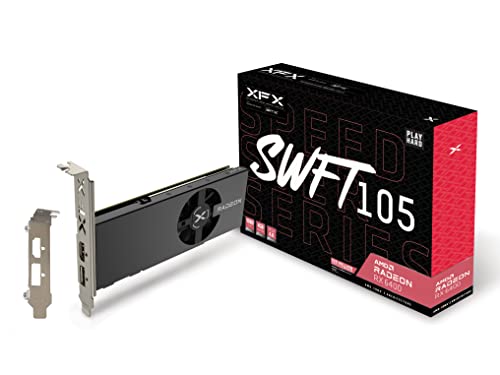
| XFX Speedster SWFT105 Radeon RX 6400 | Stronger light gaming | 4GB GDDR6 single fan card |
How to Choose
Memory Type and Size
Memory decides what a card can hold at once, and the type matters as much as the amount. A card with 4GB of GDDR6 moves textures faster and handles modern games more smoothly than a card with 2GB of DDR4, which suits older titles and desktop work instead. Check the listing for the memory type and the bus width together, because a narrow 64-bit bus limits both cards here, and the faster memory on the RX 6400 is what gives it the edge. Match the memory to your games: light esports and older titles run well on 2GB, while newer games and higher resolutions call for the 4GB card.
Power Draw and Connectors
Power draw decides whether a card works in your machine without changes, so read the listing for the wattage before you buy. Both cards here draw their power from the slot alone and need no extra connector, which means they fit desktops with modest power supplies that were never built for gaming. A 20W card runs cool and quiet in almost any case, while a 53W card still stays within what most office power supplies can feed. Confirm your power supply rating and the spare wattage on its label, and remember that a card which needs a six-pin connector will not run on a supply that lacks one.
Board Size and Case Fit
Entry-level cards live in small cases, so measure before you buy rather than after the box arrives. A low-profile card with a short board fits slim desktops and small-form-factor cases that a full-height card cannot enter, and both cards here are built for that job. Check the listing for the board length, the slot height and the bracket type, and compare them with the space inside your case. A single-fan cooler keeps the card short, yet it also means the fan works harder under load, so leave room for airflow around the card and keep the case vents clear of dust. Check the thickness too, since a wide cooler can block the next slot.
Outputs and Display Support
Outputs decide what you can plug in, so count your monitors before you choose. One card here offers HDMI and DVI, which suits an older monitor or a second display, while the other adds DisplayPort alongside HDMI for newer screens and higher refresh rates. Check the listing for the exact port list and the maximum resolution each port supports, because a DVI port will not carry sound and a DisplayPort connection suits high-refresh gaming monitors. If you run two monitors, confirm the card drives both at once, and check that your monitor cables match the ports on the card. A monitor with only VGA needs an adapter, so check the cable you already own.
The 2 Best Options
GIGABYTE GeForce GT 1030 Low Profile D4 2G
The GIGABYTE GT 1030 is the smallest, quietest card in this guide, built for slim desktops. Its 2GB of DDR4 memory and 384 CUDA cores handle desktop work, video playback and older games with ease, while the single fan and low-profile bracket fit cases that taller cards cannot enter. The card draws only 20W from the slot, so it runs on power supplies that were never meant for gaming, and the HDMI port carries 4K output to a television or a large monitor. It is the card to choose when the case is small, the power supply is modest, and the job is everyday computing.
Specs
- 2GB DDR4 memory, 64-bit interface
- 384 CUDA cores, boost clock 1417 MHz
- Low-profile single-fan design with bracket included
- HDMI 2.0b and DVI-D outputs
- PCI Express 3.0, draws 20W from the slot
- No extra power connector required
Best for: Slim office desktops and small cases that need a quiet graphics upgrade.
Watch out for: DDR4 memory runs slower than GDDR5, so newer games need low settings, and the listing showed limited availability at last check.
XFX Speedster SWFT105 Radeon RX 6400
The XFX SWFT105 RX 6400 is the stronger card here, pairing 4GB of GDDR6 memory with the RDNA 2 architecture for noticeably smoother light gaming. Its single-fan cooler keeps the board compact enough for small cases, the boost clock reaches 2321 MHz, and the HDMI 2.1 and DisplayPort 1.4a outputs support newer monitors and higher refresh rates. The card still draws only 53W and needs no extra power connector, so it drops into most desktops without a power supply upgrade. It is the pick when you want the best light-gaming performance this class offers without touching the rest of your machine.
Specs
- 4GB GDDR6 memory, 64-bit interface
- RDNA 2 architecture, boost clock up to 2321 MHz
- Single-fan compact design
- HDMI 2.1 and DisplayPort 1.4a outputs
- PCI Express 4.0, draws 53W from the slot
- No extra power connector required
Best for: Light gaming on a desktop that needs the fastest card in this class without a new power supply.
Watch out for: Recent tracking showed this card above the usual level for its class, so confirm the listing before you buy.
Which One Fits Your Situation
Slim Office Desktop
A slim desktop with a small power supply and a low-profile slot leaves only one sensible choice. The GIGABYTE GT 1030 fits where taller cards cannot, draws almost no power, and turns an office machine into a capable everyday computer. Measure the bracket height and the board length first, because a low-profile card still needs its bracket to match the case, and the 20W draw keeps the machine quiet.
Light Gaming on an Old PC
If your goal is light gaming on a machine you already own, the XFX RX 6400 gives the stronger result. Its GDDR6 memory and RDNA 2 design handle esports titles and older games at smooth frame rates, while the 53W draw still needs no extra connector. Check that your case fits the single-fan board and that your monitor uses HDMI or DisplayPort, then enjoy the step up without a power supply swap.
Second Monitor and Media
A second monitor or a television connection calls for the right outputs rather than raw speed. The GT 1030 suits a second display and 4K video playback with its HDMI port, while the RX 6400 adds DisplayPort for a newer monitor. Either card drives a dual-screen desk, yet the GT 1030 runs cooler and quieter in a machine that stays on all day, which matters for a media setup.
First Upgrade for a Beginner
A first graphics upgrade should be simple, and both cards here install without a power connector or a case change. The GT 1030 is the gentler start for a slim case, while the RX 6400 rewards a standard case with stronger gaming. Pick the card that matches your case size, seat it in the slot, install the driver from the maker, and the machine gains a new lease on life.
Common Mistakes
- Buying a card without measuring the case, then finding the board too tall or too long to fit.
- Ignoring the memory type, because DDR4 and GDDR6 behave very differently in games.
- Choosing a card that needs a power connector your supply does not have.
- Expecting demanding new titles to run at high settings on an entry-level card.
- Skipping the driver install, which leaves the card running on basic display output only.
Frequently Asked Questions
Will these cards run modern games?
These cards run light esports titles and older games smoothly, and they handle newer games only at low settings and modest resolutions. The RX 6400 with GDDR6 memory copes better than the GT 1030 with DDR4, yet neither card is built for demanding new releases at high settings. If your library is mostly older or competitive titles, either card serves well.
Do I need a new power supply for either card?
Neither card needs a new power supply, because both draw their power from the motherboard slot alone and use no extra connector. The GT 1030 draws 20W and the RX 6400 draws 53W, which most office power supplies can feed. Check your supply rating first, and confirm the slot is a PCI Express x16 slot before you order.
Can I use these cards in a slim desktop?
The GT 1030 is a low-profile card made for slim desktops, and it ships with a low-profile bracket for narrow cases. The RX 6400 is a compact single-fan card for small cases, yet it is full-height, so measure your case first. A slim case with a low-profile slot only accepts the GT 1030, while a small case accepts either card.
Which card should I pick for video playback?
Both cards handle 4K video playback, and the choice turns on your display rather than the card. The GT 1030 suits a television or a second monitor over HDMI, runs cooler, and stays quiet. The RX 6400 adds DisplayPort for newer monitors, so pick the GT 1030 for a quiet media machine and the RX 6400 for a newer display.
More from Amazon
Programs that pair well with the guide above. Offers and eligibility are set by Amazon and may change.
Free shipping on eligible items, Prime Video and more. Eligible new members can start with a free trial.
Start a Prime free trialAd-free music streaming. Eligible new subscribers can start with a free trial.
Try Music Unlimited freeA Prime membership for ages 18-24 with a trial period. Eligibility is set by Amazon.
See Prime for Young AdultsAudiobooks and podcasts to listen to on the go. Eligible new members can start with a free trial.
Try Audible freeAs an Amazon Associate we earn from qualifying purchases.