Key takeaways
- Compare the best home weather stations with wireless sensor arrays, Wi-Fi consoles and rain gauges, plus placement tips for readings you can trust.
A home weather station puts a sensor array in your own yard and a console on your counter, so the temperature, wind and rainfall it reports are the ones outside your door rather than at an airport across town. The five stations below all use wireless outdoor arrays, but they split into clear camps: full consoles with local displays, app-first systems with no screen at all, and expandable platforms that accept extra sensors over time.
One limit applies to every pick here. Sensor placement decides accuracy more than the sensor brand does — a unit mounted over a hot roof, beside a dryer vent or under a tree reads fiction no matter what it is called. The forecast icons on a console come from the internet feed or from the barometric pressure trend, not from the outdoor sensors, so no station predicts weather by itself. And consumer stations are hobby instruments, not calibrated measurement tools: two correctly installed stations on the same fence can still disagree slightly, and that is normal for this class.
Disclosure: As an Amazon Associate, I earn from qualifying purchases.
How to Choose a Home Weather Station
Start with the mounting spot, because it rules out more models than any feature list. Wind readings need open air above roof height and away from walls that block or funnel the flow. Rain collectors need a level mount where roof runoff and sprinklers cannot splash in. Temperature and humidity sensors need shade and airflow; a radiation shield helps, but a sensor baking in direct sun on a still afternoon will still read high. Plan the pole or mast before you pick the station, and remember that the array needs occasional cleaning and battery checks, so a spot you can reach with a ladder beats a perfect spot you cannot service.
Next, decide how you want to read the data. A physical console shows everything at a glance with no phone and keeps working when the internet drops. An app-first station trades the screen for graphs, alerts and history on your phone, and it goes blank as a local display the moment you actually want one. Wi-Fi models upload to public networks such as Weather Underground, which fills in maps and archives your data, but the upload depends on your router staying up. Radio range figures are line-of-sight numbers; brick walls, metal siding and distance shrink them fast, so measure the real path from array to console before trusting a headline range.
Finally, match the sensor set to what you will actually watch. Most owners check temperature, wind and rain daily and glance at UV or solar readings rarely. Extra channels for soil moisture, lightning or indoor air matter only if you garden, farm or run a pool. Update speed also shapes the feel of a station: arrays that report wind every few seconds show gusts as they happen, while slower arrays smooth them away. None of this makes a station a laboratory instrument — it makes it a consistent record of your own yard, which is the honest job of the class.
Power and upkeep deserve a thought before the box arrives. Solar arrays still carry backup batteries, and a shaded mounting spot that is kind to temperature readings can leave the panel short of sun in winter, so expect an occasional battery swap even on solar models. Consoles mostly run on mains power with battery backup, which means the display goes dark during an outage even while the array keeps sensing. Rain collectors collect more than rain: leaves, seeds and insects find the funnel, and a clogged collector quietly under-reports until someone climbs up and clears it. A station is a small outdoor instrument that lives outside for years, and the models that age best are the ones whose sensors you can clean, whose batteries you can reach, and whose maker still sells replacement parts.
The 5 Best Home Weather Stations
1. Ambient Weather WS-2902C
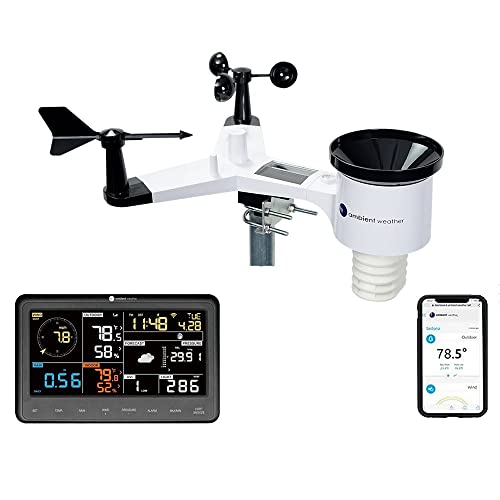
The WS-2902C is the mainstream pick of this roundup: a 7-in-1 Osprey array, a color console and Wi-Fi upload in one box. The array measures temperature, humidity, wind speed and direction, rainfall, UV and solar radiation, and it reports on a fast cycle, so gusts and downpours show up on the console as they happen rather than as averages. The console connects to the Ambient Weather Network and Weather Underground, which adds phone viewing, graphs and alerts without extra hardware. It also accepts a small number of optional Ambient Weather add-on sensors, which gives it a modest growth path. For most yards it is the balanced answer: a real console on the counter, a full sensor set outside, and no separate hub to wire up.
Specs
- Sensor array: 7-in-1 (temperature, humidity, wind, rain, UV, solar radiation)
- Console: color TFT display with Wi-Fi
- Upload: Ambient Weather Network, Weather Underground
- Power: solar panel with battery backup on the array
- Link: wireless, up to 330 ft line of sight
See the Ambient Weather WS-2902C on Amazon
2. Ambient Weather WS-2000
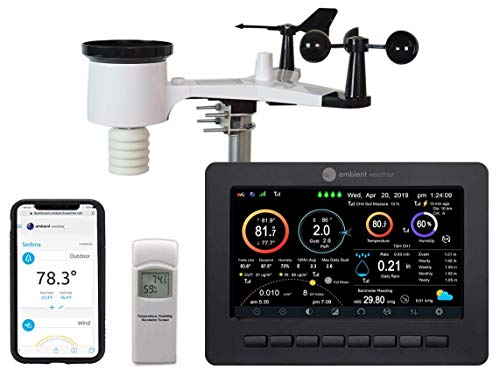
The WS-2000 pairs the same Osprey array with a larger tablet-style console and a much deeper sensor bench. Where the WS-2902C is a finished station, the WS-2000 is a platform: it accepts optional add-on sensors for soil moisture, lightning detection, water temperature and additional indoor and outdoor thermo-hygrometers, all shown on the one display. Buyers who know they will expand later save a full replacement by starting here.
Specs
- Sensor array: 7-in-1 Osprey (temperature, humidity, wind, rain, UV, solar radiation)
- Console: 7-inch HD TFT tablet-style display
- Expansion: supports multiple optional Ambient Weather sensors
- Upload: Ambient Weather Network, Weather Underground
- Power: solar panel with battery backup on the array
See the Ambient Weather WS-2000 on Amazon
3. Ecowitt Wittboy Pro HP2564

The Wittboy Pro removes the two parts that wear out first. Its WS90 array reads wind with an ultrasonic sensor instead of spinning cups and rain with a haptic sensor plate instead of a tipping funnel, so there is nothing to seize, clog with leaves or fill with insects. The 7-inch HP2560 console uploads to Ecowitt, Weather Underground, WeatherCloud and WOW, and the Ecowitt ecosystem behind it is the widest in this roundup, with soil, pool, air quality and leak sensors that pair to the same console.
Specs
- Sensor array: WS90 7-in-1 (temperature, humidity, wind, rain, light, UV)
- Wind sensing: ultrasonic, no moving parts
- Rain sensing: haptic piezoelectric plate
- Console: HP2560 7-inch TFT display
- Upload: Ecowitt, Weather Underground, WeatherCloud, WOW
See the Ecowitt Wittboy Pro HP2564 on Amazon
4. AcuRite Iris (5-in-1) 01512M
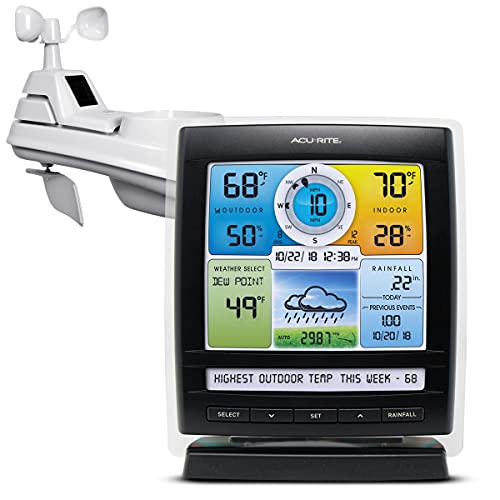
The Iris is the deliberately simple station here. Its 5-in-1 sensor covers temperature, humidity, wind speed and direction and rainfall, and the indoor display shows current conditions, records and a forecast built from the built-in barometer and learning calibration. There is no Wi-Fi and no app on this model, which is the point: nothing to configure, no account, and no dependence on a router. For a kitchen counter or a grandparent’s house, that simplicity is the feature.
Specs
- Sensor array: 5-in-1 (temperature, humidity, wind speed and direction, rainfall)
- Console: digital display with barometric forecast
- Link: wireless, up to 330 ft line of sight
- Connectivity: none — standalone, no Wi-Fi or app
- Power: battery powered sensor and display
See the AcuRite Iris 01512M on Amazon
5. Tempest Weather System by WeatherFlow
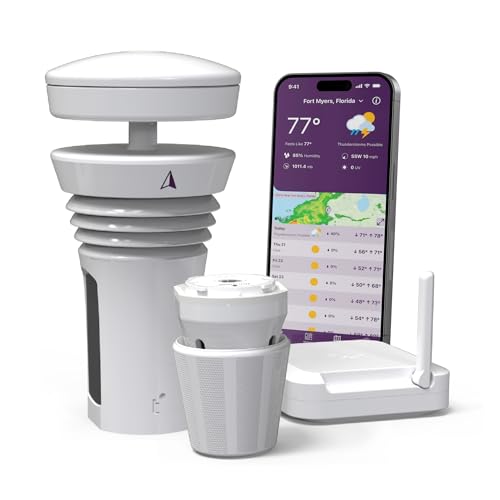
The Tempest takes the app-first idea furthest. The all-in-one outdoor unit has no moving parts at all: wind is read sonically, rain by a haptic surface, and it adds barometric pressure, light, UV and lightning detection that reports strikes up to about 25 miles away. There is no console — data lives in the Tempest app and through Alexa — and the forecast leans on WeatherFlow’s Nearcast modeling, which blends your station’s readings with regional data. That forecast is a modeled internet product, not something the sensors compute, and the station is honest about being a connected service as much as an instrument. Installation is the simplest here: one compact unit on a pole, no separate rain gauge to level and no cups to align. The trade is total dependence on the app and the cloud link — when the service or the Wi-Fi is down, there is no local screen to glance at, which console owners never have to think about.
Specs
- Sensor array: all-in-one (temperature, humidity, wind, rain, pressure, light, UV, lightning)
- Wind and rain sensing: sonic and haptic, no moving parts
- Display: app only, no console included
- Power: solar with rechargeable battery
- Extras: lightning detection, Alexa support, Nearcast forecast
See the Tempest Weather System on Amazon
Comparison Table
| Station | Sensors | Console | Wi-Fi Upload | Moving Parts |
|---|---|---|---|---|
| Ambient Weather WS-2902C | 7-in-1 array | Color TFT | Yes | Cups and vane |
| Ambient Weather WS-2000 | 7-in-1 array | 7-inch HD tablet | Yes | Cups and vane |
| Ecowitt Wittboy Pro HP2564 | 7-in-1 WS90 | 7-inch TFT | Yes | None |
| AcuRite Iris 01512M | 5-in-1 sensor | Digital display | No | Cups and vane |
| Tempest Weather System | All-in-one | App only | Yes | None |
FAQ
Where should the outdoor sensor array be mounted?
High enough to clear roof turbulence, away from heat sources such as vents, chimneys and dark walls, and where rain can fall into the collector without splash from roofs or sprinklers. Temperature sensors want shade and airflow. The best mount is the one that meets those rules and that you can still reach to clean and service.
Do home weather stations need Wi-Fi?
No. A console-only station like the AcuRite Iris works fully offline and shows live conditions at home. Wi-Fi adds phone access, graphs, alerts and uploads to public weather networks, which matter if you want history or want to check the yard from elsewhere.
How accurate is a home weather station?
Treat it as a consistent hobby instrument, not a calibrated measurement device. Good placement gets temperature within a degree or two of reference readings most of the time, while bad placement can be wrong by far more. Wind and rain figures depend even more heavily on the mounting spot than on the hardware. Haptic rain sensors and tipping funnels also measure differently in drizzle versus a downpour, so small disagreements between two stations during one storm do not mean either one is broken.
Why does the console forecast differ from the sensors?
Because the forecast does not come from the sensors. Consoles either pull a forecast from an internet service over Wi-Fi or infer one from the local pressure trend. The sensors only report current conditions; any station showing tomorrow’s weather is showing you a feed or a pressure-based estimate.
Conclusion
Pick the WS-2902C for a complete, connected station with no expansion plans, the WS-2000 or the Wittboy Pro if extra sensors are in your future, the AcuRite Iris for a screen that simply works with no network at all, and the Tempest if you prefer an app and want lightning alerts with zero moving parts. Whichever you choose, spend as much thought on the pole and the mounting spot as on the station itself — placement, not branding, is what makes the numbers believable.
More from Amazon
Programs that pair well with the guide above. Offers and eligibility are set by Amazon and may change.
Free shipping on eligible items, Prime Video and more. Eligible new members can start with a free trial.
Start a Prime free trialAd-free music streaming. Eligible new subscribers can start with a free trial.
Try Music Unlimited freeA Prime membership for ages 18-24 with a trial period. Eligibility is set by Amazon.
See Prime for Young AdultsAudiobooks and podcasts to listen to on the go. Eligible new members can start with a free trial.
Try Audible freeAs an Amazon Associate we earn from qualifying purchases.