Key takeaways
- Compare the best bass traps for home studios, from framed mineral wool corner traps to foam corner blocks, with sizes, materials and placement rules.
A small room lies about bass. The same explosion that sounds tight in one seat booms in another, and dialogue gains a chesty thickness that no equalizer setting quite removes. The cause is the room itself: low frequencies reflect off every wall and pile up where surfaces meet, so corners become storage for bass energy that leaks back late and uneven. Bass traps exist to absorb that stored energy at the exact places it collects.
This guide compares five traps built for that job, from a framed rockwool corner trap to stacks of foam corner blocks. A bass trap is not a thin wall panel with a new name. Panels one or two inches thick absorb speech and flutter echo well, but bass passes through them almost untouched; trapping bass takes depth, density, and corner placement. Every absorption figure quoted here is a maker figure from laboratory testing, not a measurement taken for this guide, and each design’s honest limits are stated in its section.
Disclosure: As an Amazon Associate, I earn from qualifying purchases.
How to Choose a Bass Trap
Depth is the first spec, not an afterthought. Porous absorbers work by slowing air movement inside the material, and low frequencies need more depth to slow down. A trap with eight to thirteen inches of corner depth reaches far lower than a two-inch tile, which is why thin foam wedges sold for walls do almost nothing below the midrange.
Corners beat coverage. Every room mode, the standing waves that make one seat boomy and another thin, terminates in the corners. Traps placed floor to ceiling in the front corners do more than the same material spread thinly across flat walls. Ceiling corners come next, then the rear corners.
Core material sets the ceiling on performance. Framed traps filled with rockwool or mineral wool pack a dense, rigid core that holds its shape for decades and absorbs deeply for its thickness. Acoustic foam is far lighter and simpler to cut and stack, but it needs greater depth to match a dense core at low frequencies, and shallow foam blocks stop working in the mid-bass.
Read NRC figures with suspicion. The noise reduction coefficient is an average of absorption across speech-band frequencies measured in a laboratory, and corner mounting can push a published figure above 1.0 through edge effects. A high figure does not guarantee control at 50 or 60 Hz, so treat every NRC number here as a rough ranking, not a promise.
Mounting decides whether renters can play. Foam blocks go up with adhesive, tape, or pins and come down with varying wall damage. Framed traps hang on brackets or screws like heavy pictures. Freestanding stacks need nothing at all. Compressed foam also needs a day or two out of its packaging to expand before it goes up.
The 5 Best Bass Traps for Home Studios
1. Auralex LENRD Bass Traps, 8-Pack, Charcoal
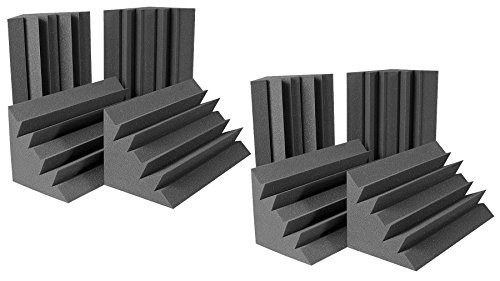
The LENRD, short for Low-End Node Reduction Device, is the design that defined the foam corner trap, and Auralex still builds it from its Studiofoam stock in a simple triangular profile: twelve inches across each wall face and two feet long. Eight pieces stack into two full-height front corners, and the charcoal finish disappears against dark theater paint. The maker publishes an NRC figure of 1.50, a laboratory number helped by corner mounting and edge diffraction; read it as evidence of strong broadband absorption rather than a guarantee at the deepest frequencies.
Specs:
- Model: LENCHA
- Size: 12 x 12 x 24 inches each
- Pack: 8 traps
- Material: Studiofoam acoustic foam
- Maker NRC figure: 1.50 (laboratory figure)
- Colors: Charcoal, purple, burgundy
- Mounting: Adhesive or mounting tabs, sold separately
The honest limit is density. Studiofoam is a light, open-cell foam, so while the twelve-inch corner depth does real work through the mid-bass, the deepest room modes in a large or very live room will still be standing after a set of these goes up. They are the proven, moderate step: a genuine corner trap, not a cure for every low-frequency problem a room can have.
See it on Amazon
2. Acoustimac DMD Corner Bass Trap, Charcoal

Acoustimac builds the opposite kind of trap: a cabinet-grade plywood frame filled with six-pound rockwool, wrapped in the maker’s DMD acoustically transparent fabric, and cut with a trapezoidal footprint so the body nests into a corner instead of bridging it. At four feet tall, two feet wide, and four inches thick, a single trap straddles a corner with an air gap behind the core, and the gap is part of the design: sound passes through the core, reflects, and passes through again. The maker states an average NRC figure of 0.95 or higher with extra absorption at the low end, and mounting hardware is in the box.
Specs
- Model: DMDBT4000C
- Size: 48 x 24 x 4 inches
- Core: 6 lb rockwool insulation
- Frame: Cabinet-grade plywood, fabric wrapped on front and sides
- Maker NRC figure: 0.95 or higher (laboratory figure)
- Shape: Trapezoidal footprint for corner fit
- Included: Mounting hardware and screws
- Sold: Singly
The trade is commitment. This is a heavy, rigid piece of furniture-grade treatment that screws to the wall, and one trap serves one corner, so a full front-wall plan means hanging several. Rooms that need treatment to come down at the end of a lease should look at the foam picks instead. For a permanent corner, the dense core and framed build are the strongest construction here.
3. SODOCT Bass Traps, 8-Pack

The SODOCT pack splits the difference between the slim wedges and the big framed traps: eight blocks of high-density polyurethane foam, each eight inches across the corner faces and twelve inches long. That eight-inch depth is the meaningful number, because it puts real material in the corner where two-inch wall foam has none, and eight pieces give a small room both front corners from floor to ceiling with pieces left for a ceiling junction. The maker states the foam meets the CA117 fire-retardant standard. The pack ships compressed, and the foam needs one to two days to expand before mounting.
Specs
- Size: 8 x 8 x 12 inches each
- Pack: 8 traps
- Material: High-density polyurethane foam
- Fire standard: CA117, as stated by the maker
- Color: Black
- Mounting: Tape or spray adhesive, sold separately
- Preparation: Ships compressed; allow 24 to 48 hours to expand
The limit is the one every foam block in this size class shares: eight inches of polyurethane handles the upper bass and lower midrange that make dialogue muddy, but the lowest octave of a subwoofer still passes largely unabsorbed. Within that boundary, this is the straightforward way to fill a spare-room studio’s corners without brackets, screws, or a frame.
4. Auralex SonoLite Bass Trap Panel, Black

The SonoLite bass trap takes the third route: a fabric-wrapped foam panel, two feet square and three inches thick, built to mount flat across a corner or along a wall-ceiling junction where a deep triangular trap will not fit. Straddling a corner is the right way to use it, because the panel then works with an air cavity behind it, which stretches its absorption lower than its three inches suggest. The black fabric wrap gives it a finished look that raw foam cannot match. Sold singly, it lets a plan start with the ceiling corners over the screen wall and grow from there.
Specs
- Model: SLITECTBLK
- Size: 24 x 24 x 3 inches
- Construction: Fabric-wrapped acoustic foam panel
- Color: Black
- Placement: Flat on a wall, or straddling a corner or ceiling junction
- Sold: Singly
Honesty about depth applies here most of all. Three inches of foam, even with an air gap, is the shallowest serious option in this guide, and its strength is the upper bass and broad smoothing of a lively room rather than the deepest modes. Chosen for junctions and ceilings, and paired with deeper traps in the vertical corners, it earns its place; asked to do the whole room alone, it will disappoint.
See it on Amazon
5. JBER Column Acoustic Wedge Corner Blocks, 16-Pack

JBER’s corner line is the light-duty end of the market: sixteen slim wedge blocks, each twelve inches long and three inches across, meant to run in continuous lines along vertical corners and wall-ceiling junctions. The maker publishes an NRC figure above 0.9 for the line, another laboratory average to read as a broadband claim rather than deep-bass evidence. What the pack genuinely offers is quantity and simplicity: sixteen pieces cover a lot of corner length, the blocks are light enough for tape or pins, and a first treatment can go up in an afternoon and come down just as fast.
Specs:
- Model: CORNER-16
- Size: 12 x 3 x 3 inches each
- Pack: 16 blocks
- Material: High-density acoustic foam
- Maker NRC figure: Above 0.9 (laboratory figure)
- Color: Black
- Mounting: Adhesive or pins, sold separately
The honest framing matters most for this pick: three-inch wedges are corner trim, not deep bass traps, and no figure on the listing changes the physics of depth. They take the edge off corner reflections and tidy the upper bass in a small room. A room with a serious boom problem should treat them as the finishing step after deeper traps, or skip straight to the deeper picks above.
Comparison Table
| Product | Size (each) | Pack | Core material | Maker NRC figure | Mounting |
|---|---|---|---|---|---|
| Auralex LENRD | 12 x 12 x 24 in | 8 | Studiofoam acoustic foam | 1.50 | Adhesive or tabs, sold separately |
| Acoustimac DMD Corner | 48 x 24 x 4 in | 1 | 6 lb rockwool in plywood frame | 0.95 or higher | Brackets and screws, included |
| SODOCT Bass Traps | 8 x 8 x 12 in | 8 | High-density polyurethane foam | Not stated | Tape or spray adhesive, sold separately |
| Auralex SonoLite Bass Trap | 24 x 24 x 3 in | 1 | Fabric-wrapped acoustic foam | Not stated | Flat mount or straddling a corner |
| JBER Column Wedge Blocks | 12 x 3 x 3 in | 16 | High-density acoustic foam | Above 0.9 | Adhesive or pins, sold separately |
Frequently Asked Questions
Do bass traps make a difference in a small streaming room?
Yes, and small rooms are where they matter most. Short wall distances push room modes up into the range where voices and effects live, so a small theater or streaming room often has worse bass problems than a large one. Traps in the front corners absorb energy where those modes collect, which tightens effects, clears dialogue, and evens the bass from seat to seat. The change is in control, not volume.
Where should the first bass traps go?
Start with the two vertical corners behind the front speakers, floor to ceiling if the pack allows it. Next come the ceiling corners above the front wall, then the rear corners behind the seats. Flat wall space beside the seats is first-reflection territory, a job for panels, and spending the trap budget there instead of in corners is the most common placement mistake.
Can acoustic wall panels replace bass traps?
No, and the difference is physics rather than quality. A one- or two-inch panel absorbs midrange and high frequencies well because those wavelengths are short; bass wavelengths are measured in feet, and absorbing them takes depth. Panels and traps are partners: panels calm reflections at ear level, traps control low-frequency energy in the corners. A room treated with only panels often sounds clear but still boomy, the signature of untreated bass.
How many bass traps does a home studio need?
Enough to fill the front corners is the working answer, and the count depends on trap length. Two-foot foam traps stack four high in an eight-foot corner, so an eight-pack treats both front corners. Framed four-foot traps need two per corner for the same run. Rear corners and ceiling junctions are the second stage. Listening to familiar content after each stage beats buying the whole room at once, because some rooms settle after the front corners alone.
Conclusion
Bass traps are the treatment that thin wall panels pretend to be. The fix for a boomy corner is depth, density, and placement: a framed rockwool trap like the Acoustimac DMD for permanent corners, the Auralex LENRD eight-pack for proven foam depth, the SODOCT blocks for corners without hardware, the SonoLite panel for ceilings and junctions where depth will not fit, and the JBER wedges as light corner trim with honestly modest reach. Every figure here is a maker figure from laboratory conditions, and no trap flattens a room by itself. Treat the front corners first, listen, and add coverage only where the room still argues back.
More from Amazon
Programs that pair well with the guide above. Offers and eligibility are set by Amazon and may change.
Free shipping on eligible items, Prime Video and more. Eligible new members can start with a free trial.
Start a Prime free trialAd-free music streaming. Eligible new subscribers can start with a free trial.
Try Music Unlimited freeA Prime membership for ages 18-24 with a trial period. Eligibility is set by Amazon.
See Prime for Young AdultsAudiobooks and podcasts to listen to on the go. Eligible new members can start with a free trial.
Try Audible freeAs an Amazon Associate we earn from qualifying purchases.