Key takeaways
- Offload cards, record direct and edit in place with the best portable SSDs for video creators, picked on sustained writes, host fit and build.
Disclosure: As an Amazon Associate, I earn from qualifying purchases.
A portable SSD does three jobs in a video workflow. It takes card dumps at the end of a shoot day, it rides on a camera or phone as direct recording media, and it holds the active project while editing away from the main machine. Each job stresses the drive differently, which is why the headline speed on the box is the least useful number on it. What matters is how fast the drive keeps writing halfway through a 200 GB card offload, whether the host port can feed it at full pace, and whether the shell survives a bag full of tripods and batteries.
Every pick below is pinned to one capacity variant: the 2 TB model, with the link matched to that exact variant. Makers sell each drive in several capacities under separate listings, and a link landing on a smaller drive is a quiet downgrade, so model numbers are stated in every section. Speed figures are maker figures, quoted as peaks. The sections below explain where those peaks stop applying, because the host computer usually decides the real number.
How to Choose a Portable SSD for Video Work
Sustained write speed beats the peak figure
The number on the box is a burst figure, measured on an empty drive over a short transfer. A card offload is the opposite test: tens or hundreds of gigabytes written in one unbroken stream. Many portable SSDs hold their peak for the first portion of a long write, then settle to a lower sustained speed once the fast cache area fills. That sustained figure, rarely printed on packaging, decides whether a shoot day’s footage lands in ten minutes or forty. Gen 2×2 and USB4 drives tend to hold higher sustained writes than 10 Gbps models, and the sections below flag which tier each drive sits in.
The host port caps everything
A drive can never run faster than the port it is plugged into. A Gen 2×2 drive rated at 20 Gbps drops to 10 Gbps behavior on any host lacking Gen 2×2 support, and that includes every current Mac: Apple machines skip Gen 2×2 entirely, so a 2,000 MB/s maker figure becomes roughly half that on a MacBook. The USB4 drive in this list needs a USB4 or Thunderbolt 4 or 5 port to reach its tier; on a plain USB 3.2 port it falls back to that port’s ceiling. Before choosing a drive, read the port spec on the machine that will do the offloading, not the badge on the drive. Matching drive tier to host tier is the whole game.
Direct recording has an approval list
Cameras and phones that record straight to a USB-C SSD keep approved media lists for a reason: a drive that disconnects mid-take or cannot sustain the codec’s data rate loses footage, not just time. Makers publish these lists per camera model. Any drive below can serve as recording media on hosts that accept standard USB storage, but the camera maker’s list overrules this article. Check the exact model and capacity against that list before trusting a drive with a one-take event.
Build, heat and the cable in the box
Location work punishes drives. Sealed shells with IP65 dust and water resistance shrug off rain and grit that would end a bare drive, and drop-rated housings matter when a drive slides off a tailgate. Heat is the quieter enemy: metal shells shed it better than plastic during long writes, and several drives here use the shell itself as part of the cooling path. Finally, the bundled cable is part of the product: a drive with both USB-C to C and C to A cables in the box covers older offload machines without adapters.
The Five Portable SSDs
1. Samsung T9 Portable SSD, 2 TB
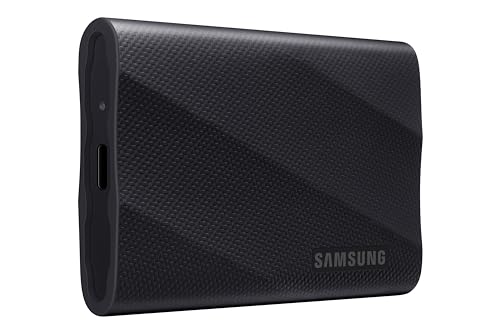
The T9 is the balanced top pick: a USB 3.2 Gen 2×2 drive with maker figures of up to 2,000 MB/s on both read and write, in a credit-card footprint that handles heat well through its metal shell and Dynamic Thermal Guard throttling. On a Windows machine with a Gen 2×2 port it is the fastest widely compatible option here; on a Mac it runs at 10 Gbps class speeds like every Gen 2×2 drive, a limit worth weighing before ordering. Samsung’s 256-bit AES hardware encryption and password protection travel with the drive through its management software. Both a USB-C to C and a C to A cable come in the box.
Specs
- Capacity and model: 2 TB, MU-PG2T0B/AM
- Interface: USB 3.2 Gen 2×2 (20 Gbps), USB-C
- Maker speeds: up to 2,000 MB/s read and write (peak figures)
- Build: metal shell, drop resistance to 3 m (maker figure)
- Weight: 122 g
- Encryption: AES 256-bit hardware encryption
- Cables: USB-C to C and USB-C to A included
See the Samsung T9 2 TB on Amazon
2. SanDisk Extreme PRO Portable SSD with USB4, 2 TB

This is the speed ceiling of the list. SanDisk’s USB4 model carries maker figures of up to 3,800 MB/s read and 3,700 MB/s write over a USB4 Gen 3×2 connection, and it is the only pick here that can use a Thunderbolt 4 or 5 port at full pace. The trade is size and host dependence: at 140 mm long and 172 g it is the biggest drive here, and on any host without USB4 it falls back to ordinary USB 3.2 speeds, where the smaller drives below make more sense. The aluminum chassis doubles as a heat sink, the silicone shell carries IP65 dust and water resistance, and drop protection is maker-rated to 2 m.
Specs
- Capacity and model: 2 TB, SDSSDE82-2T00-G25
- Interface: USB4 Gen 3×2 (40 Gbps), USB-C, backward compatible with USB 3.2
- Maker speeds: up to 3,800 MB/s read, 3,700 MB/s write (peak figures)
- Build: aluminum chassis with silicone shell, IP65 dust and water resistance
- Drop protection: up to 2 m (maker figure)
- Size and weight: 140 x 68.7 x 11.9 mm, 172 g
See the SanDisk Extreme PRO with USB4 2 TB on Amazon
3. Crucial X10 Pro, 2 TB
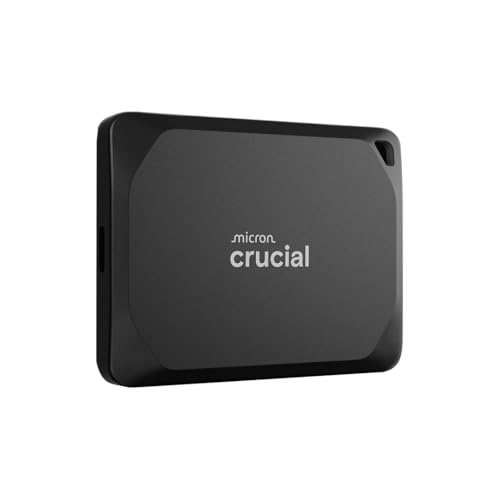
The X10 Pro is the rig-friendly pick. At 65 x 50 mm and 65 g it is small and light enough to sit in a cold shoe mount or a clamp on a camera cage without pulling the rig off balance, which is exactly where direct-recording drives live. Its interface is USB 3.2 Gen 2×2 with maker figures of up to 2,100 MB/s read and 2,000 MB/s write, so the same Mac caveat applies: Gen 2×2 hosts see full pace, everything else sees 10 Gbps class. The anodized aluminum shell carries IP65 dust and water resistance and a lanyard hole for tethering to a strap or cage, a small detail that matters when the drive hangs off a moving camera.
Specs
- Capacity and model: 2 TB, CT2000X10PROSSD902
- Interface: USB 3.2 Gen 2×2 (20 Gbps), USB-C
- Maker speeds: up to 2,100 MB/s read, 2,000 MB/s write (peak figures)
- Build: anodized aluminum, IP65 dust and water resistance
- Drop protection: up to 2 m (maker figure)
- Size and weight: 65 x 50 mm, 65 g
See the Crucial X10 Pro 2 TB on Amazon
4. Samsung T7 Shield, 2 TB
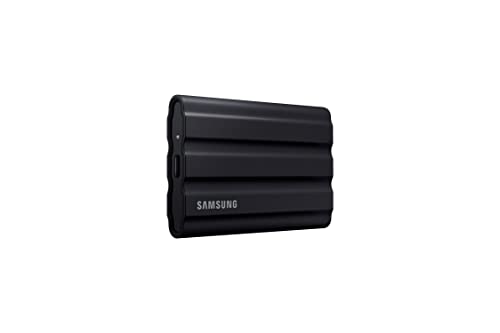
The T7 Shield is the location-work pick, built for shoots where the drive rides in a pocket, a belt pouch or the bottom of a gear bag. The rubberized elastomer shell grips instead of sliding, carries IP65 dust and water resistance, and is maker-rated for drops to 3 m. Its USB 3.2 Gen 2 interface tops out at maker figures of 1,050 MB/s read and 1,000 MB/s write, half the tier of the Gen 2×2 drives above. For card offloads that speed is rarely the bottleneck, since most card readers feed well under that ceiling anyway. It shares the T9’s AES 256-bit hardware encryption, and this listing is the black 2 TB variant, model MU-PE2T0S/AM.
Specs
- Capacity and model: 2 TB, MU-PE2T0S/AM, black
- Interface: USB 3.2 Gen 2 (10 Gbps), USB-C
- Maker speeds: up to 1,050 MB/s read, 1,000 MB/s write (peak figures)
- Build: rubberized shell, IP65 dust and water resistance
- Drop protection: up to 3 m (maker figure)
- Weight: 98 g
- Encryption: AES 256-bit hardware encryption
See the Samsung T7 Shield 2 TB on Amazon
5. SanDisk Extreme Portable SSD, 2 TB
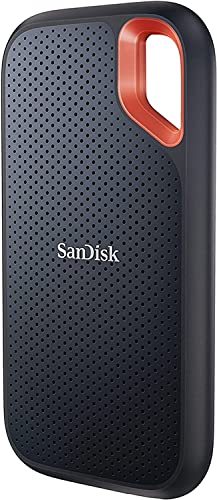
The plain Extreme is the sensible everyday offload drive. It matches the T7 Shield’s tier, USB 3.2 Gen 2 with maker figures of up to 1,050 MB/s read and 1,000 MB/s write, in a slimmer shell with a carabiner loop for clipping inside a bag. IP65 dust and water resistance comes from the updated version of this model, the one this listing covers. What it gives up is sustained pace on very long writes and the Gen 2×2 tier; what it keeps is full compatibility with every USB-C host a creator is likely to own. For shuttle duty between set and edit bay, that trade is often the right one.
Specs
- Capacity and model: 2 TB, SDSSDE61-2T00-G25
- Interface: USB 3.2 Gen 2 (10 Gbps), USB-C
- Maker speeds: up to 1,050 MB/s read, 1,000 MB/s write (peak figures)
- Build: IP65 dust and water resistance, carabiner loop
- Size: 110.5 x 63.6 x 8.9 mm
See the SanDisk Extreme Portable SSD 2 TB on Amazon
Comparison Table
| Drive | Capacity | Interface | Maker peak read / write | Sealing | Best job |
|---|---|---|---|---|---|
| Samsung T9 | 2 TB | USB 3.2 Gen 2×2 | 2,000 / 2,000 MB/s | None stated | All-round offload and edit drive |
| SanDisk Extreme PRO with USB4 | 2 TB | USB4 40 Gbps | 3,800 / 3,700 MB/s | IP65 | Fastest transfers on USB4 hosts |
| Crucial X10 Pro | 2 TB | USB 3.2 Gen 2×2 | 2,100 / 2,000 MB/s | IP65 | Direct recording on a rig |
| Samsung T7 Shield | 2 TB | USB 3.2 Gen 2 | 1,050 / 1,000 MB/s | IP65 | Location and travel work |
| SanDisk Extreme Portable | 2 TB | USB 3.2 Gen 2 | 1,050 / 1,000 MB/s | IP65 | Everyday shuttle and backup |
FAQ
Will a Gen 2×2 drive run at full speed on a Mac?
No. Macs do not support USB 3.2 Gen 2×2, so the Samsung T9 and Crucial X10 Pro fall back to USB 3.2 Gen 2 speeds, roughly half their maker peak figures. They still work normally for offloading, recording and editing; the port, not the drive, sets the ceiling. Mac owners who want the top tier should look at the USB4 drive in this list, which pairs with Thunderbolt ports at full pace.
Can these drives record video directly from a camera or phone?
On hosts that support recording to USB storage, yes, and the small Crucial X10 Pro is shaped for exactly that job. The condition is the camera maker’s approved media list: each camera and phone model certifies specific drives and capacities for direct recording, because the drive must sustain the codec’s data rate without dropping frames. Confirm the exact model and the 2 TB capacity against that list before a shoot that cannot be repeated.
Is 2 TB the right capacity for video work?
For most creators it is the working sweet spot. A day of 4K shooting fills a few hundred gigabytes, so 2 TB holds several shoot days plus an active project with room to spare, and keeps the whole working set on one drive, which simplifies backup. Larger variants of every drive here exist under their own listings; the picks above are pinned to 2 TB so links and specs describe the same product.
How should a portable SSD be backed up on location?
Treat the portable drive as a shuttle, never as the only copy. The working pattern is a two-destination offload: card to the portable SSD, then the SSD to a second drive or laptop the same day, with cards left unformatted until both copies check out. A fast drive shortens the first copy; it does nothing for the second. Any drive here can be lost or dropped, and the footage on it cannot be replaced.
Conclusion
Match the drive to the port and the job. The Samsung T9 is the default for Gen 2×2 hosts and mixed fleets, the SanDisk Extreme PRO with USB4 is the pick when a USB4 or Thunderbolt port is guaranteed, and the Crucial X10 Pro earns its place on rigs where grams matter. The T7 Shield and SanDisk Extreme Portable trade peak speed for rugged shells and universal 10 Gbps compatibility, which suits location offloads better than spec sheets suggest. Whichever tier fits, pin the capacity before ordering, confirm direct-recording support on the camera maker’s list, and keep a second copy of everything.
More from Amazon
Programs that pair well with the guide above. Offers and eligibility are set by Amazon and may change.
Free shipping on eligible items, Prime Video and more. Eligible new members can start with a free trial.
Start a Prime free trialAd-free music streaming. Eligible new subscribers can start with a free trial.
Try Music Unlimited freeA Prime membership for ages 18-24 with a trial period. Eligibility is set by Amazon.
See Prime for Young AdultsAudiobooks and podcasts to listen to on the go. Eligible new members can start with a free trial.
Try Audible freeAs an Amazon Associate we earn from qualifying purchases.