Key takeaways
- A stereo receiver can give your TV clearer dialogue and real bass without a surround setup. Compare five receivers with HDMI ARC and optical input.
A soundbar is the easy answer to bad TV sound, but it is a closed box: small drivers, bass from a separate wireless box or not at all, and when it dies you replace the whole thing. A stereo receiver drives two real speakers with a proper amplifier, and it stays useful for decades. This guide covers stereo receivers chosen for TV duty. The TV connection comes first: HDMI ARC where you can get it, a digital optical or coaxial input where you cannot, and a subwoofer output for the low end small speakers cannot reach.
Two things to understand before the picks. First, a stereo receiver has no center channel, so dialogue lives in a phantom center between the two speakers. Sit centered and dialogue sounds anchored to the screen; sit far off to one side and voices drift toward the nearer speaker. Second, watt figures are maker claims measured their own way. A receiver rated at 100 watts across the full 20 Hz to 20 kHz range with both channels driven is not the same animal as one rated at 100 watts at a single frequency with one channel driven.
How to Choose a Stereo Receiver for TV Audio
Start with the TV connection. HDMI ARC is the best option because one cable carries audio from the TV to the receiver, and with HDMI-CEC the TV remote can control the receiver volume and power. Only two of the five receivers below offer it. If your TV has an optical output, a receiver with an optical input gives you the same digital audio with one extra remote to manage. Every receiver in this guide has at least one digital input for the TV; the analog-only fallback is the last resort.
Read the watt figure, then read the footnote. Full-bandwidth figures (20 Hz to 20 kHz, two channels driven, low distortion) are the honest ones. Single-frequency figures at 1 kHz with one channel driven and 1 percent or 10 percent distortion allowed are headline figures that flatter the amplifier. For a small or medium living room, 50 to 80 honest watts per channel is ample. More watts do not make dialogue clearer; speaker placement and a subwoofer do.
Check for a subwoofer output. TV sound without a subwoofer is thin at the bottom, and bookshelf speakers on their own cannot move enough air for explosions or a double bass. A dedicated subwoofer output lets the receiver hand the low frequencies to a powered subwoofer and frees the main speakers to do what they do best. All five picks here have one.
Mind the missing calibration mic. Multichannel AV receivers ship with a room calibration microphone that measures your room and sets levels and delays for you. Stereo receivers do not. You set speaker distance, balance, and tone by ear. A 5.1 receiver set up well beats a 7.2 receiver set up badly, and the same logic applies here: a two-channel setup placed with care, speakers at ear height and toed in toward the seat, will outperform a bigger system set up badly.
Count the inputs you actually need. A TV, a streaming stick or console, a turntable, and a phone over Bluetooth cover most living rooms. A phono input matters only if you own records.
1. Marantz NR1200 Slim Stereo Receiver

Marantz NR1200 Slim Stereo Receiver
The NR1200 is the most TV-ready stereo receiver in this guide, and the only slim one. At about half the height of a traditional receiver it fits a shallow media console. Five HDMI inputs and one HDMI output with ARC handle the TV and every source box through a single cable, and HDMI-CEC lets the TV remote run the volume. That single-cable setup is the whole point: the NR1200 replaces a soundbar with something that sounds like real hi-fi.
Specs
- Channels: 2.1
- Power: 75 watts per channel (8 ohms, 20 Hz to 20 kHz, 0.08% THD, two channels driven)
- TV inputs: 5 HDMI with HDCP 2.3, 1 HDMI out with ARC, 1 optical, 1 coaxial
- Subwoofer outputs: 2
- Streaming: HEOS built in, Wi-Fi, Bluetooth, AirPlay 2
- Phono input: Yes, moving magnet with HDAM stage
- Dimensions: 17.3 x 4.1 x 14.5 in
- Weight: 18.1 lb
The 75-watt figure is a full-bandwidth number, more honest than the triple-digit headlines elsewhere in this guide. Dual subwoofer outputs are unusual at this level and let a large room run two subs for even bass. The trade-offs are the slim chassis, which runs warm in a closed cabinet, and reliance on the HEOS app for streaming setup. Note that this model supports ARC, not eARC, so it downmixes compressed surround formats from the TV to stereo.
2. Denon DRA-800H Stereo Network Receiver

Denon DRA-800H Stereo Network Receiver
The DRA-800H is the Denon answer to the same question the Marantz asks: a stereo receiver that behaves like a modern AV receiver. It has the same five HDMI inputs and ARC output, the same HEOS streaming platform, and a slightly stronger amplifier at 100 watts per channel measured under the same full-bandwidth conditions as the Marantz. It is a full-height chassis, so it needs a deeper shelf, but it runs cooler.
Specs
- Channels: 2.1
- Power: 100 watts per channel (8 ohms, 20 Hz to 20 kHz, 0.08% THD, two channels driven)
- TV inputs: 5 HDMI with HDCP 2.3, 1 HDMI out with ARC, 1 optical, 1 coaxial
- Subwoofer output: Yes
- Streaming: HEOS built in, Wi-Fi, Bluetooth, AirPlay 2
- Phono input: Yes, moving magnet
- Dimensions: 17.1 x 6 x 13 in
- Weight: 18.7 lb
The choice between them comes down to chassis and power. The Denon gives you more watts and a full-size box; the Marantz gives you a slim box and a second subwoofer output. Both are discontinued models, so confirm the listing states the exact model and ARC support before buying. Like the Marantz, the Denon supports ARC rather than eARC.
3. Yamaha R-N602 Network Stereo Receiver

Yamaha R-N602 Network Stereo Receiver
The R-N602 has no HDMI at all, which sounds like a dealbreaker for a TV guide until you look at what it offers instead. Two optical and two coaxial digital inputs take the TV audio cleanly, MusicCast streaming covers every major service, and the amplifier is an honest 80 watts per channel across the full bandwidth. For a TV with an optical output, the R-N602 does everything the HDMI models do except single-remote volume control.
Specs
- Channels: 2
- Power: 80 watts per channel (8 ohms, 20 Hz to 20 kHz, 0.04% THD, two channels driven)
- TV inputs: 2 optical, 2 coaxial digital
- Subwoofer output: Yes
- Streaming: MusicCast, Wi-Fi, Bluetooth, AirPlay
- Phono input: Yes, moving magnet
- Dimensions: 17.1 x 6 x 15.4 in
- Weight: 21.6 lb
The R-N602 is the heaviest receiver here: a large transformer and a rigid chassis are what make an amplifier sound composed at volume. The Burr-Brown DAC handles high-resolution files up to 192 kHz, which matters for music and not at all for TV. The honest weakness is the remote situation: without HDMI-CEC you juggle the TV remote and the receiver remote, or program a universal remote to do both jobs.
4. Onkyo TX-8220 Stereo Receiver

The TX-8220 is the value pick, and the one most likely to surprise a buyer who expects a budget receiver to sound thin. It has two digital audio inputs for the TV, a phono stage, Bluetooth, and a subwoofer pre-out. It also drives two pairs of speakers, so the same box can run the living room and a second room.
Specs
- Channels: 2, with A/B speaker switching
- Power: 100 watts per channel (6 ohms, 1 kHz, 1% THD, one channel driven)
- TV inputs: 1 optical, 1 coaxial digital
- Subwoofer output: Yes, pre-out
- Streaming: Bluetooth only
- Phono input: Yes, moving magnet
- Dimensions: 17.1 x 5.8 x 12.9 in
- Weight: 15.4 lb
That watt figure is measured at a single frequency, into 6 ohms, with one channel driven and 1 percent distortion allowed, so it is not directly comparable to the full-bandwidth figures above. In practice the TX-8220 drives ordinary bookshelf speakers to comfortable living-room volume without strain. It has no network streaming and no Wi-Fi, so music comes from a phone over Bluetooth or a wired source.
5. Yamaha R-S202BL Stereo Receiver
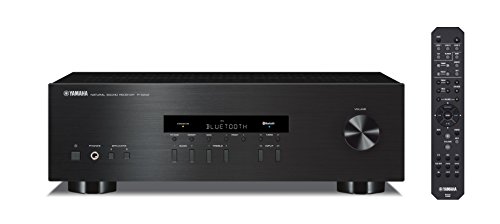
Yamaha R-S202BL Stereo Receiver
The R-S202BL is the simplest receiver in this guide and the cheapest route to real stereo TV sound. It is a plain two-channel receiver with Bluetooth, a phono input, a subwoofer output, and A/B speaker switching. There is no network streaming, no digital input, and no HDMI, so the TV connects over analog RCA or the headphone output. That is a genuine limitation, and also the reason this receiver is so reliable: there is almost nothing in it to go wrong.
Specs
- Channels: 2, with A/B speaker switching
- Power: 100 watts per channel (8 ohms, 1 kHz, 10% THD)
- TV inputs: Analog RCA only
- Subwoofer output: Yes
- Streaming: Bluetooth only
- Phono input: Yes, moving magnet
- Dimensions: 17.1 x 5.5 x 12.7 in
- Weight: 14.8 lb
The 100-watt headline is the loosest measurement in this guide, taken at one frequency with 10 percent distortion allowed, so treat it as a rough indication rather than a promise. The analog-only TV connection means the TV volume and the receiver volume both matter. But for a bedroom TV, a second room, or a turntable-and-TV setup, the R-S202BL is the honest minimum that still sounds like hi-fi rather than a toy.
Comparison Table
| Model | Channels | TV Input | HDMI ARC | Sub Out | Phono |
|---|---|---|---|---|---|
| Marantz NR1200 | 2.1 | 5 HDMI, optical, coaxial | Yes | 2 | Yes |
| Denon DRA-800H | 2.1 | 5 HDMI, optical, coaxial | Yes | 1 | Yes |
| Yamaha R-N602 | 2 | 2 optical, 2 coaxial | No | 1 | Yes |
| Onkyo TX-8220 | 2 | 1 optical, 1 coaxial | No | 1 | Yes |
| Yamaha R-S202BL | 2 | Analog RCA only | No | 1 | Yes |
Frequently Asked Questions
Do I need HDMI ARC on a stereo receiver for TV audio?
No, but it is the most convenient option. HDMI ARC carries TV audio to the receiver over one cable and, with HDMI-CEC, lets the TV remote control the receiver volume and power. A digital optical input carries the same audio quality for stereo purposes; you simply manage volume with the receiver remote instead.
Will a stereo receiver make dialogue clearer than my TV speakers?
Yes, in most rooms, because the speakers are larger, placed apart, and aimed at the listener instead of firing down or backward from a thin TV cabinet. The caveat is seating position: with no center channel, dialogue forms a phantom center between the two speakers, so the clearest sound is in the middle seat. A subwoofer helps too, because it takes the low end off the main speakers.
How much power do I need for a small living room?
For a small or medium room with bookshelf speakers of ordinary sensitivity, 50 to 80 watts per channel measured across the full 20 Hz to 20 kHz range is ample. Compare figures only when the measurement conditions match: a full-bandwidth figure with both channels driven is worth far more than a single-frequency headline figure. Speaker sensitivity matters as much as watts.
Can I add a subwoofer to a stereo receiver?
Yes. Every receiver in this guide has a subwoofer output for a powered subwoofer. Connect the subwoofer with a single RCA cable, set the subwoofer crossover near the point where your main speakers start to roll off, and keep the subwoofer volume modest. The goal is bass you feel rather than bass you notice.
Conclusion
A stereo receiver is not the fashionable answer to TV sound, but it is the durable one. The Marantz NR1200 is the best fit for most buyers because its HDMI ARC setup behaves like a soundbar while sounding like a proper hi-fi system. The Denon DRA-800H is the full-size alternative with a stronger amplifier. The Yamaha R-N602 is the pick for a TV with an optical output and a buyer who wants network streaming without HDMI. The Onkyo TX-8220 covers the whole TV checklist at the lowest outlay, and the Yamaha R-S202BL is the honest minimum for a second room or a turntable-and-TV setup. Whichever you choose, read the watt footnote, confirm the TV connection before you buy, and place the speakers with care. Two channels set up well will beat a bigger system set up badly, every time.
Disclosure: As an Amazon Associate, I earn from qualifying purchases.
More from Amazon
Programs that pair well with the guide above. Offers and eligibility are set by Amazon and may change.
Free shipping on eligible items, Prime Video and more. Eligible new members can start with a free trial.
Start a Prime free trialAd-free music streaming. Eligible new subscribers can start with a free trial.
Try Music Unlimited freeA Prime membership for ages 18-24 with a trial period. Eligibility is set by Amazon.
See Prime for Young AdultsAudiobooks and podcasts to listen to on the go. Eligible new members can start with a free trial.
Try Audible freeAs an Amazon Associate we earn from qualifying purchases.