Our Short List of 3

- Tensioned fixed frame stays flat and wrinkle-free
- Black-backed white surface with 1.1 gain for accurate color
- Velvet-wrapped frame absorbs overshoot and sharpens the image edge
- 120-inch 16:9 size fits most theater rooms
- Retracts into a slim casing when not in use
- Fiberglass-backed surface hangs flatter than cloth pull-downs
- Ships fully assembled with floating brackets
- Extra drop suits ceiling mounting

- 120-inch size at a simpler setup than a motorized screen
- Auto-lock holds the screen at the height you choose
- No motor and no power outlet needed
- Two-year warranty on the listing
All 5 Picks at a Glance
| Product | Specs | Action |
|---|---|---|
| 1. Silver Ticket STR-169120 — Best Overall Fixed Frame |
| Check price on Amazon |
| 2. Elite Screens Spectrum 2 SPM100H-E12 — Best Motorized |
| Check price on Amazon |
| 3. Elite Screens Manual M120XWH2 — Best Manual Pull-Down |
| Check price on Amazon |
 4. Vamvo 120-Inch Projector Screen with Stand — Best Portable |
| Check price on Amazon |
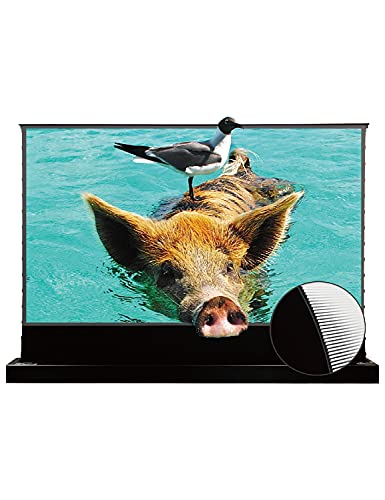 5. VIVIDSTORM S PRO VSDSTUST120H — Best Floor-Rising ALR |
| Check price on Amazon |
Key takeaways
- Find the best projectors screens for your home theater. Compare fixed frame, motorized, ALR and portable screens to match your room and projector.
As an Amazon Associate I earn from qualifying purchases.
The Short Answer
The best projectors screens for most home theaters is a 120-inch fixed frame screen with a matte white surface, and the Silver Ticket STR-169120 is the pick that anchors this guide. A fixed frame stays flat forever, the white surface shows accurate color with a standard throw projector, and the 120-inch size fits a typical living room or dedicated theater room without dominating the wall.
That said, the right screen depends on your room more than on any single product. A bright living room calls for an ambient light rejecting surface. A room that doubles as a living space calls for a motorized screen that disappears when movie night ends. A backyard calls for a portable screen with a stand. This guide compares five screens that cover those situations, so you can match the screen to the room.
Our Top Picks
- Best overall fixed frame: Silver Ticket STR-169120 — 120-inch, 16:9, white 1.1 gain surface, aluminum frame wrapped in black velvet.
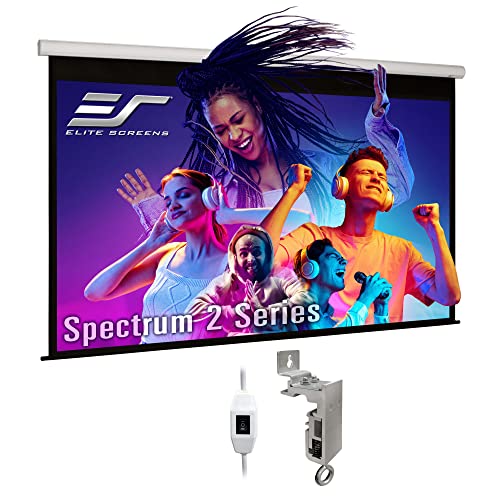
- Best motorized: Elite Screens Spectrum 2 SPM100H-E12 — 100-inch electric screen with a fiberglass-backed white surface and a three-way wall switch.
- Best manual pull-down: Elite Screens Manual M120XWH2 — 120-inch pull-down screen with an auto-lock mechanism and a two-year warranty.
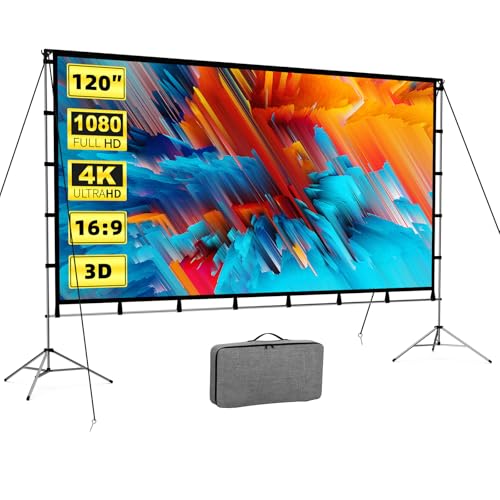
- Best portable with stand: Vamvo 120-Inch Projector Screen with Stand — 120-inch foldable polyester screen, front and rear projection, with a carry bag.
- Best floor-rising ALR: VIVIDSTORM S PRO VSDSTUST120H — 120-inch motorized floor-rising screen with an ambient light rejecting surface for ultra short throw projectors.
Quick Comparison
| Screen | Type | Size | Surface | Best for |
|---|---|---|---|---|
| Silver Ticket STR-169120 | Fixed frame | 120-inch, 16:9 | White, 1.1 gain | Dedicated theater rooms |
| Elite Screens Spectrum 2 SPM100H-E12 | Motorized electric | 100-inch, 16:9 | MaxWhite FG, 1.1 gain | Shared living rooms |
| Elite Screens Manual M120XWH2 | Manual pull-down | 120-inch, 16:9 | MaxWhite 2, 1.1 gain | Simple setups on a budget |
| Vamvo 120-Inch with Stand | Portable with stand | 120-inch, 16:9 | Polyester, front and rear | Backyard and travel |
| VIVIDSTORM S PRO VSDSTUST120H | Motorized floor-rising ALR | 120-inch, 16:9 | ALR for ultra short throw | Bright rooms with a laser TV |
How to Choose
Start with the room, not the screen
A screen is a surface that reflects light back to your eyes, and the room decides which surface works. A dark room with light control lets a matte white screen shine, because there is no stray light to wash out the image. A bright room with windows needs a surface that rejects light coming from above and from the sides, which is what ambient light rejecting screens are built to do. Measure the wall, note where the windows sit, and check whether you can darken the room before you pick a screen type.
Fixed frame, motorized, manual, or portable
A fixed frame screen is a permanent fixture. The material is stretched over a rigid frame, so it stays flat and wrinkle-free for the life of the screen. It is the right choice for a dedicated room where the screen never needs to move.
A motorized screen rolls into a slim casing on the wall or ceiling and drops down when you watch. It suits a living room where the wall has another job during the day. The motor adds a moving part, and a non-tensioned rolled surface may not lie as flat as a fixed frame, so expect a small trade in flatness for the convenience.
Match the surface to the projector
A standard throw projector pairs with a matte white surface in a dark room. An ultra short throw projector sitting on a console below the screen needs a ceiling light rejecting surface, because the light hits the screen at a steep angle and a regular white surface would wash out. A long throw projector in a bright room benefits from an ambient light rejecting surface, but confirm on the listing that the surface is made for your throw distance.
Gain, viewing angle, and aspect ratio
Gain describes how much light the surface reflects toward the viewer. A gain of 1.0 to 1.1 is close to neutral and gives a wide viewing angle, so people sitting off to the side still see a bright image. Higher gain screens are brighter head-on but dimmer from the side. For most rooms, a 1.0 to 1.1 gain white surface is the safe choice.
Aspect ratio matters because it decides the shape of the image. A 16:9 screen matches movies, streaming, and gaming. A 2.35:1 screen matches widescreen films but leaves bars on standard content. All five picks in this guide are 16:9, which is the right shape for mixed home theater use.
Installation and mounting
Fixed frame screens mount on the wall with brackets and need a flat, sturdy surface. Motorized screens need a power outlet nearby and a wall or ceiling strong enough to hold the casing. Manual pull-down screens mount the same way but need no power. Portable screens need level ground and, outdoors, stakes or weights in wind. Check the mounting hardware included in the box and confirm on the listing what tools you will need.
The Picks in Detail
1. Silver Ticket STR-169120 — Best Overall Fixed Frame
- Tensioned fixed frame stays flat and wrinkle-free
- Black-backed white surface with 1.1 gain for accurate color
- Velvet-wrapped frame absorbs overshoot and sharpens the image edge
- 120-inch 16:9 size fits most theater rooms
The STR-169120 is a 120-inch diagonal, 16:9 fixed frame screen with a white 1.1 gain PVC surface. The material is black-backed and tensioned across a six-piece extruded aluminum frame wrapped in black velvet, which absorbs projector overshoot and frames the image. The viewing area measures 104.5 by 58.875 inches, and the total size is 109.25 by 63.625 inches. The listing states compatibility with 4K and 8K, HDR, and active 3D content.
This is the screen to buy when the room is dedicated to home theater and the screen will never move. The tensioned surface stays flat, the velvet frame gives a finished theater look, and the white surface delivers accurate color with a standard throw projector in a dark room. It has been a common recommendation for home theater builds for years, and the 120-inch size is the sweet spot for most rooms.
Pros
Cons
2. Elite Screens Spectrum 2 SPM100H-E12 — Best Motorized
- Retracts into a slim casing when not in use
- Fiberglass-backed surface hangs flatter than cloth pull-downs
- Ships fully assembled with floating brackets
- Extra drop suits ceiling mounting
Elite Screens Spectrum 2 SPM100H-E12
The Spectrum 2 is a 100-inch diagonal, 16:9 electric screen with a MaxWhite FG surface, a fiberglass-backed matte white material with 1.1 gain and a 180-degree viewing angle. The fiberglass backing helps the surface hang flatter than a cloth-backed pull-down. It ships fully assembled in a white aluminum casing with floating wall and ceiling brackets, and it plugs into a standard outlet. A three-way up, stop, and down wall switch is included, and the screen has a 12-inch extra drop above the image so it can be ceiling-mounted with the picture at eye level.
This is the screen for a living room that does double duty. It rolls away when you are done watching, so the wall stays clear during the day. The remote control kit is a separate purchase, so confirm on the listing what is included in the box before ordering.
Pros
Cons
3. Elite Screens Manual M120XWH2 — Best Manual Pull-Down
- 120-inch size at a simpler setup than a motorized screen
- Auto-lock holds the screen at the height you choose
- No motor and no power outlet needed
- Two-year warranty on the listing
The Manual Series M120XWH2 is a 120-inch diagonal, 16:9 pull-down screen with a MaxWhite 2 surface at 1.1 gain. You pull the screen down by hand and the auto-lock mechanism holds it at the height you set. The listing carries a two-year warranty. There is no motor and no power outlet needed, which keeps the setup simple and removes the most common failure point of an electric screen.
This is the pick for a room where a retractable screen is useful but a motor is not worth the added complexity. It gives the same 120-inch size as the fixed frame picks, it disappears when rolled up, and it costs less to install than a motorized screen. The trade is that a rolled surface can develop waves over time, so it will not stay as flat as a fixed frame.
Pros
Cons
4. Vamvo 120-Inch Projector Screen with Stand — Best Portable
- Sets up in minutes with no wall mounting
- Carry bag makes it easy to transport
- Front and rear projection support
- 120-inch size works for groups outdoors
Vamvo 120-Inch Projector Screen with Stand
The Vamvo 120-inch screen with stand is a portable 16:9 screen made from polyester, with a 160-degree viewing angle and support for front and rear projection. It folds into a carry bag and the aluminum stand sets up in minutes, so it works in a backyard, at a campsite, or in a room with no free wall. The listing includes tethers and stakes for outdoor setup.
This is the only pick in this guide that leaves the house. It is the right choice for backyard movie nights, camping trips, and any setup where a wall-mounted screen is not an option. The polyester surface will not match a tensioned fixed frame for flatness, but for outdoor use the portability matters more than the last bit of image flatness.
Pros
Cons
5. VIVIDSTORM S PRO VSDSTUST120H — Best Floor-Rising ALR
- Floor-rising design needs no wall or ceiling mount
- ALR surface holds contrast in a bright room
- Tensioned surface stays wrinkle-free
- Smart app and voice control on the listing
The VIVIDSTORM S PRO VSDSTUST120H is a 120-inch diagonal, 16:9 motorized floor-rising screen with an ambient light rejecting surface built for ultra short throw projectors. The screen rises from a floor housing at the touch of a button, so there is no wall mounting and no ceiling casing. The listing states a tensioned wrinkle-free surface, smart app and voice control, and compatibility with 4K and 3D content. The viewing area is 104.57 inches wide, and sizes from 72 to 120 inches are listed, so confirm on the listing that you are ordering the 120-inch model.
This is the pick for a bright living room with a laser TV or ultra short throw projector. The ALR surface rejects ceiling light to hold contrast when the room cannot be fully darkened, and the floor-rising design suits rooms where wall mounting is not welcome. It is built for ultra short throw projectors, so it is not the right match for a standard throw projector mounted on the ceiling.
Pros
Cons
Who Should Choose What
- Dedicated theater room, standard throw projector: Silver Ticket STR-169120. A fixed frame in a dark room is the most reliable combination in this guide.
- Living room that needs the wall back: Elite Screens Spectrum 2 SPM100H-E12. It retracts, it ships assembled, and the fiberglass-backed surface hangs flat.
- Retractable screen without a motor: Elite Screens Manual M120XWH2. Simple, no power needed, and the same 120-inch size as the fixed frame picks.
- Backyard, camping, or a room with no wall space: Vamvo 120-Inch with Stand. It is the only portable pick here and it sets up in minutes.
- Bright living room with a laser TV: VIVIDSTORM S PRO VSDSTUST120H. The ALR surface and floor-rising design are built for exactly that setup.
Common Mistakes
Buying the screen before measuring the wall. A 120-inch screen needs roughly 109 inches of wall width with its frame. Measure first, then order. A screen that does not fit the wall cannot be fixed by moving the projector.
Pairing an ALR surface with the wrong projector. Ambient light rejecting surfaces are built for a specific throw distance. An ultra short throw ALR screen used with a standard throw projector can dim the image. Confirm on the listing that the surface matches your projector type.
Ignoring ambient light. A white screen in a bright room washes out no matter how bright the projector is. If you cannot darken the room, an ALR surface or a brighter room setup matters more than the screen brand.
Mounting a fixed frame alone. A 120-inch fixed frame is wide and awkward to hold level while marking holes. A second person makes the job faster and keeps the frame straight.
Forgetting the remote kit. Some motorized screens ship with only a wall switch, and the remote kit is a separate purchase. Check the included accessories on the listing before ordering so movie night does not wait on a second shipment.
Choosing size by the wall instead of the seat. A screen that fills the wall but sits too close to the sofa is uncomfortable to watch. Measure the seating distance first, then pick the size that fits both the wall and the seat.
FAQ
What size projector screen should I buy?
Match the screen to your seating distance. A 100-inch screen suits roughly 10 to 12 feet of seating distance, and a 120-inch screen suits roughly 12 to 14 feet. Measure from the screen wall to your main seat before ordering, and confirm the diagonal size and aspect ratio on the listing.
Is a fixed frame screen better than a motorized screen?
A fixed frame stays flatter because the material is tensioned over a rigid frame, so it gives the most consistent image. A motorized screen is better when the room has another use and the screen needs to disappear. Neither is better in every room; the room decides.
Do I need an ALR screen?
You need one when the room cannot be darkened and stray light hits the screen. A matte white screen is the right choice in a dark room. An ALR surface helps in a bright room, but it must match your projector type, so confirm on the listing that it is built for your throw distance.
Can I use a projector screen outdoors?
Yes, with a portable screen built for it. The Vamvo pick in this guide folds into a carry bag and includes tethers and stakes. Fixed frame and motorized screens are indoor products and should not be used outdoors.
What is screen gain?
Gain describes how much light the surface reflects toward the viewer. A gain of 1.0 to 1.1 is close to neutral and gives a wide viewing angle. Higher gain looks brighter from directly in front but dimmer from the sides. Most rooms are best served by a 1.0 to 1.1 gain surface.
Can I use a white wall instead of a screen?
A white wall can show an image, but a screen gives a flatter surface, a defined edge, and a surface tuned for reflection. A wall also shows texture and color shifts that a screen hides. A screen is worth it when image quality matters to you.
Conclusion
The best projectors screens are the ones that match the room. A fixed frame like the Silver Ticket STR-169120 is the anchor pick for a dedicated theater room. A motorized screen like the Elite Screens Spectrum 2 suits a shared living room. A manual pull-down like the Elite Screens M120XWH2 keeps things simple. A portable screen like the Vamvo 120-inch with stand takes movie night outside. And a floor-rising ALR screen like the VIVIDSTORM S PRO is the answer for a bright room with a laser TV. Measure the wall, check the seating distance, match the surface to the projector, and confirm the details on the listing before you order.
More from Amazon
Programs that pair well with the guide above. Offers and eligibility are set by Amazon and may change.
Free shipping on eligible items, Prime Video and more. Eligible new members can start with a free trial.
Start a Prime free trialAd-free music streaming. Eligible new subscribers can start with a free trial.
Try Music Unlimited freeA Prime membership for ages 18-24 with a trial period. Eligibility is set by Amazon.
See Prime for Young AdultsAudiobooks and podcasts to listen to on the go. Eligible new members can start with a free trial.
Try Audible freeAs an Amazon Associate we earn from qualifying purchases.