Key takeaways
- Width: the top surface must support the feet. Wide-set feet on a narrow console can leave the TV overhanging, which is a tipping risk.
- Weight: the stand’s stated capacity needs headroom over the TV plus any soundbar or devices on top.
- Room: a 75-inch set in a small room can look overwhelming on a tall stand. Lower furniture tends to keep the screen centered nearer eye level.
- Doorways and assembly: larger furniture ships in heavy boxes. Measure stairs and doors if the unit is solid wood.
A 75-inch TV needs a stand roughly 65 to 75 inches wide with a sturdy frame and a clearly stated weight rating, and buyers with limited floor space should look hard at wall mounting or a heavy-duty floor stand instead. The jump from 65 to 75 inches adds a lot of width and weight, which turns a stand purchase into a stability decision as much as a styling one. This guide covers what to measure, how stand types trade off at this size, and which established makers are worth a look.
Our top picks


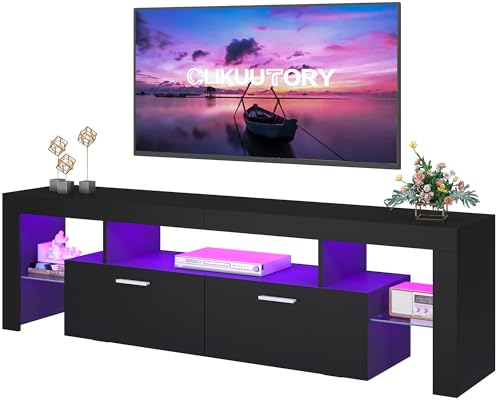
As an Amazon Associate we earn from qualifying purchases at no extra cost to you.
Why 75 inches changes the stand question
A 75-inch TV is commonly about 65 to 67 inches wide, though exact width varies by model and bezel. The set also tends to be heavier and deeper than a 65-inch, and some models use wide-set feet or a long center bar. Each of those details is listed on the maker’s spec sheet, and each can rule out a stand that looks fine in a product photo.
- Width: the top surface must support the feet. Wide-set feet on a narrow console can leave the TV overhanging, which is a tipping risk.
- Weight: the stand’s stated capacity needs headroom over the TV plus any soundbar or devices on top.
- Room: a 75-inch set in a small room can look overwhelming on a tall stand. Lower furniture tends to keep the screen centered nearer eye level.
- Doorways and assembly: larger furniture ships in heavy boxes. Measure stairs and doors if the unit is solid wood.
At a glance: stand types for a 75-inch TV
| Type | Best for | Key points | Limits |
|---|---|---|---|
| Wide media console | Living rooms with space and several devices | Big top surface, storage, cable routing | Large footprint; needs a wide wall section |
| Heavy-duty floor stand with mount | Renters or open-plan rooms | Adjustable height, small footprint | Must support the TV’s weight and VESA pattern; heavy to assemble |
| Corner unit | Rooms where a wall is occupied by windows or doors | Uses corner space | Check that the TV’s width fits the angled top |
| Mobile TV cart | Offices, training rooms | Casters, shelves | Stability on carpet; follow the maker’s tip-over guidance |
| Wall mount plus low cabinet | Buyers who want the cleanest look | TV on the wall, devices in a cabinet below | Needs suitable wall structure and a rated mount |
| Fireplace-style console | Rooms wanting a focal point | Decor insert under the TV | Heater inserts have strict clearance rules |
Makers worth looking at
Product lineups change, and sizes sometimes drop out. Confirm a model’s current listed width, depth, weight capacity and TV-size rating on the maker’s own page before buying.
Budget tier
Sauder, Ameriwood Home, Walker Edison and Bestar offer wide ready-to-assemble consoles in engineered wood. Many are rated for TVs up to 75 inches or more, but ratings vary by model. Reviewers commonly note that budget units are best when the load stays centered and when the stand is anchored as directed. Fasteners and cam-lock hardware deserve careful assembly, since looseness shows up over time.
Mid-range tier
Walker Edison, Safavieh and Home Styles sell consoles that mix wood, metal frames and glass or slatted doors. This tier usually offers thicker top panels, adjustable shelves and cable access. For 75-inch sets, look for four or more support legs or a solid base panel, and for tops rated clearly above the TV’s weight.
Premium tier
West Elm, Crate and Barrel, Article, and Room and Board sell media consoles in solid or veneered wood, with metal hardware and cleaner design. Greater weight helps stability, but premium units can be difficult to move. They suit buyers who want furniture that will outlast the TV.
Floor stands and carts
Mounting Dream, Perlesmith, Sanus and Mount-It sell floor stands and carts for large TVs on VESA brackets. Each lists a supported screen-size range and maximum weight. For a 75-inch TV, confirm that the stand’s range includes 75 inches, that the VESA pattern matches, and that the base is wide enough for stability as described in its manual.
Fit and compatibility checklist
- Record the TV’s width, depth, weight and foot spacing from its spec sheet.
- Find the stand’s top dimensions and maximum TV size and weight; compare each one.
- Allow for a soundbar and its height relative to the screen’s lower edge.
- If the TV has a center pedestal, check that it fits on the stand surface without overhang.
- Measure the wall space, doorway and path to the room before ordering large furniture.
- For floor stands, use only the hardware supplied by the maker, and confirm the VESA pattern.
Safety and care
Bigger TVs are harder to catch if they tip. Maker manuals commonly advise anchoring the furniture to the wall, and securing the TV to the stand if it allows, using the provided anti-tip hardware. Keep children and pets away from climbing shelves and doors. Do not place a TV on a stand with a weaker rating than the set requires. Two people should lift a 75-inch TV. If a console includes a heater or electrical features, follow the manual, and consult an electrician for any wiring or outlet changes. Keep vents clear to avoid heat build-up around devices.
For care, wipe laminate and veneer with a lightly damp cloth, and follow the maker’s guidance for solid wood and glass. Recheck screws and fasteners on assembled furniture periodically, since movement and vibration can loosen them.
Pick X if …
| Pick this | If you |
|---|---|
| A wide budget console | want a low-cost, ready-to-assemble solution and have a wall wide enough |
| A mid-range metal-and-wood console | want sturdier build and better cable management |
| A solid-wood premium console | want long-term furniture quality and visual weight |
| A heavy-duty floor stand | rent or cannot mount, and want adjustable height |
| A corner unit | need to use an angled space |
| A wall mount with a low cabinet | want a minimal look and can mount safely |
| A mobile cart | need to move the TV between rooms |
Alternatives
- Full-motion wall mount: frees floor space and allows angle changes. It needs proper wall support and a mount rated beyond the TV’s weight; professional installation is sensible for big sets.
- Low credenza under a mounted TV: hides devices without carrying the TV’s weight.
- Projector with a screen: for rooms where a 75-inch TV is not enough or where a wall is the better surface.
Budget tiers in plain terms
At this size the tiers differ mostly in structure rather than looks. Budget consoles save cost with thinner engineered-wood panels and simple fasteners, so they reward careful assembly, even weight distribution and wall anchoring. Mid-range units usually add thicker tops, metal frames or legs and better cable routing. Premium furniture adds solid or thick veneered wood, better hardware and finishing, and sometimes custom sizes. Spending more does not remove the need to read the stated capacity, since a heavier piece still has a rated limit set by its maker.
A practical approach is to decide the stand width first, then the storage you need, then the tier. If you own a console, a streaming box and a receiver, closed storage with cable openings matters more than a decorative top. If you own only the TV and a soundbar, a slim low console or a wall mount may be enough, and the saved budget can go to better mounting hardware or a stronger anchor kit.
Placement tips for large TVs
- Keep the screen center near seated eye level, which usually means a low or mid-height console.
- Leave a few inches behind the TV for airflow and cables, and do not push the set hard against the wall unless the manual allows it.
- Avoid placing a large TV where doors or walkways could bump the stand.
- Position the stand away from direct sun and heating vents, which can affect both finishes and electronics.
- Use cable ties and a power strip with surge protection mounted behind the unit so cords do not pull on the TV.
Frequently Asked Questions
How wide should a stand be for a 75-inch TV?
Most 75-inch TVs measure roughly 65 to 67 inches wide, so a stand of about 65 to 75 inches is common. Check the TV’s spec sheet for width and foot spacing. A stand a little wider than the TV looks balanced and offers a margin for error.
Can a 75-inch TV be placed on a standard TV stand?
Only if the stand’s listed maximum TV size and weight include it. Many stands are rated for smaller sets. Using one outside its rating risks sagging or tipping, so rely on the maker’s stated limits.
Is wall mounting safer than a stand for a big TV?
A correctly installed mount on suitable wall structure can be very secure and removes tabletop tip-over risk, but poor installation is hazardous. Use a mount rated for the TV’s weight and VESA pattern, follow the instructions, and use a professional if the wall type or stud location is uncertain.
Do I need to anchor my TV stand?
Maker manuals and safety groups commonly recommend anchoring furniture and securing the TV, especially with children in the home. Use the hardware provided and follow its instructions.
What if my TV’s feet are wider than the stand?
Then the set will overhang or cannot sit securely, so choose a wider stand or consider a wall or floor mount. Some TVs let you move the feet to an inner slot; the manual shows whether that is possible.
Where should a soundbar go with a 75-inch TV on a console?
Usually in front of the TV on the stand, provided the TV’s feet leave enough height below the screen. If they do not, a wall-mounted TV or a stand with a soundbar shelf may suit better. Compare the soundbar height with the TV’s stated clearance.
More from Amazon
Programs that pair well with the guide above. Offers and eligibility are set by Amazon and may change.
Free shipping on eligible items, Prime Video and more. Eligible new members can start with a free trial.
Start a Prime free trialAd-free music streaming. Eligible new subscribers can start with a free trial.
Try Music Unlimited freeA Prime membership for ages 18-24 with a trial period. Eligibility is set by Amazon.
See Prime for Young AdultsAudiobooks and podcasts to listen to on the go. Eligible new members can start with a free trial.
Try Audible freeAs an Amazon Associate we earn from qualifying purchases.