Our Short List of 3

- Motion type: Oscillation (pivotal)
- Motor: 200 W
- Speed levels: 99, plus 10 preset programs
- Frequency range: Approx. 4–12 Hz

- Motion type: Oscillation, linear and pulsation (4D combinations)
- Motors: Triple motor
- Training modes: 7
- Weight capacity: 330 lb
- Motion type: Oscillation
- Design: Curved platform deck
- Display: LED with real-time calorie tracking
- Controls: Remote control and panel
All 5 Picks at a Glance
| Product | Specs | Action |
|---|---|---|
| 1. LifePro Waver Vibration Plate |
| Check price on Amazon |
| 2. LifePro Rumblex Plus 4D Vibration Plate |
| Check price on Amazon |
| 3. MERACH CV30 Vibration Plate |
| Check price on Amazon |
 4. Hurtle Fitness Vibration Platform (HURVBTR36) |
| Check price on Amazon |
 5. AXV Vibration Plate (Slim) |
| Check price on Amazon |
Key takeaways
- Compare the best vibration plates by motion type, motor power, platform size and capacity, plus honest guidance on what vibration can and cannot do.
A vibration plate is a powered platform that shakes at a set frequency while you stand, squat, or hold a position on it. Your muscles respond to the movement with rapid, involuntary contractions, which is why ten minutes on a plate feels like more work than ten minutes of standing still. That effect is real, but it needs honest framing: the evidence supports vibration plates as a supplement to exercise, not a replacement for it. The strongest findings cover balance, circulation, and muscle activation when the plate is combined with actual movements such as squats, lunges, and calf raises. Standing passively on a shaking platform is not a workout, no matter what the box marketing suggests.
The five plates below cover the main shapes this category takes: a single-motor oscillating model, a triple-motor machine that adds linear and pulsation modes, a curved deck with a calorie-tracking display, a wheeled platform for moving around the house, and a slim budget plate for small spaces. Each was chosen because its identity and specifications could be verified against its maker and its Amazon listing.
Disclosure: As an Amazon Associate, I earn from qualifying purchases.
How to Choose a Vibration Plate
Start with the motion type, because that is the real fork in this category. Most home plates use oscillation: the platform pivots on a central axis like a seesaw, so one foot rises as the other drops. Oscillation runs at lower frequencies, roughly 4 to 15 Hz, with larger amplitude, and it feels like a rocking, walking-style stimulus. Vertical or linear plates move the whole platform straight up and down at higher frequencies, often 25 to 50 Hz, with smaller amplitude; that is the motion used by studio and clinical machines, and it delivers a sharper, more uniform load. A third mode, pulsation, adds a rapid tapping pulse. Neither motion is automatically better. Oscillation is gentler and suits beginners, older users, and balance work. Linear motion loads muscles harder per second and suits strength-focused users who already train. What matters is knowing which one you are buying, because listings often hide the motion type behind vague words like “3D” or “4D.”
Motor power and platform size decide who the plate actually fits. As a working rule, look for at least 200 watts in a full-size plate; a small motor under a heavy user on a high setting will strain and wear early. Treat the stated weight capacity as a hard ceiling, not a suggestion. Platform size matters just as much: a deck around 21 inches long suits standing work only, while decks closer to 27 inches give room for wide stances, seated work, and floor exercises. If you plan to do anything beyond standing, buy the bigger deck.
Speed levels are mostly marketing arithmetic. A plate with 99 or 120 speed steps is not 99 times better than one with 7 well-chosen settings; the fine steps simply slice the same frequency range thinner. Frequency range and amplitude tell you more than the step count. Low frequencies around 4 to 8 Hz feel like a massage and suit warm-ups and recovery. The middle band, roughly 8 to 14 Hz on oscillating plates, is where most exercise work happens. Higher settings increase intensity fast, so change one variable at a time and keep sessions short at first, around 10 minutes.
Check the practical details before you buy. A remote control is close to essential, because bending down to a floor-level panel mid-exercise breaks your position. Resistance bands that clip to the plate turn a leg-only tool into something that can work arms, chest, and back. Weight and portability matter in a home: plates range from under 20 pounds to well over 80, and a carry handle or transport wheels decide whether the machine gets used daily or lives in a closet. Finally, respect the contraindications listed in the FAQ below: if any of them apply to you, get medical clearance before your first session.
1. LifePro Waver Vibration Plate
- Motion type: Oscillation (pivotal)
- Motor: 200 W
- Speed levels: 99, plus 10 preset programs
- Frequency range: Approx. 4–12 Hz
The Waver is the reference point for home oscillation plates: a single 200-watt motor, a seesaw motion, and a wide speed range that starts gently enough for balance work. Its frequency band of roughly 4 to 12 Hz and amplitude up to about 8 mm place it squarely in the low-impact camp, which is exactly where most home users should be. The 330-pound capacity and 27-inch deck make it one of the few compact plates that fits larger users and wider stances.
Ten preset programs plus manual control cover the basics, and the included loop bands and mini bands make it easy to add upper-body work without buying accessories separately. It is a sensible first plate: strong enough to stay useful as you progress, gentle enough for daily recovery sessions, and simple enough that the remote is the only control most people touch.
See the LifePro Waver on Amazon
2. LifePro Rumblex Plus 4D Vibration Plate
- Motion type: Oscillation, linear and pulsation (4D combinations)
- Motors: Triple motor
- Training modes: 7
- Weight capacity: 330 lb
The Rumblex Plus answers the motion question by refusing to pick one answer. Three motors combine oscillation, linear (vertical) movement, and pulsation, and they can run separately or blended into what LifePro calls 4D motion. That makes it the most versatile plate here and the closest a home machine gets to covering both ends of the category: the gentle rocking of an oscillator for warm-ups, and the sharper vertical load for strength work.
Seven training modes manage the motor combinations, and a wrist remote lets you change modes without stepping off. The flat deck is rated to 330 pounds, and the box includes an exercise mat, two resistance bands, and four mini bands, so it arrives ready for floor work too. The trade-off is complexity: with three motors and blended modes, there is a learning curve, and new users should spend their first week in single-motion modes before combining them.
See the LifePro Rumblex Plus 4D on Amazon
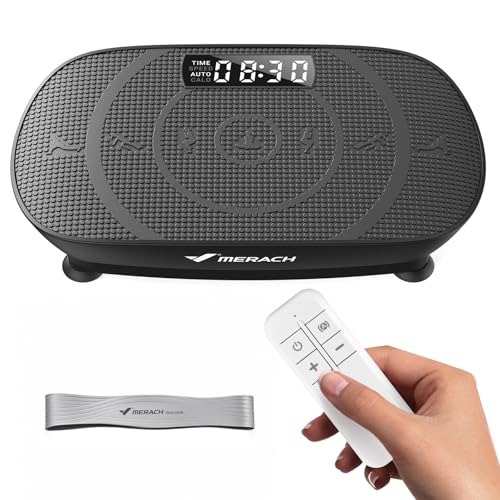
3. MERACH CV30 Vibration Plate
- Motion type: Oscillation
- Design: Curved platform deck
- Display: LED with real-time calorie tracking
- Controls: Remote control and panel
The CV30 takes a different design route: instead of a flat board, its deck is curved, which changes how your feet sit and gives the surface a more planted feel during standing work. MERACH built the feedback into the machine with an LED display that tracks session data including a real-time calorie estimate. Treat that number as a rough gauge rather than a measurement; the time and speed readouts are the genuinely useful part for repeating a workout exactly.
This is an oscillating plate aimed at guided home sessions, with remote control so settings change without breaking position. The curved profile also makes it easier to store against a wall than a flat slab of the same footprint. Choose it if you like structured, repeatable sessions and want the machine itself to keep count of time and intensity.
4. Hurtle Fitness Vibration Platform (HURVBTR36)
- Motion type: Oscillation
- Motor: 300 W
- Speed levels: 40
- Weight capacity: 265 lb
Hurtle’s platform is the mover of the group. A carry handle and built-in wheels solve the problem that quietly kills home fitness gear: a machine that is annoying to relocate stops being used. At under 27 inches long it is compact, yet its 300-watt motor is the strongest single motor on this list, driving 40 speed levels of oscillating motion.
The capacity ceiling of 265 pounds is lower than the LifePro models, so heavier users should look elsewhere on this page. For everyone under that line, the package is complete: remote control, resistance bands for upper-body work, and session timers up to 20 minutes for longer recovery routines. It suits apartments and shared spaces where the plate needs to come out, do its job, and roll away again.
See the Hurtle Fitness Vibration Platform on Amazon
5. AXV Vibration Plate (Slim)
- Motion type: Oscillation and pulsation
- Motor: 200 W
- Speed levels: 120, plus 5 preset programs
- Weight capacity: 330 lb
The AXV Slim is the small-space option: roughly 21 inches long, under 20 pounds, and slim enough to slide under a bed or stand in a closet. Its 200-watt motor drives oscillation and pulsation modes across 120 speed levels with five preset programs, and the LED display shows time and speed so you can repeat sessions consistently. A built-in Bluetooth speaker handles music, and the two included resistance bands cover basic arm and shoulder work.
The stated 330-pound capacity is generous for a plate this size, though very tall users will find the short deck limits stance width; this is a standing-work machine, not a floor-exercise platform. As a low-commitment way to test whether vibration training fits your routine, it covers the fundamentals honestly.
See the AXV Vibration Plate on Amazon
Comparison Table
| Model | Motion | Motor | Speed Levels | Capacity | Platform |
|---|---|---|---|---|---|
| LifePro Waver | Oscillation | 200 W | 99 | 330 lb | 27.3 x 15.3 in |
| LifePro Rumblex Plus 4D | Oscillation, linear, pulsation | Triple motor | 7 modes | 330 lb | Full-size deck |
| MERACH CV30 | Oscillation | Not stated | Remote-guided programs | See listing | Curved deck |
| Hurtle HURVBTR36 | Oscillation | 300 W | 40 | 265 lb | 26.8 x 15.0 in |
| AXV Slim | Oscillation, pulsation | 200 W | 120 | 330 lb | 21 x 12.6 in |
FAQ
Do vibration plates actually work?
They do something measurable: muscles contract reflexively in response to the platform’s movement, and studies link regular use with better balance, circulation, and modest strength gains when sessions involve real exercises like squats and calf raises. They are a supplement that can make light training more productive, not a replacement for training itself, and no plate burns meaningful calories while you simply stand on it.
What is the difference between oscillation and vertical vibration?
Oscillation rocks the platform like a seesaw at lower frequencies with bigger movement, which feels gentler and suits beginners and balance work. Vertical, or linear, plates move straight up and down at higher frequencies with smaller movement, loading muscles harder and faster. Studio and clinical machines are usually vertical; most home plates oscillate, and a few multi-motor models offer both.
How long should a vibration plate session last?
Around 10 minutes is the standard session length for beginners, and most machines cap timers between 10 and 20 minutes. Two or three short sessions a week is a sensible starting rhythm. More is not automatically better: long exposures at high settings can leave joints achy and cause dizziness or itchy, over-stimulated legs, both signs to stop.
Who should not use a vibration plate?
Skip whole body vibration, or get medical clearance first, if you are pregnant, have a pacemaker or other implanted device, recent surgery or fractures, retinal detachment issues, severe migraines, or certain joint replacements and spinal conditions. When in doubt, the honest answer is to ask your clinician before the first session, not after a problem appears.
Conclusion
For most people, the LifePro Waver is the right starting point: honest oscillation, a 200-watt motor, room for real stances, and a gentle low end for recovery days. If you want one machine that spans both motion families, the Rumblex Plus 4D earns its premium complexity with triple-motor versatility. The MERACH CV30 suits structured, display-guided sessions, the Hurtle is the one to buy if the plate must move around the house, and the AXV Slim proves the concept in the smallest footprint. Whichever you choose, treat the plate as an amplifier for real exercise, keep sessions short, and let motor power and platform size, not speed-level counts, drive the decision.
More from Amazon
Programs that pair well with the guide above. Offers and eligibility are set by Amazon and may change.
Free shipping on eligible items, Prime Video and more. Eligible new members can start with a free trial.
Start a Prime free trialAd-free music streaming. Eligible new subscribers can start with a free trial.
Try Music Unlimited freeA Prime membership for ages 18-24 with a trial period. Eligibility is set by Amazon.
See Prime for Young AdultsAudiobooks and podcasts to listen to on the go. Eligible new members can start with a free trial.
Try Audible freeAs an Amazon Associate we earn from qualifying purchases.