Key takeaways
- Pros: Officially certified Ultra High Speed at the lowest per-cable price in this group; supports the full HDMI 2.1 feature set including 8K@60Hz and 4K@120Hz.
- Con: Some owners note the molded strain reliefs are shorter than those on pricier competitors, which could matter if the cable runs through a tight wall plate.
Buying a 4K television, a PS5, or a new monitor rarely ends at the device itself. The cable connecting them determines whether you actually get the sharpness, the high refresh rate, and the HDR color that the product promises. Walk through any electronics retailer or browse “4k hdmi cable” on a marketplace and you will find dozens of nearly identical black cords at prices ranging from a few dollars to fifteen, with no obvious way to tell which one will carry a clean signal and which one will flash a black screen the moment you enable VRR.
What separates a dependable cable from a risky one comes down to three things: whether it carries an official Ultra High Speed certification (a QR-verifiable guarantee of 48Gbps throughput), whether its connectors are solidly seated in the housing so they survive repeated plugging, and whether the wire gauge and shielding are adequate for the run length you need. A short uncertified cable might work fine for 1080p but can degrade or drop out at 4K HDR with a 120Hz signal. The roundup below compares eight popular options on published specifications, listed prices, and recurring owner feedback so you can match a cable to your setup without gambling.
Our top picks



As an Amazon Associate we earn from qualifying purchases at no extra cost to you.
Quick Picks
| Product | Best for | Price |
|---|---|---|
| Highwings 8K 10K 4K HDMI Cable | Budget single-cable 8K/4K 120Hz | $6.49 |
| Anker HDMI Cable 8K@60Hz / 4K@120Hz | Trusted-brand reliability | $9.99 |
| Highwings HDMI Cable 2.0 HDR Braided | Lowest-cost 4K HDR with ARC | $5.42 |
| Highwings 8K HDMI 2.1 Cable 2-Pack | Two devices from one purchase | $8.99 |
| Silkland Certified HDMI 2.1 Cable | Braided durability at full 48Gbps | $9.99 |
| Ubluker 10K 8K 4K HDMI Cable | Extreme refresh rates up to 4K 240Hz | $9.99 |
| UGREEN 8K HDMI 2.1 Cable | Premium build and brand confidence | $12.99 |
| Highwings HDMI Cable 15 ft | Long in-wall or behind-furniture runs | $9.99 |
How We Picked
We narrowed candidates on four criteria that matter most in this category. First, certification status: an official HDMI Licensing Administrator Ultra High Speed label is the only verifiable proof that a cable sustains 48Gbps, so uncertified products had to offer a compelling value or feature to remain. Second, bandwidth headroom relative to price: a cable that exceeds your current needs by a wide margin costs almost nothing more to manufacture, so we flagged where headroom is genuinely useful. Third, connector and jacket construction: braided nylon sleeves and metal or reinforced plastic housings were weighted heavily because most reported failures trace back to loose or cracked plugs. Fourth, recurring owner feedback patterns: we looked for clusters of complaints about signal dropout, connector wobble, or short lifespan rather than isolated negative reviews.
The 8 Best 4K Hdmi Cable in 2026
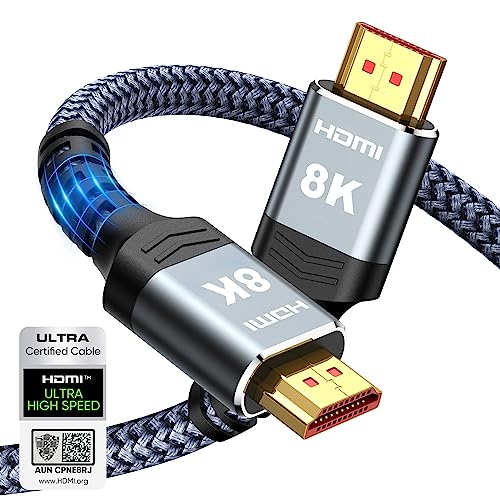
Highwings 8K 10K 4K HDMI Cable
This is the entry point for anyone who wants certified 48Gbps performance without paying a premium. Owners upgrading from older HDMI 2.0 cords to drive 4K 120Hz on a PS5 or Xbox Series X consistently report that the signal holds steady with HDR and eARC enabled. The braided jacket feels sturdy for the price and the connectors snap in with satisfying resistance.
- Pros: Officially certified Ultra High Speed at the lowest per-cable price in this group; supports the full HDMI 2.1 feature set including 8K@60Hz and 4K@120Hz.
- Con: Some owners note the molded strain reliefs are shorter than those on pricier competitors, which could matter if the cable runs through a tight wall plate.
Skip this if you need two cables for the same price or require a longer run than 6.6 feet.
Anker HDMI Cable 8K@60Hz / 4K@120Hz
Anker’s reputation for solid accessories transfers well here. Buyers who prefer a recognizable brand name rather than a marketplace-only label tend to settle on this cable, and owner feedback reflects broad satisfaction with connector fit and consistent 4K 120Hz output on LG and Samsung OLEDs. The braided exterior resists tangling during routing behind entertainment centers.
- Pros: Backed by a brand with a visible warranty channel that many shoppers trust; connectors fit snugly in recessed TV ports without pulling at adjacent inputs.
- Con: Not advertised as officially Ultra High Speed certified in the same verifiable way as some competitors, so spec-obsessed buyers may question the certification label.
Skip this if you want documented HDMI LA certification above all else or if the Highwings single-cable price matters more than brand familiarity.
Highwings HDMI Cable 2.0 HDR Braided
At $5.42 this is the cheapest option in the roundup and a pragmatic choice for anyone running a 4K Blu-ray player, a standard cable box, or a PC to a 4K 60Hz television. It supports HDR, ARC, 3D, and HDCP 2.2, which covers the majority of living-room setups that do not involve next-gen console frame rates.
- Pros: Lowest cost in the group; braided jacket and compact connector shells make it easy to tuck behind a TV mount.
- Con: Limited to HDMI 2.0 bandwidth, so it cannot deliver 4K at 120Hz or 8K at any refresh rate — a hard ceiling if you plan to upgrade your display later.
Skip this if your source or display already requires HDMI 2.1 features like VRR or 4K@120Hz.
Highwings 8K HDMI 2.1 Cable 2-Pack
Two certified 48Gbps cables for $8.99 means each cable costs under $4.50, the best per-cable value in this entire list. This is ideal for households with a PS5 and an Xbox Series X both feeding the same TV, or for anyone who wants a spare cable for a second monitor or projector. Owners repeatedly mention the convenience of having a backup already on hand.
- Pros: Unbeatable price per cable with full HDMI 2.1 certification; both cables share the same braided build and connector quality as the single Highwings option.
- Con: The strain-relief design is basic; if you route through a tight wall plate you may want a model with a slimmer connector shell.
Skip this if you only need one cable and would rather spend the difference on a premium single option with reinforced connectors.
Silkland Certified HDMI 2.1 Cable
Silkland occupies the middle of the value range at $9.99 and earns praise for its noticeably thicker braided jacket, which owners describe as feeling like a cable meant to survive years of rearranging a desk or entertainment unit. Certification is verifiable, and the connector housings use a metal-alloy finish that resists loosening over time.
- Pros: The jacket is among the most durable-looking in the group, with multiple braid layers; officially certified for the full 48Gbps bandwidth and all HDMI 2.1 features.
- Con: Slightly stiffer than thinner braided alternatives, which can make it harder to bend around tight corners behind a wall-mounted TV.
Skip this if you need maximum flexibility in a cramped routing space or want the absolute lowest price per certified cable.
Ubluker 10K 8K 4K HDMI Cable
Ubluker lists support for 4K at 240Hz and 10K resolution, targeting the small but growing group of buyers who want to future-proof a display that exceeds anything currently shipping. At $9.99 the price is identical to several other options, so the spec sheet is the differentiator. Owners with 4K 144Hz monitors report clean VRR operation and no signal dropout.
- Pros: Advertised refresh-rate ceiling is the highest in this roundup, making it the safest bet if a future display exceeds 120Hz; supports eARC and HDR10+.
- Con: The brand has far less name recognition than Anker or UGREEN, which may concern buyers who prioritize a straightforward warranty claim process.
Skip this if you want a well-known brand behind the packaging or if your current setup tops out at 4K 120Hz and you would rather save a dollar or two.
UGREEN 8K HDMI 2.1 Cable
UGREEN commands the highest price in this group at $12.99 and justifies it with build quality that owners describe as noticeably more robust: thicker connector housings, a denser braided sleeve, and gold-plated contacts that resist oxidation. For buyers who want a single cable to trust for years of daily use in a home-office or media-room setup, the premium is modest in absolute terms.
- Pros: Connector durability and finish quality are top-tier; UGREEN’s retail presence makes replacement and warranty claims simple.
- Con: Costs roughly double the Highwings single-cable option for identical certified specifications, so the price gap is purely about build and brand rather than performance.
Skip this if you already own multiple HDMI sources and would get more total value from the 2-pack Highwings option at a lower combined price.
Highwings HDMI Cable 15 ft
Longer runs are where uncertified or under-gauged cables fail most often. This 15-foot option from Highwings carries Ultra High Speed certification at the same $9.99 price as several 6.6-foot competitors, making it a practical pick for anyone who needs to reach a ceiling projector, a second-floor TV, or a source tucked deep inside a cabinet. Owners with in-wall conduit routes report stable 4K HDR without the intermittent flickering that plagues cheaper extended cables.
- Pros: Certified 48Gbps at 15 feet is rare at this price point; braided jacket helps protect the longer cable from abrasion inside walls or along baseboards.
- Con: At 15 feet the cable is noticeably heavier and less flexible for tight behind-TV bends; you may need a short adapter cable for the final few inches at the source.
Skip this if a shorter run suffices; every additional foot of length adds a small but real risk of signal degradation at peak bandwidth.
Buying Guide
Certification and Bandwidth
The single most important spec on an HDMI cable is whether it carries official HDMI Licensing Administrator certification. A cable labeled “Ultra High Speed” with a scannable QR code has been independently verified to sustain 48Gbps, which covers 4K at up to 120Hz, 8K at 60Hz, and all dynamic HDR formats. An uncertified cable that claims “8K” on the package may work intermittently but is not guaranteed under load. If your source or display supports VRR, ALLM, or 4K@120Hz, buy a certified cable and skip anything without the label.
Run Length and Signal Integrity
Bandwidth degrades with cable length. Under 6.6 feet, most well-made cables deliver a clean signal regardless of construction quality. Above 10 feet, the risk of attenuation at peak bandwidth rises, and at 15 feet or longer you need a cable specifically designed for extended runs: thicker copper gauge, more shielding layers, and ideally certification that explicitly covers the advertised length. If you need more than 25 feet, passive HDMI is no longer the right tool; an active optical or fiber-optic HDMI cable becomes the practical choice.
Connector Build and Strain Relief
Most cable failures in the first year are not internal wire breaks but connector problems: a plastic shell cracks, the plug loosens in the port, or repeated flexing at the strain relief exposes conductors. Metal-alloy housings and long rubber strain reliefs resist these failures. If your setup involves plugging and unplugging frequently — a laptop dock, a switcher, or a wall plate with limited clearance — the extra few dollars for a well-built connector will pay for itself by avoiding a replacement.
Our Verdict
The top pick for most buyers is the Highwings 8K 10K 4K HDMI Cable at $6.49. It is the cheapest officially certified Ultra High Speed cable here, it delivers the full HDMI 2.1 feature set, and owner feedback confirms reliable 4K 120Hz and eARC operation. If budget is the overriding concern and your current setup tops out at 4K 60Hz with HDR, the Highwings HDMI Cable 2.0 Braided at $5.42 is the value pick — provided you accept that it cannot handle a future upgrade to a 120Hz display. One condition under which another product wins: if you need to reach a ceiling-mounted projector or a second-floor TV, the Highwings 15-foot model is the only certified cable in this group that extends the run length without jumping to a higher price tier.
FAQ
Do all HDMI cables deliver 4K resolution?
No. Older standard and high-speed HDMI cables lack the bandwidth for 4K at HDR and higher refresh rates. You need at least a Premium High Speed (18Gbps) cable for 4K 60Hz HDR, and an Ultra High Speed (48Gbps) cable for 4K 120Hz or 8K.
Is HDMI 2.1 backward compatible with my 4K Blu-ray player?
Yes. An HDMI 2.1 cable plugs into and works with any earlier HDMI port. The 4K Blu-ray player will simply use the bandwidth it requires, and you gain nothing or lose nothing by using the higher-spec cable.
Does cable length affect picture quality?
At short lengths under 6 feet the effect is negligible for well-made cables. As length increases beyond 10 to 15 feet, signal attenuation can cause flickering, color banding, or complete dropout at peak bandwidth unless the cable uses thicker conductors and more shielding.
Do I need a separate audio return cable alongside an HDMI?
No. eARC and ARC are carried on the same HDMI cable that transmits video, so one cable handles both the picture and the audio return to a soundbar or receiver. This applies to all eight options listed above.