Key takeaways
- Pro: Dual USB and microSD inputs give you more total storage than any other player here.
- Pro: Micca’s firmware is known for clean loop playback without re-buffering between files.
- Con: The $54.99 price is the highest in this group, and you are paying partly for the brand name.
Smart TVs keep accumulating software, ad slots, and mandatory update prompts. For anyone who simply wants to plug a USB stick into a television and play a video file, an alpha media player remains the most direct solution. Small businesses running looping digital signage, educators playing recorded lectures, and home viewers with large MKV libraries on external drives all share the same problem: they need a standalone box that decodes files reliably without a network connection, a browser, or a computer attached. No app store update will ever replace hardware that does exactly one job and does it well.
Yet the market is crowded with near-identical black boxes at slightly different prices, and the spec sheets are often vague or internally contradictory. What separates a dependable player from a frustrating one is codec breadth, stable thermal behavior during long loops, and automation features such as auto-play on power-up. A device that advertises 4K but decodes only H.264 at thirty frames per second is less useful than one that quietly handles H.265 containers without dropped frames. The eight options below occupy a narrow price band but differ in ways that matter to specific use cases in 2026.
Our top picks




As an Amazon Associate we earn from qualifying purchases at no extra cost to you.
Quick Picks
| Product | Best for | Price |
|---|---|---|
| Micca 4K Ultra-HD | Commercial signage reliability | $54.99 |
| NEUMI Atom 4K Lite | Trigger-based automation on a budget | $45.99 |
| Black Mini 1080p | Smallest footprint, lowest resolution | $39.99 |
| Micca G3 2K Quad-HD | MicroSD users who want Micca quality | $44.99 |
| 4K Media Player with Auto Resume | Home movie playback | $49.99 |
| 4K Full-HD Signage Player | Dual-slot signage on a tight budget | $43.99 |
| NEUMI Atom 1080P | Absolute lowest price from a known brand | $37.99 |
| 4K H.265 Decoding Player | Broadest file format support | $42.99 |
How We Picked
We ranked these players using four criteria drawn from published specifications and aggregated owner feedback. First, codec and container support as explicitly named by the manufacturer — we weighted players that list H.265, MPEG-2, and multiple containers over those that simply say “supports all formats.” Second, maximum output resolution and frame rate stated on the product page. Third, automation features relevant to unattended playback: digital triggers, auto-resume, and loop modes. Fourth, price-to-capability ratio. Our rankings reflect spec sheets and owner-reported experiences rather than independent lab testing.
The 8 Best Alpha Media Player in 2026
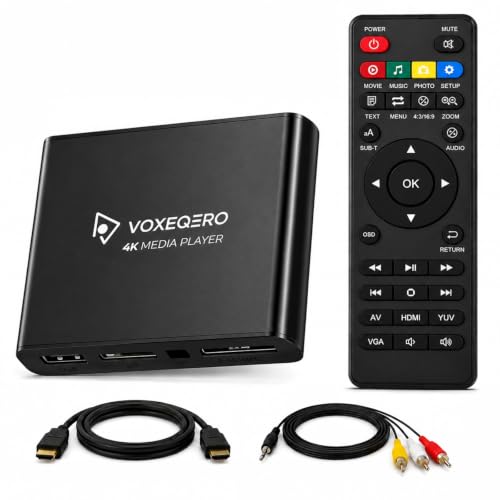
1. Micca 4K Ultra-HD USB and microSD Media Player, 4K HDMI, Digital Signage
This is the signage-first choice for operators who cannot afford a dropped frame during a business-hours loop. Micca has built a reputation over years of selling media hardware, and the company backs this unit with dual inputs that let you run both a USB stick and a microSD card simultaneously — useful when a playlist spans more storage than a single drive can hold. Owner feedback consistently highlights stable multi-hour operation without thermal throttling.
- Pro: Dual USB and microSD inputs give you more total storage than any other player here.
- Pro: Micca’s firmware is known for clean loop playback without re-buffering between files.
- Con: The $54.99 price is the highest in this group, and you are paying partly for the brand name.
Skip it if you only need a single media slot and never run content longer than an hour.
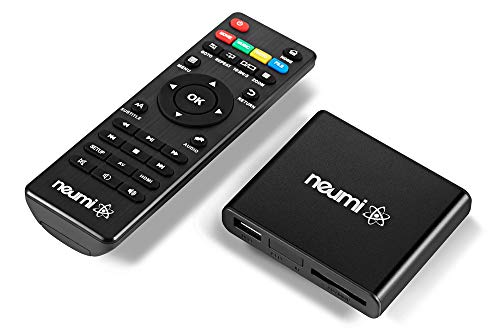
2. NEUMI Atom 4K Lite Digital Trigger Media Player for USB Drives and SD Cards
The digital trigger feature is what makes this player interesting. When your TV powers on, the trigger circuit starts playback automatically — no remote control needed, no manual interaction. That matters for retail displays, museum exhibits, and any installation where nobody is standing next to the screen. At $45.99 it costs less than the Micca flagship while still targeting 4K output.
- Pro: Digital trigger enables fully automated power-on-to-playback cycles without software configuration.
- Pro: NEUMI’s Atom line has generally solid owner reviews for consistent output timing.
- Con: The “Lite” designation in the product name suggests a reduced codec list compared to NEUMI’s higher-tier Atom models.
Skip it if your content library includes older containers like RMVB or MPEG-2 that may not appear on the supported formats list.
3. HDMI Media Player, Black Mini 1080p Full-HD Ultra HDMI Digital Media Player
At $39.99 this is the cheapest player in the roundup that still carries a clear “Full-HD” claim. The mini form factor is genuinely compact — roughly the size of a large USB drive — so it disappears behind a TV or monitor without a visible dongle or cable mess. For conference rooms, kiosks, or any display where 1080p is sufficient, it does the job at the lowest entry cost.
- Pro: Compact size makes it nearly invisible on the back of a display.
- Pro: Second-lowest price overall, undercutting only the NEUMI Atom 1080P.
- Con: 1080p ceiling means you will never use a 4K display at its native resolution.
Skip it if you are buying for a 4K television or a projector capable of UHD output.
4. Micca G3 2K Quad-HD USB and microSD Media Player, 4K HDMI, Digital Signage
The G3 occupies an odd middle ground: Micca markets it as 2K while listing a 4K HDMI output on the same spec sheet. In practice, “2K” here refers to the decoding capability (2560×1440 class) while the HDMI port can pass through to a 4K display with upscaled content. For owners who want Micca’s reliability and a microSD slot without paying the full flagship premium, this saves $10 over the 4K Ultra-HD model.
- Pro: Includes both USB and microSD inputs like the more expensive Micca model.
- Pro: $5 less than the flagship while retaining the 4K HDMI output port.
- Con: The “2K Quad-HD” versus “4K HDMI” labeling creates real confusion when comparing to competitors on paper.
Skip it if you want a straightforward spec sheet and do not mind paying $10 more for the explicitly labeled 4K model.
5. 4K Media Player for TV, USB SD Playback, HDMI AV Output, Auto Resume
Auto-resume is the headline feature, and it is genuinely useful for home viewers who pause a two-hour film and expect it to continue from the exact frame when they power the player back on. The inclusion of an AV composite output alongside HDMI is a thoughtful touch for anyone connecting to an older television in a second room or basement setup. At $49.99 it sits between the Micca flagship and the NEUMI 4K Lite.
- Pro: Auto-resume remembers your last position, eliminating manual seeking on long files.
- Pro: Composite AV output provides backward compatibility with non-HDMI televisions.
- Con: Generic product naming and thin manufacturer information make warranty and firmware updates uncertain.
Skip it if you are deploying commercially and need a brand with accessible support documentation.
6. 4K Full-HD USB and microSD Digital Media Player for TV Digital Signage
For under $44, this player offers both USB and microSD slots with signage-focused firmware — a combination that is hard to find at this price from Micca or NEUMI. The target buyer is a small business owner who wants the flexibility of two media types without the Micca premium. Owner reports describe it as a workable compromise when budget is the primary constraint.
- Pro: Dual media slots at the second-lowest 4K-class price in this group.
- Pro: Signage firmware typically includes loop and scheduling features out of the box.
- Con: The “4K Full-HD” product name is internally contradictory and signals less rigorous spec documentation.
Skip it if guaranteed 4K decoding matters more than saving $10 versus the Micca flagship.
7. NEUMI Atom 1080P Full-HD Digital Media Player for USB Drives and SD Cards
The cheapest entry in this entire comparison at $37.99, and it comes from NEUMI — a brand with recognizable product consistency rather than a generic unbranded listing. For 1080p signage panels, basic classroom projectors, or any application where pixel density is already limited by the display itself, there is no reason to pay more. You get NEUMI’s packaging, support structure, and known firmware behavior at the floor price.
- Pro: Lowest cost of any player from a brand with identifiable product support.
- Pro: Supports both USB and SD card inputs despite the minimal price.
- Con: Hard 1080p ceiling; if you later upgrade your display, this player becomes the bottleneck.
Skip it if you already own a 4K panel or anticipate upgrading to one within the next few years.
8. HDMI Media Player, 4K Ultra HD Digital Media Player, USB/SD Card Expansion, 4K@30Hz Output, H.265/H.264/AVC Decoding
This player wins on format breadth. The spec list covers H.265, H.264, AVC, MP4, MKV, AVI, TS, RMVB, MOV, ISO, MP3, and JPG — an unusually wide container list for a device under $43. The RMVB and ISO support in particular signals an older but highly capable SoC that handles legacy RealMedia archives and disc image files without conversion. For users who inherited a mixed-format library from earlier media servers, this is the only option here that will play everything without transcoding.
- Pro: Broadest stated codec and container list in the group, including RMVB and ISO.
- Pro: 4K@30Hz output with H.265 hardware decoding at the third-lowest price.
- Con: The chipset implied by RMVB support is dated; thermal and power behavior are not described in marketing materials.
Skip it if your entire library is modern MP4 or MKV and you prefer a cleaner, more current hardware platform.
Buying Guide
Output Resolution and Frame Rate
Advertised 4K support means little without understanding the frame rate. Most players in this group output 4K at 30Hz, which is acceptable for static signage and talking-head video but noticeably juddery for fast-motion clips or scrolling menus. If your content includes motion-heavy footage on a 4K display, confirm the player outputs 4K@60Hz. For 1080p displays, a 30Hz ceiling on the player still works fine because the display itself cannot show more frames regardless.
Codec and Container Support
H.265 (HEVC) decoding has become the baseline for modern 4K content, but it is more processor-intensive than H.264. Players that claim H.265 without specifying a maximum bitrate or resolution may still stutter on high-bitrate 4K files. Check whether the product page lists specific maximum resolutions per codec — for example “H.265 up to 4K@30fps” versus just “H.265 supported.” Also verify file system compatibility: many players read FAT32 and exFAT but not NTFS or ext4, which can block large files from a desktop-formatted drive.
Automation Features for Unattended Use
If the player will run without a human pressing buttons — in a store, kiosk, classroom, or display wall — automation features determine whether the setup works long-term. Digital triggers start playback when the display receives power. Auto-play resumes a loop on each boot. Auto-resume picks up where a file was last paused. Scheduling lets you define on/off windows. Determine which combination your installation requires before choosing a model, because no firmware update can add a physical trigger circuit that is absent from the board.
Our Verdict
The top overall pick is the Micca 4K Ultra-HD. Dual media inputs, proven firmware stability for long signage loops, and a well-supported brand make it the safest recommendation for both commercial and demanding home use, and the $54.99 price is justified by the consistency owners report. The best budget pick is the NEUMI Atom 1080P at $37.99: it is the cheapest player from a known brand, and for 1080p displays it delivers everything a simple signage loop needs. The format-heavy HDMI Media Player with 4K@30Hz output wins when your library includes RMVB, ISO, or other legacy containers that no other option in this group explicitly supports.
FAQ
What exactly is an alpha media player?
“Alpha media player” is a category descriptor for standalone hardware devices that decode video, audio, and image files from USB or SD card storage and output them through HDMI to a TV or monitor. The name comes from a generation of players that used early ARM-based SoCs; the term now applies broadly to any simple plug-and-play media box without an operating system or app store.
Do I need 4K output for digital signage?
Most signage panels and retail displays remain 1080p or lower, so 4K decoding capability is unnecessary for static or low-motion content. If your installation uses a UHD panel or a projector with native 4K support, then a 4K-capable player will produce a visibly sharper image. Match the player’s output to your display’s native resolution, not beyond it.
Can these players stream from a NAS or network drive?
No. All eight products in this roundup read local files from USB flash drives or SD/microSD cards. None include Ethernet or Wi-Fi, so network-attached storage, DLNA servers, or SMB shares are outside their design. If you require network playback, you need a different category of device entirely.
Why do some players claim 4K but say Full-HD in the product name?
This is a marketing inconsistency rather than a technical specification. “Full-HD” strictly means 1920×1080, so pairing it with “4K” in a product title is contradictory. In some cases the player decodes 4K files but upscales internally before outputting 1080p; in other cases the label is simply sloppy copywriting. When the spec sheet is ambiguous, the lower resolution claim is the safer assumption.