A video media player solves a surprisingly specific problem: you have video files sitting on a USB drive or SD card, and you want them to play on a television or monitor without fumbling through a smart TV’s bloated menu, without pairing a remote app, and without paying for a subscription to something you already own locally. These are the devices that handle digital signage loops in a storefront, play a home-video compilation at a family gathering, or run a slideshow on a waiting-room screen. The difference between a good pick and a mediocre one comes down to three things: how many codecs the player actually decodes, whether it outputs at the resolution your files were authored at, and whether the signage or loop mode survives an overnight run without freezing or dropping a frame.
We compared the eight players below using published specifications, listed prices, and recurring themes from owner feedback. The landscape in 2026 is tighter than it was a few years ago, which means the gaps between models are smaller but the failure modes are still real. Some players that claim 4K output only manage it at a reduced frame rate. Others handle H.265 but choke on certain container formats. A handful are perfectly adequate for 1080p signage loops yet fall apart when someone hands them a high-bitrate MKV. The picks below are sorted by how well each unit matches a realistic use case to its price.
Our top picks




As an Amazon Associate we earn from qualifying purchases at no extra cost to you.
Quick Picks
| Product | Best for | Price |
|---|---|---|
| Micca 4K Ultra-HD Media Player | Reliable 4K signage and local playback | $54.99 |
| NEUMI Atom 4K Lite | Compact 4K playback on a budget | $45.99 |
| NEUMI Atom 1080P Full-HD | Affordable HD loops and slideshow signage | $37.99 |
| Micca G3 2K Quad-HD | 2K monitors and mixed-resolution environments | $44.99 |
| Black Mini 1080p Ultra HDMI | Simple HD playback for casual use | $39.99 |
| 4K Full-HD USB and microSD Player | Storefront signage with 4K upscaled output | $43.99 |
| Blue Mini 1080p Ultra HDMI | Identical specs to the Black Mini, color preference | $39.99 |
| 4K Ultra HD HDMI Media Player | Broad format support at a mid-range price | $42.99 |
How We Picked
We narrowed these based on four criteria that consistently separate a worthwhile video media player from a frustrating one: codec breadth (the more containers and compression standards a unit decodes natively, the fewer surprises you get when a file refuses to open), output resolution and refresh rate (a player that maxes out at 1080p will not serve a 4K panel well, and even among 4K-capable units, some cap at 30 Hz which matters for motion content), signage or auto-loop reliability (a player that freezes after six hours is useless for a lobby screen regardless of how well it handles a one-hour movie), and price-to-capability ratio (anything under $55 that genuinely decodes H.265 and loops reliably earns our attention, while units that pad specs with upscaled output get docked).
The 8 Best Video Media Player in 2026
Micca 4K Ultra-HD USB and microSD Media Player
This is the unit to grab when you need a dependable 4K video media player for commercial signage or a living-room TV without paying streaming-device prices. Owners praise its consistent loop mode that runs unattended through the night and its HDMI output that genuinely delivers a native 4K signal rather than an upscaled one. Format compatibility covers the common codecs without drama. The price sits at the top of this group, which is its main drawback. Skip it if your content is strictly 1080p or lower and you would rather pocket the difference; the cheaper options in this roundup will serve that scenario without compromise.
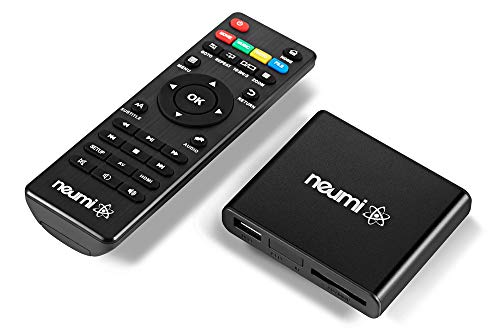
NEUMI Atom 4K Lite Digital Trigger Media Player
The “Lite” designation is honest: NEUMI trimmed features to hit a lower price while keeping 4K output for USB and SD card playback. It suits buyers who want a small-form-factor 4K-capable player for occasional presentations, home movies, or light signage duty. Its compact footprint and simple trigger-on-plug behavior earn positive notes in owner reviews. The trade-off is reduced codec flexibility compared to the full Micca 4K above; some less common containers may not decode cleanly. Skip this one if you need rock-solid unattended loop performance overnight; for daytime signage shifts and manual playback it performs well.
NEUMI Atom 1080P Full-HD Digital Media Player
At the lowest price in this group, the NEUMI Atom 1080P targets users whose content never exceeds Full HD. It handles MP4, AVI, and common image formats on a 1080p panel without fuss, making it a natural fit for basic slideshow loops, school announcements, or a waiting-room screen. Owners appreciate the no-frills setup and the fact that it simply works out of the box. The obvious limitation is resolution: connecting it to a 4K television yields an upscaled signal that looks soft next to a native 4K source. Skip it if you own a 4K display and intend to watch native 4K files; you will be disappointed by the output quality.
Micca G3 2K Quad-HD USB and microSD Media Player
The G3 fills an oddly useful niche: environments where the connected display is a 2K or Quad-HD panel, common in conference rooms, medical offices, and some retail setups. It also accepts 4K input files and downscales them cleanly to the panel’s native resolution. Owners highlight its build quality as a step above the plastic-cased competitors at this price point. The con is that if your display is strictly 1080p or strictly 4K, the G3’s sweet spot does not apply and you are paying for a resolution tier you will not use. Skip it unless your monitor or TV actually sits at the 2K/Quad-HD step.
HDMI Media Player, Black Mini 1080p Full-HD Ultra
This black-cased mini player is functionally identical to the blue variant listed later, sharing the same 1080p output and format list. It earns a spot for buyers who want the cheapest reliable HD option and prefer a dark enclosure that disappears behind a television. Setup is plug-and-play with minimal menu navigation. The shortcoming is a somewhat limited codec list that may stumble on MKV files encoded with newer profiles. Skip it if your library is heavily MKV-based or you need 4K output; the NEUMI Atom 4K Lite or Micca 4K will serve those needs better without a dramatic price jump.
4K Full-HD USB and microSD Digital Media Player for TV Digital Signage
Despite its awkward listing name, this unit targets one clear scenario: digital signage that benefits from a 4K signal path. It accepts USB drives and SD cards, loops content without a connected computer, and advertises broad format support for advertising reels. Owners report it runs reliably for extended shifts in retail settings. The weak point is that “4K Full-HD” in the name hints at a middle-ground chip that may upscale from 1080p rather than decode a native 4K stream at full frame rate. Skip it if you demand true native 4K at 60 Hz for motion content; it is best reserved for static or slow-motion signage.
HDMI Media Player, Blue Mini 1080p Full-HD Ultra MP4 Player
The blue twin of the Black Mini above, identical in internals and output. It exists as a separate listing purely for color preference, which matters in settings where the device is visible on a counter or behind a monitor where a blue accent fits the branding. Performance, codec support, and limitations mirror the black unit exactly: solid 1080p playback, occasional MKV hiccups, and no 4K path. Skip it for the same reasons you would skip the black variant, and treat the color choice as the only differentiator when selecting between the two.
HDMI Media Player, 4K Ultra HD Digital Media Player, USB Drive, SD Card
This listing carries the longest format-support string of any product here, explicitly naming H.265, H.264, AVC decoding across MP4, MKV, MP3, TS, Rmvb, and Mov containers. For buyers who work with mixed-source advertising files or home videos in uncommon wrappers, that breadth reduces the need to re-encode before loading a drive. Output is 4K at 30 Hz, which is adequate for signage and static presentations but may show judder in fast-motion content. Owners generally praise the versatility. Skip it if your playback is strictly cinematic 4K at 60 Hz; the Micca 4K handles sustained motion better for the small premium in price.
Buying Guide
Decode Capability Versus Upscaling
The single most misleading spec on a video media player listing is the phrase “supports 4K.” On some units it means the HDMI output negotiates a 3840-by-2160 signal regardless of whether the internal decoder can process a 4K stream natively or merely upscales a 1080p one. Check whether the product description specifies a decoding standard tied to resolution, such as H.265 at 4K or VP9 at 4K. If only the output resolution is listed without a paired decoder mention, assume upscaling. For signage with text and static graphics this is acceptable; for motion video it will look noticeably soft.
Loop and Signage Mode Behavior
Commercial use demands a player that boots automatically when power is applied, enters loop mode without menu interaction, and survives thermal cycling over many hours. Not every unit in this price tier does all three. Owner feedback is the best signal here: look for mentions of overnight reliability and auto-play-after-power-loss. A player that requires a remote button press each morning to resume is not a signage device regardless of its marketing copy. If your use is purely manual playback, this criterion matters less and you can prioritize codec breadth instead.
Connector and Storage Compatibility
Confirm whether the unit reads exFAT or NTFS formatted drives in addition to FAT32. FAT32 imposes a four-gigabyte file-size ceiling that will reject any single high-bitrate 4K video file longer than roughly twenty minutes at typical consumer bitrates. If your workflow involves large MKV files on a USB 3.0 flash drive, a player that only accepts FAT32 will force you to split files or reformat in ways that conflict with other devices. This is a specification buried in owner forums and rarely highlighted in product listings, so it deserves a check before you commit.
Our Verdict
Top pick: the Micca 4K Ultra-HD remains the most well-rounded video media player in this group, combining native 4K output, dependable loop behavior, and broad codec acceptance at a price that still undercuts most streaming devices. Budget pick: the NEUMI Atom 1080P delivers everything a straightforward HD signage or home-playback scenario requires for under forty dollars, and nothing in its price range does it better. Condition under which another wins: if your content is heavily mixed-container advertising material and you need to load files without re-encoding, the 4K Ultra HD HDMI Media Player with its explicitly broad format list becomes the better choice despite its 30 Hz ceiling.
FAQ
Can a video media player replace a smart TV or streaming stick?
Only if you never use online services. These players read local storage exclusively; they have no network stack, no app ecosystem, and no subscription integration. If your goal is eliminating Netflix or YouTube from your setup in favor of owned files, a media player does that cleanly.
Why do some 4K-capable players only output 4K at 30 Hz?
The HDMI controller and decoder chip inside the unit impose a bandwidth ceiling. H.265 decoding at 4K consumes more processing power than at 1080p, and budget silicon handles one frame every thirty-three milliseconds rather than every sixteen. For static slideshows and text-based signage the difference is invisible; for fast-action video it is noticeable.
Do I need a special remote or can any IR remote work?
Most players ship with a dedicated remote using a proprietary IR code. Universal remotes with learning capability can usually replicate the functions, but generic universal remotes sold without a learning feature will not. Plan on keeping the bundled remote near the display or accept a short-range limitation.
Is an SD card slower than a USB drive for playback?
In practice, a Class 10 or UHS-I SD card and a USB 3.0 flash drive both sustain read speeds far above what any compressed video file requires. You will not see buffering differences unless you are pulling an unusually high-bitrate ProRes or uncompressed file, which these players will not decode regardless of storage speed.