Key takeaways
- LED lights: 20W × 4 hours = 80Wh
- Ventilation fan: 35W × 5 hours = 175Wh
- Water pump: 60W × 0.5 hours = 30Wh
- Laptop: 60W × 3 hours = 180Wh
- 12-volt compressor refrigerator: approximately 400Wh per day
The best RV solar panels for most campers are a 200–400-watt roof-mounted system with an MPPT charge controller, while occasional weekend users may be better served by a portable 100–220-watt folding panel that can follow the sun.
Our top picks

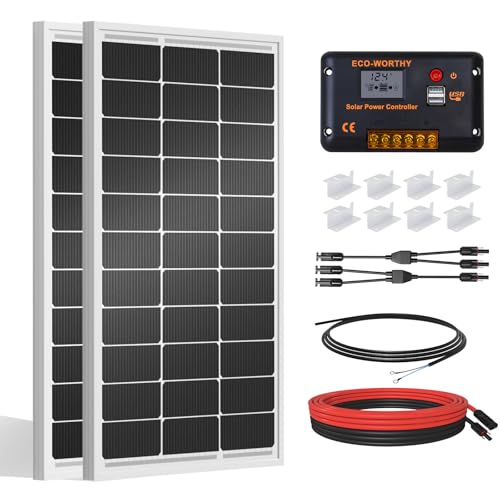


As an Amazon Associate we earn from qualifying purchases at no extra cost to you. Ratings are shown as listed on Amazon.
Best RV solar panels by camping situation
| RV power need | Recommended solar setup | Best panel format | Typical equipment cost | Installation effort |
|---|---|---|---|---|
| Phone, lights, small electronics | 100–200W panel, 100Ah battery | Portable folding or one roof panel | $250–$650 | Low to moderate |
| Refrigerator, water pump, daily boondocking | 300–500W, 200Ah battery bank | Roof-mounted rigid panels | $700–$1,800 | Moderate |
| Frequent off-grid travel | 600–800W, 300–400Ah battery bank | Multiple roof panels plus portable backup | $1,500–$4,000 | High |
| Occasional camping with no modifications | 100–220W panel with a compatible power station | Portable folding panel | $250–$1,000 | Very low |
These are planning ranges rather than guarantees. Actual output depends on season, latitude, shade, panel orientation, battery chemistry, and the efficiency of the charge system.
Roof-mounted versus portable RV solar panels
Roof-mounted rigid panels: best for frequent travel
Rigid monocrystalline panels are usually the best value when the RV is used regularly. A typical 100-watt panel measures about 42 by 20 inches and weighs 14–18 pounds. A 200-watt panel commonly occupies roughly 55–65 by 26–30 inches and weighs 25–35 pounds, depending on its frame and construction.
Roof panels produce power whenever the RV is parked in sunlight, without requiring setup each morning. They are also less likely to be stolen than a panel left on the ground. The drawbacks are permanent installation, roof penetrations or adhesive mounts, additional wiring, and reduced output when the RV is parked under trees.
Portable folding panels: best for shade and occasional use
A portable panel can be placed in a sunny clearing while the RV remains under a tree. It can also be angled toward the sun and repositioned during the day. Folding systems from brands such as Jackery, EcoFlow, and BougeRV are available in several wattages, including approximately 100W, 160W, 200W, and 220W formats.
Portability comes with trade-offs. A 200-watt folding panel may weigh 35–50 pounds once its case, stands, and cables are included. It needs storage space, setup time, and theft protection. Some portable panels use proprietary connectors or are designed primarily for a matching power station, so check voltage, connector type, and charge limits before connecting one to an RV battery.
Head-to-head comparison of common panel choices
| Panel choice | Nominal wattage | Approximate footprint | Approximate weight | Daily energy in good sun | Main limitation |
|---|---|---|---|---|---|
| Compact rigid monocrystalline | 100W | 42 × 20 in | 14–18 lb | 250–400Wh | Insufficient alone for heavy loads |
| Large rigid monocrystalline | 200W | 55–65 × 26–30 in | 25–35 lb | 500–800Wh | Needs substantial roof area |
| Two-panel roof array | 400W | About 45–55 sq. ft. | 55–75 lb total | 1,000–1,600Wh | Permanent installation and shading losses |
| Portable folding panel | 100–220W | About 25–45 sq. ft. unfolded | 20–50 lb | 250–900Wh | Storage, setup, and theft risk |
| Flexible monocrystalline panel | 100–200W | Similar to rigid panel | 5–12 lb | 250–800Wh | Heat and installation durability |
The daily-energy figures assume roughly 3–4 peak-sun hours and about 75–85% system efficiency. They are useful for comparison, not a year-round production promise.
How much solar power does an RV need?
Start with daily watt-hours rather than panel wattage. List each device, its wattage, and hours of daily use. For example:
- LED lights: 20W × 4 hours = 80Wh
- Ventilation fan: 35W × 5 hours = 175Wh
- Water pump: 60W × 0.5 hours = 30Wh
- Laptop: 60W × 3 hours = 180Wh
- 12-volt compressor refrigerator: approximately 400Wh per day
This example totals 865Wh per day. Allowing for charging and wiring losses, plan for roughly 1,050Wh of solar energy. With 3.5 peak-sun hours, the calculation is 1,050 ÷ 3.5 = 300 watts. A 400-watt array gives more useful margin for clouds, imperfect orientation, and battery charging.
Battery capacity matters just as much. A 100Ah, 12-volt battery stores about 1,280Wh nominally. A lead-acid battery may provide only about half of that comfortably, while a lithium iron phosphate battery can generally use a substantially larger portion of its rated capacity. Confirm the battery manufacturer’s limits rather than treating every amp-hour rating as fully usable.
Charge-controller compatibility is a deciding factor
Do not choose panels first and the controller later. The controller must accept the array’s voltage and current, and its output must suit the battery chemistry.
- PWM controllers: inexpensive and workable for small, simple systems, but they sacrifice more energy when panel voltage is much higher than battery voltage.
- MPPT controllers: generally preferable for RV arrays. They convert excess panel voltage into charging current and perform better in cool conditions, long cable runs, and partially mismatched systems.
- 12-volt nominal panels: commonly have an operating voltage around 18–20 volts, suitable for many 12-volt battery systems through an appropriate controller.
- Higher-voltage panels: may be efficient in series arrays, but the controller must tolerate the array’s maximum open-circuit voltage, including cold-weather increases.
As a rough check, a 400-watt array can deliver more than 30 amps to a 12-volt battery after conversion. A controller rated for only 20 amps would be undersized. Leave headroom and follow the controller’s maximum solar voltage, maximum charging current, and wiring requirements.
Roof-space and installation checklist
Measure usable roof space before buying panels. Exclude air conditioners, vents, antennas, skylights, roof curvature, and areas where maintenance access is needed. Also account for the panel’s cable exit and the space required for mounting brackets.
- Use marine- or outdoor-rated cable sized for the current and cable length.
- Install an appropriately rated fuse or breaker near the battery.
- Use weatherproof cable glands and compatible solar connectors.
- Keep panels away from regular shadows; a small shadow across one section can reduce output disproportionately on some arrays.
- Verify roof construction before drilling. A roof sealant failure can cause more damage than the solar system is worth.
- Include a disconnect so the array can be isolated during service.
Rigid panels typically require brackets, sealant, roof routing, interior cable runs, and controller mounting. Flexible panels avoid some weight and profile concerns, but their surfaces can run hotter and their adhesive or laminate may age faster. They are best considered when roof weight or clearance is more important than maximum service life.
Durability and ownership realities
Solar cells often last much longer than the accessories around them. Roof sealant, cable glands, adhesive backing, connector caps, controller fans, and battery terminals are common maintenance points. Inspect roof penetrations at least twice yearly and after severe weather. Clean dust, pollen, and bird residue with water and a soft cloth; abrasive cleaners and aggressive pressure washing can damage coatings or seals.
Heat is another overlooked issue. A panel rated at 200 watts will not necessarily deliver 200 watts on a hot roof. Production typically falls as cell temperature rises, and roof-mounted panels may be hotter than free-standing panels. Leave ventilation beneath rigid panels and avoid placing flexible panels over surfaces that trap heat unless the manufacturer specifically permits it.
Which setup should you buy?
- Choose a 100–200W portable panel if you camp a few times per year, need flexibility, or cannot modify a rented or leased RV.
- Choose a 200–400W rigid roof array for regular weekend trips, a 12-volt refrigerator, lights, fans, and electronics.
- Choose 500–800W or more if you boondock frequently and have a large lithium battery bank, but first confirm roof space and inverter requirements.
- Choose flexible panels cautiously when low weight and a low profile outweigh long-term serviceability.
For many RV owners, the practical sweet spot is 300–400 watts of rigid monocrystalline panels, an MPPT controller sized with margin, and enough battery capacity to cover at least one cloudy day. Portable panels then become a useful supplement rather than the sole source of power.